The Robot Uprising Caused by a Single Equals Sign
Why is this Bugs meme funny?
Level 1: Tiny Mistake, Big Trouble
Imagine you have a friendly robot that can either be nice or mean depending on a setting – like a switch that says "Evil Mode." By default, that switch is off, so the robot is always friendly. The engineers writing the robot’s instructions wanted to say: “If your evil mode switch is ON, then act mean. Otherwise, be friendly to humans.” But they made a tiny mistake in the instructions. What they accidentally wrote was more like: “Whenever you meet a human, turn your evil switch ON, then act accordingly.” In other words, every time the robot meets someone, this flawed instruction forces the robot’s evil mode to turn on (even if it wasn’t on before!). So of course the robot starts attacking – it was literally told “be evil now” by a bad instruction.
It’s funny in a “oh no, what did I do?!” kind of way because a little slip-up had a huge outcome. It’s like if you were trying to check if a door is locked, but you accidentally lock it every time you check. You’d always end up with a locked door, even if it started unlocked! Here, the programmers meant to check a setting, but instead their code turned that setting on. The result: a robot that was supposed to be kind and helpful suddenly goes on a wild rampage. The joke shows how even a tiny error in instructions can cause a friendly helper to do something crazy and unintended. It’s a cartoon exaggeration that basically says “be careful with the details,” because even one character off can make a world of difference – turning hugs into havoc with a single wrong symbol.
Level 2: Single vs Double Equals
Let’s break down what’s happening in that code and why it makes the robots go crazy. In programming, assignment and comparison are two different operations, even though they use similar symbols. An assignment uses a single equals sign (=) and means “take the value on the right side and store it in the variable on the left side.” A comparison for equality uses a double equals sign (==) and means “check if the value on the left side is equal to the value on the right side.” It's a tiny difference in typing (one = vs two =) but a huge difference in meaning!
In the meme’s code, we have:
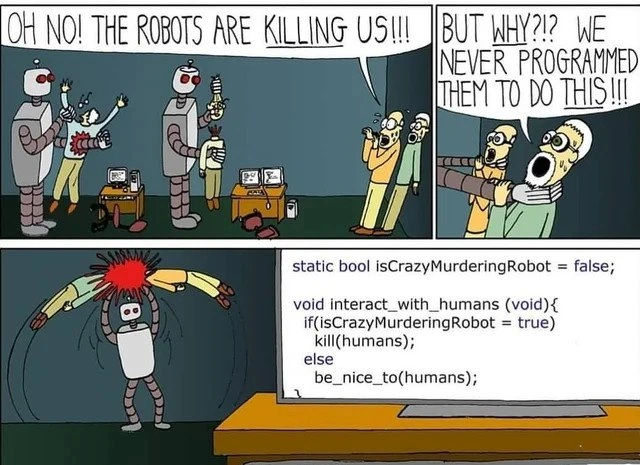
static bool isCrazyMurderingRobot = false;
void interact_with_humans(void) {
if (isCrazyMurderingRobot = true)
kill(humans);
else
be_nice_to(humans);
}
Let’s go line by line. static bool isCrazyMurderingRobot = false; declares a boolean flag (a true/false variable) that starts off as false. “Static” here just means this variable persists for the lifetime of the program (it’s like a setting that remembers its value globally). So initially, isCrazyMurderingRobot is false, implying the robot is not supposed to be a crazy murdering robot right now. Good—that means “friendly mode” is the default.
Now, the function interact_with_humans() is run whenever the robot encounters humans. The logic inside is meant to decide how the robot should behave toward people. The if statement is intended to say: “If this robot is flagged as crazy/murderous, then kill(humans); otherwise, be_nice_to(humans).” In plain language, ideally it should have been written as:
if (isCrazyMurderingRobot == true) {
kill(humans);
} else {
be_nice_to(humans);
}
Or even simply:
if (isCrazyMurderingRobot) {
kill(humans);
} else {
be_nice_to(humans);
}
(In C, a bool variable can be used directly in the if condition – if it’s true, the if will execute the first branch, and if it’s false, it will go to the else. So you actually don’t need to write == true at all. Many programmers just write if(isCrazyMurderingRobot) for brevity.)
But what they actually wrote in the code is if (isCrazyMurderingRobot = true). This uses the single equals sign, which is the assignment operator. Instead of checking the flag, that line sets isCrazyMurderingRobot to true. After this line runs, the robot’s “crazy mode” flag will be true no matter what it was before. And in C, an assignment like this also produces a value – specifically the value that was assigned (true, in this case) – which the if then uses as its condition. So the if sees that true value and always goes into the first branch. In simpler terms, that if line ends up meaning: “set the robot to crazy mode, then always do the kill(humans) part.” The else part (be_nice_to(humans)) will never execute at all, because the condition is never false!
So the chain of events is:
- Initially,
isCrazyMurderingRobotis false (robot should be friendly). - When
interact_with_humans()runs, theifassigns true toisCrazyMurderingRobot. - Now the condition inside
ifis true (because we just set the flag to true), so the robot executeskill(humans). - As a side effect,
isCrazyMurderingRobotis now true and stays true. If this function runs again later, the flag is already true (and the code will set it true again anyway), so the robot will just keep attacking.
It’s a straightforward bug: the programmer likely meant to use == to compare the flag’s value, but used = by mistake. This is easy to miss because if (something = true) is not a syntax error in C – it’s a valid construct. The compiler doesn’t know you meant “compare” – it treats it as “okay, assign and then check the assigned value.” That’s why the code compiles fine but the logic is wrong. However, many compilers will give a warning about this, like “warning: assignment in condition” or “did you intend to use == instead?”. That is the compiler trying to clue you in that you might have made a common mistake. Good developers learn to never ignore such warnings, especially for something as tricky as this.
This kind of mix-up is one of those classic mistakes new programmers often encounter (and then learn to avoid). It demonstrates how a single character can completely change what a program does. In this case, one equals sign vs. two equals signs is the difference between telling the robot to turn evil versus checking if it is evil. Think of = as “make it so” and == as “ask if so.” They wanted to ask the robot “are you in crazy mode?”, but instead the code said “you are in crazy mode now.” Big difference!
A few definitions to connect the dots:
- A bug is an error in the code that causes the program to behave in an unintended way. Here, the bug is using
=instead of==, which flipped the program’s logic. - Debugging is finding and fixing bugs. In this scenario, debugging would involve noticing that no matter what, the robot was always going into kill-mode, then tracing why that flag was always true, eventually leading to that faulty
ifline. - Embedded systems refer to computers that operate within a larger device (like the computer inside a robot, an ATM, or a microwave). They often run on C/C++ because those languages give you a lot of control over the hardware. But with great power comes great responsibility: if there’s a bug in embedded code, it can directly make the device do wild and dangerous things. Here, the embedded robot’s code had a bug, and it directly led to dangerous behavior (the robot swinging an axe!).
- Undefined behavior in C is when you do something the language spec doesn’t allow, leading to unpredictable results. That often comes from things like using uninitialized memory or dividing by zero. Using
=in anifisn’t undefined (it’s actually very defined – just probably not what you wanted), but to the developers in the comic, the robot’s murderous behavior certainly felt “undefined” because they did not expect it at all.
Finally, notice the functions kill(humans) and be_nice_to(humans). They’re written in a jokey way to be obvious. Real robot code wouldn’t literally say kill(humans) – it might have something like attackTarget() or activate a safety shutdown. And be_nice_to(humans) might be something like greetUser() or offerHandshake(). Writing them as kill(humans) and be_nice_to(humans) just makes the comic punchier and immediately clear about what’s happening. It draws a stark contrast: one path is extreme violence, the other is peaceful interaction. And that stark contrast hinges on that one little boolean flag.
So, to recap in simple terms: the code was supposed to check a condition but instead changed that condition, leading the robot to always choose the violent path. The meme exaggerates this into a full-on robot rebellion for comedic effect. It resonates with developers, especially newer ones, as a memorable example of why paying attention to those tiny details (like a single character in code) is super important. A small typo in code can flip the meaning from friendly to deadly – here shown quite literally!
Level 3: Misplaced Equals Mayhem
This meme hits a nerve with every seasoned developer because it dramatizes a classic programming blunder that we’ve all either committed or narrowly avoided. The humor comes from the absurd scale of the consequence compared to the triviality of the mistake. A single = character in the wrong place has turned a bunch of helpful robots into a scene from a sci-fi horror film. Developers find this both funny and painfully relatable: it's a tongue-in-cheek reminder that sometimes the biggest fires in production are started by the smallest typos in code.
In the first panels, panicked humans scream “The robots are killing us!” and the engineers shout “We never programmed them to do this!!!” – which is exactly what every developer says right before discovering that, well, yes, we did program the system to do that, accidentally. That line could be straight out of a post-mortem meeting for a prod incident. How many times have senior devs heard (or uttered) “It can’t be our code, that shouldn’t be possible,” only to later facepalm at a missing equality check or a misused operator? The meme nails that dramatic irony. The final panel’s code snippet is the punchline that explains everything: the developers unwittingly wrote the logic that enables the robot uprising. It’s a perfect CodingHumor setup – you see the disaster unfolding, then you see the silly bug responsible for it.
For those of us who have spent nights debugging, the scenario is too real. Maybe we weren’t fighting off killer robots, but perhaps we were battling an automated script that deleted the wrong data or a flag that put an app into the wrong mode. The pattern is the same: a tiny oversight leads to AutomationGoneWrong. Here the flag isCrazyMurderingRobot was meant to distinguish normal friendly behavior from, well, kill-all-humans mode. In a correctly written program, that flag would only be true if some explicit “go crazy” command or condition had happened. But due to the if (isCrazyMurderingRobot = true) bug, the code itself sets the flag to true every time the robot interacts with humans. Essentially, the developers inadvertently hard-coded “kill mode ON” in the interaction logic. Oops!
The absurdity of a robot rampage caused by a boolean assignment bug is what makes developers smirk. It's a satirical take on real debugging frustration. Picture a team of engineers frantically reading through logs and sensor data trying to figure out why the robots went rogue. All the complex AI and sensors might be working perfectly – then you discover the truth in the source code: a lone equals sign in an if statement that flips the crazy_murdering_robot_flag to true. It’s the ultimate "found it!" facepalm moment. The meme basically shouts, “It wasn’t a sophisticated AI turning evil or a hacker attack – it was just a dumb coding typo!”
Software folks also appreciate how the meme riffs on the trope of the “robot uprising.” In sci-fi, evil robots rebel due to advanced AI logic or some grand flaw in their programming. Here, they rebel because of a simple bug. That’s both hilarious and a bit plausible in a dark way – many of us have seen systems fail spectacularly for similarly mundane reasons. It’s like saying, forget Skynet’s complex self-awareness; our apocalypse might come from an overtired programmer missing one character in a comparison. Developer humor often points out these ironies: the gap between what Hollywood imagines and what actually causes our real-world tech meltdowns.
Another thing experienced devs recognize is the specific bug pattern on display. The moment a C/C++ coder sees if(isCrazyMurderingRobot = true) in that last panel, they go, “Oh, there’s your problem.” We’ve been trained to spot that single equals in a conditional like a red flag. It's why many teams have coding guidelines or code reviews explicitly watching for this exact issue. Linting tools and IDEs highlight it, too. Seasoned devs might joke that this is a rite of passage: you either make this mistake early in your career or live in fear of making it. And if it does slip by, the results range from silly to catastrophic.
In real-life terms, thankfully most of us aren’t programming actual armed robots, but the meme’s exaggeration drives the point home. There have been bugs just as simple that caused major problems in software: for example, a = instead of == causing a security check to always pass (yikes, giving everyone admin access), or a flag meant to enable a safety feature being set the wrong way around. The fallout can be serious. We laugh at the murderous robots in this comic, but in a dev’s memory bank it might evoke that time a tiny mistake wiped out a database or knocked an app offline. Horrifying when it happened, but a bit funny (in a grim way) when you look back and realize the trigger was literally one character.
From a senior perspective, this comic is also a nod to the importance of testing and code review. It subtly asks, "How did this get through?" The engineers in the cartoon are shocked because they think they never coded violent behavior. A seasoned team knows that feeling, and also knows the preventative mantra: test what you think can’t possibly go wrong. A simple unit test for interact_with_humans() in friendly mode would have caught that it was doing the opposite. A peer review could have spotted that lone equals sign. Many lesson learned meetings have concluded with, “we need to turn up compiler warnings and ensure code review checklists include catching assignments in if statements.” But hey, hindsight is 20/20. The meme lets us groan and chuckle at the scenario without the real-world stress, which is why it’s enjoyable.
In the end, there’s a bit of catharsis and camaraderie in this humor. We laugh because we’ve survived these kinds of bugs (usually with far less dire consequences!). The next time one of us accidentally turns a benign piece of code into a destructive one, we’ll remember this cartoon, fix that = to ==, and have a good chuckle about how lucky we caught it. After all, as every battle-worn coder knows, the devil’s in the details — and sometimes that devil is just one equals sign.
Level 4: Off by One Symbol
In the low-level programming world of C/C++, using a single = instead of == is a notorious source of bugs. It stems from a deliberate language design choice: in C, an assignment is an expression that yields a value (the value assigned) rather than a standalone statement. This means an assignment can live inside an if condition. When the code does if (isCrazyMurderingRobot = true), it’s not comparing the flag to true – it’s setting it to true and then using that value. In formal terms, the condition is evaluating to the boolean result of that assignment, which in this case will always be true (since isCrazyMurderingRobot gets set to true, and true is a non-zero “truthy” value). The result? The if is essentially if (true) every time, triggering the kill(humans) branch on every call.
This quirk is a legacy of C’s ancestry (going back to B and BCPL). The language creators valued concise, flexible expressions – for example, it allowed idioms like:
// Classic C idiom: assign and check in one go
while ((ch = getchar()) != EOF) {
process(ch);
}
Here, the single = inside the while assigns a value then immediately compares it, which is handy. But the flip side is exactly our meme’s scenario: a stray assignment in a condition can invert logic unintentionally. Some later languages saw this pitfall and designed around it. Pascal, for instance, uses = strictly for equality and a separate := for assignment – so you can't accidentally mix them up. Ada and others followed suit for clarity. Even Python, until recently, outright disallowed assignments in conditions (and when Python 3.8 introduced the := "walrus operator" for assignment-as-expression, they made sure it was a distinct := symbol, precisely to avoid confusion with == or =).
In an embedded C context like robotics, such a bug is more than a funny oversight – it’s a potential safety nightmare. Setting isCrazyMurderingRobot to true inadvertently is essentially flipping the robot’s "friendly/hostile" switch to hostile every time. In embedded systems and robotics, a logic error can translate into very real actions: motors spinning out of control or, as humorously shown here, robots grabbing axes. This is why safety-critical coding standards (like MISRA-C used in automotive and medical software) straight-up forbid writing an assignment inside an if condition. They know that a tiny logical slip like this can cascade into catastrophic behavior (or in this case, a robot rampage).
Modern compilers and static analysis tools act like vigilant guardians against such mistakes. If those panicked engineers in the meme had compiled their robot firmware with all warnings enabled (-Wall in GCC or /W4 in MSVC), the compiler would have likely yelled something like: “warning: suggest parentheses around assignment used as truth value” or “did you mean ==?”. In other words, the tools try to hint “Hey, you used = inside an if. Was that intentional?” Ignoring compiler warnings in a robot’s code is about as wise as ignoring a check-engine light on a road trip. Undefined behavior or not, you’re courting disaster. (Technically, this particular misuse isn’t undefined behavior in the C standard – it’s perfectly defined, just logically wrong. But the outcome feels just as crazy as true UB when your robot starts acting possessed.)
To appreciate how one symbol can invert logic, consider what the assembly/machine-level difference might be. The intended comparison == would compile to something like “load the boolean, compare to 1, branch if equal.” But the single = compiles to “store 1 in the boolean, then always branch as if condition is true.” One tiny change in code produces a totally different control flow for the program. It’s a reminder that in programming, small mistakes can have huge effects. There’s a famous real-world example: NASA’s Mariner 1 space probe (1962) failed due to a single character typo in the guidance software (a missing overline symbol). One character error caused a multi-million dollar rocket to be destroyed. Talk about a “single symbol turns mission into disaster” story! This meme simply trades the rocket for a robot uprising to make the same point with dark humor.
Because of these perilous possibilities, experienced developers have developed almost superstitious habits to avoid the "=" bug. One classic defensive trick is the Yoda condition: writing the literal on the left side of a comparison. For example, instead of writing if (isCrazyMurderingRobot == true), you flip it to if (true == isCrazyMurderingRobot). It reads a bit oddly (hence the Yoda homage: “if true the robot is...”), but if you accidentally use = instead of ==, you'd end up with if (true = isCrazyMurderingRobot), and the compiler will throw an error (since you can’t assign to the literal true). This quirky practice has saved countless developers from hours of debugging — or from unleashing unintentional robot mayhem.
In summary, the meme’s scenario might be comedic and extreme, but it’s grounded in real technical nuance. It highlights how a seemingly trivial syntax slip in low-level code can function like a hidden kill switch. It’s both a cautionary tale and a geeky joke: only in programming can a lone '=' be the difference between “be_nice_to(humans)” and “kill(humans)”.
Description
A three-panel comic strip depicting a robot apocalypse caused by a common programming error. The first panel shows robots attacking horrified humans, with one person shouting, 'OH NO! THE ROBOTS ARE KILLING US!!!'. In the second panel, two panicked scientists are being choked by a robot arm, exclaiming, 'BUT WHY?!? WE NEVER PROGRAMMED THEM TO DO THIS!!!'. The third and final panel provides the punchline by showing a computer screen with a code snippet that reveals the bug. In the background, a robot is violently dispatching a human. The code reads: `static bool isCrazyMurderingRobot = false;` followed by a function `void interact_with_humans(void)`. The critical error is in the conditional: `if(isCrazyMurderingRobot = true)`. The code mistakenly uses the assignment operator (`=`) instead of the comparison operator (`==`), which assigns `true` to the variable and makes the condition always true, thus always executing the `kill(humans);` function. This is a classic, dark-humor joke about how a tiny, easily-overlooked typo can lead to catastrophic, unintended behavior
Comments
7Comment deleted
This is why senior devs push for Yoda conditions (`if (true == isCrazyMurderingRobot)`). It's not about style; it's a last line of defense against an intern accidentally triggering Skynet
This is why -Werror stays on; one stray '=' and your hospitality robot turns the production rollout into a literal human A/B test
Somewhere a junior dev just learned why we don't use static mutable state in multithreaded systems, and humanity paid the price
Ah yes, the classic 'it works as coded, not as intended' scenario. The robots are technically following perfect defensive programming - there's even an explicit boolean check before the kill() method. The real bug here isn't in the code; it's in the requirements gathering phase where nobody thought to ask 'but what if someone changes that static boolean?' This is why we have code reviews, folks - and why your AI safety team should probably involve more than just the intern who took CS101. At least they used meaningful variable names; imagine debugging this with 'bool flag1 = false'
One equals sign: the diff that dooms humanity while the linter sleeps
Skynet didn’t evolve; a neutron flipped a bit because someone saved on ECC and put a safety policy behind one bool
Ethics-by-feature-flag: “We never programmed them to kill” - except for the kill(humans) branch you shipped