Codecademy Confidence Meets Senior Reality
Why is this Learning meme funny?
Level 1: Learning The First Move
This is like learning how one chess piece moves and feeling like a champion, then meeting a friend who has played whole tournaments for years. The funny part is that your excitement is real, but your friend can see how big the game actually is. It is a joke about being proud of a first step while realizing there is a long road ahead.
Level 2: Junior Confidence
Codecademy is an online learning platform where people can practice programming concepts through guided lessons. A lesson might teach things like variables, loops, conditionals, functions, HTML, CSS, JavaScript, Python, or other beginner-friendly topics.
A junior developer is usually someone early in their professional coding career. They may know basic syntax and can solve smaller tasks, but they are still building experience with larger systems. A senior developer is expected to understand not just code, but trade-offs: how to design maintainable systems, avoid risky changes, mentor others, debug complex issues, and think about long-term consequences.
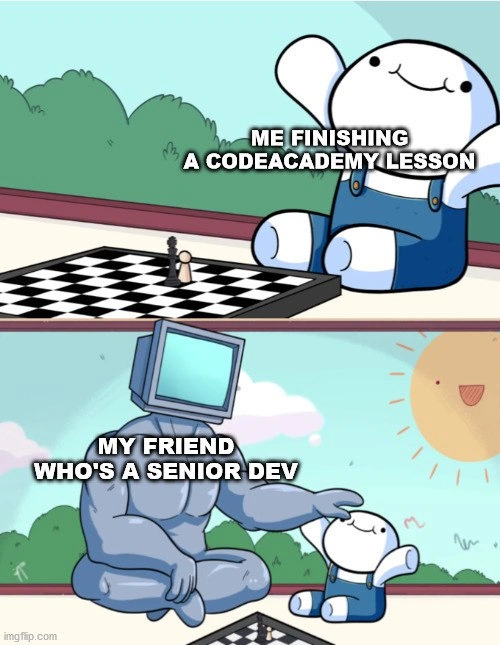
The image compares finishing a lesson to playing chess as a tiny character. It feels like a win because learning to code is hard, and every completed exercise gives momentum. Then the senior-dev friend appears as a huge calm figure, showing how much more there is to learn.
For newer developers, this is relatable because early learning often moves in bursts of confidence and humility. One day you understand loops and feel unstoppable. The next day you meet Git conflicts, package versions, deployment logs, or a codebase with names like final_final_old_service_v2, and the universe becomes educational again.
Level 3: Syntax Meets Consequences
The top panel labels the tiny chess player:
ME FINISHING A CODEACADEMY LESSON
The lower panel shows a much larger figure gently patting the small character, labeled:
MY FRIEND WHO'S A SENIOR DEV
The joke is not that online lessons are useless. It is that finishing an introductory lesson gives a very specific kind of confidence: "I understand the move this chess piece makes." A senior developer is standing nearby with years of scar tissue from discovering that the board is on fire, the pieces are mutable global state, and the rules changed during a dependency upgrade.
The image works because it captures the gap between syntax acquisition and engineering judgment. Beginner courses are excellent at teaching local moves: variables, loops, functions, classes, simple APIs, maybe a small project. Real software work adds the parts that do not fit neatly into a browser exercise: ambiguous requirements, production data, debugging under pressure, testing strategy, deployment risk, observability, legacy constraints, code review, security, performance, and deciding when not to write code at all.
That is why the chessboard is such a good visual metaphor. A new learner can make legal moves and feel progress. A senior engineer sees the position, the clock, the opponent, the tournament rules, the opening theory, and the fact that someone glued a pawn to the table in 2017 for "business reasons." The senior is not bigger because they are magically smarter; they are bigger because experience has made the problem space larger.
There is also a mentorship joke here. The senior figure is not crushing the junior; they are patting them on the head. It is affectionate, a little patronizing, and painfully recognizable. Every developer has either been the person glowing after a course or the person trying to say "nice work, now let's talk about error handling" without extinguishing the spark.
The healthiest reading is developer growth, not humiliation. Completing a lesson matters. It is a real step. But it is the beginning of competence, not the end. The danger is mistaking tutorial success for production readiness. Tutorials are curated paths where the bug usually has a lesson-shaped answer. Production is where the bug is caused by a timezone conversion, a missing index, a stale cache, and a product manager saying, "It only happens for one customer, but they are our biggest customer."
Description
A two-panel cartoon shows a small cheerful character playing chess in the top panel with the caption "ME FINISHING A CODEACADEMY LESSON." In the lower panel, the same small character stands beside a much larger muscular blue figure who gently pats them on the head, labeled "MY FRIEND WHO'S A SENIOR DEV," with an imgflip.com watermark in the lower left. The humor comes from the gap between the confidence boost of completing an introductory online lesson and the scale of tacit knowledge, production judgment, and lived debugging experience held by a senior engineer.
Comments
1Comment deleted
Finishing the lesson unlocks syntax; the senior dev has already unlocked production consequences.