Skip to content
DevMeme
1246 of 7435
A Developer's Modern Stack for the Interview
Career HR Post #1388, on Apr 25, 2020 in TG

A Developer's Modern Stack for the Interview

Why is this Career HR meme funny?

Level 1: Hiding the Mess

Imagine you have a really messy bedroom with toys, books, and clothes strewn everywhere. Now, your friend is coming over to see your room. You start to panic because you want your room to look nice and neat for your guest. So what do you do? You quickly scoop up all the clutter and stuff it into your closet or shove it under your bed. You take your newest, coolest toy or gadget and put it out on the dresser where it's easy to see. By the time your friend walks in, the room looks clean and organized — none of the mess is visible.

Your friend looks around and says, "Wow, your room is so tidy and modern-looking!" and you smile and say, "Ha, yeah!" But inside, you might be a bit nervous, hoping they don’t open the closet door. Because if they did, all the hidden junk would tumble out and they'd see the truth: you didn’t really throw anything away or clean up properly, you just hid the mess.

This meme is exactly like that, but with a software project. The team had a bunch of old, messy code (their “toys on the floor”), and when a new person came to check things out (the interviewee), they rushed to hide all that old stuff out of sight. Then they showed off only the shiny new code and tools (like you showing off your coolest toy) so that the visitor would be impressed. It’s funny because we all recognize that little trick — tidying up by hiding the mess — and the comic shows the developer doing it with code, wearing the same nervous smile you might have when you know you’re pretending things are more perfect than they really are.

Level 2: The Legacy Closet

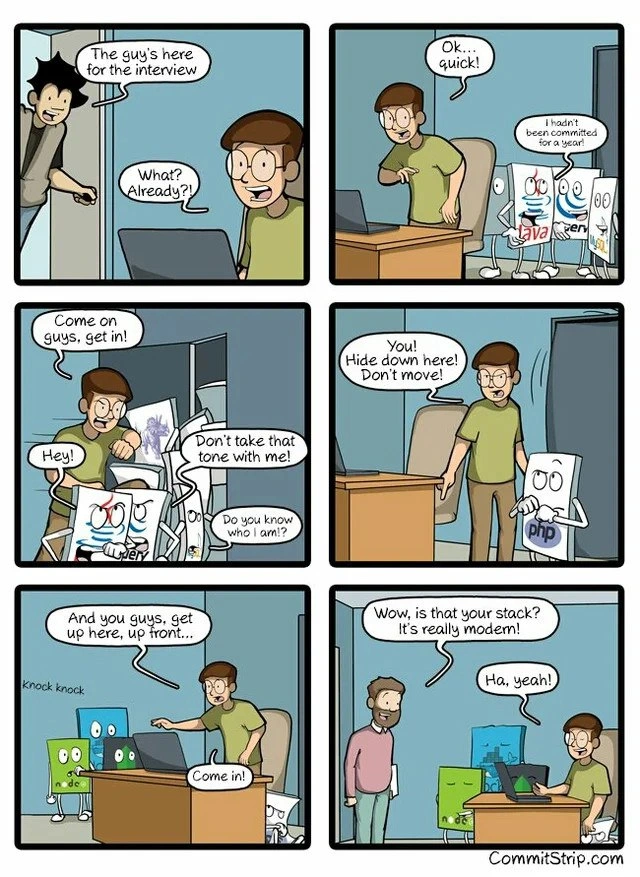
Now let's break down the joke in a more straightforward way. The comic is a six-panel story (from CommitStrip, a webcomic about programmer life) that exaggerates what some teams do when showing their project to a newcomer.

  • The situation: A developer hears that a candidate for a developer job (an interviewee) has arrived for their interview. The candidate is basically a guest coming to see how the company works. The developer panics because the team’s tech stack has some older, messy parts he's not proud of, and he doesn’t want the candidate to see those. The tech stack means all the technologies they use: programming languages, frameworks, databases, etc., that make up their product.

  • Hiding the old stuff: In the next panels, we see the developer jump into action. There are boxes with faces and logos labeled "oracle", "java", "perl", and "php". These represent the older technologies the company uses – essentially the legacy systems in their codebase. (The comic gives these technologies human-like behavior to make the scene funny – this is called anthropomorphism, turning things into characters.) The Oracle, Java, and Perl boxes are complaining: one says “I hadn’t been committed for a year!” and another grumbles “Do you know who I am?”. Let’s explain those lines:

    • “Not committed for a year” – In software development, to commit means to save code changes into a repository (like using Git). If a piece of code hasn’t been committed to in a year, it means nobody has updated it for a long time. It’s basically saying, “Hey, my code hasn’t changed in a year!” That implies this Oracle/Java/Perl system is old and perhaps neglected (no new features or refactors in a long time).
    • “Do you know who I am?” – This is something a very important or famous person might say when they feel they’re not being treated with respect. The Java/Oracle box says this because, historically, Java and Oracle were big deals in tech (for many years, almost every large company used Oracle databases and Java applications). The legacy tech is personified as a proud elder feeling insulted that it’s being shoved into a closet.
    • These older tech boxes also say things like “Don’t take that tone with me!” – they’re grouchy, like upset old employees. It’s a humorous way to show that legacy systems often have a sort of pride or stubborn presence in a company (“I’ve been here for years!”) even if management now finds them inconvenient.

    So what does the developer do with these? He quickly takes those printed diagrams (probably old architecture drawings) and those complaining legacy tech boxes and stuffs them into a closet. This is like hiding clutter when you don’t have time to properly clean. He even points at the PHP box and says, “You! Hide down here! Don’t move!” The PHP box meekly goes under the desk. In real terms, PHP is an older web programming language that the company likely uses for some of their system, but it’s not something they want to brag about. The developer is essentially removing any visible trace of these older technologies from the room so the interviewee won’t notice them. It’s a comical exaggeration of a team trying to hide its LegacyCode.

  • Showcasing the new stuff: Next, the developer brings out two other boxes labeled Node.js and React (Node is the green one, React is the blue one). He places them up front and center. This represents the team showcasing their modern tech stack. Let’s clarify:

    • Node.js is a relatively newer technology (since around 2009) which allows JavaScript to run on the server side. Many startups and modern web applications use Node.js for their back-end (server logic) because it’s fast and it lets you use one language (JavaScript) for both client and server.
    • React is a modern JavaScript library for building user interfaces (created by Facebook in 2013). It’s used to build rich, dynamic front-end applications (what you see in the browser). It’s very popular and considered "cool tech" in the web development world. By putting Node.js and React boxes in front, the developer is making sure these are the first thing the candidate sees — basically saying “This is what we use!” about the new stuff, while hoping the candidate won’t ask about what’s in the closet.
  • Impressing the interviewee: Finally, the interviewee (candidate) comes in. He sees the Node.js and React boxes (and not the hidden ones) and says, “Wow, is that your stack? It’s really modern!” Here stack means the set of technologies used. So he’s basically saying, “Wow, you guys use up-to-date, modern tech here – that’s awesome!” From his perspective, he’s seeing Node.js and React, which are indeed very modern choices in 2020. He doesn’t see any Oracle databases or old code, so he assumes the whole company uses cutting-edge tools.

    The developer replies, “Ha, yeah!” with a nervous smile. He’s agreeing outwardly, but the “ha” and the sweat drops drawn on him suggest he’s a bit anxious or guilty. Why? Because he knows the stack is not entirely modern; he’s hiding a bunch of old legacy tech literally in the closet behind him! The humor is in that contrast — what the candidate believes versus what the reality is.

What’s being satirized? The strip is highlighting how companies sometimes handle TechnicalInterviewProcess and recruiting: by marketing their tech stack to look as attractive as possible. The term tech stack marketing is apt – it’s like they are advertising only the best parts of their technology to the candidate (similar to how an ad highlights the best features of a product). They hide anything that seems outdated or uncool, just like someone might hide old furniture in a back room when guests come over.

In real life, of course, you can’t physically hide parts of a codebase. Instead, this hiding is figurative: it means they just don’t talk about the old stuff. If a candidate asks, they’ll maybe downplay it: “Oh, we have a little bit of PHP left from an older system, but we’re mostly on Node now.” Or they won’t bring it up at all unless asked. The comic simply visualizes this by using the closet gag.

Legacy systems and tech debt in reality: Almost every company that’s more than a few years old has some legacy systems. Software evolves quickly, and what was a hot technology 10 or 15 years ago (like Java, or PHP) might be considered outdated today. But companies can’t just throw out their entire product and rebuild it from scratch every few years — that would be incredibly expensive and risky. So they keep using the old tech that works and slowly add new parts or replace pieces over time. This means that a lot of companies have a mix of old and new in their code.

For example, a company might have started in 2005 building a big system on Java and Oracle. In 2020, they might have built some new microservices in Node.js and a new front-end in React on top of it. Both coexist. The old system is the legacy part (maybe handling critical stuff like transactions or data storage), and the new system is handling the user-facing stuff or new features. This mix is normal, but when talking to new developers or presenting the company externally, there’s often a desire to focus on the shiny new parts. After all, developers interviewing for jobs are usually excited by modern tech — few people get excited hearing “our backend is a monolithic Perl script from 2003.”

Technical debt comes into play here because all those old parts of the system that haven’t been updated represent work that was postponed. The company likely accumulated debt by continually building new features without refactoring the old ones. Over time, that debt becomes a big pile of old code that's risky or hard to change. Instead of confronting it head on (which might mean a big project to rewrite or modernize, with uncertain payoff), sometimes companies just live with it. They maintain the old code just enough to keep it running, but they don’t draw attention to it.

The humor and the lesson: The comic is funny to developers because it exaggerates a truth we acknowledge with a grin: tech teams, like anyone, want to put their best foot forward. There’s an element of InterviewHumor here – usually we think of candidates trying to impress interviewers, but here the team is trying to impress the candidate! They’re essentially doing a bit of a magic trick: “Nothing to see in that closet, look here at our cool Node and React!” It’s also a little bit of dark humor about workplaces: sooner or later, the new developer will find out about the legacy code (when they get the job and start working, they might suddenly be told, “Actually, can you help on this old PHP module?”). So it’s poking fun at the short-term thinking of “let’s worry about that after we hire them.”

In simple terms, this comic is using a funny scenario to say: many coding teams have old, ugly parts in their code, and when someone new comes, they might hide those parts and only show the new, fancy parts. It’s very much like cleaning up a messy house by hiding all the junk in one room. The title itself sums it up: “Quick, hide the legacy stack before the interviewee sees our codebase.” The word legacy means older or inherited, and codebase is the collection of source code. So they are literally hiding the old codebase from the interviewee.

The fact that the interviewee says "It's really modern!" and the developer nervously says "Ha, yeah!" is the final joke punch. We, as the audience, see the truth that the interviewee doesn’t: that closet bursting with legacy tech. It’s a little bit ironic and a little bit cringe (we feel a bit of secondhand embarrassment for the developer, because we know this small deception is happening).

So, if you’re newer to the field, the takeaway humor is: Even tech teams feel pressure to look good in front of others! They might have a mess but will try to appear all tidy and cutting-edge when it matters. It’s a form of pretending that’s very relatable, even outside of tech — like a student who only shows the neat corner of their desk on Zoom and hides the clutter just off-camera. Developers just have their own version of that trick!

Level 3: Modern Stack Masquerade

This comic nails a painfully familiar scenario in tech: a team performing a last-minute Modern Stack Masquerade to impress an interview candidate while frantically shoving their LegacySystems out of sight. In classic CommitStrip style, all the technologies are personified as chatty characters, which makes the situation hilariously on-point. We see a panicked developer enter full interview prep panic mode upon hearing “The guy’s here for the interview!” He literally hides the company's outdated tech stack in a closet and wheels the shiny new tools front-and-center just as the candidate walks in. It's absurd, yet every seasoned engineer who's wrestled with TechnicalDebt is smirking at how true to life this feels.

The anthropomorphic tech boxes in the panels bring the humor to life. The old-timers — Oracle (a big enterprise database), Java (the stalwart enterprise programming language), and Perl (a once-popular scripting language) — are depicted as grumbling mascots. They protest as they're shoved away:

“I hadn’t been committed for a year!”
“Don’t take that tone with me!”
“Do you know who I am?”

These lines are comedy gold for insiders. "Not committed for a year" slyly hints that nobody has touched that code repository in ages (a badge of stable, if stagnant, legacy code). And the indignant “Do you know who I am?” perfectly captures the ego of legacy systems that once ran the show. It's as if the Oracle/Java system is offended at being hidden — after all, it powered the company for a decade, and now some hot new JavaScript upstart is stealing the spotlight. Even the PHP box (representing that trusty old web backend many companies still rely on) gets told to hide under the desk, like an embarrassed junior. The comic spares no one: Oracle, Java, Perl, PHP are the cranky seniors being swept under the rug, while Node.js (the trendy server-side JavaScript runtime, flashy green box) and React (the popular front-end library, bright blue box) are the cool new kids placed proudly on display.

Why is this so funny to experienced developers? Because it's a spot-on satire of tech stack marketing and the awkward truth about many “modern” teams. Companies often engage in modern-stack posturing: they love to show off the parts of their stack built with the latest and greatest tech, while actively downplaying or hiding the archaic bits. It's like a restaurant boasting about its gourmet dishes out front, while keeping the old, greasy kitchen out of sight. Here the developer is literally doing PR for their stack: pushing the sexy Node/React combo into the candidate’s view and slamming the closet door on the legacy stuff. That nervous grin in the last panel — “Ha, yeah!” — is the face of someone internally praying the interviewee doesn’t notice a stray .java file or ask, “So, what database do you use?” that would force an awkward confession about the old Oracle brontosaur in the back room.

The humor cuts deep because so many of us have lived this. There's a shared industry trope of hiding the legacy stack from new hires. You see it in job descriptions and hear it in interviews: “We’re mostly using cutting-edge microservices and cloud tech, plus... um... some legacy systems we’re in the process of migrating.” (Sure you are.) Seasoned devs can translate that on the fly: there's a hulking old monolith lurking that nobody has the time or guts to replace. The comic exaggerates it to physical hiding, but in real life it happens via careful wording and optimistic spin. The team will hype up a new Node.js service and a sleek React frontend (those do exist), while glossing over the fact that core business logic still lives in a dusty Java EAR file, or that half the data flow relies on a bunch of Perl scripts last updated when the interviewee was in middle school.

To illustrate the contrast, consider what companies say versus what they have under the hood:

Up Front (“Modern Stack”) In the Closet (Legacy)
Node.js microservices & APIs A giant Java monolith handling core logic
React single-page app (SPA) PHP code still rendering half the pages
Real-time data pipeline Nightly Perl scripts shuffling data via cron
Cloud-native distributed storage On-premises Oracle database from 2005

Each row above is a reality we've seen. The left column is the resume-friendly tech that gets recruiters and candidates excited. The right column is the unglamorous truth lurking behind the scenes. The developer in the comic is performing this exact sleight of hand. LegacyCode and outdated frameworks are literally tossed into a closet (out of sight, out of mind), and the candidate is presented only with a curated tour of the "good parts" of the stack. The punchline lands when the wide-eyed candidate says, “Wow, is that your stack? It’s really modern!” — completely oblivious to the neglected Oracle instance and grumpy old Perl script goblins hiding just a few feet away. The reader can almost hear those legacy systems snickering from inside the closet, and we cringe-laugh because we know how quickly that illusion can shatter.

This scenario is painfully relatable. TechnicalDebt and legacy systems are the industry’s dirty little secrets, and interviews often involve a bit of polite disguise. Why do teams end up in this state? It's usually not because they're deceitful — it's because ripping out a well-established legacy system is hard and risky. Imagine a huge Oracle+Java system that's been battle-tested for 15 years. It runs the business reliably. Replacing it with a brand-new Node.js service isn't a weekend project; it's more like performing open-heart surgery on your company. One misstep and everything breaks. So, companies take the safer route: leave the sturdy old system running (“if it ain’t broke, don’t fix it”), and build new features around it using newer tech. Over time you get a hybrid Franken-stack: part legacy, part modern. The legacy part might not get much developer love (no commits in a year, as the comic jokes), but it quietly carries the load. Meanwhile, all the excitement and bragging rights center on the shiny new microservices, cloud deployments, and fancy front-end frameworks that are being added on.

The result is exactly what’s shown: a facade of modernity. (One could cheekily call it the Facade Pattern of hiring: providing a sleek interface to hide the complex, ugly subsystem behind it.) This façade is great for demos and recruiting — until the new engineer actually joins and the cracks start showing. Every veteran dev knows that moment: you arrive expecting to work with the latest tech, and discover the brownfield reality behind the supposed greenfield project. It's almost a rite of passage. You thought you'd be building a cutting-edge service, and on day one you're asked to debug a 5,000-line PHP report generator or tweak a gnarly PL/SQL stored procedure. Surprise! Welcome aboard.

The comic is funny, but it’s also a form of group therapy for developers. It acknowledges that “Yeah, we all know this happens.” The shared laughter comes with a wince, because many have been either the one hiding the mess or the one discovering it. That scene of cramming the legacy boxes away? It might as well be an allegory for how companies treat tech debt: sweep it under the rug and hope no one notices... until it bites back. And it will bite back. As any on-call engineer can attest, those hidden systems have a tendency to break at the worst possible time. The new hire might be all smiles about working with React, but the first 3 A.M. outage will introduce them to that angry Oracle database they never knew existed. It’s practically a guarantee: the closet door always swings open eventually.

So why does this farce continue despite everyone knowing better? Incentives. Companies have strong motives to appear modern — it helps attract top talent and impress stakeholders. Developers have motives too: working on new tech is more fun and good for your career, while maintaining old code can feel like a chore. So there’s a bit of a mutual unspoken agreement to emphasize the cool stuff. It’s a bit like staging a house for sale: fresh paint on the walls, while all the junk is shoved in the garage. We all know the junk is there, but we pretend it isn’t, at least for the tour. Only when you move in do you realize, “Oh, there’s a lot of stuff to clean up.”

Ultimately, this meme gets a knowing laugh because it shines a light on that little white lie in tech: the gap between the image of a ModernTechStack that we project and the messy reality under the hood. It’s funny because it’s true. Any dev with a few years under their belt can share a war story of a “modern Agile startup” that secretly ran on a tangle of legacy code. The comic exaggerates the situation to make the point crystal clear (you probably won’t see actual Oracle and PHP mascots tiptoeing around your office), but the message lands: in the software world, there's often a closet full of legacy hiding right behind that shiny Node/React facade, and everyone is nervously hoping the interviewee doesn’t open the wrong door until it’s too late.

Description

A six-panel comic strip from 'CommitStrip' illustrating a developer's frantic preparation for an unexpected interview. In the first panel, a colleague announces the interviewee's arrival, startling the developer. The second panel shows the developer quickly trying to manage a group of personified legacy technologies (like Java, and others saying 'I hadn't been committed for a year!'). In the third panel, these legacy technologies are arguing and resisting being hidden away. The fourth panel shows the developer explicitly telling a character representing PHP to hide under the desk. In the fifth panel, the developer arranges modern-looking technology characters, including Node.js, on his desk just as the interviewer knocks. The final panel shows the interviewer looking impressed, commenting, 'Wow, is that your stack? It's really modern!', to which the developer nervously agrees. The comic satirizes the common practice of developers highlighting their experience with new, trendy technologies during interviews while downplaying or hiding their extensive work with older, less glamorous legacy systems
Comments

7
Anonymous ★ Top Pick My interview stack is a carefully curated collection of bleeding-edge tech. My production stack is a fragile monolith held together by a 10-year-old PHP script, prayer, and a single, uncommented cron job
  1. Anonymous ★ Top Pick

    My interview stack is a carefully curated collection of bleeding-edge tech. My production stack is a fragile monolith held together by a 10-year-old PHP script, prayer, and a single, uncommented cron job

  2. Anonymous

    “Modern stack”? Sure - one React landing page, a Kafka topic named ‘todo’, and behind that the same Java-6 monolith & Perl cron jobs that haven’t issued a COMMIT since the iPhone debut

  3. Anonymous

    "I've been in this industry long enough to know that every 'modern' stack is just three layers of abstraction away from a Perl script someone wrote in 2003 that nobody wants to touch."

  4. Anonymous

    Every senior engineer knows the interview dance: frantically shoving your battle-tested PHP monolith and decade-old Java services under the desk while propping up those shiny React/Node microservices you deployed last month. Because nothing says 'modern architecture' quite like a Potemkin village of containers hiding a LAMP stack that's been running since the Bush administration - and honestly, it's the only part of the system that never goes down

  5. Anonymous

    Modern stack: WhateverJS up front, PHP monolith under the desk - the Strangler Pattern, optimized for recruiting

  6. Anonymous

    The ultimate event-driven architecture: microservices that respond to your tone of voice

  7. Anonymous

    Every interview has two stacks: the demo stack on a Kubernetes slide and the production stack hiding under the desk - a PHP 5.6 monolith with a Perl cron called do_not_touch.sh

Use J and K for navigation