
A Cautionary Tale in Perl and Regret
Description
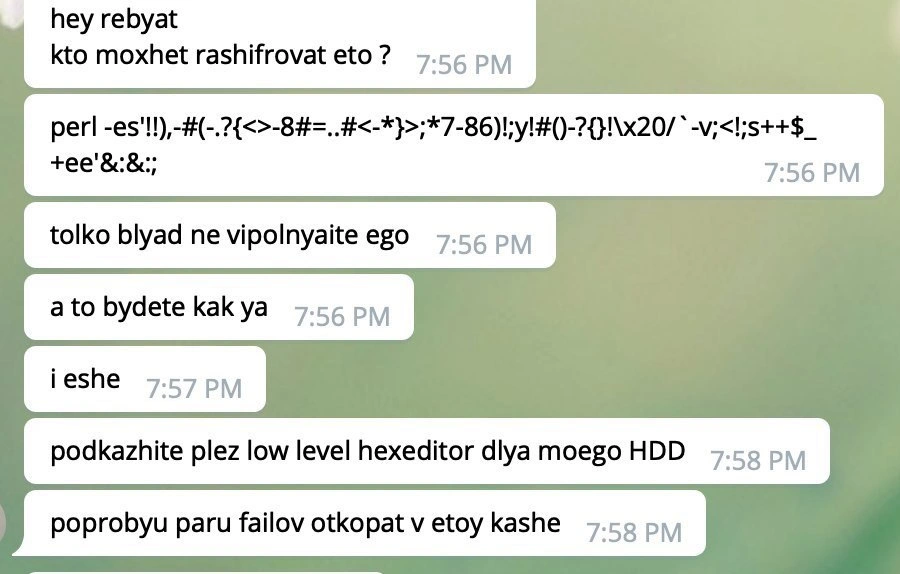
A screenshot of a chat conversation on a light green background. The messages, written in transliterated Russian, tell a short, tragic story. The first message asks, 'hey guys, who can decrypt this?'. The second message contains a long, cryptic line of Perl code, full of symbols and line noise: 'perl -es'!!),-#(-.?(<>-8#=..#<*`>,'*7-86)!;y!#()-?{}!\x20/` -v;<|;s++$_+ee'&:&:;'. This is immediately followed by a series of panicked warnings: 'just f***ing don't execute it' and 'or you will be like me'. The user then asks for a recommendation for a 'low level hexeditor for my HDD' to 'try to dig out a couple of files from this mess'. The humor is dark and serves as a classic cautionary tale for developers. It plays on the infamous readability of Perl, where code can look like random characters but perform powerful and, in this case, destructive system operations. The punchline is the user's desperate attempt at manual data recovery, implying the script they ran has catastrophically damaged their file system. It's a relatable horror story for anyone who has ever been tempted to run a cool-looking but unverified script from the internet

Comments
7Comment deleted
That's not a Perl script, it's a rite of passage. It decrypts your filesystem into a write-only format and teaches you the true meaning of 'backups'
Obfuscated Perl one-liners: because nothing says “disaster recovery drill” like trusting the internet with `sudo perl -e`
The fastest way to turn a senior developer into a junior is watching them paste mysterious Perl one-liners from chat into their terminal because "it's probably just a clever regex."
When someone asks 'who can decipher this Perl one-liner?' the correct answer is always 'nobody should try.' This is the software engineering equivalent of 'hold my beer' - a Perl script so obfuscated it makes regex look readable, followed by the universal distress signal: asking for a low-level hex editor. The progression from curiosity to catastrophe is a masterclass in why production systems have code review, why we don't execute random scripts, and why 'works on my machine' sometimes means 'worked until it didn't.' At least they're learning about disaster recovery in the most hands-on way possible - one corrupted sector at a time
If your timeline jumps from “decode this Perl y/// + s///ee thing” to “recommend a low‑level hex editor for my HDD,” you didn’t debug - you pivoted from DevOps to digital forensics because your rollback strategy was backups-as-a-theory
Hex editor on HDD: developer brain surgery with a butter knife - precise enough to carve files, dumb enough to risk the whole platter
That moment when y/// and s///e turn your shell session into a red-team demo followed by, “any recommendations for a low-level hex editor?”