Skip to content
DevMeme
490 of 7435
Today's Tech Vocabulary Lesson: Teledildonics
IoT Post #562, on Aug 15, 2019 in TG

Today's Tech Vocabulary Lesson: Teledildonics

Why is this IoT meme funny?

Level 1: Blushing Gadgets

Imagine your teacher is giving a very serious lesson, but suddenly the lesson is about something really silly or embarrassing. For example, think of a teacher explaining how a whoopee cushion works in a super scientific way, with diagrams and big words. The whoopee cushion is just a prank that makes a funny fart noise, and hearing a teacher talk about it so seriously would probably make the whole class giggle, right?

Now, in our case, the “silly thing” isn’t a whoopee cushion, but a special grown-up toy that normally isn’t talked about openly, especially not in a serious meeting. This toy can be controlled from far away by using computers or phones – kind of like a remote-controlled car, except it’s not a car, and it’s definitely only for adults. It’s a clever idea (because it lets people far apart share something fun), but it has a very goofy-sounding name: teledildonics.

So picture a bunch of engineers in a big room at a conference. They’re expecting to hear about usual tech stuff. Suddenly on the big screen, the speaker shows the word teledildonics as the “word of the day” and explains it like it’s a normal science term – breaking it into “tele” meaning far, and “dildo” (which is the name of that adult toy) meaning exactly that. The engineers in the audience know what a dildo is, and they totally didn’t expect to see that word on an official slide! You can imagine people trying not to laugh, some turning red-faced, and a little wave of laughter because it’s so unexpected and awkward.

In simple terms, this is funny because it’s a mix of serious and silly. The technology behind it is real and serious – you really can have a device that someone else controls over the internet. But the subject is so personal and usually private that seeing it discussed so formally makes everyone feel a bit shy and amused. It’s like hearing a normally strict teacher tell a joke that’s a tiny bit naughty – you’d be surprised and probably giggle. This meme shows that even very smart, very serious tech people can end up blushing and laughing when faced with a topic that’s out of the ordinary. It reminds us that technology can be about anything in life, even the things that make us giggle, and that even grown-ups have a playful side when something catches them off guard.

Level 2: Remote Control Toys

If you’re newer to the tech scene, let’s unpack this in a straightforward way. IoT stands for Internet of Things, which basically means any device that’s not a traditional computer (like a fridge, a light bulb, or a watch) that you connect to the internet or to your phone. The whole idea is to make everyday objects “smart” by letting them send data or be controlled remotely. For example, a smart thermostat can be adjusted from your phone, or a fitness band on your wrist can upload your step count to the cloud. In recent years, people have tried to put chips and connectivity in all sorts of things – sometimes to solve real problems, and other times just because it’s a fun or novel idea (that’s where the OverEngineering humor comes in).

Now, teledildonics is essentially the IoT concept applied to an adult intimate device. In plain terms, it’s a fancy word for a remote-controlled sex toy. Breaking down the word makes it less intimidating: “tele” means “far” (like telegram, telephone – all about doing something at a distance) and, well, “dildo” refers to a specific adult toy. Stick “-onics” at the end to make it sound techy (like electronics), and voila – it sounds like a legit field of study. And indeed, it is a field of study and industry! Companies have created devices that someone can control from far away, usually via a smartphone app or a computer. This could be used by couples in long-distance relationships, or for interactive experiences over the internet. It’s part of a broader area sometimes called remote haptics – “haptics” meaning touch/physical sensation – which covers anything that lets you feel something from a distance using technology.

Let’s talk about how that works technically in simple terms. Say you have this smart device — it’s basically a gadget with a little motor (to create vibration or movement) and a tiny computer chip inside. It might connect to your phone via Bluetooth. Bluetooth Low Energy (BLE) is a common wireless tech used for IoT gadgets; it’s how your fitness tracker or wireless earbuds talk to your phone without using a lot of power. So, the adult device pairs with a phone app using BLE, just like a smartwatch would. When you tap a button in the app (or when your partner taps a button on their app, from their phone anywhere in the world), the app sends a command to the gadget: “vibrate now at setting 5” or something like that. If you’re far apart, the command might go through the internet first: your phone sends it to a cloud server, the server relays it to your partner’s phone, and then that phone sends it via Bluetooth to the device on their side. All of this can happen in under a second if done right. It’s a bit like a remote-controlled car, except the “car” here doesn’t go anywhere — it just buzzes, and it’s... used for a very personal kind of enjoyment.

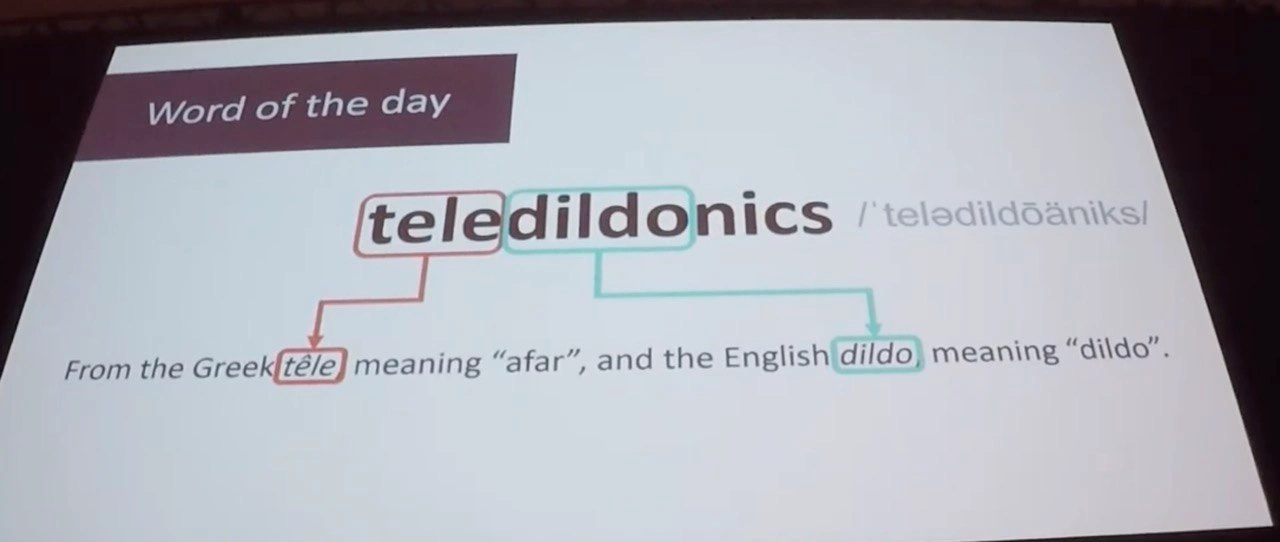
The meme shows a slide from a conference or presentation that looks like a vocab lesson. It says “Word of the day” and then presents teledildonics almost as if it’s teaching you a new language word. They even spelled out the pronunciation and pointed out the parts of the word (“tele” and “dildo”) with their origins. This presentation style is typically used for technical terms or big concepts in engineering. Seeing it used for something as cheeky as an internet-connected sex toy is what makes everyone laugh and feel a bit embarrassed. It’s the contrast: very serious tone, very unserious subject. You can imagine an audience of engineers or tech enthusiasts trying to maintain a straight face while someone on stage solemnly explains that the Greek root tele means “afar” and the English word dildo means... “dildo”. It’s textbook dry humor: act as if it’s totally ordinary to include that on a slide.

For a junior developer or someone new to tech, there are a couple of things that make this funny and interesting:

  • Unexpected subject: You don’t expect to hear about sex toys at a tech conference or in a professional setting, yet here it is, treated just like any other gadget. It shows how wide-ranging the tech world can be — from servers and algorithms all the way to, yes, intimate products. It’s a little reminder that technology touches every part of life.
  • Absurd but real use-case: It might seem like overkill to connect something like this to the internet, but there’s actually a demand and logical use-case: people want to share intimate moments over long distances, and technology can help simulate that. This is a prime example of what we call Engineering Absurdity or over-engineering in a playful sense — taking a simple concept (“make it buzz”) and doing it in the most complex way possible (over networks and protocols), because why not?
  • Learning new terms: You’re also inadvertently learning some etymology (word origins) from that slide. Many tech terms use Latin or Greek roots. Here it’s half Greek, half… slang. The slide’s joke is that they had to explain “dildo” by just saying “meaning ‘dildo’” — there’s no ancient Latin word for that part, it’s just an English word we all know, usually not seen in conference materials!

In more general terms, this meme is telling newcomers: Tech can get weird, and that’s okay. One day you might be programming a smart coffee maker, the next day you might stumble on an API for a smart... erm... personal massager. It’s all just code and hardware serving human needs (or whims). And the humor? It comes from seeing grown professionals with serious faces talking about something typically regarded as naughty or private. It humanizes the field — even in high-tech jobs, people have a sense of humor and can appreciate a good laugh when something awkward comes up. So don’t be surprised if your career in tech leads you to some unusual projects; at least you’ll have a funny story to tell!

Level 3: Even This Has an API

For seasoned engineers, this meme hits that perfect blend of shockingly real and really funny. It’s the kind of humor only a tech crowd would create: showcasing a dry, academic-style conference slide that reads “Word of the day: teledildonics” and then proceeds to break it down like a term in a linguistics textbook. In the image, the word is dissected with colored boxes: tele (in a red box, with the note “Greek tèle meaning ‘afar’”) and dildo (in a teal box, bluntly noted as “meaning ‘dildo’”). The phonetic pronunciation /ˈtelədildōäniks/ sits beside it, as if this were Merriam-Webster’s entry for some highbrow concept. It’s a deadpan presentation of an extremely cheeky term.

Now, imagine being in that audience. You’re at an IoT or hardware engineering talk, expecting maybe a rundown of the latest sensor tech or a shiny new Bluetooth protocol. Instead, the presenter throws teledildonics up on the projector. There’s a split-second where everyone processes it: Did we just see the word “dildo” in big bold letters at a serious tech event? A beat later, the chuckles spread through the room. Even the most poker-faced engineers smirk, and a few folks probably turn strawberry red. It’s an awkward conference slide moment for sure — not because the topic isn’t valid, but because it’s normally confined to behind-the-scenes lab work or niche forums, not the main stage “word of the day.” The humor is amplified by the contrast: a formal etymology lesson (complete with Greek root and all) about a device that is, by its nature, not something usually discussed so academically in public. It’s like hearing a monotone professor explain the workings of a whoopee cushion with absolute seriousness; the content and tone are hilariously mismatched.

Beyond the initial blush factor, experienced developers appreciate the broader industry truth here: IoT will connect literally anything if there’s a market (or even just a quirky idea). We’ve watched the progression over the years — smart toasters that tweet when your toast is done, WiFi-enabled fridges that email you a grocery list, Internet-connected toilets (yes, those exist, complete with companion apps). By comparison, remote-controlled adult toys were not a matter of “if” but “when”. The term teledildonics itself has been around for decades in sci-fi and tech circles (coined in the late 20th century), but seeing it go from speculative fiction to an actual product category is wild. When veteran engineers see that slide, part of the laughter is “Oh boy, we’ve finally hit that point – even this has an API now.” It’s a mix of amusement and a weird kind of pride or validation: our field truly has no boundaries. Any physical device you can imagine, no matter how personal or peculiar, will eventually get a Bluetooth chipset, a mobile app, and a cloud service. Today it’s teledildonics; tomorrow, who knows – maybe “smart” deodorants or AI-enhanced toothbrushes (both of which, incidentally, have also happened!).

From a senior perspective, there’s also appreciation for the technical absurdity. Underneath the giggles, someone has to solve real engineering problems to make these products viable. It’s funny to see the word up on a slide, but you know that behind that word is a team of developers dealing with the same headaches as any IoT project. Think about it: they must ensure the device’s firmware is robust, the Bluetooth Low Energy connection doesn’t drop at the wrong moment, and that latency we talked about is minimized for a smooth experience. They have to write unit tests for functions that control a motor’s speed and pattern — and likely do so with completely straight faces during scrum meetings. There’s probably a Jira ticket somewhere titled “Bug: device desyncs at high vibration settings over 4G”. Imagine being the poor engineer debugging a timing issue causing a 1-second lag in a transcontinental “session” — that’s a real network programming challenge hidden behind a wall of blushes. It’s equal parts engineering grind and comedy when you think about the context.

Let’s not forget the social engineering aspect in the workplace. On these teams, you have to talk about the product openly with your colleagues, which means saying the words out loud in meetings: “Did we test the new dildo hardware revision with the updated app?” There’s no euphemism on the spec sheet; it is what it is. Some teams might humorously use code names for the projects (“Project Happy” or something), but eventually you’re logging into a debugger stepping through DeviceManager.cpp dealing with a class named DildoController (because hey, that’s the accurate term). Seasoned devs find this hilarious and endearing — it’s a reminder that engineers often operate in absurd domains with complete seriousness. One day you’re optimizing battery life for a heart-rate sensor, the next you’re writing a connectivity protocol for a NSFW IoT gadget. The code doesn’t care; it’s all just devices and data.

The phrase “any physical actuator can get an RFC” also winks at the way our industry formalizes everything. Eventually, someone writes down specifications and best practices, even for things like this. There was a time when connecting a thermostat to the internet seemed frivolous, and now there are entire standard protocols (like MQTT, CoAP) for IoT devices. Likewise, you can bet if multiple companies make intimate IoT devices, they’ll form a standards committee (behind closed doors, perhaps) to ensure interoperability. It wouldn’t shock any senior engineer if a Bluetooth SIG profile or a formal API standard emerges titled something euphemistic like “Remote Physical Interaction Protocol” (with a knowing nod to what it’s really for). In fact, the open-source world already has libraries to unify control of these devices – because of course some brilliant (and perhaps cheeky) developers said, “Let’s make a general interface so we don’t have to reinvent the wheel… or other shapes.”

In summary, the meme lands so well with experienced tech folks because it confirms a running joke of our profession: no technology is too absurd or too “out there” to be taken seriously. The entire room blushes not just because of the naughty word on the slide, but because it’s delivered in the exact same tone as a lecture on, say, network topology or container orchestration. It’s the ultimate straight-faced acknowledgment that yes, even this is part of our world now. Seasoned engineers love that juxtaposition — it’s a break from the corporate buzzwords and a reminder that sometimes innovation leads us to wonderfully bizarre places.

Level 4: Haptic Telepresence Realities

At first glance, teledildonics might sound like a punchline, but it actually sits at the crossroads of some serious tech domains: remote haptic feedback, real-time control systems, and the ever-expanding Internet of Things. In essence, this term refers to transmitting tactile sensations over distance – think of it as telepresence for touch. It’s closely related to research on haptic telepresence, the same kind of technology that lets surgeons operate robotic arms from miles away. The twist here is that the “robotic actuator” in question is an intimate gadget rather than a surgical instrument. But from an engineering standpoint, controlling a motorized actuator across a network, whether it’s a robot gripper or a personal device, poses similar challenges.

One fundamental challenge is latency. Physical intimacy typically relies on real-time feedback, but when devices are connected via the internet (or even just via Bluetooth to a phone and then to the cloud), you introduce delay. Signals have to travel through radio waves and network cables; the speed of light and network routing hop-by-hop mean even a well-optimized path might add 50-200 milliseconds or more. In remote haptics, that delay can make synchronous interaction feel a bit “off”. There’s actually a term in networking research called the tactile internet, which aims for ultra-low latency (on the order of a few milliseconds) so that remote touch feels instantaneous. It’s notoriously hard to achieve at global distances – an unavoidable reality of physics. In tele-intimacy applications, this means there’s virtually always a tiny lag between a person’s action and their partner’s device responding. Engineers try to mask it (for example, sending pre-programmed patterns rather than continuous real-time control, so brief network jitter doesn’t kill the mood), but you can’t completely cheat physics. Essentially, teledildonic tech has to gracefully handle the fact that love signals might literally be traveling halfway around the world.

Another crucial aspect is security and privacy. Any IoT device needs security, but here the stakes feel especially high (and yes, rather personal). Early IoT products infamously skimped on encryption and authentication – from smart fridges to security cameras – and Bluetooth Low Energy gadgets were no exception. In the case of intimate devices, a lack of proper pairing or encryption could mean an unwelcome stranger intercepting or even injecting signals. In fact, there have been proof-of-concept hacks where researchers showed they could hijack someone’s Bluetooth-connected personal device because the manufacturer left the default PIN as 0000 or had no authentication at all. Modern designs use robust encryption (e.g. leveraging the Bluetooth Secure Connection protocols or end-to-end encryption if the control flows through a cloud server) to scramble any commands over the air. They also enforce strict pairing routines – only the trusted user’s phone/app can control the hardware, often with mutual authentication. The meme’s sly nod — “any physical actuator can eventually get an RFC” — reflects a truth that standards and security guidelines do emerge even for these sensitive gadgets. There isn’t an official IETF RFC called “teledildonics” (the IETF didn’t literally publish an RFC 6969 for this, although that numbering would’ve raised eyebrows), but de-facto standards are being built. Developers have created open protocols and libraries to control intimate hardware across brands, essentially an API for pleasure devices. Under the hood, that means defining data schemas and command sets (vibration intensity, patterns, device handshakes) not unlike any other device category. It’s equal parts absurd and advanced: crafting a reliable communication protocol for, well, remote intimacy.

Finally, even the hardware itself involves solid engineering. These devices contain microcontrollers, firmware, sensors, and motors just like any other gadget. There’s power management (no one wants a low battery at a critical moment), firmware updates (yes, even a vibrator might get an over-the-air firmware patch to improve its Bluetooth stack or add new features), and safety constraints (limiting motor speed, preventing overheating). All those considerations fall under standard hardware engineering and IoT device management. Beneath the hilarious concept, it’s a real example of an IoT system: a physical device + software + connectivity + cloud. The only difference is this IoT node’s purpose happens to be quite… intimate. By examining teledildonics at this deep technical level, we see the humor comes from juxtaposition — we’re applying the full rigor of engineering standards, network protocols, and cryptographic security to something that still makes people giggle. In other words, it’s a legitimate technological frontier wrapped in an unconventional package, proving that no tech domain is too “touchy” to get the full engineering treatment.

Description

The image shows a photograph of a presentation slide projected onto a screen. The slide has a dark red header bar with the text 'Word of the day'. The main content of the slide defines the word 'teledildonics', with its phonetic transcription '/ˈtelədɪlˈdɒnɪks/'. The word is broken down into two parts with colored boxes and arrows indicating their origins. A red box around 'tele' points to the explanation: 'From the Greek tele meaning "afar"'. A light blue box around 'dildo' points to the explanation: 'and the English dildo meaning "dildo"'. The humor is derived from the deadpan, academic presentation of a word related to sex technology. This juxtaposition of a formal, educational format with a taboo subject is unexpected and amusing. For a tech audience, it's a funny nod to the fact that technologies like IoT, networking, and robotics are being applied to every conceivable aspect of human life. It highlights the real-world field of remote-controlled, internet-connected devices, which brings up genuine engineering challenges like latency, security, and API design, but in a highly unconventional context


Comments

7
Anonymous ★ Top Pick I'm not saying the API for our new teledildonics platform is bad, but a 200ms latency spike now constitutes a major incident, and nobody wants to be on-call for that
  1. Anonymous ★ Top Pick

    I'm not saying the API for our new teledildonics platform is bad, but a 200ms latency spike now constitutes a major incident, and nobody wants to be on-call for that

  2. Anonymous

    Finally, a feature request where ‘end-to-end latency’ has truly personal stakes - try pitching a 200 ms round-trip SLA for *that* QA environment

  3. Anonymous

    Finally, a WebSocket implementation where the client actually wants to keep reconnecting after unexpected disconnections

  4. Anonymous

    When your IoT architecture review includes discussing latency, throughput, and packet loss in contexts you never covered in your distributed systems course. Turns out 'real-time bidirectional communication' means something very different depending on which Slack channel you're in

  5. Anonymous

    Pro tip: don’t make the haptics stream ‘eventually consistent’ - when the SLA is intimacy, retries with exponential backoff are just a breakup algorithm

  6. Anonymous

    Teledildonics: the original RPC where remote procedure calls deliver haptic feedback - no auth tokens required

  7. Anonymous

    Teledildonics: where p99 latency becomes a relationship KPI, BLE still pairs with 0000, and a missing TLS cert turns into a very personal postmortem

Use J and K for navigation