David Blaine Versus Invisible JavaScript
Why is this Languages meme funny?
Level 1: Invisible Numbers
Imagine someone writes a math problem on paper, but the numbers are drawn in invisible ink. You see only +, *, and -, so the problem looks impossible. The magician can solve it because he knows where the invisible numbers are. The meme is funny because the JavaScript developers brag that they can solve anything, then get beaten by code they can barely see.
Level 2: Spaces That Aren't Spaces
JavaScript programs are read in stages. First, the engine breaks source text into pieces called tokens: names, numbers, strings, operators, and punctuation. A variable name like count is a token. An operator like + is another token. Usually that feels obvious because the text on the screen matches what the engine sees.
This meme breaks that expectation. The code uses Unicode escape sequences such as \u115F and \u3164 as names for global variables. Those characters can look blank or almost blank in many fonts. So the printed expression looks like it has missing numbers, but it actually has hidden variable names between the operators.
The magic-trick format works because the developers think they are being asked to solve ordinary arithmetic. Instead, they are being tested on how JavaScript handles unusual identifier characters. The answer is not about being good at math; it is about knowing that programming languages sometimes accept text that human eyes do not read clearly.
Level 3: Invisible Seniority Test
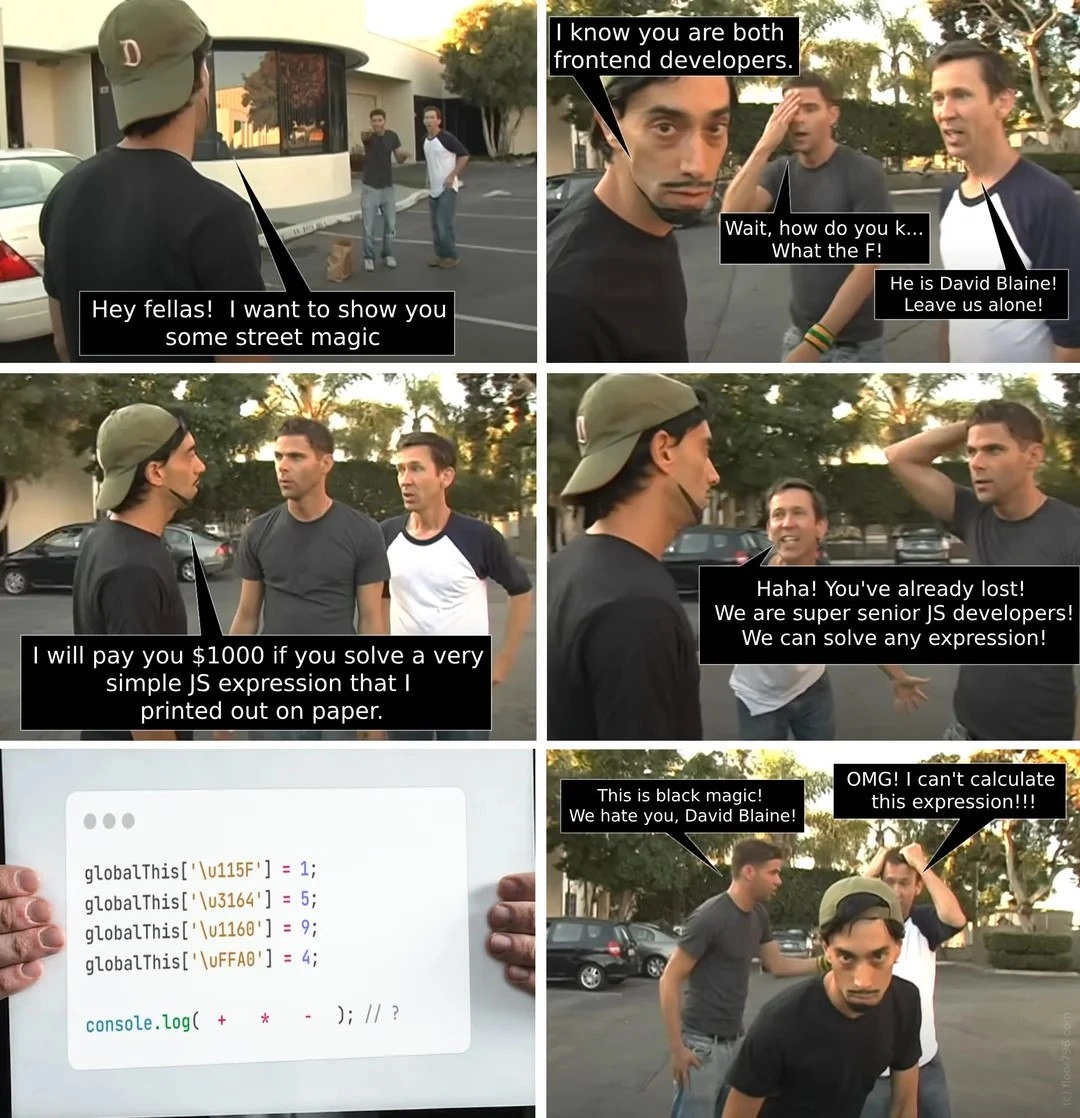
The six-panel structure sets up the humiliation perfectly. David Blaine opens with:
Hey fellas! I want to show you some street magic
Then he announces:
I know you are both frontend developers.
That is already rude, but technically targeted. Frontend and WebDevelopment developers live close to JavaScript's long tail of edge cases: browser compatibility, minification, transpilation, Unicode in user input, weird bundler output, and code that has survived three framework migrations. So when the developers brag, We are super senior JS developers! We can solve any expression!, the meme is baiting exactly the confidence JavaScript punishes.
The final panel has them yelling:
This is black magic! We hate you, David Blaine!
The funny part is that their panic is justified. The expression is "simple" only if you know the invisible operands exist. Without that knowledge, it looks syntactically impossible: unary plus, multiplication, subtraction, and emptiness. A senior JavaScript developer might expect coercion traps, NaN, typeof null, prototype weirdness, or this binding betrayal. Hidden Unicode variable names are a more specialized curse, the sort of thing that appears in a security talk, a code-golf contest, or one truly unhinged pull request.
There is also a real engineering warning under the absurdity. UnicodeSupport is necessary for global software: people should be able to write identifiers, strings, and interfaces in many languages. But powerful text support creates room for HiddenComplexity. Confusable characters, bidirectional control marks, zero-width characters, and invisible-looking identifiers can make source code misleading. That matters in code review, supply-chain security, generated code, and any system where "what the reviewer saw" must match "what the runtime executed."
Level 4: Lexical Grammar Sleight
The trick in this David Blaine meme is not arithmetic; it is tokenization. The paper visibly assigns values to four globalThis properties:
globalThis['\u115F'] = 1;
globalThis['\u3164'] = 5;
globalThis['\u1160'] = 9;
globalThis['\uFFA0'] = 4;
Then the visible console.log line appears to contain almost nothing but operators:
console.log( + * - ); // ?
A human sees suspicious blankness. The JavaScript lexer can see Unicode identifier characters. Some Unicode code points that render like empty space or near-empty filler glyphs are still valid identifier characters in ECMAScript source text. That means an expression can look like punctuation floating in a void while actually containing variable names. This is the compiler-front-end equivalent of a trapdoor under a welcome mat.
The likely intended expression is effectively 1 + 5 * 9 - 4, which evaluates to 42 because multiplication binds tighter than addition and subtraction. The "magic" is that the operands are visually camouflaged. They are not spaces to the parser; they are identifiers whose property values were attached to globalThis, making them available as global variables in sloppy enough surroundings. JavaScript did not need an invisibility cloak for variables, but the Unicode standard and language grammar shook hands in a hallway and here we are.
This is why the meme fits SyntaxAbuse, CodeObfuscation, and LanguageQuirks so cleanly. Most language weirdness memes stop at coercion, like [] + {}. This one goes lower, into the lexical layer where source code becomes tokens before parsing even begins. If your tooling, font, review interface, or diff view does not make hidden or confusable characters visible, the program you review may not be the program the engine executes.
Description
A six-panel David Blaine street-magic meme shows him approaching two men and saying, "Hey fellas! I want to show you some street magic." The men respond with captions including "I know you are both frontend developers.", "Wait, how do you k... What the F!", and "He is David Blaine! Leave us alone!", before Blaine offers, "I will pay you $1000 if you solve a very simple JS expression that I printed out on paper." The printed code assigns values to `globalThis['\u115F']`, `globalThis['\u3164']`, `globalThis['\u1160']`, and `globalThis['\uFFA0']`, then shows a `console.log(` expression that visually appears to contain only operators and spaces: `+`, `*`, and `-`; the developers boast "Haha! You've already lost! We are super senior JS developers! We can solve any expression!" and then panic with "This is black magic! We hate you, David Blaine!" and "OMG! I can't calculate this expression!!!" The trick is that several Unicode filler characters can behave like distinct JavaScript identifiers while looking like whitespace, turning a seemingly impossible expression into valid, deeply cursed code.
Comments
16Comment deleted
JavaScript did not need invisible variable names, but apparently the grammar wanted its own escape room.
Whats the answer 🤔 Comment deleted
NaN? Comment deleted
7 Comment deleted
42 Comment deleted
ah, invisible symbols... well, we can't know their order, but assuming all 4 are actually used in the calculation, we can get any of: 0 8 10 12 28 32 40 42 48 Comment deleted
My favorite number: 5077073466685484917 8462080220627957062 Dont take it seriously. Comment deleted
I feel like an idiot. What does this mean? Comment deleted
A hint: indianness Comment deleted
ah Comment deleted
yeah, i am an idiot after all Comment deleted
💀😭😂 nah Comment deleted
kindly go fuck yourself Comment deleted
💀😂😭 Comment deleted
Tbh really surprised that still no one came to comments saying that correct answer is undefined Coz that’s what console.log evaluates to Comment deleted
Now I feel lost Comment deleted