Skip to content
DevMeme
492 of 7435
The Impending Judgment of a Code Review
CodeReviews Post #565, on Aug 16, 2019 in TG

The Impending Judgment of a Code Review

Why is this CodeReviews meme funny?

Level 1: On the Hot Seat

Imagine you have to do something private, like go to the bathroom, but you have to do it on a stage with all your friends watching you. You’d feel pretty embarrassed, right? This meme is joking that showing your code to others (for them to check it) sometimes feels just like that. The programmer feels like they are sitting on a toilet in front of everyone, meaning they feel exposed and nervous. It’s a funny way to say “I feel shy and judged when everyone looks at my work.” Just like being on a hot seat in front of a crowd, having all your classmates (or in this case, coworkers) watch can be scary. The humor comes from comparing a normal developer task (code review) to a super embarrassing public bathroom scenario, making us laugh at how silly our fears can be. In simple terms: everyone’s watching me, and I’m scared I’ll mess up – that’s the feeling being joked about.

Level 2: Toilet Stage Fright

Let’s break down what’s happening in simpler terms. The meme compares code reviewing to sitting on a toilet in front of a live audience. In real life, a code review is when other developers look at your code changes (often via a Pull Request on a platform like GitHub) and give feedback before the code is merged to the main codebase. It’s usually a helpful process: reviewers might catch bugs, suggest better ways to write something, or ensure the code follows the team’s style guidelines. But for many developers – especially those early in their careers – having your code reviewed can cause stage fright. Suddenly, all your peers are reading through what you wrote line by line. Every mistake or odd solution you came up with while coding at 2 AM is now out in the open. That can be nerve-wracking!

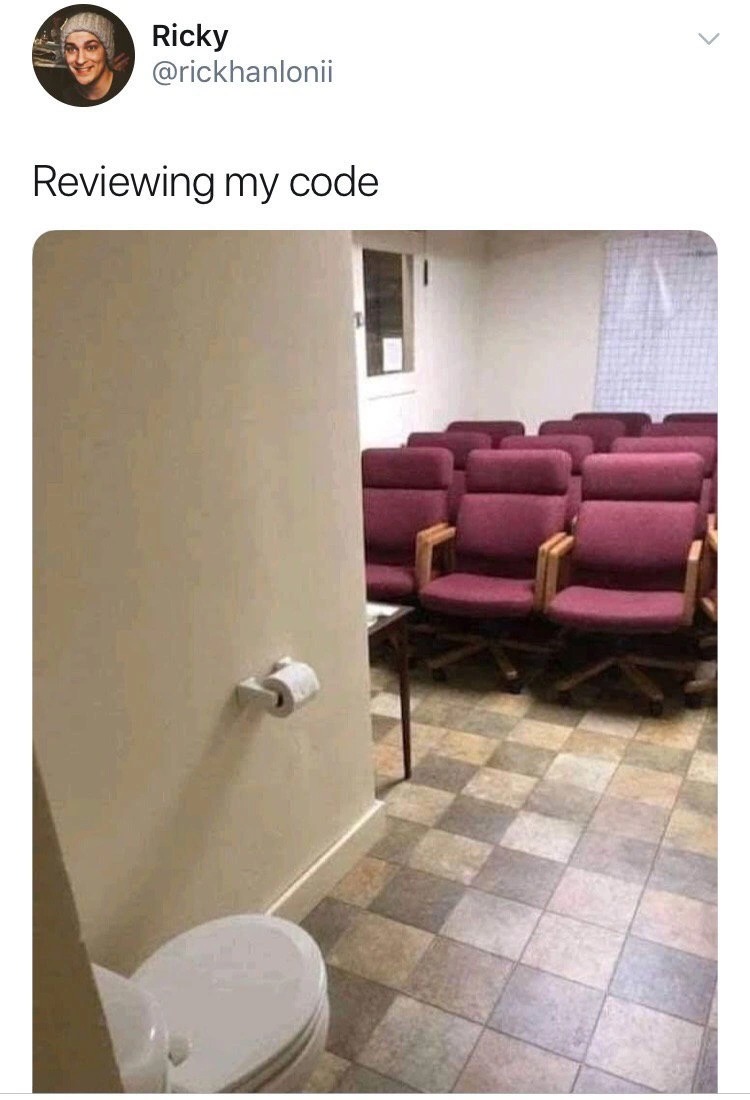
The image is a visual joke: normally, using the bathroom is a private act (often a bit embarrassing if made public), just like many people feel their coding is a somewhat personal task. Now imagine doing that private act on a stage with a bunch of chairs of people watching you – yikes! Those burgundy office chairs in the meme are arranged like an audience in a small conference room, all facing the toilet. This mirrors how it feels when you post a pull request and a crowd of team members (sometimes even folks from other teams like QA or security) all start to comment on your code. Maybe one points out a typo, another finds a bug, another suggests a different approach. Even if the feedback is meant well, you can’t help but feel a bit self-conscious. The meme’s text "Reviewing my code" implies the poster (a developer named Ricky, via the tweet) feels like code review is akin to public humiliation. It’s self-deprecating humor: the developer is joking that their code might be so embarrassingly bad that reviewing it is like watching a cringe-worthy performance.

Key terms here: Developer Experience (DX) refers to what it’s like day-to-day being a developer, and code reviews are a big part of that experience. Good DX means code reviews feel helpful and educational; bad DX means they feel scary or demoralizing. Developer anxiety in this context is that knot in your stomach when you think “What will everyone say about my code?” The meme exaggerates it: instead of just a few comments in a code review tool, it imagines an actual room where a panel of colleagues is sitting in judgment as you metaphorically “do your business.” Even if you’re new, you know the feeling of someone looking over your shoulder while you work – it’s similar here, but multiplied by the number of reviewers. This image strikes a chord with common code review pain points: feeling exposed, fearing negative feedback, or recalling a time when a code review turned a bit harsh. By visualizing that fear so literally (toilet + audience), the joke highlights how silly that extreme scenario is, which helps developers laugh at their own anxiety. After all, in reality, code reviews are usually not that bad – nobody’s actually lining up chairs to watch you type – and remembering that can take a little stress out of hitting the “Create PR” button.

Level 3: Review Panopticon

At the highest level, this meme lampoons the code review process by portraying it as a literal panopticon – a scenario where one coder sits exposed (on a porcelain throne, no less) while an entire panel of peers watches intently. In real development teams, a code review usually isn’t a spectator sport, but it can feel that way. Seasoned engineers know that submitting a pull request (PR) for review means inviting scrutiny from multiple reviewers: peers, tech leads, maybe that one architect who combs through every line. The meme’s tweet caption "Reviewing my code" paired with a toilet facing an audience of chairs exaggerates this feeling of exposure to cross-functional critique. It resonates because many of us have experienced PRs where it seems like half the team piles on with comments – some constructive, some nitpicky, all of them aimed straight at our precious diff.

From a senior developer’s perspective, the humor cuts deep: it’s poking fun at the Developer Experience (DX) when code reviews go wrong. In a healthy process, code review is about catching bugs, maintaining standards, and sharing knowledge. But when executed poorly, it can devolve into a public shaming ritual. The image suggests an in-person code review meeting straight from a developer horror story: imagine sitting literally on the "hot seat" (or in this case, the toilet seat) in front of a review board. This is an absurd twist on practices from bygone eras – formal code inspections where a developer might walk through code on a projector while a room of colleagues critiques every line. Modern reviews are usually asynchronous on platforms like GitHub or GitLab, but the psychological effect can be similar. A senior engineer might chuckle (or cringe) at the image thinking of that one big PR where multiple senior devs, QA, and even the CTO chimed in with feedback, turning a simple commit into a full-blown interrogation.

The panopticon reference is apt: in Jeremy Bentham’s prison design, inmates never know when they’re being watched, leading them to self-police out of fear. Similarly, after a few rough code reviews, a developer starts to internalize that feeling of always being observed and judged. You start second-guessing every line of code, hearing those phantom reviewer comments in your head (// TODO: really? “Why is this even global?”, "This is spaghetti code, please refactor," etc.). The meme’s toilet imagery underscores the vulnerability: writing code is an intimate creative act, and exposing it for review can feel as awkward as exposing oneself in a bathroom – especially if the code isn’t your best work (we’ve all had “crappy” code we weren’t proud of, pun intended). The row of chairs signifies a review committee, ready to scrutinize every commit and flush out your mistakes. It’s a lighthearted jab at the anxiety engineers often feel: even battle-hardened veterans can recall a code review that felt like a trial by fire (or by embarrassment). The joke lands because it exaggerates a truth: code reviews combine personal pride and public critique, a recipe for discomfort that’s painfully familiar in developer culture. We laugh because we see ourselves on that toilet, presenting our flawed code to an audience of discerning peers, hoping to get out with only minor comments and our dignity intact.

Description

This is a screenshot of a tweet by a user named Ricky, with the caption 'Reviewing my code'. The image below the text is unsettling and bizarrely arranged. In the foreground, a white toilet is partially visible, with a toilet paper roll mounted on a plain beige wall. This wall acts as a partial divider to a larger room. The larger room, seen just beyond the wall, is set up like a small auditorium or viewing gallery, filled with several rows of empty, maroon-upholstered chairs with wooden arms, all facing away from the toilet area. The floor is a checkered pattern of muted earth-toned tiles. The humor lies in the powerful metaphor for the experience of a code review. The toilet represents the developer's code - it's the product of their private effort, it might feel messy or functional but not elegant ('it's crap'). The empty chairs symbolize the impending audience of peer reviewers, managers, or stakeholders who are about to scrutinize and pass judgment on this very personal work. The meme perfectly captures the feeling of vulnerability, exposure, and anxiety that many developers feel when submitting a pull request
Comments

7
Anonymous ★ Top Pick Submitting a pull request feels exactly like this. You know, logically, that everyone's a professional, but you can't shake the feeling you're about to be judged by a jury of your peers for forgetting to flush
  1. Anonymous ★ Top Pick

    Submitting a pull request feels exactly like this. You know, logically, that everyone's a professional, but you can't shake the feeling you're about to be judged by a jury of your peers for forgetting to flush

  2. Anonymous

    Pro tip: enable "Require approving reviews" in branch protection - just don’t enable “Stadium Seating Mode” unless you’re absolutely sure that regex-based toilet-paper linter passes

  3. Anonymous

    The worst part isn't the audience watching you debug that race condition - it's knowing half of them are just there to comment on your variable naming conventions

  4. Anonymous

    Code reviews: where you realize your 'elegant solution' is just a public restroom with no door, and your entire team has front-row seats. At least in production incidents you can blame the infrastructure - here, it's just you, your questionable variable names, and that nested ternary operator you thought was 'clever' at 2 AM

  5. Anonymous

    My PR still defaults to synchronous review theater - forty chairs, two hundred comments, and one author on the porcelain stage; LGTM if we rewrite the service in Rust

  6. Anonymous

    Single-writer toilet, N reviewers - our PR pipeline enforces two approvals before flush and calls it blameless

  7. Anonymous

    In code review, you're always alone with your shit - no rubber duck, just the throne

Use J and K for navigation