Skip to content
DevMeme
4115 of 7435
Single-letter variables as intellectual property defense: security layer or self-inflicted legacy?
CodeQuality Post #4491, on Jun 19, 2022 in TG

Single-letter variables as intellectual property defense: security layer or self-inflicted legacy?

Why is this CodeQuality meme funny?

Level 1: Hiding in Plain Sight

Imagine you have a secret recipe for the best cookies in the world. You’re worried someone might steal your recipe, so you come up with a plan: instead of writing “sugar”, “flour”, and “butter” in the recipe, you just write A, B, and C. Now the recipe looks like gibberish: “Mix 1 cup of A with 2 cups of B,” and so on. It’s true, if a stranger looked at that, they might not know right away that A is sugar and B is flour. But here’s the problem: next week, even you might not remember which one was A and which was B! And if your friend wants to help you bake using your recipe, they’ll have absolutely no clue what to do because the instructions are too vague. The funny (and silly) idea in the meme is just like that. By hiding the meaning of things (using confusing names), you hope to keep the “secret” safe. But really, you’re just making a mess for yourself and everyone else who tries to use it. It’s like writing your homework in a secret code so no one can copy it – but then even the teacher can’t read it to give you a grade, and you might forget what you meant when you read it later! 🤦‍♂️ In simple terms, the joke is that making something harder to understand doesn’t truly protect it; it just causes headaches. It’s funny because it’s obviously a bad idea once you think about it – you end up locking yourself out with your own “smart” trick.

Level 2: Readability vs. Obscurity

Let’s break down the concepts and humor in simpler terms. The meme is essentially about code readability versus a misguided notion of code security. Here are the key ideas involved:

  • Single-letter variables – This means naming variables in your code with names like x, y, or i instead of descriptive names like userAge or totalPrice. In normal practice, single letters are only used in very limited cases (for example, the variable i is commonly used as a loop counter in for loops). Outside of small contexts, we usually avoid one-letter names because they don’t tell you anything about what the variable is for. If you see code that says p = m * c;, you might scratch your head wondering what p, m, and c represent. In contrast, price = mass * c; at least hints at some relationship (maybe the equation E = m*c^2 if we named it slightly more clearly). In short, single-letter variables make code cryptic.

  • Naming conventions – These are agreed-upon guidelines or patterns for naming things (variables, functions, classes) in code. Different languages or organizations have their own conventions (for example, Java uses camelCase for variables like maxRetries, Python often uses snake_case like max_retries). But all conventions share one goal: make the code understandable. A good name is like a little hint about what a variable holds or what a function does. For example, a variable named total_score clearly indicates it holds some total score value. Conventions also cover things like using meaningful words, not abbreviating too much, and avoiding ambiguous letters. In a well-named codebase, someone new can guess what variables like user_list or is_admin mean without needing a 50-page manual. The “senior engineer” in the meme is suggesting a drastic anti-convention: use 1-3 letters only, regardless of context. That goes against every common naming guideline out there! It’s almost a caricature of bad coding practice.

  • Code Quality and MaintainabilityCode quality isn’t just about the program working; it’s about how easy it is to read, extend, and fix the code. Maintainability refers to how easily the code can be maintained over time (like fixing bugs or adding new features). High-quality code is usually self-explanatory or well-documented. Low-quality code is confusing and brittle. Using descriptive names is one of the simplest ways to boost code quality because anyone reading the code can understand the intent without constantly cross-referencing or running the code. If all variables are a, b, c, d... the only way to understand the code might be to run it step by step or read additional documentation (if it even exists). It’s tiring and error-prone. For a team project, low maintainability means new developers will have a hard time onboarding, and even experienced team members risk introducing bugs because they misunderstand what x was supposed to be. So, intentionally writing hard-to-read code is the opposite of what we strive for in professional software development. It’s considered a bad practice because it makes maintaining and updating the software much harder.

  • Code Obfuscation – This is the practice of making code deliberately difficult to read. There are actual tools that obfuscate code (for example, to protect proprietary code that is distributed publicly, like minimizing and mangling JavaScript for web browsers). But crucially, obfuscation is usually done as an automated step after writing clear code, not during initial development. And it’s generally seen as a last resort or minor speed bump, not real security. The meme’s scenario is basically someone advocating manual obfuscation via naming. It’s like saying, “Don’t write clean code; write it like a riddle so outsiders can’t understand it.” In the software world, this is almost always a bad idea. It’s true that sometimes companies worry about their intellectual property (unique algorithms or business logic) being stolen. However, the serious ways to protect that are legal (patents, licenses, NDAs) or technical (not exposing the code, using compiled binaries, etc.), rather than just naming things poorly. Security through obscurity (hiding things in hopes attackers won’t find them) is generally frowned upon. Security experts prefer designs that are secure even if the attacker knows how they work (relying on secret keys or passwords, not secret code structure). So using confusing variable names is at best a very thin defense, and at worst it just handicaps your own team.

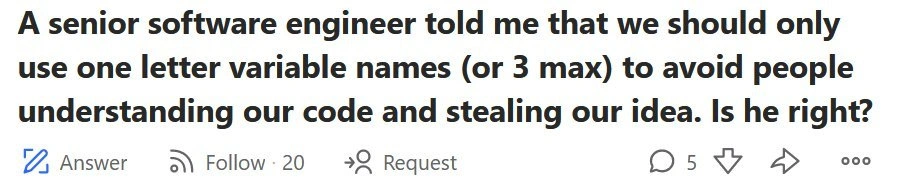
  • Developer humor and context – The reason developers find this question funny is because it exaggerates a real tension in programming: clarity vs. cleverness. Every programmer learns the importance of good naming (there are even memes about how hard it is to name things in programming, or jokes that the two hardest problems in CS are “cache invalidation and naming things”). Seeing someone suggest short variable names as a security measure is absurd, almost like a parody of a clueless developer or a very misinformed “senior.” It’s a bit like if someone said, “Use really bad spelling and handwriting so nobody can plagiarize your essay.” 🙃 The meme format (a Q&A style screenshot) adds to the humor – it reads as if a confused junior dev heard this advice and is wisely checking with the community, essentially asking “Is this for real?” The small interface elements (“Follow · 20”, “5 answers”) imply that others are engaged, likely pouring in answers like “No, this is not right at all!” The whole thing lampoons the idea of “security by confusion”. Seasoned devs chuckle because it’s an obvious no-no presented in a deadpan, almost believable way.

To visualize why clear naming matters, consider a quick code comparison. Here’s a simple example in Python of clear vs. obfuscated naming:

# Clear, readable code:
number_of_apples = 5
number_of_oranges = 8
total_fruit = number_of_apples + number_of_oranges
print(f"We have {total_fruit} pieces of fruit.")

# Obscured code with one-letter names:
a = 5
b = 8
c = a + b
print(f"We have {c} pieces of fruit.")

In the first snippet, even a new programmer can guess we’re counting apples and oranges and then summing them up. In the second snippet, a, b, and c could be anything: the calculation might represent something entirely different to a reader who doesn’t know the context. You’d have to read surrounding code or comments to figure out what a and b stand for. If this were a real codebase and a was actually, say, the user’s age and b was the number of years since account creation, then naming them a and b would be super misleading. The logic would work, but the next person reading it might think those are just arbitrary numbers or start guessing incorrectly. This increases the chance of mistakes.

So, in plain terms: using one-letter variable names make your code like a puzzle. It doesn’t truly stop someone from understanding the code if they put in effort; it just raises the difficulty unnecessarily. Meanwhile, everyone on your team who isn’t the original author now has to play puzzle-solver every time they revisit that code. That’s why we have variable naming wars on what the best name is – because naming is important! (Though virtually everyone agrees “single letters for everything” loses that war immediately.) A senior engineer misguidance like this is thankfully rare to hear seriously. If you do hear it, it’s a pretty good sign that you should get a second opinion. In almost all cases, code is more secure when it’s well-structured and clear, so developers can spot bugs and security holes. On the flip side, confusing code is insecure because even your team might miss a flaw hidden in that tangle of x, y, z variables.

The bottom line for a junior developer: No, using one-letter or extremely short variable names to prevent idea theft is not a standard or wise practice. It’s an example of bad practice masquerading (poorly) as security. Prioritize clarity in your code. Your future self and your teammates will thank you, and it won’t make it any easier for bad actors to steal your work – they likely won’t have access to your source code at all, and if they do, short names won’t stop them. In fact, if someone is determined enough to steal your code’s logic, they can do so regardless of naming; but if your code is ever to be used in a team, clear naming will make everyone’s life better. Remember: write code for humans to read, and for computers to execute. Don’t try to turn your code into an unreadable secret – it won’t magically make your idea safer, but it will make your project harder to maintain.

Level 3: Security Through Obscurity

The scenario in this meme triggers an instant facepalm among experienced developers. A "senior" engineer suggesting one-letter variable names to prevent idea theft is the textbook definition of security through obscurity – an infamous anti-pattern. In theory, the idea is "if no one can understand our code, no one can steal our brilliant logic." In practice, it’s a recipe for self-inflicted legacy code nightmares. Why? Because obscuring code doesn’t create real security; it creates confusion for everyone (including your future self at 3 AM). Seasoned devs know that truly securing an application means implementing proper access controls, encryption, and solid architecture – not turning your codebase into a cryptographic puzzle.

Let's unpack why this is humorous and painful at the same time. Code readability is a cornerstone of code quality. There's a famous saying in software development:

"Any fool can write code that a computer can understand. Good programmers write code that humans can understand." – Martin Fowler

Using single-letter or ultra-short variable names as a “security layer” flies in the face of this wisdom. It sacrifices maintainability for a false sense of safety. Sure, a thief glancing at float x, y, z; might not immediately get your algorithm, but give any determined person a few minutes and they’ll decipher it. Meanwhile, your team (and even you, a few months down the line) will struggle to figure out what x, y, and z represent. The humor is that this so-called intellectual property defense mostly defends against your own developers trying to understand or extend the code. It’s like setting a booby trap that trips your teammates more than any outsider.

In real-world scenarios, this kind of approach leads to technical debt. Imagine a critical section of your system where variables are named a, b, c instead of, say, userCount, maxRetries, timeoutSeconds. When something breaks in production (and things will break), the on-call engineer is left playing a twisted game of “alphabet soup debugging.” It’s 3 AM, the system is down, and you’re poring over logs asking, “What the heck does m stand for? Is it minutes? money? magicNumber?” This is the on-call nightmare the meme hints at. The code becomes a crossword puzzle with no clues, turning a simple fix into hours of hair-pulling. The tragic comedy writes itself: the only people deterred by this “security” measure are the very developers who are supposed to maintain the code. Hackers or competitors aren’t stopped by goofy naming – if they have your source code or binary, they can still reverse-engineer the logic. But your dev team, under stress, might give up and rewrite the whole thing from scratch (the ultimate costly refactor), muttering curses about whoever chose those single-letter names.

This meme also satirizes a warped mentality sometimes jokingly called “job security through obscurity.” That’s when a developer writes code so convoluted or poorly documented that they think they’ll be indispensable (because “only I can understand my code”). Here, the senior engineer’s advice sounds like an extreme case of that: “Let’s make our code unreadable so nobody else can steal or even use it.” 🙄 In healthy engineering culture, naming conventions and clarity are valued over clever “tricks” to confuse readers. Any legitimate senior engineer would encourage clean, descriptive names, not code obfuscation. The fact this advice is coming from someone titled “senior” is part of the joke – it’s a misguidance that no competent mentor would seriously give. (Unless, of course, they said it in jest and someone took it literally!) The meme’s question format (“Is he right?”) pokes fun at the possibility that a junior dev might actually be unsure. The collective response from the developer community would be a resounding “No, he’s hilariously wrong.”

From an architectural perspective, relying on secrecy of code to protect an idea is fundamentally flawed. Robust security assumes that attackers can understand your system’s code or design, yet it remains secure because of proper safeguards (this principle is known in security circles as Kerckhoffs's principle or Shannon’s Maxim: the enemy knows the system). In other words, if the business truly has an idea worth stealing, one-letter variables won’t stop a determined competitor. Patents, copyrights, or keeping the source closed might; but naming a variable x instead of creditCardNumber will not. In fact, modern compilers and minifiers (for languages like JavaScript) often automatically rename variables to single letters for performance or size reasons – but we still keep the original source code clear and well-commented. Why? Because we treat that obfuscated code as a byproduct for machines, not something humans should ever maintain. We generate it, we don’t hand-write it. If you find yourself hand-writing code that looks like machine output, something’s gone very wrong in your development process.

In summary, the humor here comes from the absurd inversion of priorities: prioritizing a mythical security benefit over universally accepted best practices in code readability. It highlights a classic bad practice in a mocking tone. We laugh (maybe a bit ruefully) because many of us have seen some degree of this in the wild – like a module where every variable is named after fruits (apple, banana, cherry for no reason) or a crusty legacy script with one-letter identifiers that someone believed were “good enough.” We know that feeling of “What was this person thinking?” The meme exaggerates it to an extreme: a dev deliberately writing cryptic code as a “security layer.” It’s funny because it’s a parody of both poor engineering and misguided security. And it’s also a tiny bit painful, because deep down every programmer knows that maintaining such code would be pure misery. The verdict from the senior perspective: This scheme is beyond wrong. It’s like locking your house by throwing away the keys – nobody will get in, including yourself.

Description

Image shows a Q&A-style webpage with black text on a white background. The main question, in bold sans-serif font, reads: “A senior software engineer told me that we should only use one letter variable names (or 3 max) to avoid people understanding our code and stealing our idea. Is he right?” Under the question are small grey interface elements: a blue pencil icon labeled “Answer,” an RSS icon with “Follow · 20,” a person icon labeled “Request,” and to the far right a grey speech-bubble with “5,” an up-arrow, and an ellipsis menu. Visually minimal, the screenshot highlights the absurd premise. Technically, it lampoons the ‘security through obscurity’ myth - sacrificing readability, maintainability, and code quality for a pseudo-security strategy that any seasoned architect knows will backfire into costly refactors and on-call nightmares

Comments

6
Anonymous ★ Top Pick Sure, hide the idea with single-letter variables - nothing thwarts corporate espionage like code you’ll be paying yourself double time to decipher next quarter
  1. Anonymous ★ Top Pick

    Sure, hide the idea with single-letter variables - nothing thwarts corporate espionage like code you’ll be paying yourself double time to decipher next quarter

  2. Anonymous

    That's the same senior who thinks security through obscurity is a valid architecture pattern and stores passwords in a field called 'p' to throw off hackers

  3. Anonymous

    Ah yes, the legendary 'security through incomprehensibility' pattern - where your IP protection strategy is hoping attackers give up before your own team does. Nothing says 'senior engineer' quite like advocating for code that reads like a Perl golf competition entry. Pro tip: if your security model relies on variable names, your threat model is 'someone glancing at my screen from across the room.' The real genius move? When the senior engineer leaves, nobody can maintain the codebase anyway - ultimate job security through mutually assured technical debt

  4. Anonymous

    If variable names are your security control, you’ve built an access model that denies attackers and every future maintainer equally - right until on-call at 3am discovers “x” is the payments service

  5. Anonymous

    Security by obscurity, senior edition: unreadable code foils thieves - and your own team for a decade

  6. Anonymous

    Single-letter variables as IP defense is like using gzip for DRM - only effective against your future self at 3am on-call

Use J and K for navigation