
The Cardinal Sin of Redundant Boolean Checks
Description
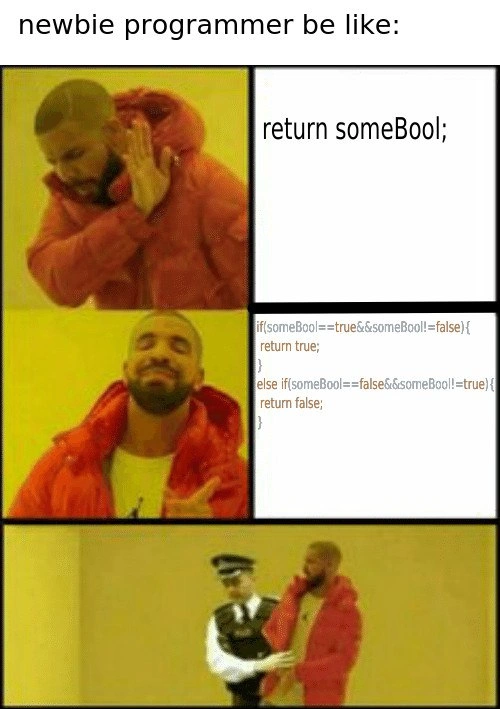
A three-panel meme captioned 'newbie programmer be like:'. The first two panels use the 'Drake Hotline Bling' format. In the top panel, Drake looks away in disapproval from a simple, clean line of code: 'return someBool;'. In the middle panel, Drake smiles approvingly at a much more verbose and convoluted block of code that accomplishes the exact same thing: 'if(someBool==true&&someBool!=false){ return true; } else if(someBool==false&&someBool!=true){ return false; }'. The third panel, the punchline, shows Drake being escorted away by a police officer, implying that writing such unnecessarily complex code is a criminal offense against programming principles. The meme satirizes a common mistake made by beginner programmers who haven't yet grasped concise boolean logic, often explicitly checking for true/false conditions when the variable itself is already a boolean. For senior developers, this is a painfully familiar anti-pattern seen in code reviews, and the final panel is a humorous exaggeration of their desire for code quality enforcement



Comments
7Comment deleted
This is why the 'git blame' command exists. It's not for attribution, it's for building the case for the prosecution
The junior’s PR turned “return flag;” into a 12-line if/else because “defensive coding.” I told him the only thing that code defends against is the CPU’s branch predictor having a quiet evening
This is the same code pattern I've seen in production after a 6-month enterprise consulting engagement that billed $2M to "ensure robust boolean validation across all service boundaries."
Ah yes, the classic junior move: checking if a boolean is simultaneously true AND false - Schrödinger's variable, where the code exists in a superposition of 'will never execute' and 'why did this pass code review?' The real kicker is that even if you removed the impossible logic, you'd still be left with 'if(someBool==true) return true; else return false;' - which is just 'return someBool;' with extra steps and a desperate cry for mentorship
Turning “return b;” into “if (b == true && b != false) …” is SAT-solver cosplay - leave three-valued logic to the legacy DB; in a language with booleans, just return the bit
If your boolean needs both == true and != false, you’re auditioning for a SAT solver - return someBool and let the linter retire in peace
Because trusting a boolean's self-awareness is for senior devs; newbies need if-else therapy to confirm true isn't lying