The Programmer's Endless Dunning-Kruger Cycle
Why is this Learning meme funny?
Level 1: The Learning Rollercoaster
Learning something new can feel like a rollercoaster ride with big ups and downs. Imagine a kid learning to ride a bike. At first, they pedal a short distance and feel super proud – they might think, “Wow, I’m really good at this!” (that’s the big confidence high). But then they try to go faster or turn, and suddenly they wobble and crash. Now they feel upset and unsure, thinking “Oh no, I’m never going to get this right” – that’s the low point when confidence drops. After a bit of practice with some help, they start to get the hang of it and feel better again, slowly gaining real skill. But later on, if they try a new trick or a bigger bike, they might struggle and feel shaky all over again until they learn that too. In simple terms: learning anything new – like coding – has moments when you feel on top of the world and moments when you feel completely lost. Those happy “I’ve got it!” moments are the peaks, and the “This is so hard, I give up…” moments are the valleys. It’s normal to have both. The meme is joking that being a programmer means riding this up-and-down learning rollercoaster again and again, every time you tackle something new. The funny part is recognizing that everyone goes through these ups and downs – you race up with confidence, then tumble down with doubt, but if you hang on, you’ll climb up again as you learn more. It’s a normal (and even funny) part of getting better at things.
Level 2: Learning Curve Loops
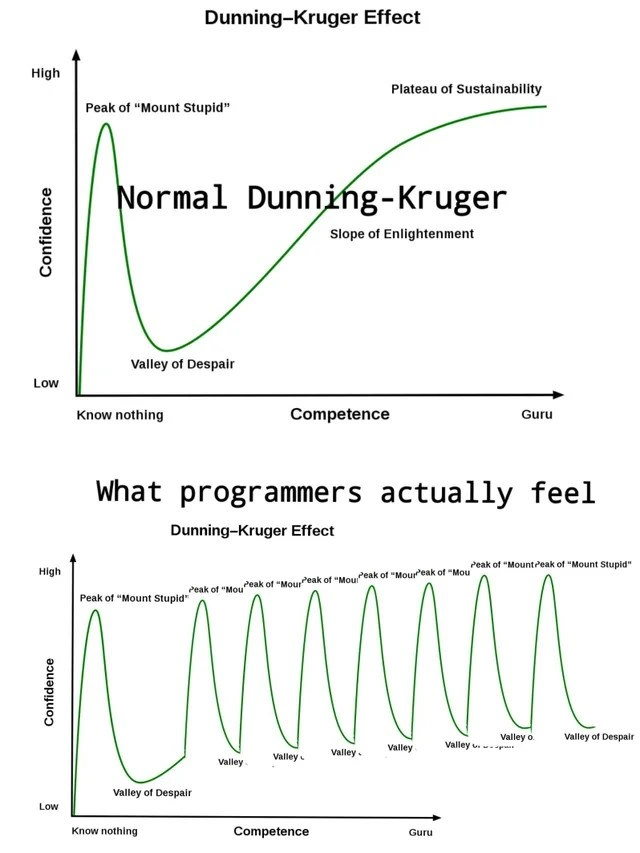
Let’s break down what the chart means for a newer developer. The Dunning–Kruger effect is a psychology concept describing how beginners can feel very confident because they don’t yet realize what they don’t know. Imagine a graph with Competence (actual skill/knowledge) on the X-axis and Confidence (how sure you feel about your skill) on the Y-axis. In the “Normal Dunning–Kruger” top diagram, as a person learns a bit (moving right on competence), their confidence shoots way up — that peak is jokingly labeled the “Mount Stupid”. It’s the stage when you’ve learned just enough to think “Hey, I’m pretty good at this!” but in reality your understanding is still shallow. Then, as you gain a little more experience, you suddenly become aware of how much you don’t know. Your confidence can collapse into the “Valley of Despair”, where you might think “I’ll never understand this, I must be terrible.” From that low point, if you keep learning and practicing, your confidence slowly rises again (this is the Slope of Enlightenment) as you become truly competent. Eventually you reach a more stable, realistic confidence in your ability — a “Plateau of Sustainability” — where you know enough to be effective but also understand the limits of your knowledge (the guru level where confidence and competence finally align more fully).
Now, the bottom part of the meme says “What programmers actually feel” and shows multiple peaks and valleys repeating. This suggests that in software development, we experience this cycle repeatedly, not just once. Why would that be? Because in tech you’re always learning new things. You might go through a Dunning–Kruger mini-curve every time you:
- pick up a new programming language,
- start a fresh project,
- adopt a fancy framework or tool, or
- tackle a tricky feature you haven’t built before.
For example, say you just learned the basics of Python. You write a simple game and it works – woohoo! You feel on top of the world (first Mount Stupid peak: “Programming is easy, I’m a natural.”). Next, you join a project or try to add a complex feature and nothing works, errors everywhere. Suddenly you realize coding is much harder than your small examples – this crash of confidence is the Valley of Despair: “I’m completely lost, maybe I’m not cut out for this.” But you don’t stop there. You debug, Google errors, ask a question on Stack Overflow, and gradually things start to make sense. Your confidence rises as you gain real understanding (climbing that slope). You fix the bugs and the app runs smoothly – now you’re feeling good and learning a lot. That’s closer to genuine competence. However, just when you think you’ve mastered Python, your job asks you to optimize performance or use a new library you’ve never heard of. Suddenly you’re a “newbie” again at that specific task, and guess what? You might hit another mini-peak of overconfidence (“How hard could this be? I’ve coded plenty!”), followed by another crash when reality sets in (“Oh no, I have no idea how to do this efficiently…”). And so on. This is the loop of the learning curve in real life – a series of ups and downs rather than one smooth climb.
Many developers also talk about imposter syndrome, which ties in here. Imposter syndrome is that anxious feeling that you’re not actually competent, that you’re “faking it” and will be exposed as a fraud. In the chart, those repeated valleys label the times programmers doubt themselves and feel like imposters even if they’ve actually gotten better. It’s common in tech because no matter how much you know, there’s always more to learn — someone else always seems to know more, or there’s a new update that makes you feel behind again. This meme reflects that DeveloperReality: one moment you’re confident in your code, the next moment you see something that completely baffles you and your confidence plummets. Developer humor often exaggerates this to say, “Hey, if you feel like you’re constantly oscillating between ‘I rock!’ and ‘I know nothing.’, you’re not alone – that’s what being a programmer is actually like.” It’s both funny and a bit comforting, showing that feeling confused or frustrated at times is a normal part of the developer experience.
Level 3: Recursion on Mount Stupid
In theory, the Dunning–Kruger effect is depicted as a single journey: you start at “Know nothing,” quickly ascend to the infamous Peak of "Mount Stupid" (overconfidence when you’ve learned just a little), plunge into the Valley of Despair (when reality sets in about how much you don’t know), then slowly climb the Slope of Enlightenment toward a Plateau of Sustainability as true competence grows. That’s the classic textbook curve. But in real software development, this confidence-vs-competence journey isn’t a one-and-done trip – it’s an iterative loop. The meme’s bottom graph (labeled “What programmers actually feel”) shows a jagged waveform of repeated peaks and valleys. Every spike is another Mount Stupid moment and every dip another despairing trough. Why? Because each new language, framework, or project is like hitting the restart button on the learning curve. Programmers don’t just go through Dunning–Kruger once; we relive it over and over with each new challenge.
This endless cycle resonates with developers because it satirizes our perpetual imposter syndrome and the rollercoaster of shipping code. One day you’re riding high after a successful build deploy — you’ve refactored a gnarly module and think, “I’m basically a guru now.” That’s the peak talking. The next day, an unforgiving production bug or a baffling code review slams you down into the valley, muttering “I have no idea what I’m doing…” 😅. The humor here is equal parts catharsis and cautionary tale: overconfidence in programming often precedes a fall. Seasoned engineers recognize this pattern. It’s funny because it’s true — we’ve all seen a junior dev swagger in after a tutorial, only to panic when faced with a real codebase. Heck, even veterans aren’t immune: learn a hot new JavaScript framework over the weekend, feel on top of the world Monday (another Mount Stupid!), then spend Tuesday combing through cryptic error logs and doubting your career choices (Valley 😖).
This meme cleverly exaggerates that oscillating emotional state. The “Normal Dunning–Kruger” curve implies a eventual stable Plateau (as if one day you’ll feel consistently confident). But modern development is too fast-paced for that cozy ending — there’s always a new tool, a new domain, or an update that upends your understanding. The “plateau” keeps getting pushed out of reach. Instead, what we get is a repeating sine wave of confidence: a series of boom-and-bust cycles in our self-assessment. It highlights a key truth in the DeveloperExperience_DX: feeling like a genius one moment and an idiot the next isn’t a sign of failure, it’s just part of the job. In fact, many of us eventually find humor (or at least weary acceptance) in this pattern. After enough cycles, you start to see the Valley of Despair not as a dead-end, but as a familiar pit stop on the way to real insight. As the joke goes, “guru status is just a temporary state before the next Know nothing moment.” The meme lands because it transforms a psychological concept into a developer inside joke: progress in tech isn’t a smooth climb, it’s a wild zigzag where confidence often lags behind competence, and humility is gained the hard way, one faceplant at a time.
Description
A two-panel meme comparing the standard Dunning-Kruger effect to the programmer's experience. The top panel, labeled 'Normal Dunning-Kruger', shows a graph of Confidence versus Competence. The line graph starts at low competence and low confidence, shoots up to a 'Peak of "Mount Stupid"', plummets into the 'Valley of Despair', and then gradually climbs up the 'Slope of Enlightenment' towards a 'Plateau of Sustainability' at the 'Guru' level of competence. The bottom panel, titled 'What programmers actually feel', shows a modified version of this graph. Instead of a single curve, it depicts a repeating series of smaller Dunning-Kruger cycles. As competence increases, the programmer repeatedly hits a new 'Peak of "Mount Stupid"' only to fall into another 'Valley of Despair'. The technical context is a commentary on the nature of a software engineering career. The field evolves so rapidly that with each new technology, framework, or programming language a developer learns, they essentially restart the Dunning-Kruger cycle. This creates a perpetual loop of gaining confidence and then feeling like a beginner again, which is a core reason for the prevalence of imposter syndrome in the tech industry, even among highly experienced professionals

Comments
7Comment deleted
A programmer's career is just a series of sprints, each one beginning on the peak of Mount Stupid and ending in the valley of 'why did I choose this profession?'
Developers don’t just climb Mount Stupid - we containerize it, auto-scale it to ten replicas, and wake up in a fresh Valley of Despair every time the health check flips red
The only difference between a junior and senior developer is that seniors have learned to schedule their existential crises between sprint planning meetings
After 20 years in the industry, I've learned that the Dunning-Kruger curve isn't a journey - it's a subscription service. Every new framework, language paradigm shift, or architectural pattern resets you back to Mount Stupid, and the Valley of Despair has better Wi-Fi than my office. The real 'Plateau of Sustainability' is just accepting that you'll oscillate between 'I'm a genius' at 2 AM when your hack works and 'I should have been a carpenter' at 2 PM during code review. The senior engineers who claim they've reached guru status? They're just better at hiding which valley they're currently in
Senior dev confidence is just exponential backoff: spike after hello‑world, timeout in prod, then retry when the next framework promises it’s “simple by design.”
The programmer's Dunning-Kruger: Oscillating between 'I got this' and 'Why code at all?' faster than a React re-render on state hell
After two decades, my confidence is a Nyquist-violating Dunning - Kruger square wave: estimate “3 points”, open the monorepo, discover five unowned Kafka topics and a feature-flag maze, CI goes green, canary detonates, repeat