Skip to content
DevMeme
1634 of 7435
Clippy's Revenge on Microsoft's GitHub
Microsoft Post #1828, on Aug 2, 2020 in TG

Clippy's Revenge on Microsoft's GitHub

Why is this Microsoft meme funny?

Level 1: Unwanted Help

Imagine you’re doing a really important school project with your friends, and you’re focused, trying to get it just right. Suddenly, a little cartoon helper pops up on your computer screen – it’s a happy-looking paperclip with big eyes – and it says, “It looks like you’re trying to do your homework. Need some help?” At first, you might giggle because it’s cute and unexpected. But then you remember: this little helper always interrupts at the wrong time and never actually helps much.

In this meme, a programmer is working on sharing some code (kind of like showing your homework to a teacher for checking). That paperclip character (named Clippy) suddenly appears, offering help. The funny part is that the programmer didn’t ask for help, and this paperclip has a history of being more annoying than useful. It’s like when you’re building a LEGO tower and a well-meaning younger sibling keeps grabbing blocks to “help” but just messes up your progress. You’d probably sigh and say, “No thanks, I got this.”

So, the picture is making people laugh because it mixes something old and goofy (the cartoon paperclip who always butts in) with something new and serious (programmers sharing and reviewing code online). The feeling it creates is, “Aww, not this guy again!” – a mix of surprise, a little frustration, but in a silly way. Even if you’ve never coded, you know what it’s like when someone or something tries to “help” you when you really don’t want it. This meme is basically that feeling, shown with a friendly but pesky paperclip popping up at the worst time. It’s funny and a little absurd, like a clumsy helper showing up in the middle of a big kid’s job.

Level 2: GitHub Meets Clippy

This meme is a mash-up bringing together GitHub’s pull request page and Clippy, the cartoon paperclip from old Microsoft Office. To a newer developer, let’s break down why that’s funny:

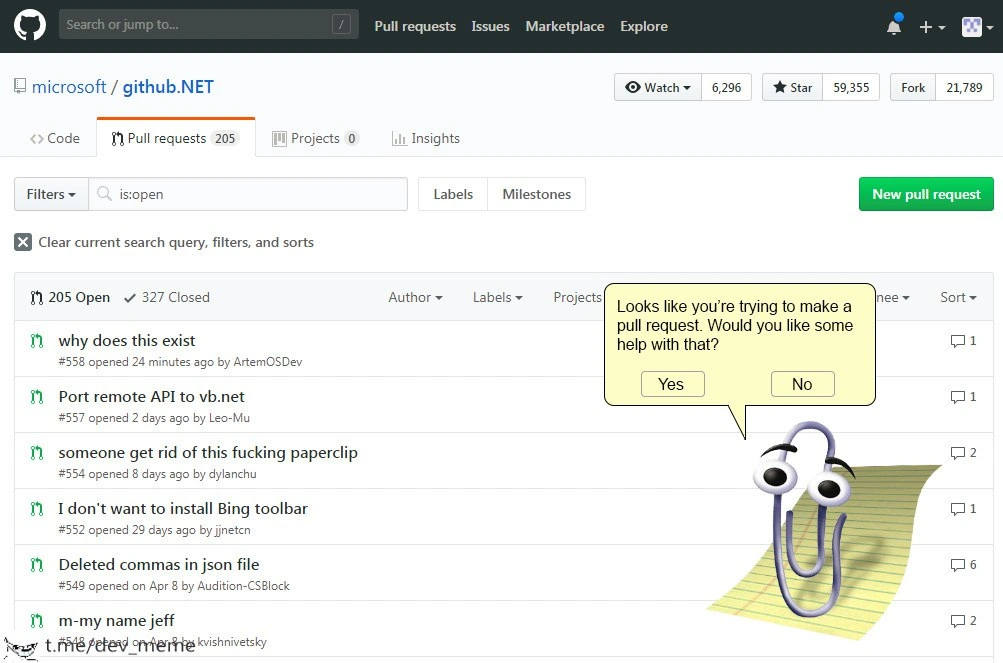
GitHub Pull Requests: GitHub is a platform for hosting code using the Git version control system. A pull request (PR) is how developers propose changes to a codebase. You push some commits to a branch and then open a PR so that others (usually your team or project maintainers) can review your code, discuss it, and eventually merge it into the main project. It’s essentially a formal request: “Please pull my changes into the project.” The screenshot in the meme shows the Pull Requests tab of a repository named microsoft/github.NET, with 205 open PRs (which is a lot!). Usually, each PR has a title describing the change. In real life, titles are things like “Fix null pointer exception in UserService” or “Add Spanish translation to README”. But here, the titles are absurd and humorous on purpose.

Clippy (Microsoft Office Assistant): If you’ve never met Clippy, he was a virtual assistant in Microsoft Office around 1997–2003. He’s a smiling paperclip with googly eyes who would pop up in your document with a speech bubble saying things like, “It looks like you’re writing a letter. Need help?” Clippy’s goal was to help users by offering tips and shortcuts, but he became famous for being more annoying than helpful. Imagine typing away, and suddenly a little cartoon character appears, suggesting something obvious or irrelevant – that was Clippy. Many users (especially power-users like developers) quickly disabled him. Clippy has since become a bit of a joke and a nostalgic symbol of clunky Microsoft user design from that era.

Now, combine these two worlds: GitHub’s modern code review workflow and Clippy’s old-school pop-up style. Normally, when you create a PR on GitHub, the interface is pretty straightforward – you fill in a title, maybe a description of your changes, and then other developers can comment with feedback. There’s no cartoon assistant in the corner. So seeing Clippy in the GitHub UI is immediately odd and funny. The speech bubble in the meme says: “Looks like you’re trying to make a pull request. Would you like some help with that?” That’s a parody of Clippy’s classic line. The humor comes from the idea of an intrusive_helper butting into a developer’s workflow. Developers usually prefer tools that stay out of the way unless needed. The thought of a cheery cartoon interrupting a serious code review is both silly and horrifying (in a funny way).

Let’s decode those humorous PR titles in the screenshot, since they’re full of in-jokes:

  • “why does this exist” – This sounds like a frustrated developer stumbling on some weird code or feature and literally questioning its purpose. As a PR title, it’s not helpful or descriptive (normally, you’d never title a PR this way), which makes it funny. It’s poking fun at how baffled a dev would be to find Clippy-related code in a GitHub project.
  • “Port remote API to vb.net” – “Port” means to adapt software so it works in a different environment or language. VB.NET (Visual Basic .NET) is one of the .NET framework’s languages. It was popular in the early 2000s but today most new .NET code is written in C#. Suggesting to port something to VB.NET in 2020 is a bit like saying “Let’s redo this modern app in an older style for no reason.” It’s a humorous nod to outdated technology. Maybe Clippy only speaks VB? 😛 For context, .NET can use multiple languages, and VB.NET is fully capable, but it’s seen as old-fashioned by many in the industry now. So this PR title is absurd – why would you port a remote API (some server code, probably) to VB.NET unless you’re living in the past? It exaggerates the “Microsoft nostalgia” theme, since VB was a Microsoft staple.
  • “someone get rid of this fucking paperclip” – Pardon the language, but this is exactly how a lot of people feel about Clippy! The title is basically “Can someone please remove Clippy from this project?” In the meme’s story, it implies a developer actually took the time to create a pull request whose sole purpose is to eliminate Clippy. It’s comedic because it’s so blunt and unprofessional for a PR title (dropping an F-bomb) – it reads like the person was at wit’s end. It also mirrors what many of us did years ago: digging through settings or registry hacks to banish Clippy from our PCs. In an open source project, a PR with a title like that would be eyebrow-raising (to say the least!), but here it conveys how universally unwanted Clippy’s “help” is among developers.
  • “I don't want to install Bing toolbar” – This references the old practice where some installers (even non-Microsoft ones) would try to sneak in the Bing search toolbar for your web browser. It became a running joke among tech folks that every Microsoft product would ask you to install Bing or set Bing as your default search. In context, maybe our hypothetical GitHub assistant Clippy said, “To continue with your pull request, please install the Bing toolbar!” 😂 This PR title suggests a dev trying to remove or protest that requirement. It’s poking fun at Microsoft’s habit of bundling unrelated add-ons. For developers, being asked to install a browser toolbar – especially Bing, which many devs don’t use – would be aggravating. So it’s another layer of exaggerated humor: Clippy’s “help” comes with baggage.
  • “Deleted commas in json file” – JSON stands for JavaScript Object Notation, a common format for configuration and data files. In JSON, items are separated by commas. Removing commas from a JSON file would actually break the format (the JSON would be invalid and any program trying to read it would error out). A pull request with this title sounds like someone made a very trivial or misguided change. It’s funny because every developer learns quickly that missing or extra commas in JSON can cause everything to crash. We’ve all run into that error at least once. So a PR bragging “I deleted some commas in a JSON” is like saying “I introduced a bug” in a proud way. It mocks novice contributions or automated PRs that don’t really improve anything (sometimes you see PRs that just tweak formatting or whitespace – zero actual benefit). Maybe Clippy auto-“fixed” the JSON and caused trouble, so now there’s a PR to revert that. It’s a playful jab at how automated helpers might do dumb things.
  • “m-my name jeff” – This one is purely a reference to a popular meme (from the movie 22 Jump Street, a character awkwardly says “My name Jeff”). It doesn’t relate to coding at all. By including this as a PR title, the meme is just layering on random internet humor. It signals that not all those 205 PRs are serious – some are trolls or jokes. On real GitHub projects, maintainers occasionally get bizarre PRs (like someone doing something silly or posting a meme in the code). Here it amplifies the absurdity: the repository is now half serious, half jokester central, likely thanks to Clippy-chaos. It’s also the kind of nonsensical thing Clippy might not know how to handle at all (“Uh, who is Jeff and why is he in the code?”).

All these elements tie into common developer culture experiences. CodeReviews are usually a strict, serious business – you follow guidelines, you use polite language when asking for changes, etc. The meme turns that on its head: developers are dropping formalities and just venting (“why does this exist” “get rid of this !@$% paperclip”). It’s funny because you normally never see that on a professional repository, but boy can we relate to the feeling! Every dev has encountered some piece of legacy code or annoying tool and thought, “Whose idea was this? Please, no more!” – even if they wouldn’t actually write that in a work setting. So the meme lets us laugh at what usually stays unspoken.

Also, consider developer experience (DX). That term refers to making tools and environments pleasant for developers. Clippy is almost a case study in bad DX for a lot of people. He was distracting, often not context-aware enough for complex tasks, and you didn’t have a smooth way to control when he appeared. Modern developer tools (like GitHub, VS Code, etc.) try to be the opposite – they aim to be minimal, only assisting when asked (like pressing a shortcut for IntelliSense autocompletion). So putting Clippy into GitHub exaggerates a worst-case scenario for DX: a helper that interrupts your flow, suggests irrelevant things, and even tries to rope in other unwanted software (like that Bing toolbar). It highlights why devs value unobtrusive design.

It’s worth noting the meme image is a fictional scenario – GitHub does not actually have Clippy built-in (thank goodness 😅). The image has been edited to add Clippy to the corner. The repository “microsoft/github.NET” and those PR titles are made up for comedic effect. But it resonates because Microsoft could theoretically do something wild like that (they probably wouldn’t, but our imagination runs). The joke lands especially well in 2020 because Microsoft had just been owning GitHub for a couple of years, and developers were joking: “What Microsofty things might they add? Please not Clippy!” It’s a playful way to poke at that underlying concern in a lighthearted manner.

Lastly, the meme references are all about Microsoft’s influence: Microsoft Clippy being injected into GitHub (which they own), references to a Microsoft language (VB.NET), a Microsoft search engine (Bing), and a general "this thing is old and in the way" vibe. So if you know those contexts, it’s a rich stew of VersionControlHumor and office_assistant_nostalgia. If you didn’t know: VB.NET is a programming language from Microsoft’s .NET framework, successor to old Visual Basic. Bing toolbar was a browser add-on pushed by Microsoft to promote Bing search. JSON is a data format common in web development (and removing commas from JSON is a no-no). And of course Clippy is that pesky paperclip – he even had a real name: Clippit. All these help make sense of the joke.

In short, for a junior dev: this meme is funny because it imagines an out-of-date, bothersome cartoon assistant (Clippy) popping up in a serious modern coding context (a GitHub pull request). Developers are reacting with a mix of nostalgia (“Oh wow, Clippy? Haven’t seen you since childhood!”) and horror (“Please go away, you’re not going to help me merge code!”). It’s the clash of past vs present and useful vs annoying. Code review is hard enough without a googly-eyed paperclip trying to get involved!

Level 3: Paperclip PR Invasion

Ah, Clippy – the infamous Microsoft Office assistant – has somehow crash-landed into our GitHub pull request workflow. For seasoned developers who survived Clippy’s heyday, this mash-up is hilariously horrifying. The meme shows the GitHub Pull Requests page for a repository named microsoft/github.NET (a cheeky nod to Microsoft owning GitHub and potentially rewriting it in .NET). Front and center is that googly-eyed paperclip on a yellow notepad, chirping:

Clippy: “Looks like you’re trying to make a pull request. Would you like some help with that?”

This instantly triggers flashbacks. In the late 90s and early 2000s, Clippy would pop up in Microsoft Office with “It looks like you’re writing a letter…” just as you were in the zone, promptly derailing your train of thought. Developers and users alike learned to dread that cheerful interjection. Now imagine, decades later, you’re deep in code review mode on GitHub and – boop! – Clippy reappears, offering to “help” with your code review. It’s the stuff of comedic nightmares: an intrusive_helper from the past invading a modern dev workflow.

The humor works on multiple levels of nostalgia and shared developer trauma. Microsoft has a reputation for bundling “helpful” extras that nobody asked for – Clippy being the prime example, and the "Bing toolbar" not far behind. This meme riffs on that history. Microsoft famously acquired GitHub in 2018, so the joke is that some overly nostalgic program manager at Redmond went wild: “Hey, let’s integrate Clippy into GitHub!” Cue collective groans (and giggles) from developers. The screenshot’s repository name and open PR titles play out the absurd scenario:

  • “why does this exist” – A PR title echoing every baffled developer’s response to unwanted features. It’s the maintainer’s existential dread: Why on earth would someone add Clippy to a code platform? This title perfectly captures the head-shaking disbelief of the team discovering Clippy stowaway in their codebase.
  • “Port remote API to vb.net” – A tongue-in-cheek suggestion to use Visual Basic .NET, a language largely considered legacy in serious modern back-end development. It pokes fun at misguided contributions: “Sure, let’s rewrite modern GitHub functionalities in outdated VB.NET just because!” The senior dev eye-roll here is hard to miss – it’s like someone suggesting to rewrite a high-performance service in COBOL for kicks.
  • “someone get rid of this fucking paperclip” – Here’s the raw frustration. The profanity-laced plea is a hilarious breaking point for the dev team. A contributor has literally opened a Pull Request to remove Clippy from the project, titled with the exact words everyone’s thinking. This is comedy gold for any veteran who remembers trying to disable Clippy in Office: we did get rid of that paperclip 20 years ago, and now we have to do it again? It’s as if a developer saw Clippy’s code in the repository and immediately went into emergency purge mode.
  • “I don’t want to install Bing toolbar” – Another jab at Microsoft’s old habits. Back in the day, installing some Microsoft apps (or even Java and Flash updates) often came with a sneaky checkbox: “Also install the Bing search toolbar.” Developers grew to hate these bundles. In this fictional GitHub scenario, perhaps Clippy’s “help” might come with the requirement to install a Bing extension (because why not!). The PR title implies a dev furiously refactoring out some forced Bing integration. It’s the team begging, “Please, no more unwanted add-ons in our workflow!”
  • “Deleted commas in json file” – This PR sounds innocuous but is actually darkly funny. Removing commas from a JSON file would break the JSON syntax entirely. It parodies trivial or nonsensical contributions – maybe an overeager newbie or a rogue automated tool “fixing” things that shouldn’t be fixed. It’s a subtle nod to how some pull requests make things worse (like an overzealous assistant might). In a Clippy-takeover scenario, you can imagine Clippy recommending, “I noticed some extra commas in your config, I removed them for you!” – and promptly breaking the build. Classic.
  • “m-my name jeff” – A completely random meme reference (from a popular movie gag), thrown in to emphasize the absurdity of the PR list. It has nothing to do with code. It suggests that amid the chaos of Clippy’s return, even internet meme nonsense is seeping into the pull requests. Perhaps a contributor (or Clippy itself) is just spouting off-topic humor at this point. It underscores the DeveloperHumor vibe – sometimes PRs in big repos feel this random if you’re not in the loop.

All these PR titles combined paint a picture of a repository in playful disarray, thanks to Clippy’s unwanted “assistance”. Pull-request culture usually values professional, descriptive commit messages and titles. Seeing exasperated phrases like “why does this exist” or profanity in a PR title is jarringly funny – it breaks the usual decorum, highlighting how code review pain points can push even the calmest dev to tongue-in-cheek despair.

From an experienced engineer’s perspective, this meme also satirizes the gap between developer experience (DX) ideals and reality. In theory, tools and assistants are supposed to improve workflow. In reality, a badly implemented assistant creates more work: more PRs to remove its nonsense, more useless notifications, more clutter – exactly what Clippy did in Office. The shared trauma is real: many of us spent the early 2000s hunting through Word’s settings to disable Clippy permanently. Seeing Clippy again, looming over our code, we can’t help but laugh and shudder. It’s like a bad penny (or paperclip) turning up again.

There’s also a knowing wink at open source project maintenance buried here. The page shows 205 Open pull requests – imagine being a maintainer with 205 pending PRs! It’s overwhelming. Now toss Clippy into the mix, “helpfully” prompting every time you open a PR. A senior dev knows that managing a busy repo’s PR queue is already a Herculean task. The last thing you’d want is a cloying assistant interrupting your triage flow with obvious tips (“It looks like this PR adds a feature. Make sure to review it!” – Gee, thanks Clippy…). The humor lands because we know how counterproductive such a feature would be in practice. It’s satire on DeveloperExperience_DX misfires: sometimes companies add flashy assistants or bots, thinking they’ll streamline things, but they end up spouting useless info or nagging everyone.

And let’s not ignore the office_assistant_nostalgia factor. Clippy is a cultural icon in tech – beloved by some for the memes, despised by most who actually used him. He represents a bygone era of user interfaces. Merging that with GitHub, a modern development platform, is inherently funny because it’s so out-of-place. It’s like seeing a floppy disk popup asking if you want to save your cloud project – a temporal collision that tickles our sense of irony. The meme’s author even gave Clippy the classic speech bubble with “Yes” and “No” buttons, pixel-perfect to the late-90s design. As experienced devs, we catch all those details and chuckle: we’ve gone from Clippy to pull requests, from VB to modern C#, from on-prem Office to cloud-based collaboration, yet here comes that darn paperclip again as if nothing’s changed.

In summary, at the senior level this meme is poking fun at Microsoft’s past DeveloperExperience blunders (Clippy, Bing toolbars, VB.net legacy, etc.) colliding with present-day developer workflows (VersionControl on GitHub, CodeReviews via PRs). It highlights the kind of inside joke only people who’ve been around the tech block would fully appreciate. We laugh (and maybe cringe) because we collectively remember how annoying Clippy was, and we’re so glad he’s not actually part of our GitHub process – seeing him there, even in jest, reminds us how precious our distraction-free coding time really is. It’s a senior dev’s nightmare wrapped in a nostalgia blanket and served as comedy. The only sane reaction to Clippy’s “Would you like some help?” in the middle of a code review is a resounding “No” – probably clicked with the same reflexive irritation we had 20 years ago. The paperclip might have big googly eyes, but we’ve seen through its helpful act before. 😂

Description

A screenshot of the 'Pull requests' page for the 'microsoft/github.NET' repository on GitHub. The page shows a list of open pull requests with humorous and chaotic titles such as 'why does this exist', 'Port remote API to vb.net', 'someone get rid of this fucking paperclip', and 'I don't want to install Bing toolbar'. Superimposed over the right side of the screen is Clippy, the infamous animated paperclip assistant from older versions of Microsoft Office. Clippy is sitting on a piece of yellow lined paper and, in a speech bubble, says, 'Looks like you're trying to make a pull request. Would you like some help with that?', with 'Yes' and 'No' buttons below the text. This meme humorously merges two distinct eras of Microsoft: the often-annoying user-assistance of the past (Clippy) with the modern developer-focused platform of GitHub. The joke lands with senior developers who have a nostalgic, if painful, memory of Clippy's interruptions and can imagine the absurdity of such an assistant in a professional coding environment. The chaotic PR titles further satirize the nature of open-source contributions on popular repositories
Comments

7
Anonymous ★ Top Pick Microsoft finally found a use for Clippy's source code: training the GitHub Copilot to suggest the most unhelpful and distracting code completions possible
  1. Anonymous ★ Top Pick

    Microsoft finally found a use for Clippy's source code: training the GitHub Copilot to suggest the most unhelpful and distracting code completions possible

  2. Anonymous

    “Sure, Clippy, I’d love help with my pull request - just squash 205 stale branches, resolve the time-traveling merge conflicts, and explain to the CTO why we’re suddenly porting everything to VB.NET.”

  3. Anonymous

    After 25 years in the industry, you realize the real legacy code isn't COBOL or FORTRAN - it's the psychological trauma from Clippy that still makes senior engineers instinctively close any UI element that bounces, wiggles, or offers unsolicited help

  4. Anonymous

    Ah yes, Clippy's return to haunt us in the one place we thought we were safe - our pull requests. The irony is that one of the visible PRs is literally titled 'someone get rid of this fucking paperclip,' which is either the most meta bug report ever filed or proof that even in 2024, we still can't escape Microsoft's most persistent legacy feature. At least this time he's asking permission before force-installing Bing toolbar through your CI/CD pipeline

  5. Anonymous

    Clippy in dotnet/runtime PRs: the legacy assistant that's harder to kill than your most entrenched COBOL monolith

  6. Anonymous

    GitHub Clippy: “Looks like you’re opening a PR - want me to auto-insert the 300‑line enterprise template, tag six CODEOWNERS, fail CI on a missing JSON comma, and schedule the CAB for next month?”

  7. Anonymous

    Clippy as CODEOWNER: looks like you’re making a pull request - I’ve auto‑requested eight reviewers, blocked merge until 27 checks pass, and scheduled your rebase after main’s daily force‑push; press Yes to open three more compliance forms

Use J and K for navigation