Tiny Black Kitten Wearing Business Tie Ready for First Day at the Office
Why is this CorporateCulture meme funny?
Level 1: Burnt Toast Again
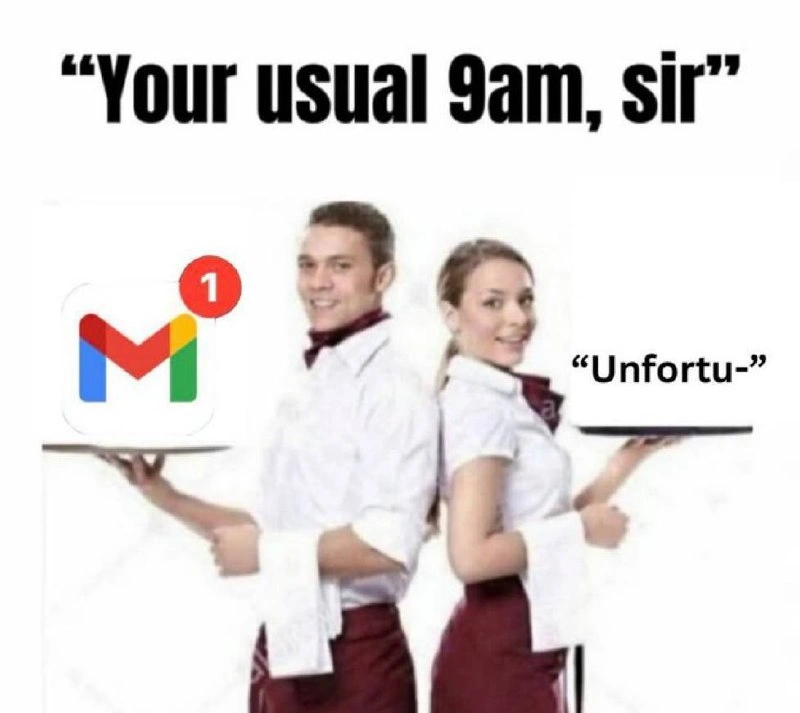
Imagine every morning you sit down for breakfast, and a waiter brings you a piece of toast. But every single day the toast is completely burnt. The waiter smiles politely and says, “Unfortunately, your toast is burnt again.” You’d probably sigh and think, “Not again….” It’s kind of funny in a sad way, because you expect it now — burnt toast has become your weird daily tradition. In this meme, the developer’s “breakfast” is a bad-news email at 9 AM. The fancy waiter is like the email notification, very politely delivering the same awful surprise each day. Even though it’s presented nicely (with a polite greeting and all), it’s still the same disappointment every time. The humor comes from how getting bad news over and over can start to feel oddly routine, just like that daily burnt toast.
Level 2: 9AM Inbox Surprise
Production: In tech, “production” means the live environment where real users interact with the software — basically, the real-world app or website that’s in use. If you have a personal website or a favorite game, the version everyone can access is the production version. A production issue refers to something going wrong in that live environment. For example, if an online store’s website crashes and shoppers can’t buy things, that’s a production issue. It’s the kind of problem that companies take very seriously because it affects actual customers.
On-call duty: Many software teams rotate an on-call schedule, meaning one team member is designated to respond to any urgent problems 24/7 during their shift. Think of it like a firefighter on duty, but for software. If a server crashes or a critical bug happens at 3 AM, the on-call engineer’s phone will ring (via an alert app, a text, or an alarm). It’s their job to wake up, jump on the issue, and try to fix it ASAP. The idea is that someone is always watching the fort, even at odd hours. Being on-call can be stressful – you never know when you’ll be called into action – which is why getting an alert or email first thing in the morning can make your stomach drop.
Incident email: When something bad happens in production (often called an “incident” or an “outage”), there’s usually a follow-up incident report to explain it. This often comes as an email to the team or even to users, summarizing what went wrong and what’s being done about it. A lot of these emails start with a sorry tone, like: “Unfortunately, we experienced an issue…”. It’s a polite, professional way to break the bad news. For example, an incident email might say, “Unfortunately, our service was down from 1:00 AM to 1:45 AM due to a database error. We have resolved the issue and everything is back online.” Getting this kind of email at 9 AM means you’re starting your day by reading about a problem that happened, which is exactly what the meme is joking about.
Gmail notification badge: The meme shows the Gmail app icon with a red circle and the number 1 in it. That little red circle is a notification badge – it tells you how many unread emails (or messages) you have. So, a "1" means one new email you haven't read yet. Many companies use Gmail (Google’s email service) for work emails, so it’s common for developers to see that badge on their phone or computer. When you’re on-call or just expecting news, seeing a “1” on your email first thing can make you a bit anxious. It often prompts a thought like, “Uh oh, what happened now?” In the context of the meme, that Gmail badge is basically the waiter delivering the news that something happened – it’s the visual cue that an incident email is waiting for you.
Recurring outages & anxiety: If production issues happen frequently, it can turn into a running joke (and a nightmare) on the team. People might say things like “Oh great, our morning outage ritual is right on time,” meaning it’s become a routine to have something broken by morning. This is obviously not a good thing in reality, but developers sometimes joke about it to ease the tension. Over time, constantly worrying about what might break next can lead to a feeling of DevOps anxiety – a kind of background stress that something will go wrong at any moment. “DevOps” is just a term for the combined practice of development and operations, and those folks are responsible for keeping systems running. So DevOps anxiety is that edgy feeling you get when you’re always bracing for the next alert or the next “unfortunately” email. It’s like when you hear a notification ding and your heart skips a beat because you suspect it’s bad news. The meme plays on this by showing the expected bad news arriving like clockwork, which is both funny and a bit too real for anyone who’s been in that situation.
Level 3: Daily Dose of Disaster
The meme serves up a scenario all too familiar in DevOps culture: a polished presentation of an every-morning production meltdown. Two dutiful waiters stand back-to-back like a fancy restaurant ad. One carries a tray with a bright Gmail icon, complete with the little red 1 notification badge for an unread message. The other waiter’s tray is empty but has the cut-off text “Unfortu–” hovering nearby, clearly the beginning of that dreaded word. Above them, the caption reads “Your usual 9am, sir”, as if delivering the same order each day. It’s a perfect storm of irony: a production issue being served with white-glove courtesy. To any seasoned developer or SRE, this image screams one thing: the morning outage email. We instantly recognize that polite but ominous phrasing “Unfortunately, ...” – the email subject no one wants to see, especially not as their wake-up call. By setting it up as a refined ritual, the meme highlights how routine these failures have become. It’s basically saying, “Here we go again, the daily disaster, served right on schedule.”
Why is this funny? Because it’s painfully relatable in a dark-humor way. The formal tone — “Your usual 9am” and the sir — exaggerates the absurdity that critical failures happen so often we treat them like a regular coffee order. It’s like a barista cheerily handing you your "Grande Latte of Outage" every morning. The hyper-politeness (“sir”) is dripping with sarcasm: in reality, nobody feels this gracious about a 9AM incident report. But we’ve all seen those carefully worded emails that try to soften bad news with a courteous tone. The meme visually nails that contrast: an elegant presentation of a mess. It resonates especially with senior engineers who’ve been through the on-call grind for years. After the 50th time stumbling into work to an “Unfortunately...” email, you develop a grim sense of humor about it. The image basically winks at the viewer: “You know this drill, my friend.” The laugh comes from recognizing our own experience in it — the fancy waiter is us, treating catastrophe like clockwork.
This kind of shared trauma bonding is very real in engineering teams. The half-displayed “Unfortu-” alone is enough to give experienced devs flashbacks. We immediately think of the classic opening line in outage notes: “Unfortunately, we experienced an unexpected downtime at 3:27 AM...” etc. It’s practically a template at this point. In fact, many of us have a running joke that we could auto-generate these emails: “Unfortunately, [service] [crashed/is down] due to [XYZ] at [time]. We are looking into it.” The meme gets a chuckle because it’s true — you could fill in those blanks almost every other week (or every day in a bad month). It’s the comedic predictability that hurts so good. The caption calling it “your usual 9am” is so on point: it implies the team has gotten used to this sad routine. Like a weary regular at a café who doesn’t even need to order, the disaster just arrives on cue. One can almost imagine a senior dev rolling their eyes and muttering, “Ah yes, right on time,” when that Gmail ping hits. On-call veterans often joke that if a week goes by without a late-night page or a morning incident email, something feels cosmically off.
The specifics of the image also poke fun at how these situations are handled in corporate life. The Gmail logo is huge and unmistakable – because of course it’s an email, the universal medium for post-mortems and sorry-about-that notes. And that red 1 badge is basically a trigger for DevOps anxiety now. Many of us have a near-Pavlovian response: see a “1” on the email app first thing in the morning, heart skips a beat. Especially if your team uses Gmail or Google Workspace for communication, that little red bubble can be the harbinger of doom. The meme artist intentionally showed only part of the subject line (“Unfortu–”) because every dev fills in the rest automatically. It’s a clever visual trick: our brains complete it to “Unfortunately,...” without needing another letter. In that sense, we’re complicit in the joke — we’ve seen this subject so often, we read it even when it’s not fully there. And let’s be real, no one starts an email with “Unfortunately” if they’re delivering good news. It’s basically corporate for “Brace yourselves, bad stuff happened.”
Now, why do these 9AM horror-grams keep happening? The meme hints at a truth: some systems are so brittle, or some organizations so frenetic, that outages become a regular feature. There’s an industry saying for debugging: “It’s always DNS” (the domain name system) whenever something goes wrong in production. That’s a tongue-in-cheek way of noting how often the root cause is something seemingly fundamental yet overlooked. In the same spirit, one could say “It’s always something” – maybe a database ran out of connections, or a memory leak crashed a service, or last night’s deploy had an undetected bug. In a microservices architecture, a tiny hiccup in one service can cascade into a full-blown incident. Seasoned devs have seen chain reactions like a database lock that caused a backup in message queues that then brought down a web server. So the content of these unfortunate emails is often a grab-bag of familiar failure modes. The humor (tinged with despair) comes from how unsurprising that content tends to be. Seen one, seen ’em all. It’s comedic in the same way gallows humor is – we joke because otherwise we’d cry. A continuous barrage of issues can indicate deeper technical debt or organizational problems, but when you’re in the thick of it, you cope by joking that “downtime is our most reliable feature.”
From a senior perspective, the meme also underscores how important good communication is during on-call chaos. That waiter isn’t just bringing any dish; he’s presenting it properly, announcing it – similarly, teams often follow a ritualized process when an incident occurs. There’s typically a formal incident report email that goes out, often following a template or a policy (to ensure clarity and completeness). It usually does start with a polite apology (“Unfortunately” or “We regret to inform you…”) and includes the timeline of what broke and when it got fixed. This professionalism is crucial in the workplace, but in meme-land it becomes satirical: we’re essentially gift-wrapping our daily failure. The text “Your usual 9am, sir” could be straight out of an IT Ops playbook if they had one for customer service. It’s poking fun at the almost ceremonial way we handle repeated outages. There’s the acknowledged pattern (the usual), the timing (9am sharp, like clockwork), and the courtesy (sir). All of this, contrasted with the frustrating content of that email, creates a rich irony that engineers find both funny and a bit too true. It’s the kind of joke you laugh at while nervously checking your own inbox.
Ultimately, this meme hits on the camaraderie of DeveloperHumor and DeveloperFrustration alike. It says: “We’ve all been here. We all know that sinking feeling. But hey, at least we can serve it with a smile, right?” The title could easily be “Breakfast of Champions – SRE Edition.” It highlights an unhealthy reality (constant issues) through a healthy coping mechanism (humor). When you’re bleary-eyed, starting your day by reading about how your system caught fire overnight, sometimes a little joke like this is the spoonful of sugar that makes the medicine go down. Just don’t be surprised if tomorrow at 9AM, right on cue, you get to live the meme again. 🤖☕ “Your usual outage, sir” – some jokes, unfortunately, write themselves.
Level 4: Murphy's Outage Law
In large-scale tech systems, failure isn’t just possible – it’s practically guaranteed given enough time. This is sometimes humorously referred to as Murphy’s Law applied to computing: Anything that can go wrong will eventually go wrong. Modern applications often consist of many interdependent parts (think dozens of microservices, servers, databases, third-party APIs, etc.). From a probability perspective, if each component is highly reliable (say 99.9% uptime), the chance of none failing in a day dwindles as you add more components. For example, if you have 100 independent services each with 99.9% reliability, the probability that all of them are up on a given day is $(0.999)^{100} \approx 0.90$ (about 90%). That means there's roughly a 10% chance something is wrong on any given day. Over a typical workweek, it's almost certain you'll hit an issue. It’s a case of the Law of Large Numbers biting back: with so many opportunities for failure, daily incidents stop being freak occurrences and become statistically expected. This is why engineers say outages are inevitable in complex systems – the question isn’t if, but when (and apparently “when” is often around 9 AM 😅).
Site Reliability Engineering (SRE) formalizes this reality with concepts like MTBF (Mean Time Between Failures) and error budgets. No system can realistically have 0% failure rate; instead, teams define acceptable downtime and aim to keep failures small and short. An interesting approach in advanced ops is Chaos Engineering – famously, Netflix’s Chaos Monkey will randomly take down servers in production to ensure the system can handle failures gracefully. It might sound counterintuitive to cause incidents on purpose, but it’s built on the same insight this meme darkly jokes about: failures will happen, so you might as well plan for them and even rehearse them. The “unavoidable 9AM Gmail ping” is essentially the unwanted drill we get when something slipped past our defenses. In theoretical terms, the best we can do is design systems to be resilient (so one component failing doesn’t become a full outage) and to respond quickly. Still, as systems grow more complex, a morning incident report sometimes feels as sure as sunrise. The meme nails this truth with a wink – even in the realm of math and systems theory, a little bit of entropy is always on the menu.
Description
A photograph of an adorable tiny black kitten sitting on a desk wearing a miniature striped business tie (dark navy with red and white stripes). The kitten sits between a glass of milk and a closed black notebook with a blue pen. Behind it are small toy cars (pink VW Beetle and a blue car) and a blue bandana. The edge of a laptop is visible in the foreground. The kitten has a grumpy, determined expression as if it's a junior developer arriving at their first day of work, overdressed and slightly intimidated but ready to contribute. No text overlay is present - the humor comes purely from the visual of this impossibly small kitten dressed for a corporate environment
Comments
14Comment deleted
This kitten's commit history is empty but its dress code compliance is at 100% - already more professional than half the senior devs who show up to standups in yesterday's hoodie
It's the most reliable service I've seen. Zero downtime, perfectly scheduled delivery at 9am sharp. If only the company's actual product had this level of uptime and predictability
I keep proposing we replace the daily “Unfortunately, prod is down” email with a scheduled Lambda, but apparently automating despair is still out of scope
After 20 years in tech, I've learned that Gmail's notification badge is just a real-time counter of how many people discovered production issues over the weekend that they're now making your problem
The precision of that 9am Gmail notification is more reliable than our CI/CD pipeline. It's the one daily standup blocker that actually shows up on time - right when you're about to say 'no blockers' for the third day in a row, that notification badge appears like a product manager with 'just one quick question' about last quarter's technical debt
My inbox achieves eventual consistency: at 09:00 the ATS cron writes Unfortunately… with five‑nines availability; offer letters are strictly best‑effort
Daily standups: the one cron job you can't just comment out
Pretty sure there’s a company-wide cron job named send_unfortunately running at 09:00 - idempotent, highly available, and perfectly timed to wreck my flow state
i dont get it Comment deleted
happy person Comment deleted
nah im just dumb Comment deleted
unemployed morning Comment deleted
or a rust dev :D Comment deleted
Did you mean? Comment deleted