
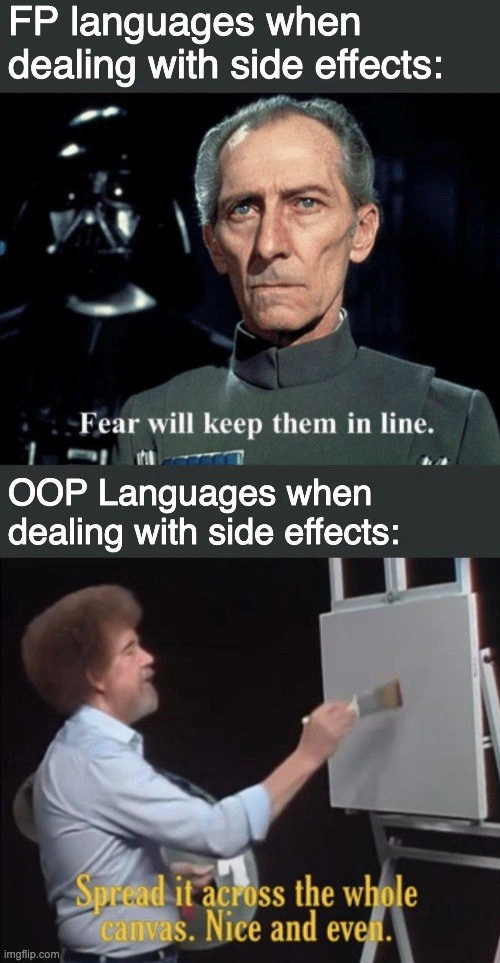
Programming Paradigms on Side Effects: Fear vs. Happy Accidents
Description
A two-panel meme contrasting how Functional Programming (FP) and Object-Oriented Programming (OOP) handle side effects. The top panel, labeled 'FP languages when dealing with side effects:', features a scene from Star Wars with Grand Moff Tarkin saying, 'Fear will keep them in line.' This represents the strict, controlled, and often compiler-enforced discipline FP languages use to manage side effects, treating them as something to be contained. The bottom panel, labeled 'OOP Languages when dealing with side effects:', shows the painter Bob Ross cheerfully in front of a canvas, saying, 'Spread it across the whole canvas. Nice and even.' This humorously depicts the common practice in OOP where mutable state and side effects are often widespread throughout an application's objects, embraced as a natural part of the process, much like Bob Ross's happy little trees

Comments
7Comment deleted
Functional programmers treat side effects like nuclear waste, sealing them in monads. OOP programmers treat them like glitter - a little here, a little there, and soon it's on everything and you'll never get rid of it
Functional devs smuggle side-effects through an IO monad like it’s the Death Star plans; OOP devs just @Autowired them everywhere and call them “happy little services.”
After 15 years of arguing about paradigms, I've realized FP developers spend more time explaining monads than OOP developers spend debugging null pointer exceptions - and somehow both camps think they're winning
This perfectly captures the eternal struggle: FP devs spend three days wrapping side effects in IO monads and effect systems to maintain referential transparency, while OOP devs just mutate that private field and call it encapsulation. Both camps are convinced they're doing it right - one treats side effects like nuclear waste requiring containment protocols, the other treats them like paint on a canvas. The real irony? Both approaches work until you need to debug state mutations at 2 AM, at which point FP devs are grateful for their type system's 'fear,' and OOP devs are wondering which of the 47 objects in the call chain decided to 'spread it across the whole canvas.'
FP: side effects need a type-checked visa and an IO escort; OOP: give them a mutable singleton and a DI paint roller, then rebrand the splatter as “business logic.”
FP quarantines effects at the edges with types; OOP declares a Singleton ‘Utils’ and suddenly every method is a paint roller
FP: Side effects are the dark side. OOP: Side effects are just happy little accidents