Skip to content
DevMeme
1086 of 7435
5 Kilobytes Per Second: An Epic Tale of Lag
Networking Post #1220, on Apr 1, 2020 in TG

5 Kilobytes Per Second: An Epic Tale of Lag

Why is this Networking meme funny?

Level 1: Snail Speed Sadness

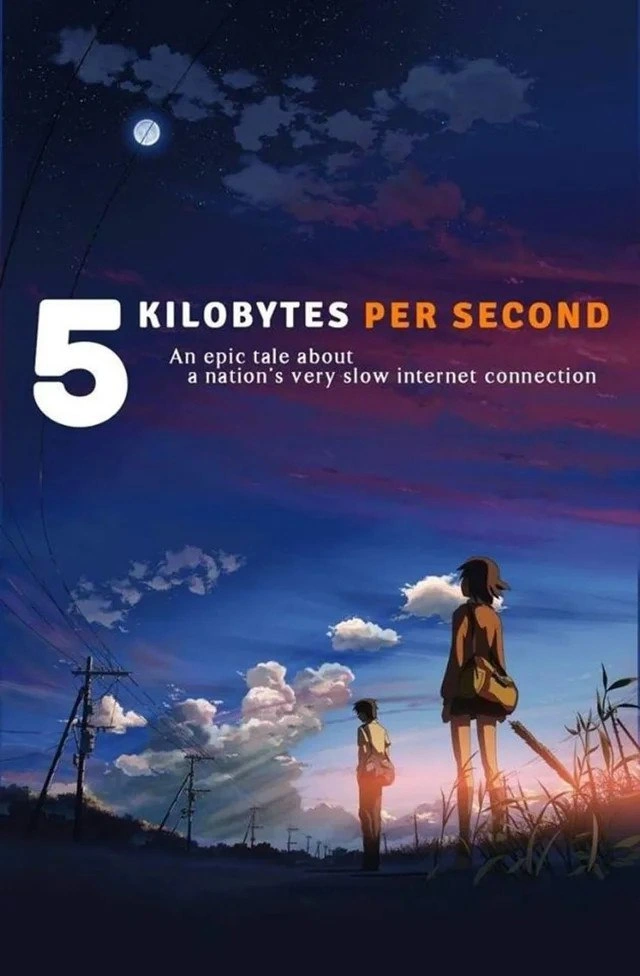
Imagine you’re trying to drink a milkshake through the tiniest straw in the world – you only get a teeny little sip every few seconds. It would take forever to finish the milkshake, and you’d probably feel pretty frustrated, right? That’s what using the internet at 5 kilobytes per second is like. It’s super duper slow, like a snail moving along while everyone else is driving cars. In the picture, they made it look like a sad anime movie poster because it’s kind of funny to exaggerate how sad and dramatic we feel when the internet is crawling. The big number “5 KILOBYTES PER SECOND” is saying “this is ridiculously slow,” and the line about an epic tale of a nation with slow internet is joking that enduring bad internet could be a heroic story. In simple terms: when the internet is that slow, you wait and wait… and wait. Maybe you get upset or sigh like a character in a sad movie. The meme makes us laugh because we’ve all had a moment where something downloaded so slowly that it felt like ages – turning that feeling into an over-the-top cartoon drama just makes the pain amusing. It’s like waiting for paint to dry or grass to grow, and needing a comforting anime scene to get through it. Even if you don’t get the anime reference, you can laugh because, well, waiting forever for the internet is both annoying and a little silly when shown in such a dramatic way.

Level 2: Return to Dial-Up

Let’s break down the meme in simpler terms. 5 kilobytes per second is an extremely slow internet speed by today’s standards. It means you can download only 5 KB of data in one second. To put that in perspective, a single digital photo from your phone might be 2,000 KB (which is 2 MB). At 5 KB/s, that photo would take over 6 and a half minutes to download! 🤯 For something larger, like a 5 MB MP3 song (about 5,000 KB), you’d wait almost 17 minutes. And a standard 700 MB video? Forget it – that could literally take days at this rate. Most home internet connections nowadays are in the megabytes per second (MB/s) range, which is thousands of KB/s. So 5 KB/s is akin to the dial-up modem days from the 1990s, when connecting to the internet often meant slow speeds and a lot of patience (plus that screeching modem sound). In fact, dial-up topped out around 7 KB/s. So this meme’s speed is like traveling back in time to those dial-up days – or being stuck on a very bad, throttled cell network. It’s that slow.

Now, why does this matter to developers? Modern software development relies heavily on the internet. When developers set up a project, they use package managers and tools that download lots of files from the web. For example: if you run npm install to get JavaScript libraries, your computer might need to download tens or hundreds of megabytes of data (all those dependencies in node_modules). If your network speed is only 5 KB/s, downloading even 1 MB (which is 1024 KB) takes over 3 minutes. So tens of MB could take hours or all day. That’s incredibly frustrating when you’re trying to code and test something. Similarly, pulling a Docker container image, running pip install for Python packages, or doing a git clone of a repository all involve transferring data from remote servers. Developer productivity plummets when each of those operations crawls at snail pace. Instead of coding, you’re stuck watching loading bars or “Downloading… (1%)” for ages. It’s like if a chef had to wait hours for each ingredient to arrive before they can cook – it’s wasted time. This is why performance and networking issues are a big deal: a slow connection can bring even a powerful computer to its knees, simply because it’s starved of data.

Let’s talk about some terms featured in the tags and why they’re relevant here. NetworkLatency refers to the delay it takes for data to travel from one point to another. If latency is high (say you’re communicating with a server on the other side of the world), each request and response takes longer to go back and forth. High latency can make a connection feel sluggish, especially for interactive tasks, even if raw speed (bandwidth) is okay. However, in this meme’s case, 5 KB/s is more about bandwidth (the amount of data you can receive per second) being extremely limited. Think of bandwidth like the width of a pipe: a narrow pipe (low bandwidth) can only let a trickle of water through, no matter how high the water pressure. Bandwidth throttling is when something (an ISP, a network policy, or misconfiguration) deliberately or accidentally limits your speed to a small amount – effectively squeezing that pipe. Developers sometimes encounter throttling on corporate networks or public Wi-Fi, where large downloads are capped. PerformanceIssues is a broad tag indicating things that hurt the speed or efficiency of systems – clearly, a 5 KB/s connection is a huge performance issue for any network-dependent task. And that leads to DeveloperFrustration: nothing is more universally frustrating for a developer than when the tools you need are downloading agonizingly slowly. It’s a helpless feeling because you can’t “code” your way out of it – you just have to wait.

The meme itself is a movie poster parody of a Japanese anime film called “5 Centimeters Per Second.” In that film, the title refers to the speed at which cherry blossom petals fall, used as a poetic metaphor for how two people slowly drift apart over time and distance. It’s a very emotional, slow-paced movie famous among anime fans for its beautiful art and tear-jerking story. The meme takes that emotional concept and humorously applies it to slow internet speed. So “5 Kilobytes Per Second” is a play on words: instead of cherry petals drifting down, it’s data dribbling to your computer. The subtitle joke, “An epic tale about a nation’s very slow internet connection,” suggests that an entire country’s internet is so slow that it deserves an epic, romanticized story about enduring it. This is classic anime reference meets developer humor. The background image – with the pretty dusk sky, power lines, and two silhouetted figures – mimics the aesthetic of the anime, giving the meme a dramatic flair. One character in the foreground and another in the distance implies a great separation between them, just like a developer feeling far away from the server or data they need. It’s funny because it’s taking a trivial annoyance (slow downloads) and blowing it up to melodramatic proportions, which is a common technique in meme culture. For a junior developer or someone new to these jokes, it’s useful to know the reference to fully appreciate why it’s styled that way. But even without knowing the film, the meme still works: you see “5 KILOBYTES PER SECOND” in big letters and you immediately understand, “Oh, that is absurdly slow – it would feel like a drawn-out drama.”

In summary, this meme touches on Networking and Performance issues in a big way. It’s highlighting a worst-case scenario for internet speed and showing how that can wreck Developer Productivity. It uses a clever pop culture twist (the anime movie parody) to make the joke more humorous and visual. If you’ve ever waited forever for a file to download or a build to complete because of internet slowness, this meme is painfully relatable. On the surface it’s a joke about internet speed, but it’s also poking fun at how overly dramatic we feel internally when tech isn’t cooperating. In those moments, it does feel like you’re the sad character standing in the rain, waiting for better connectivity days. 🌧️

Level 3: The Throughput Tragedy

In this meme, a painfully slow network throughput is being dramatized as if it were a poignant anime film. The title “5 KILOBYTES PER SECOND” parodies Makoto Shinkai’s famous movie 5 Centimeters Per Second, replacing the gentle falling speed of cherry blossoms with an abysmally low download speed. Seasoned engineers immediately recognize the absurdity: 5 KB/s (about 40 kilobits per second) is a rate so slow it borders on tragicomic. It’s the kind of network bandwidth struggle that can turn a routine update into an all-night saga. By invoking the melancholy, nostalgic vibe of that anime’s poster – complete with a moonlit sky and two distant characters – the meme equates waiting on a crawling internet connection to a heart-wrenching long-distance relationship. The humor lies in exaggeration: a developer’s mundane frustration (waiting for a file to download) is blown up into an “epic tale” of longing and loss. It’s a clever blend of pop culture reference and tech pain that senior devs find both hilarious and relatable. After all, who hasn’t felt personally victimized by a slow network at some point?

From a Networking perspective, 5 KB/s is beyond sluggish – it’s a downright bottleneck. In modern terms, that’s like reverting to dial-up modem days (~56 kbps) or even worse. Experienced developers know that such a speed will cripple virtually any modern workflow. At 5 KB/s, even plaintext web pages load in geologic time, and forget about pulling a Docker image or an OS update. This is a performance issue so severe that no amount of code optimization or CPU power can overcome it – the limiting factor is entirely the network’s narrow pipe. We’re talking high latency and possibly heavy bandwidth throttling here, the kind of scenario where packet loss or a single congested router can derail your whole day. It’s the nightmare of every on-call engineer: you’re trying to quickly patch a server or grab a dependency, but the network is crawling like a snail. The situation often gets humorously described as “sending data via carrier pigeon” because literally sneakernet (shipping a USB drive by mail) might outpace such a connection. There’s even a classic joke in computing: “Never underestimate the bandwidth of a station wagon full of tapes hurtling down the highway.” At 5 KB/s, physically moving data with a car – or a pigeon – literally has more bandwidth than your internet link! This extreme contrast is what makes the meme so poignant and funny to seasoned devs: it’s a network latency horror story wrapped in anime beauty.

Why is 5 KB/s so devastating in practice? Let’s put it into context that an experienced developer can appreciate:

  • Repo clone – Cloning a moderate Git repository (say 50 MB of code) would take ~3 hours at best. In real life, slow links have more hiccups, so it might timeout repeatedly. Your git clone could become a marathon of broken transfers.
  • Container pull – A typical Docker image (hundreds of MBs) might literally require days. For example, pulling an Ubuntu base image (~70 MB) over 5 KB/s could exceed 4 hours if it even succeeds. A larger image or multiple layers? You’d be looking at an overnight ordeal (and probably an angry pager alert when it fails).
  • Package install – Package managers like npm or pip fetch dozens of files. Each tiny library introduces handshake overhead. At this speed, running npm install for a modern web project (hundreds of MB of node_modules) would be an all-day affair. The first few packages trickle in, but many will error out before completion. It’s the classic “Works on my machine” – except nothing works until everything finally downloads sometime next week.

This illustrates a core truth in systems: network bandwidth can be a single point of failure for developer productivity. You can have the fastest laptop and the most optimized code, but if your connection is stuck at anime-protagonist-separated-by-distance speed, you’re not getting anywhere. Senior devs have war stories of being tethered to a feeble hotel Wi-Fi or a remote VPN where pushing a critical hotfix felt like sending bits through molasses. These shared traumas fuel the developer frustration behind the joke. It’s funny-because-it’s-true that at 5 KB/s, progress bars barely inch forward, and each percentage point gained feels like a victory (cue the dramatic orchestra music).

The meme also taps into meme culture by using a movie poster parody format. This isn’t just random art; it’s specifically mirroring a well-known anime scene to amplify the emotion of the scenario. The original 5 Centimeters Per Second is famous for its gorgeous sky backdrop and wistful, distant characters – symbolizing people who care about each other but are physically far apart. In the tech twist, the developer (like the girl in the foreground) stands waiting with a laptop (implied), and the data or the server (like the boy receding in the distance) is oh-so-far away across poor infrastructure. The caption “An epic tale about a nation’s very slow internet connection.” adds a layer of social commentary. It implies an entire country’s infrastructure is so bad that every download is a dramatic saga. For veteran engineers, this isn’t even pure fiction – they recall times when undersea cable cuts or ISP throttling turned the internet into a trickle for millions of people. It’s a satirical nod to how network latency at a national scale can feel like living in a plot of a slow-paced drama.

In essence, the meme resonates with deep truths that senior developers know all too well: Performance issues in networking can be heartbreakers. We invest so much in CI/CD pipelines, microservices, and cloud infrastructure, but sometimes, something as basic as network speed brings everything to a halt. It’s the absurdity of having cloud servers that can autoscale in seconds, yet your local pipe is so constrained you can barely ssh in. By framing this frustration as an anime-worthy saga, the meme gets a laugh from seasoned devs who have been in that exact emotional state – staring at a progress bar under a dimming sky, feeling the distance (in bytes and kilometers) between them and success. It’s cathartic humor, reminding us we’re not alone in cursing the Wi-Fi gods when bytes trickle in slower than cherry blossoms fall.

Description

A parody of a Japanese anime movie poster. The image features a beautiful, dramatic anime-style illustration of two young figures standing in a rural landscape under a vast, starry twilight sky with a full moon. The text over the image mimics a movie title. A large white number '5' is followed by the words 'KILOBYTES PER SECOND' in orange and white. Below this, a subtitle reads: 'An epic tale about a nation's very slow internet connection'. The meme's humor is derived from its parody of the well-known anime film '5 Centimeters per Second' by Makoto Shinkai. The original's theme of emotional distance is replaced with the technological distance and frustration caused by an incredibly slow internet connection, a relatable pain point for anyone in the tech industry, especially those who remember the days of dial-up


Comments

7
Anonymous ★ Top Pick The sequel is '5 Megabytes per Second,' a sci-fi fantasy about a mythical land where `npm install` completes in under a minute
  1. Anonymous ★ Top Pick

    The sequel is '5 Megabytes per Second,' a sci-fi fantasy about a mythical land where `npm install` completes in under a minute

  2. Anonymous

    Nothing says “enterprise VPN” like 5 KB/s - zero-trust taken so literally it refuses to trust more than one TCP segment per round-trip

  3. Anonymous

    5KB/s: fast enough to watch your CI pipeline timeout in real-time, but too slow to pull the Docker image that would fix it

  4. Anonymous

    When your deployment pipeline is so slow you could literally walk the binary to production faster than it uploads - but at least the sunset views during the transfer timeout are cinematically stunning. This is what happens when your infrastructure team's idea of 'high availability' means the connection is available, just not high-speed

  5. Anonymous

    At 5 KB/s, after Brotli and HTTP/3, the fastest “CDN” is still Sneakernet - AWS Snowmobile beats the national backbone on p99

  6. Anonymous

    5 KB/s - where microservices are a distributed timeout and your 800MB Docker base image qualifies as a SEV-1

  7. Anonymous

    The nation's CI/CD pipeline: where artifact downloads rival the time to refactor a COBOL monolith over carrier pigeon

Use J and K for navigation