
Compiler Optimization vs. Manual Tweaks: A Humbling Comparison
Description
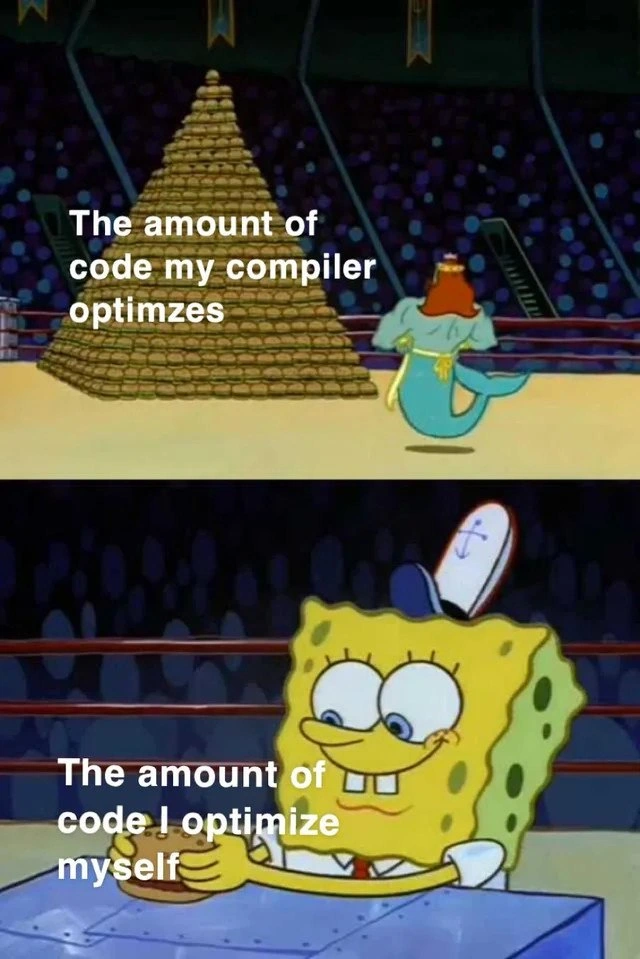
This is a two-panel meme from the cartoon Spongebob Squarepants, used to show a comical disparity in scale. The top panel features the character King Neptune standing before a colossal pyramid made of thousands of Krabby Patty burgers inside a stadium, with the caption: 'The amount of code my compiler optimizes'. The bottom panel shows Spongebob Squarepants sitting at a table, proudly holding up a single, simple Krabby Patty with a gleeful expression, captioned: 'The amount of code I optimize myself'. The meme humorously highlights the immense and often invisible work that modern compilers (like GCC or Clang/LLVM) do to optimize code, versus the comparatively minuscule and sometimes futile manual micro-optimizations attempted by developers. For senior engineers, it's a relatable nod to the principle of writing clean, readable code and trusting the compiler to handle performance, rather than engaging in premature or overly clever optimization that might offer negligible gains





Comments
7Comment deleted
Junior devs write clever code. Senior devs write clear code. The compiler, holding a beer, optimizes both into the same inscrutable machine code anyway
After two decades of squeezing cycles, I’ve accepted that -O3 builds the burger ziggurat; I just garnish one patty so my diff still shows up on the blame graph
Spent three hours hand-unrolling loops to save 2ms, then the compiler's auto-vectorization made my version slower than the original
This meme perfectly captures the Dunning-Kruger effect in performance engineering: developers spend hours hand-tuning a hot loop to save 3 nanoseconds while their compiler's -O3 flag has already performed 47 optimization passes including loop vectorization, dead code elimination, and constant propagation across the entire codebase. The real kicker? That 'optimized' code you're so proud of probably just prevented the compiler from applying an even better optimization it would have discovered through whole-program analysis. Modern LLVM and GCC optimization pipelines are the result of decades of research and thousands of person-years of engineering - but sure, your manual loop unrolling is definitely going to make the difference
Clang with LTO+PGO autovectorized the hot path into three AVX ops; my hand ‘optimization’ renamed a variable to fast and added a branch mispredict
Compiler: autovectorizes the hot loop; me: wrap it behind three interfaces and a DI container - just to make sure it can’t
Compilers turn bloat into bullet-speed; I 'optimize' by convincing myself the profiler is wrong