Skip to content
DevMeme
1185 of 7435
The Duality of a Developer's Day: Memes vs. Code
MentalHealth Post #1323, on Apr 16, 2020 in TG

The Duality of a Developer's Day: Memes vs. Code

Why is this MentalHealth meme funny?

Level 1: Laughs vs Tears

Pretend you’re reading a funny comic strip about a kid doing homework. In the comic, the kid makes silly mistakes and crazy excuses to avoid the work, and you laugh because it’s just a story – it’s not your problem. Now imagine your teacher gives you a really hard homework assignment. Suddenly it’s not funny anymore. You might feel confused or upset, maybe even want to cry if the homework is too hard. The comic was fun because you weren’t the one doing the work; you were just watching someone else in a goofy situation. But doing the real homework yourself can be frustrating and tough. That’s exactly what this meme is saying: it’s a lot of fun to laugh at jokes about coding, but when you actually have to write real code (do the real work), it can be stressful and might make you feel like crying. In simple terms, laughing at something is easy, but doing it for real is much harder.

Level 2: Bugs Are No Joke

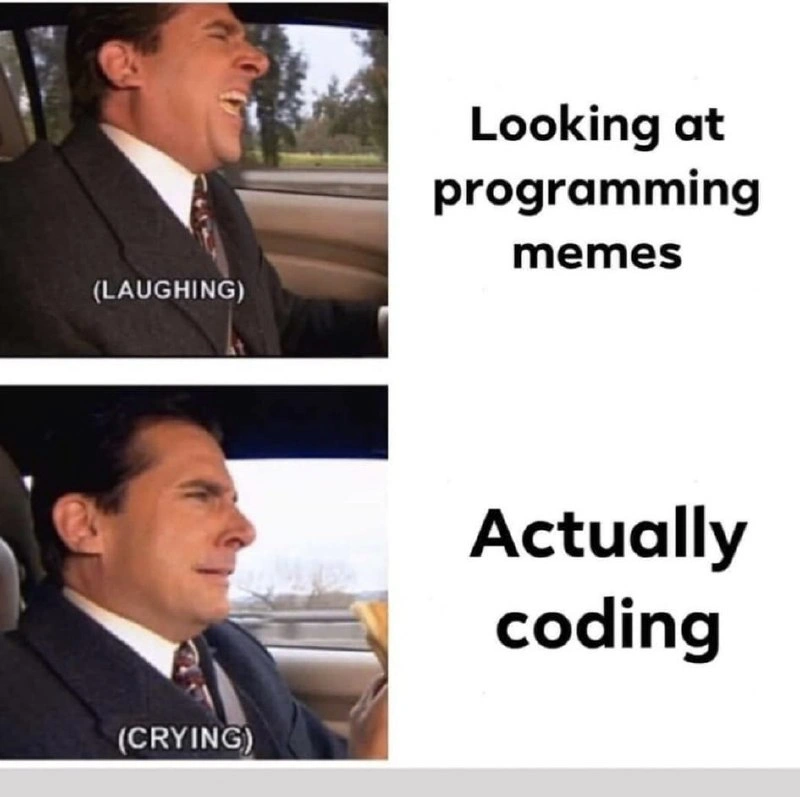
This meme uses a simple two-picture format to tell a story. In the first picture (top panel), we see a man laughing with the caption “Looking at programming memes.” This means that when the developer is just reading funny programming jokes online, he’s having a great time and smiling. In the second picture (bottom panel), the same man is crying with the caption “Actually coding.” That shows when the same developer sits down to write code, suddenly he’s upset or overwhelmed to the point of tears. It’s a dramatic way to say: reading jokes about coding is fun, but doing the real coding work can be really hard and frustrating.

Programming memes are jokes or funny images about coding and developer life. If you’ve ever seen a meme, you know it’s often a silly picture with a caption that people share because it’s relatable or humorous. A programming meme might joke about something like a code bug, a confusing error message, or a common annoyance like forgetting a semicolon (;). People laugh at these because they recognize the situation. Actually coding, on the other hand, means writing and debugging real code. Coding is creative and rewarding, but it’s also very exacting. Computers only do exactly what you tell them, so a tiny mistake can cause your program to crash or behave strangely. That’s where the frustration comes in. The meme humorously captures this contrast: looking at a joke about someone else’s messy code is entertaining, but dealing with your own messy code can make you want to cry.

There are many everyday examples behind this meme. Imagine a joke that goes, “Haha, I spent 2 hours debugging (searching for the cause of a problem) only to find I missed a semicolon!” – you might chuckle at that. However, when you actually spend two hours pulling your hair out over why your code isn’t working, and then you discover it’s because of one missing ; at the end of a line, you’re not laughing anymore, right? You’d feel annoyed at yourself or the situation. That missing semicolon is a real bug (a mistake in the code), and finding it was an actual headache. This kind of thing happens a lot in programming, which is why the joke is so relatable to developers.

The phrase “Works on my machine” is another classic inside joke in coding communities. It means the code runs perfectly on the developer’s own computer but fails on another computer or on the server. As a meme or t-shirt slogan, “Works on my machine” gets a laugh because every coder has run into that scenario. But if you find yourself saying it in real life—meaning your app only works on your laptop and nowhere else—it’s definitely not funny in that moment. It usually leads to a tricky investigation to figure out what’s different about your machine versus others. That debugging process can be tedious and stressful. So once again, it’s fun to joke about in theory, but painful in practice.

This meme is labeled under Developer Experience (DX) and Developer Productivity for good reason. Developer Experience basically refers to how enjoyable and efficient a developer’s day-to-day work is. If the tools, codebase, and processes are good, coding feels smooth (maybe less crying); if they’re bad, coding can feel awful (like in the meme’s bottom panel). Here, the programmer clearly has a bad experience writing code – hence the tears. Developer Productivity is about how much useful work (new features, bug fixes, etc.) a programmer can get done in a given time. When you’re stuck fighting with problems or feeling upset, your productivity naturally drops. The meme exaggerates it as “crying instead of coding,” but it reflects a real concern: a frustrated developer isn’t very productive. Ironically, sometimes taking a short break to enjoy a programming meme can cheer you up and actually help you be more productive when you return to coding. A little laugh can remind you that you’re not alone and can reset your mood.

Finally, this meme highlights some common developer pain points – those are the typical problems that cause programmers grief. Examples of pain points include things like hard-to-find bugs, confusing code left by someone else, tight deadlines, or poor documentation. These issues lead to developer frustration, which is exactly what we see in the bottom image (the crying face). The existence of so many developer humor memes shows that these struggles are widespread – it’s a way for developers to vent and bond over their shared troubles. The joke here is very relatable humor: almost anyone who has coded for a while knows that whiplash of laughing at a silly coding comic one minute, then sighing or even crying over real code the next. It’s funny because it’s true. Knowing that others go through the same ups and downs makes it a bit easier for each person to handle their own coding challenges.

Level 3: Comic Relief vs Code Grief

This meme nails a universal developer coping mechanism. In the top panel, a well-dressed man (a familiar comedic character to many) is shown laughing enthusiastically under the caption “Looking at programming memes.” In the second panel, the same man is suddenly crying, and the caption switches to “Actually coding.” This jarring emotional flip from blissful laughter to pained tears is a punchline that hits uncomfortably close to home for many engineers.

The humor works because it contrasts the idealized fun of coding culture with the harsh reality of development work. Many of us developers use programmer humor as a refuge: we share silly posts on Slack or scroll through Reddit’s r/ProgrammerHumor for a quick laugh during a tough day. It’s cathartic to see our daily struggles turned into jokes. But then comes the moment we switch back to our actual code editor and face the messy truth: those same problems we laughed about are now staring us in the face, and it’s not so funny anymore.

In other words, we laugh at the meme precisely because we’ve lived it. The comedy here is a form of collective self-irony: we’re thinking “If I don’t laugh about this NullPointerException now, I might cry when I hit one later.” The top image (LAUGHING) represents that cheeky moment of denial where everything about coding seems amusing and light-hearted—like reading a comic about a database outage and chuckling, since it’s not your problem at that second. The bottom image (CRYING) is reality crashing down: your code won’t compile, tests are failing, and that database outage? It’s now your on-call issue at 3 AM. Cue nervous laughter turning into quiet sobbing.

So why does writing code sometimes reduce even experienced engineers to metaphorical tears? The meme hints at a truth about Developer Experience (DX): building software is often a minefield of unexpected complexity and frustration. When you’re just looking at memes, you’re a spectator enjoying the punchlines of problems solved (or unsolved) by someone else. There’s no pressure, no stakes. But when you’re actually coding, you’re the one responsible for fixing things: every bug, every cryptic error message, every vague ticket in the JIRA backlog becomes your personal battle. Each glitch or bug not only tests your patience but also quietly erodes your Developer Productivity for the day. It’s hard to churn out new features when you’re bogged down fixing build failures or chasing a memory leak. No wonder that sometimes a five-minute meme break feels like the only way to reboot your frazzled brain before diving back into the code.

Even a seasoned software engineer with years of experience can relate to that bottom panel. It’s the face you make when your elegant code refactoring unexpectedly breaks half the test suite, or when you realize the feature that looked straightforward is turning into a nightmare of edge cases. Senior developers aren’t immune to this; they’ve just been through it enough times to almost find it funny—hence the endless stream of inside jokes and memes on team chat. We pass around memes about deployment failures, merge conflicts, or “it was just a one-line change” precisely because we’ve survived those fires and need to laugh about it to stay sane.

There’s a saying in programming: “We laugh so we don’t cry.” That could be the unofficial motto of Developer Humor culture. The disparity in this meme is funny because it’s true — much like how medical professionals have dark jokes about their stressful work, developers share war stories via memes. The top panel’s laughter is that sweet, fleeting schadenfreude (enjoyment of others’ troubles) or relief that at least this horrible bug story is happening to someone else. The bottom panel is when the joke boomerangs back into your own life. Suddenly you’re the one stuck in “dependency hell” or undoing a production fiasco, and you realize those meme posts were basically documentary films.

In essence, this meme pokes fun at the huge gap between how we wish coding felt and how it actually feels on a bad day. The developer experience we dream of is smooth and enjoyable (the laughter), but the developer experience we often get is full of headaches (the tears). It’s a reminder that for all the fancy tools, frameworks, and best practices, programming is still a challenging craft. Every joke we laugh at is born from someone’s real struggle. And each time we dive back into our own code, we risk reenacting those struggles firsthand. So next time you see a teammate cracking up at a coding meme in the middle of a hectic sprint, remember: they’re not slacking off – they’re probably just bracing themselves for the tears that actual coding might bring later. Trust me, those tears are coming as soon as they open that 10-year-old legacy code file.

Description

This is a two-panel reaction meme featuring Michael Scott from the TV show 'The Office' driving a car. The top panel shows him laughing boisterously, with the subtitle '(LAUGHING)'. To the right of this image is the text 'Looking at programming memes'. The bottom panel shows a stark contrast: Michael Scott is now visibly upset and crying, with the subtitle '(CRYING)'. The adjacent text reads 'Actually coding'. The meme humorously captures the emotional rollercoaster of a software developer's life. It highlights the stark difference between the detached amusement of browsing relatable, funny content about the profession and the often frustrating, difficult, and emotionally draining reality of actually building, debugging, and shipping software. It's a universally understood sentiment in the tech community about the struggles that lie beneath the surface-level humor
Comments

7
Anonymous ★ Top Pick Looking at memes is like a successful `git fetch` - you get all the latest updates without any of the merge conflicts. Writing the code is the interactive rebase from hell that follows
  1. Anonymous ★ Top Pick

    Looking at memes is like a successful `git fetch` - you get all the latest updates without any of the merge conflicts. Writing the code is the interactive rebase from hell that follows

  2. Anonymous

    Looking at dev memes is a perfect cache hit; actually coding is discovering invalidation, naming, and the off-by-one release schedule all share the same critical section

  3. Anonymous

    The memes are funnier than the code because they abstract away the three meetings required to explain why your elegant solution won't work with the legacy system nobody wants to touch

  4. Anonymous

    This meme perfectly encapsulates the recursive irony of developer culture: we create memes about our suffering to cope with the suffering, then laugh at those memes, only to return to the very suffering that inspired them. It's essentially a while(true) loop of emotional states with no break condition - much like that refactoring project you started three sprints ago that somehow made the codebase worse. The real kicker? Even this analysis is just another layer of meta-humor we'll laugh at before returning to debug that Heisenbug in production

  5. Anonymous

    Looking at dev memes is a read-only, cache‑warm path; actually coding is a write‑heavy transaction against a legacy monolith under a global lock

  6. Anonymous

    Memes validate our pain in O(1) time; coding accrues O(n²) tech debt regret

  7. Anonymous

    Programming memes are stateless; actually coding is discovering your “simple” state machine has 14 undocumented states - and one that only exists in prod at 2 a.m

Use J and K for navigation