Skip to content
DevMeme
1182 of 7435
The Secret to a Flawless Pull Request History
CodeReviews Post #1321, on Apr 16, 2020 in TG

The Secret to a Flawless Pull Request History

Why is this CodeReviews meme funny?

Level 1: Never Try, Never Fail

Imagine you have a friend at school who brags, “I’ve never gotten a single answer wrong on any test!” That sounds amazing, right? But then you find out the reason: they never actually took a test because they skipped every exam.😏 Of course they have no wrong answers – you only get answers wrong if you try to answer in the first place! This meme is just like that, but with writing code.

It’s funny because the character is saying he never had any of his code rejected by others. That sounds like he’s a perfect coder, like a hero walking away from a big explosion without a scratch. But the truth (the second part of the joke) is that he avoided showing his code to anyone at all. He didn’t let anyone review it, so naturally nobody could tell him it was wrong. It’s as if our boastful friend found a sneaky trick: you can’t lose if you don’t play.

So the humor here is really a wink-wink lesson: simply not participating might save you from any failure, but it also means you achieve nothing. In everyday life, it’s like someone saying, “I’ve never lost a game in my life,” and you realize it’s because they’ve never actually played any games. We all recognize that’s a silly way to claim success. The meme makes us laugh because we know real heroes (or real developers) actually step up, take the test, play the game, or submit the code — even if sometimes things blow up or they get things wrong. After all, you learn and win by trying, not by hiding from the challenge.

Level 2: No PR, No Problem

Let’s break down what’s happening in this meme for those newer to the world of team coding. In modern software development, especially with tools like Git and platforms like GitHub, developers use something called a Pull Request (PR) to propose changes to a codebase. When you make a PR, you’re essentially saying, “Hey team, I’ve got some new code I want to add. Can you check it?” This kicks off a CodeReview process: other developers will look at your code, comment on it, and possibly suggest improvements or find bugs. If everything looks good, they approve the PR and the code gets merged (included into the main code). If there are problems, they might ask you to fix things before they accept it. In some cases, a PR can be rejected or closed without merging if the changes aren’t what’s needed.

Now, having a PR “rejected” isn’t like being yelled at or anything dramatic – usually it means the code wasn’t ready or was going in the wrong direction. It’s normal to get some pushback. VersionControl systems keep track of these reviews. Teams might even measure how many of a developer’s PRs get approved on the first try versus how many require changes. That’s the pr_metrics_gaming angle: if someone is obsessed with their stats, they might worry about a high rejection rate making them look bad.

The meme jokes about a cheeky (and absurd) way to keep a flawless record for PRs: simply never submit any code for review. In other words, never push any code up to the repository for others to see. (In Git terms, to “push” code means uploading your commits to the remote server, like GitHub, often so you can open a pull request.) If you never push your changes or never open that PR, no reviewer can ever reject it. Voilà – 0 rejections because there were 0 attempts! It’s like a student bragging they’ve never gotten a single homework problem wrong, but leaving out the fact that they haven’t turned in any homework at all.

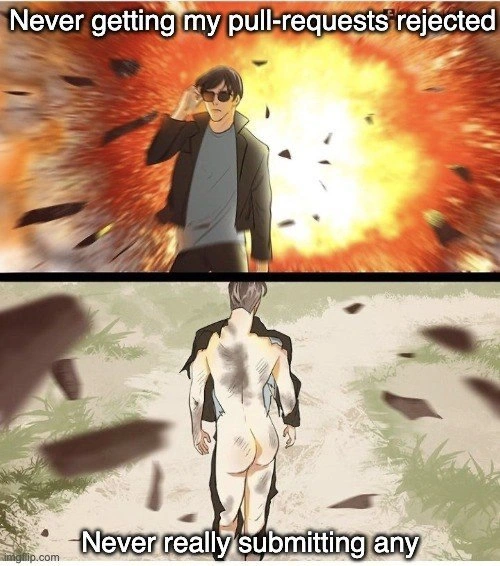
The images illustrate this joke with a bit of cinematic flair. The top panel shows an anime-style explosion with a character walking away coolly, phone in hand, not even looking back at the fiery blast. This is referencing the classic “cool guys don’t look at explosions” action movie trope – you’ve probably seen heroes in movies just casually walking as things blow up behind them. The text on that top frame says, “Never getting my pull-requests rejected.” It portrays the developer like a badass action hero who’s untouchable, as if his code is so good he can walk away from any situation without a scratch.

Then comes the punchline in the bottom panel. The same character is shown from behind, his clothes blown off except a few charred bits. In other words, reality hit him – he’s not actually unscathed. The text there reads, “Never really submitting any.” This reveals the trick: the reason he never faces the heat of a rejected PR is because he never actually submits a PR. He looks confident, but it’s a hollow kind of confidence. He isn’t a super coder; he’s just avoiding the code review process entirely. The two_panel_explosion_meme format sets us up with a dramatic statement and then delivers the comedic twist. The huge explosion represents all the potential drama and feedback of code review that he’s sidestepping. And him walking away unbothered (even as his clothes are literally burned off) emphasizes how ridiculous it is to think you can escape unhurt by simply pretending nothing happened.

In simpler terms: the meme is poking fun at developers who care more about stats or DeveloperHumor bragging rights than actual work. It’s telling us that saying “I have no PR rejections” means nothing if the reason is “I didn’t do any PRs.” For a new developer, the lesson hidden in the laughter is: don’t be afraid to push your code and get it reviewed. Sure, if you never put your code out there, no one can criticize it – but you also won’t improve or get anything done. The real RelatableDevExperience for most devs is that good code comes from iteration and sometimes a few rejection fires that help you build back better. So, while the meme is a joke, it’s showing a goofy example of what not to do: you can’t claim victory if you never even enter the battle!

Level 3: 100% Acceptance Rate

In practice, pull request rejections are a normal part of CodeReview culture. Most seasoned developers have had a PR returned with requests for changes, or even outright declined because of major issues. It’s never fun to have your hard-crafted code picked apart. This meme taps into that shared experience by presenting the ultimate humblebrag: “I never get any of my code changes rejected!” — followed by the revelation that, well, that’s because they never actually submit code for review. It's a sarcastic take on how DeveloperProductivity can be superficially preserved on paper.

The humor hits home for senior engineers because we've seen these PR metrics misused in real life. Some organizations track things like number of commits, PR approval rates, or bug-free releases as if higher numbers always mean better developers. Wise devs know that such numbers can be gamed. Here, the developer achieves a 100% PR acceptance rate by the ultimate gaming strategy: avoiding all pull requests. It’s like bragging about zero merge conflicts when you’re the only one not merging anything. Experienced folks recognize this as an anti-pattern — the team member who is overly defensive about their stats instead of focusing on real output.

There’s an undercurrent of cynicism: imagine a corporate environment where managers applaud a developer’s flawless record without asking how it was achieved. A cynical veteran might quip, "Sure, no code changes means no code reviews means no one can reject your work. Stellar performance, right?" We've all encountered that one colleague who stays in their comfort zone, maybe fixing only trivial typos or just attending meetings, contributing little code so they can never be blamed for breakage. On the surface, nothing they do ever blows up — but that’s because they’re lighting no fires to begin with.

The two-panel explosion imagery perfectly dramatizes this. In the top panel, our protagonist walks away from a fiery blast like a Hollywood hacker-hero, casually declaring “Never getting my pull-requests rejected.” It’s that classic walk_away_from_explosion_trope: looking cool and unbothered, as if his work is so perfect that nothing fazes him. But the bottom panel pulls the rug out: he’s depicted practically naked with clothes charred off, and the caption admits “Never really submitting any.” That’s the punchline — his cool-guy swagger is a facade. In reality, he achieved the record by avoidance_as_a_strategy, not by skill. The explosion metaphor here could represent the chaotic reality of software development: things break, builds fail, code blows up in your face. Our guy pretends to stroll away unscathed, but the tattered clothes reveal the truth: you don’t walk through real explosions without getting burned, and you don’t participate in real coding without some criticism or failure.

For many developers, this scenario is darkly relatable. We joke that “the only truly bug-free code is no code at all.” In the same vein, the meme jokes that the only way to guarantee a PR with no requested changes is to never open the PR. It’s a tongue-in-cheek reminder that chasing a perfect record on paper often means you’re not actually pushing boundaries. Real code involves risk — if you never risk a rejection, you probably never risked doing anything important either. The laughter (tinged with a bit of pain) comes from recognizing that a relatableDevExperience: focusing on looking good rather than doing good is a trap even smart developers can fall into when metrics become the goal. The meme exaggerates it to an absurd degree to make us smirk and maybe cringe a little, because we’ve all seen just enough truth in it.

Level 4: Goodhart's Law in Action

At a theoretical level, this meme exposes a vacuous victory in software development. The developer boasts a perfect record—0 pull-request rejections—which is only true in the trivial sense that he submitted 0 pull requests. In formal logic, a universal claim like "none of my code reviews were negative" can be vacuously true if you have no code reviews at all. It's like proving all your code is flawless by simply not writing any. The claim holds mathematically, but it's meaningless.

This is a textbook case of Goodhart's Law applied to developer productivity metrics. Goodhart's Law states that when a measure becomes a target, it ceases to be a good measure. Here the "measure" is a low PR rejection rate. The developer treated that metric as the goal itself, and predictably, the metric became detached from real productivity. By not pushing any code, he optimizes the KPI to technically achieve a 0% rejection rate, but at the cost of contributing nothing. The metric 100% acceptance is achieved by gaming the system rather than actually writing quality code. In effect, the VersionControl process (like Git/GitHub pull requests) has been subverted: the appearance of perfect code review outcomes is maintained by the simplest hack—avoid code reviews entirely.

From a broader perspective, this darkly funny scenario highlights how any system of measurement can be exploited. We've seen this pattern in tech history: measure lines of code and developers will write unnecessary verbose code; measure bug counts and suddenly trivial issues get reported and fixed for easy points. Here the target was zero PR rejections, and the "solution" was zero PRs. It’s a reminder that focusing on superficial metrics can lead to unintended consequences. In the end, much like an overcautious AI following its objective to an extreme, the developer technically "wins" the code review game by refusing to play.

"The only winning move is not to play." — WarGames (1983)

By echoing this classic quote, the meme’s subtext becomes clear: if you rig the rules (don’t play), you can’t lose. But walking away from the explosive challenges of real development (just like walking away from a literal explosion) might leave you with a flawless record and nothing else — an empty victory scorched by irony.

Description

This is a two-panel anime-style meme that contrasts a glamorous facade with a less impressive reality. In the top panel, a cool, well-dressed man in sunglasses walks away from a fiery explosion without looking back, exuding confidence. The caption reads, 'Never getting my pull-requests rejected'. This panel sets up the expectation of a highly skilled and successful developer whose code is always perfect. The bottom panel reveals the truth: the same man is seen from behind, his clothes completely shredded and tattered from the blast, walking through the smoky aftermath. The punchline caption reads, 'Never really submitting any'. The humor lies in the anticlimax. The developer's perfect record isn't due to skill, but to a complete lack of participation. It's a sharp satire on vanity metrics, the fear of criticism in code reviews, and the difference between appearing productive and actually shipping code. For experienced developers, it's a relatable commentary on colleagues who might avoid scrutiny by contributing very little
Comments

6
Anonymous ★ Top Pick My motto is 'LGTM'. Looks Good To Me... because I'm the only one who ever sees my commits on my local branch
  1. Anonymous ★ Top Pick

    My motto is 'LGTM'. Looks Good To Me... because I'm the only one who ever sees my commits on my local branch

  2. Anonymous

    We just hit elite DORA scores - 0 min lead time, 0% change-failure, 100% PR approval - after I aliased “git push” to “echo ✔️”

  3. Anonymous

    The same energy as maintaining 100% test coverage on code that never ships because you're still "refactoring the architecture" after six months

  4. Anonymous

    Ah yes, the ultimate code review strategy: achieve a 100% PR approval rate by maintaining a 0% submission rate. It's like running a production system with zero deploys - technically flawless uptime, but your stakeholders might have questions about that empty Git history and why the feature branch has been 'almost ready' for three sprints

  5. Anonymous

    Achieved 0% PR rejection by deploying Goodhart’s Law: set PR_SUBMIT=false - dashboard green, throughput asymptotically zero

  6. Anonymous

    100% PR approval rate, 0% submission rate - statistically flawless architecture

Use J and K for navigation