Skip to content
DevMeme
1184 of 7435
C++ Interfaces vs. Implementation: A Tale of Two Files
Languages Post #1320, on Apr 16, 2020 in TG

C++ Interfaces vs. Implementation: A Tale of Two Files

Why is this Languages meme funny?

Level 1: Neat Outside, Messy Inside

Imagine you go to a friend’s house and see their living room all clean and everything in place – it looks very neat, like they really have their life together. That’s like the front of the man in the picture wearing a tidy suit. But then you open your friend’s closet door and tons of junk and toys spill out everywhere – it turns out they just shoved all the mess out of sight. That hidden mess is like what we see in the mirror reflection of the man wearing a wild outfit. The meme is funny because it’s showing something similar: on the outside something looks formal, organized, and proper, but behind the scenes it’s chaotic and unexpected. It’s like a person who appears very serious and professional in public, but at home they’re dancing in a goofy costume when no one’s watching. We laugh because it’s a big surprise and a little bit silly – it reminds us that sometimes things aren’t exactly as they first appear.

Level 2: Interface vs Implementation

Let’s break down the basics behind this meme. In C++ programming, and some other compiled languages, we often split code into two parts:

  • A header file (usually with a .h extension) which contains the declarations of things: for example, it lists functions, classes, and their public members, but typically doesn’t include the full code of the functions. Think of it as a menu or a blueprint – it tells you what is available and how you can call or use it, but not the gritty details of how it’s done. It’s like a formal announcement or a clean interface.
  • A source file (with a .cpp extension for C++) which contains the definitions or implementations of those declarations. This is where the actual logic lives – the lines of code that get executed when those functions are called. The source file can include loops, calculations, calls to other functions, and any complexity needed to fulfill the promises made in the header. In other words, it’s the implementation or the behind-the-scenes code.

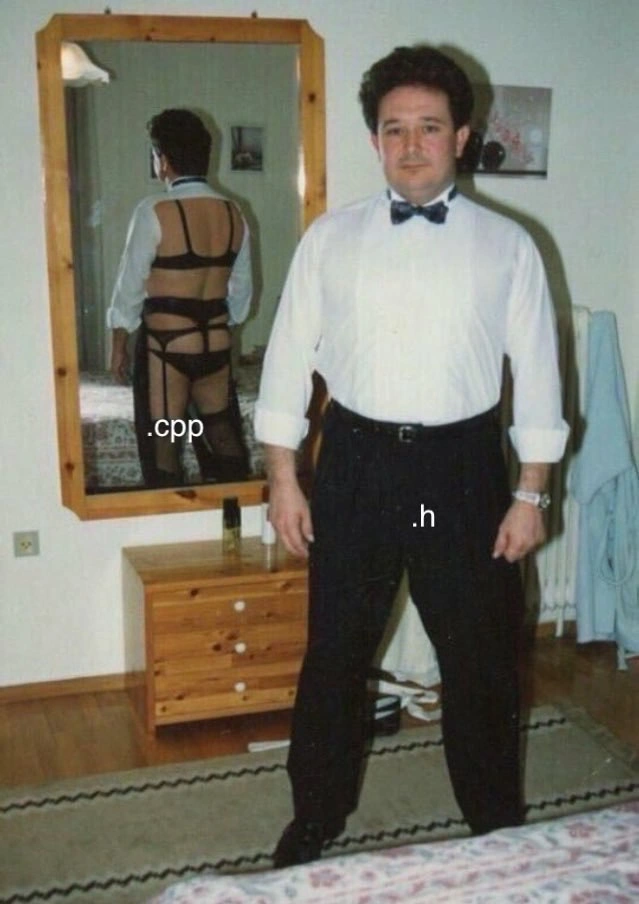
Now, the meme uses a funny photograph analogy: The person standing facing us is dressed very formally (white shirt, bow-tie, polished trousers), and the text “.h” is written on that front image. This represents the header file – neat, respectable, organized for public presentation. The same person’s back is visible in a mirror behind him, but oddly in the reflection he’s wearing a revealing black lingerie outfit with garters, labeled “.cpp”. This reflection is representing the source file’s content – something hidden from the outside world that could be wild, complex, or messy.

So why is this funny to developers? It highlights encapsulation, a principle in programming where the internal details (“private implementation”) are hidden behind a clean external interface (“public interface”). The .h file is basically what other programmers or parts of the program are supposed to see and use. It might contain well-documented function prototypes, clear structure, and no extraneous details. The .cpp file is not usually directly included by other parts of the program — instead, it’s compiled into machine code. Because of this, a programmer can afford to have more messy or complicated code in the .cpp since nobody includes a .cpp directly; they only include the .h and trust that the implementation works. In short, other programmers will “judge the book by its cover” (the .h), not by the whole messy contents of the .cpp.

A junior developer might have learned about object-oriented programming and heard the term “abstraction” or “information hiding.” This is exactly that concept in practice: you hide the details that others don’t strictly need to know, exposing only what is necessary. The meme plays on that by showing a scenario where the hidden part (the implementation) isn’t just a little bit complex – it’s ridiculously different in tone and style from the tidy front.

Real-world example: Suppose you have a class Car in a program. In Car.h, you might see a nice, clean list of methods like startEngine(), stopEngine(), accelerate(int amount). It all reads very clearly, like chapters in a user manual. Now, if you open up Car.cpp, you might expect to see the code for how the engine starts or how acceleration is handled. If the codebase is well-maintained, that code will be straightforward. But if not, you might scroll through Car.cpp and find 500 lines of code with weird if-else conditions (if(speed > 100 && gear == 5 && fuelMix < 0.2) then...), debug print statements (std::cout << "Unexpected value" << std::endl;), maybe commented-out remnants of old code, and so on. It could even call some function like hackToPreventStalling() – which makes you raise an eyebrow. The header wouldn’t betray any of this complexity; it just calmly stated void startEngine(); without hinting at the circus inside.

Code maintainability is a key term here: it refers to how easy it is for someone to read, fix, or update the code later. A code with a clean interface but chaotic implementation can be hard to maintain because once you dive into the implementation, it’s confusing or poorly structured. It’s a bit like having a user manual that’s nicely printed and organized (header), but when you actually open the device to repair it (source), you find jumbled wires and duct tape. This kind of code may work (just as a messy wired device might still turn on), but any new engineer needing to modify it might be in for a surprise. That surprise factor is exactly what the meme humorously captures.

Also, by using a mirror and outfit analogy, the meme references a common joke format: “business in the front, party in the back.” This phrase originally describes a mullet hairstyle (where from the front it looks like short formal hair, and the back is long and wild like a rocker). Developers repurpose this phrase for code to mean “clean interface, wild implementation.” The .h is the business (formal, all class), and the .cpp is the party (anything goes in there!).

The LanguageQuirks tag is relevant because this sharp separation of interface and implementation is particularly prominent in C++ (and C). Not all languages have this in two different files; for example, in Java or Python you typically write the interface and implementation together in one class file or module. C++ inherited the .h + .cpp split from the C language’s way of compiling code, where headers were needed to share information between separately compiled units. It’s a bit of a quirk to newcomers why you have to have two files for one class. But it enforces this idea: one part for others to see, one part to do the work behind closed doors.

In summary at this level: The meme jokes that a C++ program can look all tidy and proper on the surface (in its header files), but hide a lot of craziness or complexity in the actual code (the source files). It’s funny because it’s often true — many developers have opened what looked like a simple module only to find an “interesting” surprise lurking in the implementation. It teaches newer developers about the importance of reading both the interface and the implementation when trying to understand code, and also subtly warns: just because code looks well-designed from the outside doesn’t mean it truly is on the inside.

Level 3: Public Face, Private Chaos

Anyone who’s maintained a large C++ codebase will chuckle (or cringe) at this. The meme contrasts a pristine outward interface with a wild inner implementation, capturing a familiar developer experience. In C++, a .h file is the public face of your code: it’s what other programmers see and include, so it’s often kept tidy, minimal, and professional. You declare clean class interfaces, nice struct definitions, and straightforward function declarations. It’s the code equivalent of a pressed white shirt and bow-tie — everything looks in order. But the mirror’s reflection labeled .cpp reveals what’s behind the scenes: the actual source file where all the real work happens. This is where the code might be held together by duct tape and macros, peppered with // TODO: comments, weird corner-case fixes, and maybe a touch of undefined behavior flirting at the edges. It’s sporting figurative lingerie and garters: surprising, risky, possibly embarrassing if anyone saw it directly. Why is this so funny and resonant? Because encapsulation in C++ (and in programming in general) creates a boundary where outsiders only see the nice API, while insiders know the messy truth. We’ve all seen libraries or modules where the header advertises a simple, elegant functionality (bool saveUserData(User u); – easy enough, right?) but when we peek into the implementation, it’s hundreds of lines of convoluted logic (parsing files, handling five legacy formats, a recursive algorithm, and oh, a global mutex too).

This meme nails a common code quality satire: outward compliance with good design and architecture practices, while internal code rot or complexity is conveniently out of sight. It highlights an anti-pattern: polishing the interface for reuse and readability, but letting the implementation become a dumping ground of quick fixes, copy-pasted functions, or tangled design patterns gone wrong. Seasoned devs share war stories of classes that looked harmless in the header but caused all-night debugging sessions in the .cpp – think of an innocuous initialize() method that behind the scenes launches threads, reads from disk, and connects to two databases with barely a comment in sight. The mirror metaphor is apt: just as a mirror can reveal what you don’t see from the front, diving into a .cpp often reveals the mirror image of the project’s promised design ideals.

Why does this happen in real projects? Often due to time pressure, evolving requirements, or multiple developers hacking away over years. The interface (.h) is stable because changing it can break API contracts with other code – so teams are cautious and keep it clean. But inside the .cpp, they have more freedom (or temptation) to patch and extend functionality in whatever way works, since fewer external components directly depend on those lines. Over time, that implementation can accrete bizarre workarounds (say, an off-by-one fix for a bug from 2008, a special-case if for a customer’s config, or a macro that expands to 50 lines of code for a platform-specific tweak). The result? A code module leading a double life: respectable on the surface, scandalous under the hood. It’s a comedic reflection of “do as I say, not as I do” in code form.

To illustrate, imagine a header vs. source for a class and see the discrepancy:

// File: FormalAPI.h (the polished front-facing header)
class DataProcessor {
public:
    // A simple, clear promise of what this function does
    bool processUserInput(const std::string& input);
    // ... other clean declarations ...
};
// File: ChaoticImpl.cpp (the anything-goes implementation)
#include "FormalAPI.h"
#include <regex>
#include <iostream>
bool DataProcessor::processUserInput(const std::string& input) {
    // The reality behind the promise:
    static bool firstCall = true;
    if (firstCall) {
        std::cout << "Initializing subsystems...\n";
        firstCall = false;
    }

    // Some convoluted logic hidden from the header:
    try {
        std::regex specialPattern("(^\\d+$)");
        if(std::regex_match(input, specialPattern)) {
            throw std::logic_error("Input looks like all digits, unsupported!");
        }
    } catch (...) {
        // Swallowing exceptions - who will know?
    }

    // TODO: Fix hard-coded return condition
    return input.size() % 2 == 0;  // Completely arbitrary success criteria
}

In this exaggerated example, processUserInput had a neat signature in the header – it sounds straightforward – but the .cpp shows a slew of hidden side effects and strange decisions (one might say it's wearing unexpected attire). There’s a static flag doing one-time initialization (sneaky global-ish state), an attempt at using <regex> with a weird pattern and a swallowed exception (yikes, silent failures), and finally an inexplicable return rule based on string length parity. This is obviously bad code in real life (and triggers any reviewer’s alarms), but it’s a dramatization of the kind of surprises developers actually encounter inside large systems. The meme exaggerates it further by likening it to the contrast between formal evening wear and risqué lingerie.

Beyond the laughter, there’s an undercurrent of truth that maintainability suffers when implementations diverge too far from the tidy interfaces. New engineers often trust the interface documentation and assume the code behind is equally well-groomed – only to be stunned when they step through in a debugger or read the function’s definition. The shock value is real and relatable. It’s a reminder that good software design isn’t just about making the front look good (the API design, the architectural diagrams) but also keeping the back-end implementation healthy. Otherwise, you get a codebase with a split personality: it markets itself as well-designed, but inside it’s one mishap away from a wardrobe malfunction. And just like the fellow in the photo wouldn’t want to be caught by surprise with his back to the audience, no team wants their code’s hidden chaos exposed during a critical demo or production incident. This meme speaks to developers with a wink and a sigh: “We’ve all been there – the class looked so proper until we saw the truth in the mirror.”

Level 4: The Encapsulation Illusion

In software engineering theory, this meme visualizes the classic principle of information hiding taken to a comedic extreme. Back in 1972, David Parnas wrote about designing modules with clean interfaces while concealing inner workings. C++ embodies this with header files (.h) as formal interfaces and source files (.cpp) as the implementation details. The .h presents the public API – neatly organized function prototypes, class declarations, and documentation – much like a polished specification or even a formal proof. Meanwhile, the .cpp holds the actual code logic, which can be as complex and untamed as necessary to get the job done. In an ideal world (or in formal methods), the implementation would be as elegant as the interface. But in reality, the abstraction barrier provided by headers can turn into a one-way mirror: it lets clients see the interface but hides the gory details. The humor here taps into the gap between theory and practice – encapsulation is supposed to safeguard maintainability and code quality, yet it also enables a scenario where a module’s inner code is radically more chaotic than its outward promises. Just as a rigorous mathematical function might hide an NP-hard computation behind a simple signature, a pristine C++ header can mask labyrinthine logic or hacky shortcuts in the source. This illusion of simplicity is a cornerstone of software design: it’s powerful, but it can also be misleading. The meme winks at this duality – academically, we praise separating interface from implementation for better architecture (and indeed, patterns like the PIMPL idiom or Facade rely on it), but that same separation can become a hiding place for technical debt. In short, the image is a cheeky reminder that underneath the formal veneer mandated by language architecture and design patterns, the actual code can defy all that civility with impunity.

Description

The meme uses a 'business in the front, party in the back' visual gag to represent C++ code structure. The image shows a man from the chest up, dressed formally in a white tuxedo shirt and a black bow tie. He appears composed and professional. This forward-facing view is labeled with '.h', representing a C++ header file. However, his reflection in the mirror behind him reveals that the back of his shirt is cut away, and he is wearing revealing black lingerie, including a bra, garter belt, and stockings. This messy, hidden reality is labeled '.cpp', representing the implementation file. The joke is a sharp commentary on a common reality in software development, particularly with older C++ codebases: the public interface defined in the header (.h) file is often clean, well-documented, and presents a respectable API, while the corresponding implementation in the source (.cpp) file can be a chaotic, tangled mess of complex logic, hacks, and technical debt that is hidden from the consumer of the code

Comments

7
Anonymous ★ Top Pick The header file is the polished LinkedIn profile. The CPP file is the commit history at 3 AM on a Friday before a long weekend
  1. Anonymous ★ Top Pick

    The header file is the polished LinkedIn profile. The CPP file is the commit history at 3 AM on a Friday before a long weekend

  2. Anonymous

    .h: const-correct, impeccably documented, pure as snow; .cpp: 3 000 lines of template sorcery, four #ifdef SOLARIS, and one humiliating goto holding the whole circus together

  3. Anonymous

    The header file is what you show during the architecture review; the implementation is what you pray nobody finds during the security audit

  4. Anonymous

    The eternal truth of C++ development: your .h file is the polished API you present at architecture reviews, while your .cpp file is where template metaprogramming, macro abuse, and that one recursive lambda you're not proud of actually live. It's not technical debt if nobody can see the implementation, right? Just remember: what happens in the .cpp file stays in the .cpp file - at least until link time

  5. Anonymous

    The .h is what you present at architecture review; the .cpp is what the postmortem uncovers - macros, ODR skirmishes, and template bloat - aka why PImpl and -fvisibility=hidden exist

  6. Anonymous

    C++ encapsulation masterpiece: .h dressed for the boardroom, .cpp airing the dirty laundry of inline hell and template bloat

  7. Anonymous

    Header: clean API. Implementation: #ifdef labyrinth, const_cast gymnastics, and a PIMPL begging the linker to keep quiet

Use J and K for navigation