
C++ Interfaces vs. Implementation: A Tale of Two Files
Description
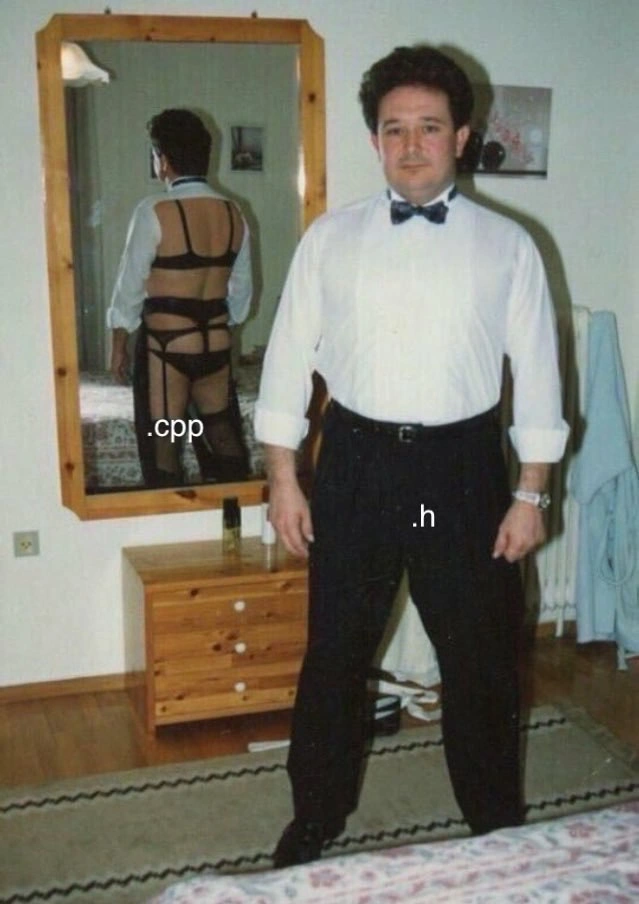
The meme uses a 'business in the front, party in the back' visual gag to represent C++ code structure. The image shows a man from the chest up, dressed formally in a white tuxedo shirt and a black bow tie. He appears composed and professional. This forward-facing view is labeled with '.h', representing a C++ header file. However, his reflection in the mirror behind him reveals that the back of his shirt is cut away, and he is wearing revealing black lingerie, including a bra, garter belt, and stockings. This messy, hidden reality is labeled '.cpp', representing the implementation file. The joke is a sharp commentary on a common reality in software development, particularly with older C++ codebases: the public interface defined in the header (.h) file is often clean, well-documented, and presents a respectable API, while the corresponding implementation in the source (.cpp) file can be a chaotic, tangled mess of complex logic, hacks, and technical debt that is hidden from the consumer of the code




Comments
7Comment deleted
The header file is the polished LinkedIn profile. The CPP file is the commit history at 3 AM on a Friday before a long weekend
.h: const-correct, impeccably documented, pure as snow; .cpp: 3 000 lines of template sorcery, four #ifdef SOLARIS, and one humiliating goto holding the whole circus together
The header file is what you show during the architecture review; the implementation is what you pray nobody finds during the security audit
The eternal truth of C++ development: your .h file is the polished API you present at architecture reviews, while your .cpp file is where template metaprogramming, macro abuse, and that one recursive lambda you're not proud of actually live. It's not technical debt if nobody can see the implementation, right? Just remember: what happens in the .cpp file stays in the .cpp file - at least until link time
The .h is what you present at architecture review; the .cpp is what the postmortem uncovers - macros, ODR skirmishes, and template bloat - aka why PImpl and -fvisibility=hidden exist
C++ encapsulation masterpiece: .h dressed for the boardroom, .cpp airing the dirty laundry of inline hell and template bloat
Header: clean API. Implementation: #ifdef labyrinth, const_cast gymnastics, and a PIMPL begging the linker to keep quiet