Compiler Optimization vs. Manual Tweaks: A Humbling Comparison
Why is this Compilers meme funny?
Level 1: Giant Feast vs Tiny Snack
Imagine you have a super helper who does almost all of your work for you. Let’s say you need to prepare food for a big party. Instead of you doing it all, a master chef comes in and cooks a giant feast – we’re talking a huge table overflowing with burgers, pizzas, and treats for everyone. Meanwhile, all you made by yourself was one small sandwich. You’re sitting there smiling at your little sandwich, feeling proud, but when you look up, you see the chef has made a mountain of food! It’s a funny and happy feeling: on the one hand, you did a tiny bit of work (your one sandwich), but this awesome helper did a huge amount of work (the entire buffet). In the end, the party guests are fed mostly thanks to the chef’s giant feast, not your single snack. This is just like what happens when we program: the computer’s compiler is like that master chef – it automatically handles a ton of improvements to make the program run fast (the feast), and the programmer might only have to directly improve a little bit themselves (the one sandwich). We find it funny because the contrast is so big, and it’s a relief too – it’s nice to have a powerful helper doing most of the heavy work!
Level 2: Burger Stack Showdown
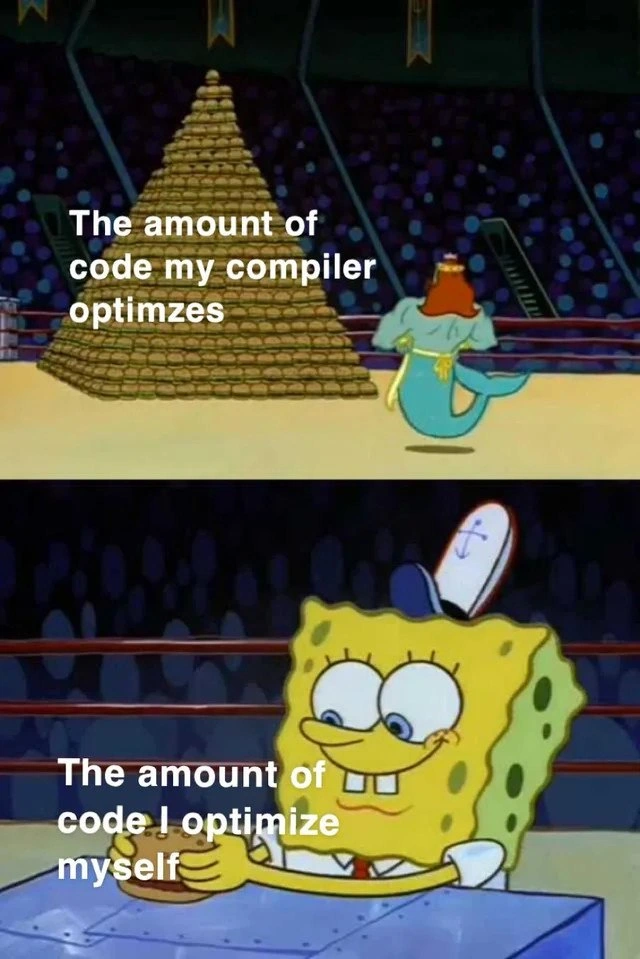
Let’s break down the joke in simple terms. We have a SpongeBob meme with two pictures. In the top picture, there’s an arena scene with a huge pyramid of Krabby Patty burgers (literally a massive stack of burgers towering high) and a mermaid character looking up at it. Next to this mountain of burgers, a caption says “The amount of code my compiler optimizes.” This is showing an analogy: the compiler is doing a huge amount of optimization on your code (making it run faster or more efficient), represented by that giant pile of burgers. In the bottom picture, we see SpongeBob himself at a table, smiling and admiring a single Krabby Patty in his hands. The caption there says “The amount of code I optimize myself.” This implies that the manual optimizations a programmer does (the tweaks we personally make to speed up our code) are just that one little burger, a tiny fraction of the total. SpongeBob’s happy expression with his lone burger adds to the humor – he’s proud of that one burger, even though it’s nothing compared to the burger stack above. It’s a playful way to say: “Look, the compiler automatically handles this gigantic amount of work making my program faster, while I only handle a tiny bit.”
Now, what exactly is a compiler and what does it mean to optimize code? A compiler is a special tool (a program) that takes the code you write (for example in C++ or Rust) and translates it into the low-level instructions that the computer’s hardware understands (like machine code or assembly language). But modern compilers don’t just translate code naively line by line. They also improve it – that’s what we mean by code optimization. They might rearrange things, simplify operations, or drop unnecessary parts of the code to make the final program run faster or use less memory. For instance, if the code has something useless (like calculating a value that never gets used), the compiler can throw that away (that’s called dead code elimination). If you do the same calculation multiple times, it can do it once and reuse the result (common subexpression elimination, though you don’t need to remember the term). It can even detect some clever math shortcuts – like if you multiply by 2, which computers do quickly anyway, it might internally treat it as a bit shift which is extremely fast. Basically, the compiler has a whole bag of tricks to make sure the program is efficient. These automatic performance optimizations happen when you compile your program, especially if you ask for them (for example, compiling in “Release mode” or using an optimization flag like -O2).
On the other hand, when we say “the code I optimize myself,” we’re talking about manual optimization – the changes a developer might consciously make in the source code to try to improve performance. For example, a programmer might try to use a more efficient algorithm (like using a better sorting method), or they might try to reduce how many times a certain slow function gets called. But there’s a famous saying in programming: “Premature optimization is the root of all evil.” What that means is that if you try to optimize your code too early or without evidence that something is a real performance problem, you might waste time or even make the code worse (harder to read, or even introduce bugs) for very little gain. And often, the compiler is already doing the easy optimizations for you! So experienced programmers will first write the code in a clear and correct way, then use a profiler or tests to see if any part of it is actually too slow, and only then focus on optimizing that part (and even then, they’ll know the compiler will help with a lot of the grunt work).
This meme falls into the developer humor category because it’s an inside joke about our tools and habits. It uses the SpongeBob scene as an analogy (a burger stack analogy) for something technical. SpongeBob memes are super popular in online tech communities because the characters’ expressions are so relatable. Here, the massive burger pyramid vs the single burger is a funny exaggeration of how much more the compiler’s automatic optimizations contribute compared to the little tweaks a programmer makes manually. In reality, a good compiler might make your program run, say, twice as fast or more just by flipping on those optimizations, whereas a programmer might only find a small additional improvement by hand-tuning a bit of code. The spongey yellow guy holding that one burger and grinning is like us programmers feeling happy about the tiny performance improvement we squeezed out, while completely acknowledging (or humorously ignoring) that the compiler already handled the heavy lifting. It’s basically saying, “Thank goodness the compiler does 99% of the work, because I only optimized this one little thing myself!” and we find that funny and reassuring at the same time.
Level 3: In Compiler We Trust
This SpongeBob meme nails a piece of classic developer humor about optimization. The visual joke compares the compiler vs manual optimization effort: a mountain of Krabby Patties representing all the code improvements your compiler effortlessly handles, versus SpongeBob admiring a single patty representing the few micro-optimizations a developer might do by hand. Seasoned developers chuckle at this because we’ve all been there – poring over code to shave off a millisecond, only to realize later that the compiler (or JIT runtime) had already optimized away most of the obvious inefficiencies. It’s a humorous reminder that, in the realm of performance, modern compilers are incredibly powerful allies. We trust them to do the heavy lifting. In fact, a common mantra is “Write clear, correct code first – trust the compiler (and profiler) for performance.” In other words, PrematureOptimization (tweaking code for speed before you even know if it’s needed) is often counterproductive. The meme’s text “the amount of code my compiler optimizes” (typo and all) sitting atop that enormous burger pyramid highlights how much work is done automatically under the hood. Meanwhile, “the amount of code I optimize myself” over SpongeBob’s single burger shows how little manual optimization usually matters in comparison.
Why is this funny to developers? Because it’s so true. We’ve seen new programmers obsess over micro-optimizations – like unrolling a tiny loop by hand, or futzing with low-level bit operations – imagining they’ll get huge speedups. Experienced devs know that in most cases the compiler’s ahead of you: it’s already unrolled that loop, vectorized those math operations, and pruned unused branches. It’s as if the compiler is the ultimate short-order cook stacking burgers to the sky, and the dev is just adding one more pickle to the top. The contrast is comical. There’s also an implicit poke at our ego: sometimes devs take pride in the one clever trick they optimized, but the compiler quietly optimized hundreds of things without any fanfare. The SpongeBob image of him lovingly holding that one patty (with a big grin) mirrors a developer’s slight self-satisfaction at a minor optimization we did, blissfully ignoring the sea of improvements the toolchain made automatically.
This “compiler vs developer” dynamic has a deeper truth in the world of Performance tuning. It’s generally far more important to choose efficient algorithms and write clear code (things compilers can’t do for you) than to hand-tune machine-level details (which compilers excel at). The meme plays on this by visually exaggerating the difference: the compiler’s contribution to raw speed is enormous (think of languages like C/C++ or Rust – turning high-level code into super optimized machine code is their compilers’ day job!), whereas the developer’s contribution is comparatively tiny. It’s a lighthearted way of saying “Hey, give credit to the compiler.” After all, without optimization flags or a good JIT, our programs might run like a snail. Turn on that -O2 or -O3, and suddenly it’s like the compiler turbocharged our code — often without us changing a single line! The meme’s timing (circa 2020) isn’t tied to a specific event, but by then developers widely recognized how optimizing compilers (LLVM, GCC, MSVC, and even JVM/JavaScript engines) have become extremely adept. Notably, the caption even misspells “optimizes” as “optimzes,” perhaps an accidental joke that even the word got “optimized” by dropping a character 😉. Typos aside, every senior dev reading this meme nods knowingly: we’ve learned the hard way that trusting the compiler and avoiding needless manual tweaks is usually the best route to performant software. In short, the meme humorously champions the idea that “In Compiler We Trust.”
Level 4: O3 Odyssey
At the highest optimization level, modern compilers perform almost superhuman feats of code transformation. The top panel’s towering Krabby Patty pyramid perfectly symbolizes the monumental stack of optimizations that a compiler’s back-end applies to your code. Each burger in that stack is like a distinct optimization pass in the compiler pipeline, collectively producing highly efficient machine code. Under the hood, the compiler breaks down your source into an intermediate representation (think an advanced form of pseudo-assembly), then goes on an optimization spree: constant folding (e.g. converting 2+2 into 4 at compile time), dead code elimination (removing code that does nothing), common subexpression elimination (reusing results of repeated calculations), loop unrolling, function inlining, vectorization for modern CPUs – the list goes on. It’s an all-you-can-optimize buffet of improvements, far beyond what any human could reliably do by hand. The meme’s exaggerated 99-to-1 ratio isn’t far off – compilers often do handle the vast majority of low-level PerformanceOptimization work, especially at aggressive settings like -O3 (in GCC/Clang) which enable dozens of these optimization passes (an O3 odyssey, indeed).
To pull this off, compilers leverage decades of CompilerDesign research and some serious computer science theory. They construct control-flow graphs and employ data-flow analysis to understand how values move through the program. They use concepts like static single assignment (SSA) form to make optimizations easier and safer. A compiler’s optimizer is a bit like a chess grandmaster looking many moves ahead – it considers how changing one instruction might enable another optimization later. For example, it might replace a slow division with a faster multiply if it can (a classic strength reduction), or inline a small function’s code right at the call site to avoid the overhead of a function call. It even knows about the CPU’s quirks: reordering instructions to avoid pipeline stalls, keeping frequently-used values in CPU registers (via register allocation algorithms that famously relate to NP-hard graph coloring problems), and aligning data for faster access. Each of these micro-optimizations is one burger in that massive stack.
To appreciate the compiler’s wizardry, consider a quick example. Here’s a snippet of C code and what an optimizing compiler might do:
// Original code
int compute(int x) {
int result = 0;
for (int i = 0; i < 1000; ++i) {
result += x * 2; // multiply by 2 inside loop
}
return result;
}
Even at -O2 or -O3, a good compiler will work its magic: it will realize that x * 2 doesn’t need to be computed every iteration (common subexpression elimination and loop-invariant code motion). It might hoist the multiplication out of the loop or even convert it to a shift (x << 1) if that’s faster on the target architecture (though modern CPUs handle multiplication just fine, so compilers focus on bigger wins like unrolling or vectorizing the loop). It may unroll the loop or use SIMD instructions (auto-vectorization) to add, say, 4 values per iteration using 128-bit registers. The end result? The machine code is drastically shorter and faster than a literal translation of the original source. The as-if rule in languages like C++ allows the compiler to make any change, no matter how wild, as long as the program’s observable behavior is as if the original code ran. That means the compiler can pre-compute, re-order, or outright remove operations freely, so long as the final outcome (what gets printed, returned, etc.) is correct. It’s like a massive refactoring and optimization engine that guarantees not to introduce bugs – a kind of algorithmic alchemy turning clunky source code into efficient binary.
From a theoretical standpoint, some compiler optimizations border on solving hard problems. For instance, finding the optimal way to allocate registers or schedule instructions to avoid CPU pipeline stalls can be NP-complete, so compilers use clever heuristics to get near-optimal results in a reasonable time. They also perform alias analysis to figure out if different pointers or references might refer to the same memory (if not, more optimizations become legal). The bottom line: the compiler’s automatic CodeOptimization is exhaustive and incredibly sophisticated, accounting for hardware details and applied consistently across the entire codebase. By contrast, a developer manually tweaking code can maybe handle a few hotspots – akin to SpongeBob cherishing that one perfect Krabby Patty in the bottom panel. The meme humorously acknowledges that practically 99% of the optimization work is handled by the tools (the compiler’s burger stack of transformations) while the human’s contributions are a tiny, almost adorable afterthought.
Description
This is a two-panel meme from the cartoon Spongebob Squarepants, used to show a comical disparity in scale. The top panel features the character King Neptune standing before a colossal pyramid made of thousands of Krabby Patty burgers inside a stadium, with the caption: 'The amount of code my compiler optimizes'. The bottom panel shows Spongebob Squarepants sitting at a table, proudly holding up a single, simple Krabby Patty with a gleeful expression, captioned: 'The amount of code I optimize myself'. The meme humorously highlights the immense and often invisible work that modern compilers (like GCC or Clang/LLVM) do to optimize code, versus the comparatively minuscule and sometimes futile manual micro-optimizations attempted by developers. For senior engineers, it's a relatable nod to the principle of writing clean, readable code and trusting the compiler to handle performance, rather than engaging in premature or overly clever optimization that might offer negligible gains

Comments
7Comment deleted
Junior devs write clever code. Senior devs write clear code. The compiler, holding a beer, optimizes both into the same inscrutable machine code anyway
After two decades of squeezing cycles, I’ve accepted that -O3 builds the burger ziggurat; I just garnish one patty so my diff still shows up on the blame graph
Spent three hours hand-unrolling loops to save 2ms, then the compiler's auto-vectorization made my version slower than the original
This meme perfectly captures the Dunning-Kruger effect in performance engineering: developers spend hours hand-tuning a hot loop to save 3 nanoseconds while their compiler's -O3 flag has already performed 47 optimization passes including loop vectorization, dead code elimination, and constant propagation across the entire codebase. The real kicker? That 'optimized' code you're so proud of probably just prevented the compiler from applying an even better optimization it would have discovered through whole-program analysis. Modern LLVM and GCC optimization pipelines are the result of decades of research and thousands of person-years of engineering - but sure, your manual loop unrolling is definitely going to make the difference
Clang with LTO+PGO autovectorized the hot path into three AVX ops; my hand ‘optimization’ renamed a variable to fast and added a branch mispredict
Compiler: autovectorizes the hot loop; me: wrap it behind three interfaces and a DI container - just to make sure it can’t
Compilers turn bloat into bullet-speed; I 'optimize' by convincing myself the profiler is wrong