Skip to content
DevMeme
702 of 7435
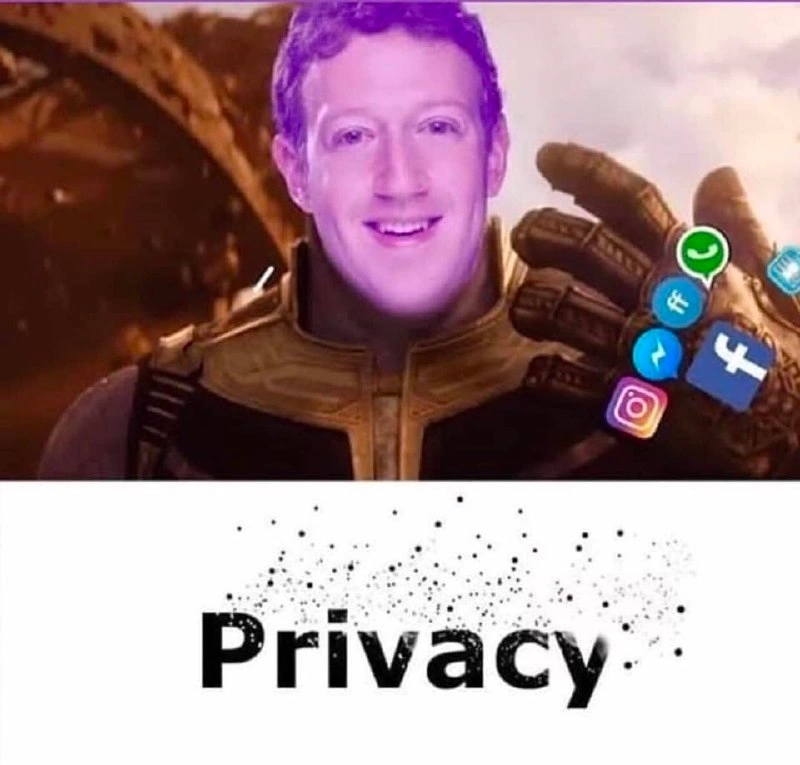
Mark Zuckerberg as Thanos, Wiping Out Privacy
DataPrivacy Post #795, on Nov 9, 2019 in TG

Mark Zuckerberg as Thanos, Wiping Out Privacy

Why is this DataPrivacy meme funny?

Level 1: Privacy’s Disappearing Act

Imagine you have a special diary where you write all your secrets, and you gave copies of the key to four different friends – one friend has your pictures, another knows all the fun stories you tell, another has your daily thoughts, and the last one holds your plans and messages. You trust each friend to keep their part secret. Now picture a really powerful magician who convinces all four friends to combine their keys. With a single snap of his fingers, that magician opens all the diaries at once and all your secrets just fly out into the open, disappearing like glitter in the wind. You thought your secrets were safe because you had locks and promises, but since one person controlled all the keys, your privacy vanished in an instant. It’s like a magic trick, but a scary one: one moment you have privacy, and snap! – now it’s gone, just dust in the air. This meme makes us smile because it’s using a famous superhero movie moment to show how it feels when a big company knows everything about us. It’s a joking way to say, “Be careful, if one giant has all your information, they can make your privacy disappear – just like magic.”

Level 2: GDPR vs. The Gauntlet

This meme mixes a Marvel movie moment with real-life PrivacyConcerns about SocialMedia. In the image, a villainous figure wears a glove (the “Infinity Gauntlet” from the Avengers films) but instead of magical Infinity Stones, the glove has familiar app icons on it: WhatsApp, Facebook Messenger, Facebook, and Instagram. These are all major platforms owned by the same big company (Facebook, which is now called Meta). In the Avengers story, the gauntlet and stones give the villain (Thanos) immense power – at one point he snaps his fingers and causes half the universe’s population to turn to dust. The meme is using that thanos_snap_reference to make a point about OnlinePrivacy: it shows “Privacy” as the word itself disintegrating into dust after a snap of the gauntlet. In other words, it suggests that when these powerful social-media platforms are combined, your privacy can disappear just as quickly and completely as those Marvel characters did. It’s a dramatic image, almost like saying Big Tech is so powerful that personal data protections might just vanish in an instant.

So why do developers find this both funny and painfully true? The meme caption mentions things like GDPR and consent dialogs. GDPR stands for General Data Protection Regulation, a major privacy law in the European Union that went into effect in 2018. GDPR forced companies around the world to be more careful with users’ personal data. If you’ve ever visited a website and seen a pop-up asking you to accept cookies or choose privacy settings, that’s largely because of GDPR. Companies had to add those consent dialogs to give users a choice about tracking. Engineers spent a lot of time coding these pop-ups and building ways for users to opt-out of data collection – that is, say “No, don’t track me or share my data for ads.” It was a huge effort (and often a headache for developers, hence gdpr_headaches). The meme hints at “ever-shifting consent dialogs,” referring to how those cookie notices and privacy settings screens keep changing. Sometimes they change because of new regulations or updates, but often companies tweak them to encourage users to click “Accept.” For example, a site might initially have a simple “Yes/No” choice, and later change to a design where the “Yes, accept all” button is bright and obvious while the “Manage my choices” link is tiny. These design tricks are known as dark patterns, and they make the act of opting out (saying no) harder – that’s what the meme means by an opt-out being “a UX façade”, basically a feature that’s only there to look privacy-friendly without truly empowering the user.

Now, combine this with the four apps on the gauntlet. WhatsApp, Messenger, Facebook, and Instagram each collect a lot of data about us. WhatsApp knows who you chat with (and your phone number), Instagram knows what pictures you like and share, Facebook knows your friends, interests, and what you click on, and Messenger ties into your Facebook contacts and conversations. Separately, each app already has plenty of PrivacyConcerns. But because one company (Meta/Facebook) owns all four, they have the ability to link all that data together. Imagine that you use WhatsApp to message close friends, Instagram to follow hobbies, and Facebook to RSVP to events – behind the scenes, Meta can piece together a very detailed profile of you from all those sources. That’s like putting all the Infinity Stones together: it greatly amplifies power. In business terms, the power here is data_monetization_stones – more personal data combined means more ways to target you with ads or keep you hooked on the platforms. Developers who work in Security and privacy know that even if you build good security (to keep hackers out), the real challenge is how the company itself uses the data. Laws like GDPR try to give users control, but enforcement is hard. The meme jokes that a single “snap” from Big Tech can override those controls. It reflects a cynical view that, despite all the checkboxes, settings, and legal agreements, in the end a giant company can do what it wants with your data unless regulators or users really hold them accountable.

When the word “Privacy” is shown turning to dust, it’s referencing that dramatic “dusting” visual from the Avengers movie, but here it symbolizes personal privacy fading away. The term “compliance dust” in the title is a witty way to say that all those compliance efforts (like obeying GDPR rules) might amount to nothing but dust if the company decides to change the rules or if the user isn’t truly protected. This ties into TechSatire – using humor and pop culture to critique technology. The meme is funny because it’s over-the-top, but it’s also a bit uncomfortable because it rings true. People worry that their data on social media isn’t really under their control. Developers laugh at the meme and then sigh, because many of them have been on the inside writing the code for those privacy settings, and they know how easily those can be bypassed or rendered moot by a policy change. Essentially, Privacy in the world of big social media can feel like those Avengers who turned to dust – something that can disappear tragically and quickly, with a mere snap, if too much power is concentrated in one place.

Level 3: Compliance to Dust

In this mashup of Marvel and SurveillanceCapitalism, the meme casts the head of a big tech empire as Thanos snapping away our DataPrivacy. The infamous Infinity Gauntlet from the Avengers saga is reimagined here with Meta’s crown jewels – WhatsApp, Messenger, Facebook, and Instagram – as the glowing data_monetization_stones. With all four platforms combined on one gauntlet, one snap of those mighty SocialMedia fingers and poof: user Privacy crumbles into pixelated ash. In Avengers: Infinity War, Thanos’s snap instantly erased half of all life; in this tech parody, a snap from the Meta gauntlet vaporizes your privacy protections, leaving only “compliance dust.” Seasoned engineers smirk (perhaps a bit bitterly) at this thanos_snap_reference – it’s a spot-on visualization of how a single decision by Big Tech can obliterate years of careful privacy work. The humor cuts deep: after all the gdpr_headaches – the meetings, the refactoring to add consent flags, the endless email updates about “We’ve updated our privacy policy” – one executive action can render it all moot. It’s the ultimate cynical joke: with great data power comes no responsibility (apparently).

On a technical level, this dark joke highlights how integrating multiple huge platforms effectively creates a unified meta_platforms_cluster of personal data. Each “Infinity Stone” service brings its own trove of user information: WhatsApp has your contacts and messaging patterns, Instagram has your photos and likes, Facebook knows your identity and social graph, Messenger bridges your chats – together forming an omniscient profile of OnlinePrivacy nightmares. In theory, laws like GDPR (General Data Protection Regulation) were the Avengers assembled to protect users, requiring explicit consent and giving people the right to control or delete their data. But in practice, inside corporate codebases, we end up fighting “gdpr_headaches” and implementing what often feels like PrivacyConcerns theater. Opt-out buttons and consent dialogs get added, sure, but ask any battle-scarred dev who’s implemented them: they often become a UX façade. Companies comply just enough to avoid fines while concealing data collection behind jargon-filled settings screens. It’s not that engineers don’t care about privacy – many do, deeply – but they operate under product managers snapping their fingers for growth. The result? A TechSatire scenario where half the team is building encryption or privacy features, while the other half quietly integrates the data pipelines across those platforms, ensuring nothing stays truly siloed. In this meme, the bigtech_privacy_erasure is as inevitable as Thanos’s “I am inevitable” proclamation. All those careful safeguards – cookie consent banners, privacy settings pages, fine-grained toggles – feel like they just dissolve into dust when the real business decision comes: monetize all the things. It’s a grim joke every experienced developer understands: you can sandbox and isolate data all you want, but when the boss wants a unified ad targeting database spanning WhatsApp, Instagram, and Facebook, that privacy sandbox disappears faster than Spider-Man post-snap.

From an industry perspective, the meme nails the uncomfortable truth: DataPrivacy often loses in a snap showdown against profit. We’ve seen it happen in real life. Remember the outrage when WhatsApp’s Privacy policy changed and basically said “share data with Facebook or else”? That’s a Thanos snap moment – billions of messages’ metadata, phone numbers, and usage patterns merging with Facebook’s data warehouse in one policy update. Engineers who spent months building end-to-end encryption into WhatsApp (a genuine privacy protection) saw management effectively snap and link those accounts to Facebook’s user IDs for “better ad targeting.” The “ever-shifting consent dialogs” mentioned in the description hint at how companies rebrand and redesign these prompts continuously, much like shapeshifting villains. One quarter you implement a straightforward “Do not sell my data” button; next quarter it’s buried under three menus because metrics dipped. Internally, these are often literal JIRA tickets from Legal or Growth teams: “Update cookie consent flow to improve opt-in rate”. Translation for the veterans: make the "Accept All" bigger and brighter, and the "Manage Settings" a little more annoying to use. We chuckle (or grimace) because we’ve coded that exact modal, A/B tested consent wording, and watched Privacy controls get dark-patterned into oblivion.

The meme’s fiery, apocalyptic backdrop isn’t just for drama – it reflects the scorched-earth feeling in the dev community after revelations like Cambridge Analytica (where a single quiz app siphoned data on millions, prompting global PrivacyConcerns). That scandal was a catalyst for GDPR enforcement and for public outcry. Yet here we are, joking that Mark Zuckerberg with an Infinity Gauntlet can snap and turn “Privacy” to ash. It rings true because engineers know the limitations of law vs. architecture: GDPR can mandate data portability and deletion, but implementing those at the scale of Meta’s ecosystem is like trying to recall all the ash particles after Thanos’s snap – nearly impossible. Data has been replicated across microservices, analytics databases, third-party integrations, backups on backups. A user’s “Right to be Forgotten” request triggers a cascade through this distributed meta_platforms_cluster, and you best believe some fragments of that data will still linger (in logs, in “unstructured backups,” or in Bob from analytics’ secret S3 bucket) – just like how even after the Avengers reversed the snap, the world was never exactly the same. Every senior dev who’s worked in big tech or with big data knows this dirty secret: once data is collected and monetized, it’s never fully un-collected. Privacy often exists until it clashes with a growth objective. Then it’s “Mr. Stark, I don’t feel so good…” for privacy – a disintegrating afterthought swirling away in the wind of quarterly earnings.

Ultimately, the humor here is equal parts geeky and brutally honest. It’s geeky in how it repurposes a pop-culture infinity_gauntlet_meme to lampoon Big Tech behavior. But it’s brutally honest in exposing that uneasy laugh we do when reality hits: users’ personal data protections can vanish at the whim of those controlling the platforms, much like half the universe vanishing at Thanos’s whim. For veteran developers, it’s a laugh of TechSatire recognition – knowing that behind the scenes, the “snap” is really a series of code commits and API unifications that consolidate power over data. We laugh because if we didn’t, we’d cry about how true it often is.

Description

This is a two-panel meme that critiques data privacy in the age of big tech. The top panel features the head of Mark Zuckerberg, tinted purple, photoshopped onto the body of the Marvel villain Thanos. He is wearing the Infinity Gauntlet, but instead of Infinity Stones, the knuckles are adorned with the logos of major apps owned by Meta: WhatsApp, Facebook Messenger, Instagram, and Facebook. He has a slight, confident smile. The bottom panel has a stark white background with the word 'Privacy' in bold black text. The word is shown dissolving into scattered particles, visually referencing the 'snap' from the movie 'Avengers: Infinity War,' where Thanos erases half of all life. The meme draws a powerful parallel between Thanos collecting the Infinity Stones to gain ultimate power and Zuckerberg acquiring major social media platforms to consolidate data and market dominance, with the ultimate casualty being user privacy
Comments

7
Anonymous ★ Top Pick With a snap of his fingers, he can make half your personal data disappear... into his ad-targeting database
  1. Anonymous ★ Top Pick

    With a snap of his fingers, he can make half your personal data disappear... into his ad-targeting database

  2. Anonymous

    If GDPR had its own Infinity Stone, our privacy impact assessments would finally survive the production snap

  3. Anonymous

    We spent years implementing OAuth2, GDPR compliance, and end-to-end encryption, only to realize our users were happily granting every permission to an app that turns them into a potato

  4. Anonymous

    When your company's privacy policy is so comprehensive it requires six Infinity Stones worth of social platforms to collect every possible data point - because why settle for just knowing what users do on one platform when you can achieve omniscient cross-platform tracking? The real power move isn't the snap that makes privacy disappear; it's convincing billions of users to willingly hand over their data across your entire ecosystem while clicking 'I Agree' without reading the terms

  5. Anonymous

    Zuck's distributed social graph: perfectly balanced privacy shards, as all user data lakes should be

  6. Anonymous

    One social‑login + analytics SDK later and your DPIA, data‑minimization plan, and consent model vanish - growth calls it baseline telemetry; auditors call it evidence

  7. Anonymous

    Marketing asks for “customer 360,” legal asks for “GDPR-compliant,” we add five SDKs and a server-side pixel - gauntlet complete, and our privacy budget achieves eventual consistency (i.e., disappears)

Use J and K for navigation