Generational Gates in Software Development
Why is this Career HR meme funny?
Level 1: The Kid’s Comeback
Imagine a small kid setting up a lemonade stand, and a gray-haired neighbor walks by and says, “Aren’t you a bit young to run a business?” The kid, without missing a beat, replies with a trendy catchphrase that basically means, “Eh, buzz off, old-timer.” That’s the heart of this meme. It’s funny because normally kids are expected to be polite and respect their elders’ doubts—but here the kid cleverly brushes the older person aside. In the picture, the kid is actually a cartoon character (Phineas) who builds big crazy inventions. A grown-up asks if he’s too young to be doing such a serious job. The kid just says, “OK Boomer,” which is like saying, “Whatever you say, Grandpa,” in a joking way. We laugh because the youngster is super confident and sassy. The older guy is left speechless, and the power balance flips – the usual “respect your elders” idea gets turned upside down. In simple terms, the meme is showing a young person proving they can do big things, and when someone tries to bring them down just for being young, the kid gives a cheeky response that makes everyone smile. It’s a little story of a kid standing up for themselves with humor, which anyone who’s been told “you’re too young” can feel good about.
Level 2: Too Young to Code?
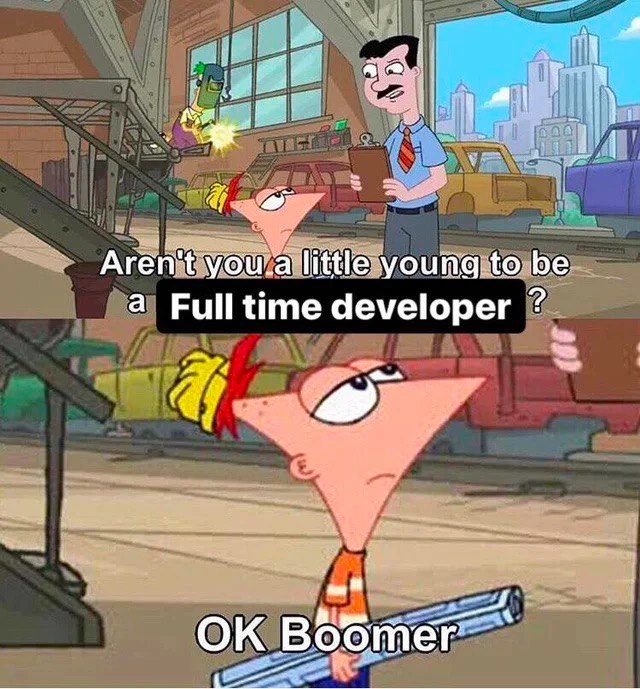
Let’s break down what’s happening in simpler terms. The meme uses a scene from the cartoon Phineas and Ferb. Phineas is a little kid who builds fantastical inventions in his backyard. In the image, he’s got a yellow hard-hat on, working in a big workshop. An adult man with a clipboard (maybe an inspector or boss-type character) is looking down at him. The adult asks, “Aren’t you a little young to be a full-time developer?” as if he can’t believe a kid could have a real developer job. That question – “Aren’t you a little young…?” – is something people in real life sometimes ask very young programmers. It’s a form of gatekeeping, which means trying to set an unfair barrier for who gets to belong in a group. Here the “barrier” the older guy is suggesting is age: basically saying “You’re not old enough to be doing this seriously.” It’s a jab that many junior developers (especially those who started early or look young) have heard at least once, whether in jest or in doubt.
Now, Phineas’s response in the meme is simply, “OK Boomer.” This is a slangy comeback. Let’s unpack it: “OK Boomer” is a popular phrase that young people (like Gen Z, which means people born in the late 1990s and early 2000s) use to reply to older folks when they feel those older folks are being condescending or out-of-touch. “Boomer” literally refers to the Baby Boomer generation (people roughly in their 55-70s today), but in internet slang it became a shorthand for “older person who just doesn’t get it.” Saying “OK Boomer” to someone is a pretty snarky (mocking but in a funny way) dismissal. It’s like saying, “Yeah, whatever you say, grandpa,” but “OK Boomer” sounds a bit more meme-y and less outright rude. In late 2019, this phrase was everywhere in memes and TikToks – it was the younger generation’s jokey way of pushing back against any stereotype or lecture coming from an older generation. In a workplace scenario, a junior developer wouldn’t normally say this to a senior colleague or a manager (that could be career suicide or at least pretty disrespectful face-to-face!), but the meme lets the junior character say it for us, which is why it’s funny.
So why is this relevant to developers, and why are people in tech laughing at this? The tags JuniorVsSenior and DeveloperHumor give a clue: it’s highlighting the tension (and funny moments) between junior devs and senior devs. A junior developer is someone new to the industry – maybe a recent college grad, a coding bootcamp alumnus, or even a teenager who just got hired straight out of high school. A senior developer is someone with many years of experience (sometimes someone who’s also older in age, though not always). In tech, there’s often a running joke about how juniors think they know everything (because they’re up-to-date on the newest technology), and seniors think the juniors actually know very little (because they lack the historical knowledge or haven’t been burned by enough real-world projects yet). This meme is squarely poking fun at the senior attitude that “you’re too young to be good at this job.” It’s a form of developer_ageism – assuming someone’s ability or maturity level just by their age.
The context mentions early_career_devs and developer_ageism, which are real things in tech. Early career devs can be incredibly skilled – sometimes they’ve been coding as a hobby since they were kids, or they might have fresh knowledge of the latest frameworks and best practices taught in school or online. However, they might face skepticism when joining a team. An older teammate might tease, “I have socks older than you!” or a hiring manager might double-check that the prodigy actually graduated high school. Meanwhile, the early career dev might feel a bit of imposter syndrome (feeling like a fraud) if people keep highlighting how young they are instead of what they can do. So when Phineas just shoots back “OK Boomer,” it’s a humorous wish-fulfillment. It’s the junior saying, “I’m young, yes, but I know what I’m doing – stop judging me by my age.” And because it’s framed as a joke in a meme, it opens up a conversation about generation_z_engineers being truly capable, and how the tech industry should maybe drop some of that old-school bias.
We should also note how the Phineas and Ferb cartoon setting amplifies the joke. In the background, you see an elaborate workshop with welding sparks flying. Phineas is holding a rolled-up blueprint. In the show, these kids build things like rocket ships on a whim. That visual exaggeration – a literal child performing advanced engineering – mirrors the way older developers metaphorically view extremely young colleagues in real life. It can feel just as jarring to a 50-year-old engineer to see a 19-year-old commit production code as it is to see Phineas building a roller coaster in his backyard. The meme format using this specific cartoon scene was already a known cartoon_meme_format for highlighting youth doing big things. By superimposing the text about being a “Full time developer,” it custom-tailors the joke to our software industry. So anyone who’s a fan of the show will recognize the setup, and anyone in tech immediately gets the twist: Phineas isn’t just building any project, he’s symbolically deploying code to production at an age that makes the ‘Boomers’ raise an eyebrow. And his comeback shuts that incredulity down with one meme-tastic phrase.
In summary, at this level, we understand the meme is about a young programmer getting flak for being “too young” in a full-time role and responding with a confident, meme-famous comeback. We’ve defined key terms: “OK Boomer” (young folks’ dismissive reply to outdated attitudes), gatekeeping (saying someone doesn’t qualify for arbitrary reasons like age), Baby Boomer (older generation the phrase riffs on), junior developer (new/young engineer), and senior developer (experienced/older engineer). It’s a slice of DeveloperHumor rooted in real generational dynamics at work, exaggerated through a fun cartoon reference. The reason it’s shared so much is because it’s a RelatableDevExperience – many of us have either been the young person eager to prove ourselves or the seasoned person startled by how the new kids seem to grow younger every year. And in this meme, the youthful side scores a tiny victory with a punchy one-liner.
Level 3: Generational Clapback
In the first panel of this meme, a seasoned authority figure (in a suit, holding a clipboard) asks the question: “Aren’t you a little young to be a Full time developer?”. This scene immediately evokes the all-too-familiar IndustryStereotypes of tech: an older professional questioning a very young engineer’s legitimacy. It’s a classic case of age-based gatekeeping. The phrase “Full time developer” is even highlighted in bold white-on-black, as if it’s a title that the older guy thinks should come with an unwritten minimum age. Anyone who’s spent time in DeveloperCulture has seen a version of this – that skeptical senior engineer or hiring manager implying, “Kid, do you really have the chops to be here full-time?”. It’s a mix of CareerHumor and mild condescension that sets the stage for a punchline.
The second panel delivers that punchline perfectly. The young character (Phineas, from Phineas and Ferb) doesn’t even blink; he just deadpans “OK Boomer.” Two words, and the generational power dynamic flips on its head. For context, “OK Boomer” was a viral catchphrase in 2019 – a witty retort Gen Z and millennials used to dismiss patronizing comments from older folks (especially those of the Baby Boomer generation). In tech circles, it became the go-to comeback when an older colleague would say something like, “Back in my day, we coded in assembly – these kids and their JavaScript frameworks have it easy,” or “You need decades of experience to understand real software engineering.” The young devs’ tongue-in-cheek answer? “OK Boomer.” Translation: “Alright, old-timer, whatever you say.” It’s GenerationalHumor distilled into a meme-friendly one-liner, signaling that the comment is out-of-touch.
What makes this especially funny to veteran developers is the role reversal happening via a cartoon. In Phineas and Ferb, there’s a running gag where an adult asks, “Aren’t you a bit young to be doing this?” whenever Phineas embarks on some elaborate engineering project. Phineas always politely replies, “Yes, yes I am,” and then continues anyway, highlighting how absurdly skilled he is despite his age. The meme riffs on that setup: instead of Phineas’ polite deflection, we get a spicier response with “OK Boomer”. It’s as if the Generation_Z_engineers of today have run out of patience with polite answers. Phineas, the early_career_dev prodigy, delivers the same message a real Gen-Z programmer might feel: I may be young, but I know what I’m doing – and I’m tired of your outdated skepticism. The humor is the DeveloperHumor reality that sometimes the JuniorVsSenior divide leads to seniors underestimating juniors, and juniors clapping back in meme-speak.
Beneath the humor, there’s a grain of truth that seasoned devs and newbies alike will recognize. In modern tech, skill can scale faster than age. It’s not unheard of for a 17-year-old self-taught coder to land an internship and then transition straight into a Full time developer role, contributing production code while their high school diploma is still fresh. Many of us have met that precocious junior developer who started coding Python at 13, pushed apps to GitHub at 15, and by 18 is deploying microservices in a startup. Meanwhile, the older generation remembers a time when software engineering was a more niche field, often requiring formal degrees and years of climbing the ladder. This mismatch can breed developer_ageism in both directions: older devs might be incredulous (or even a bit jealous) that someone so green could already be a peer, while young devs might feel the “OK Boomer” rise in their throat every time they’re patronized for lacking “real experience.” The meme captures that tension and defuses it with comedy. The absurdity of a cartoon kid in a construction workshop telling off a clipboard-wielding adult mirrors a real workplace scene, just exaggerated to TechMemes perfection.
Finally, consider how this plays out in everyday RelatableDevExperience. Maybe you’ve been the young gun on a team, asked half-jokingly by an older colleague if you were even born when dial-up internet was around. Or perhaps you’re the veteran who jokingly said to a new hire, “Wow, you’re coding full-time at 21? I was still fixing photocopiers at your age.” In either case, the “OK Boomer” meme is a lighthearted pressure release. It says what the junior wishes they could say in a meeting (but usually wouldn’t). It also gives the seniors a chuckle, reminding them not to take themselves too seriously. After all, tech is an ever-evolving field – today’s fresh-faced Gen Z engineers bring new energy and perspectives, just like the Boomers and Gen-Xers did in their youth. The meme’s popularity in late 2019 shows how timely the joke was: it was a period of intense generational dialogue, and here in our niche world of code and keyboards, we got our own spin on it. “OK Boomer”, in this context, is the junior developer’s way of cheekily saying “Respectfully, I’ve got this. Let’s move on.” It’s concise, a bit rebellious, and incredibly satisfying for anyone who’s ever felt underestimated due to their age.
Description
A two-panel meme from the cartoon Phineas and Ferb. In the top panel, an adult man with a clipboard looks at the character Phineas and asks, "Aren't you a little young to be a Full time developer?". In the bottom panel, Phineas looks unimpressed and replies with the text "OK Boomer" at the bottom of the frame. The meme humorously captures the generational divide and stereotypes within the tech industry, where young prodigies and skilled developers are common, challenging traditional notions of age-based experience. The dismissive "OK Boomer" response reflects a younger generation's frustration with perceived outdated perspectives from older colleagues
Comments
7Comment deleted
Some careers measure experience in years. In software, we measure it in frameworks you've seen die
When the kid’s daily stand-up overlaps with homeroom, you know succession planning just got CI/CD-level fast
Meanwhile, the same person asking this question has been copy-pasting Stack Overflow answers for 20 years and still can't explain why their singleton pattern needs to be thread-safe
The irony here cuts deep: the same industry that celebrates 22-year-old founders disrupting trillion-dollar markets suddenly clutches its pearls when a junior dev doesn't have a decade of experience. Meanwhile, that 'boomer' probably still thinks Git is something you yell at kids on your lawn, and the 'too young' developer has already shipped more production code than most enterprise architects review in a quarter. Age and experience correlate about as well as lines of code and software quality - which is to say, not at all, but everyone pretends they do during performance reviews
Kid's blueprint? Probably a zero-downtime monolith-to-microservices refactor boomer's team punted for 20 years
Production only reads MTTR and p95 latency; birth year is a non-functional requirement at best
Req says 8 years of Kubernetes; the “kid” replies, “I wrote the Helm chart you copy to prod - maybe put age checks in IAM, not the job post.”