Skip to content
DevMeme
1118 of 7435
Python's Exclusive Relationship with Slicing
Languages Post #1250, on Apr 4, 2020 in TG

Python's Exclusive Relationship with Slicing

Why is this Languages meme funny?

Level 1: Where’s the Last One?

Imagine you have 4 toys labeled 0, 1, 2, and 3. You tell your friend (who follows special “Python” rules): “Please hand me the toys from number 0 up to number 3.” You might think you’ll get toys 0, 1, 2, and 3 – essentially all four toys. But your friend only gives you the toys labeled 0, 1, and 2, stopping right before the toy labeled 3. You look at your friend, a bit confused, and ask, “Hey, where’s the last one?” Your friend shrugs and says, “I gave you everything up to 3, just like you asked!” – leaving out the 3.

That little misunderstanding is exactly what’s happening in the meme. The person thought asking for 0 through 3 would include the item 3, but Python only gave the items before 3. It’s funny in the way a misunderstanding can be funny: the instruction sounded clear, yet the result wasn’t what we expected. The meme makes us laugh because we feel the surprise of that missing last item – and now we know that when Python serves a slice “up to 3,” it keeps 3 for itself unless we ask for one number higher!

Level 2: Inclusive vs Exclusive

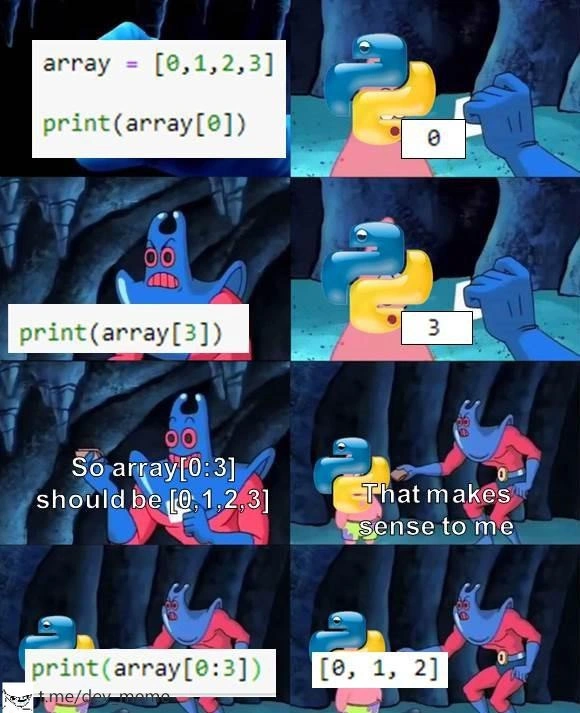
Let’s break down what’s happening in this DeveloperHumor meme. We have a Python list named array with values [0, 1, 2, 3]. In Python (and many languages), lists are zero-indexed, meaning the first element is index 0, the second is index 1, and so on. So array[0] is 0 (the first element) and array[3] is 3 (the fourth element). The meme shows that part clearly: calling print(array[0]) outputs 0, and print(array[3]) outputs 3. No surprises there.

Now, Python’s slice notation uses a start and end index separated by a colon : like array[start:end]. The key detail is that the end index is exclusive. “Exclusive” means Python will stop before that index. So array[0:3] starts at index 0 and includes 0, 1, and 2 – but not index 3. In code, it looks like:

array = [0, 1, 2, 3]
print(array[0:3])  # Output: [0, 1, 2]

The developer in the meme expected [0, 1, 2, 3] because they thought the slice might be inclusive (including the end index 3). This misunderstanding is common if you’re new to Python or coming from a different mental model. In some contexts, when we say “from 0 to 3,” we mean inclusive of both 0 and 3. But Python doesn’t work that way for slicing. The rule is: include the start index, exclude the end index. You can remember it by thinking that the range 0:3 covers indices 0, 1, 2 – it stops right before 3.

This design is actually intentional. For instance, Python’s built-in range() function works similarly: range(0, 3) produces the sequence 0, 1, 2. It might feel a bit odd at first (why not give 3 as well?), but it makes certain things easier. If you want the first 3 elements of a list, you do array[0:3] and get exactly 3 elements. If you wanted the first 4 elements, you’d do array[0:4]. The number of elements you get is the difference between the indices. In general, array[a:b] will give you b - a elements. This consistency helps once you get used to it.

The meme’s joke is a lighthearted language quirk moment. The blue fish character saying “So array[0:3] should be [0,1,2,3]” is the developer assuming an inclusive slice. The Python snake replying “That makes sense to me” is a tongue-in-cheek nod – even Python might acknowledge that the assumption seems reasonable in plain English, yet Python will still do what it was designed to do. When the code runs (print(array[0:3])), the output is [0, 1, 2], catching our poor fishy friend off guard. It’s a classic off_by_one_meme scenario – being off by one index because of the exclusive end. Once you learn this rule, you won’t be shocked next time. In fact, you’ll start to expect it and appreciate how slices work consistently with other parts of Python. But the first time, it’s definitely a “gotcha!” moment.

Level 3: Half-Open Surprise

In Python’s world of zero-based indexing, slices use a half-open interval convention – a fancy way of saying “include the start index, exclude the end index.” This meme humorously captures a classic array_slice_gotcha: a developer expects array[0:3] to return [0, 1, 2, 3], but Python silently hands back only [0, 1, 2]. Experienced developers smirk at this because they’ve been that confused fish character before. It’s a rite-of-passage in Python to learn that 0:3 means “start at index 0 and stop right before index 3.”

Why design it this way? Python follows a long-standing CS fundamental: half-open ranges make many operations simpler and less error-prone. In a half-open range [start:end), the length of the slice is simply end - start. For example, len(array[0:3]) == 3 because it includes indices 0,1,2 – three elements. If Python slices were end-inclusive, the length would be less straightforward (you’d have to do end - start + 1). Also, half-open intervals compose neatly: array[0:3] and array[3:6] cover non-overlapping adjacent sections. This convention helps avoid the off-by-one errors that plague many algorithms. Ironically, it does introduce a one-off surprise for newcomers!

The humor resonates with developers because it satirizes that “Wait, what?!” moment. In the meme’s SpongeBob reaction meme panels, a bewildered blue fish (the developer) shows a Pythonic snake a card saying “So array[0:3] should be [0,1,2,3]”. The Python-snake confidently replies, “That makes sense to me,” playing along with the mistaken logic – and then Python delivers a slice missing the last element. It’s a perfect comic setup of expectation vs. reality. This is relatable CodingHumor: we’ve all assumed a language would behave one way (perhaps from another language’s LanguageQuirks or just intuition) and then gotten schooled by a subtle rule. The meme is poking fun at Python’s python_slice_exclusive_end rule, illustrating a tiny “lesson learned the hard way.” Seasoned devs chuckle because they remember writing similar code and momentarily thinking “off-by-one error, or did I just discover a bug in Python?” – only to recall, ah yes, slices exclude the end. The punchline is that Python’s behavior is logical and consistent (the snake saying “That makes sense to me”), yet it still manages to startle those who aren’t in on the rule.

Description

An eight-panel meme using the 'Patrick Star's Wallet' format from Spongebob Squarepants to illustrate a common point of confusion in Python programming. A character (Man Ray) interacts with Patrick Star, who has the Python logo superimposed on his head, representing the Python interpreter. The meme demonstrates array indexing: `array[0]` correctly returns `0` and `array[3]` returns `3`. The developer character then logically assumes `array[0:3]` should produce the full list `[0,1,2,3]`, to which the Python-headed Patrick seems to agree. The punchline comes in the final panels when the code `print(array[0:3])` is executed, and the output is `[0, 1, 2]`, to the developer's shock. The humor hinges on the behavior of Python's list slicing, where the end index is exclusive. This is a classic 'gotcha' for developers new to Python, who expect the slice to be inclusive of the final index
Comments

7
Anonymous ★ Top Pick Python's list slicing is the original 'it's not a bug, it's a feature.' It teaches you that in programming, as in life, the end is never included
  1. Anonymous ★ Top Pick

    Python's list slicing is the original 'it's not a bug, it's a feature.' It teaches you that in programming, as in life, the end is never included

  2. Anonymous

    Python didn’t fix the off-by-one bug; it shipped it as slice semantics - and 20 years later my staff engineers still sprinkle +1s in code reviews like Parmesan

  3. Anonymous

    After 20 years, I still explain Python slicing by drawing fence posts and fence sections on a whiteboard, then watch as junior devs have the same existential crisis I had in 2003

  4. Anonymous

    Ah yes, Python's slice notation - where `array[0:3]` gives you elements 0, 1, and 2, because apparently the end index is more of a 'suggestion of where to stop before reaching.' It's the programming equivalent of 'open until 9pm' meaning they lock the doors at 8:59. Senior devs have internalized this as 'half-open intervals' from their CS theory days, but watching junior developers discover that `range(10)` doesn't include 10 never gets old. At least it's consistent with how we all feel on Fridays: the weekend starts at index 5, but we're mentally checked out by 4

  5. Anonymous

    Half-open slices are the senior dev’s cheat code: len(a[i:j]) == j - i, turning off-by-one into a feature - until the PM reads “up to 3” in the spec

  6. Anonymous

    Python slicing: [0:3] grabs three elements but skips the fourth - exclusive ends, because who needs closure anyway?

  7. Anonymous

    Python slices are half-open: len(a[0:3]) == 3 is gloriously consistent while someone still points at 3 in code review asking where it went

Use J and K for navigation