Skip to content
DevMeme
1985 of 7435
The Flaw in the YouTube Recommendation Algorithm
AI ML Post #2212, on Nov 1, 2020 in TG

The Flaw in the YouTube Recommendation Algorithm

Why is this AI ML meme funny?

Level 1: The Overexcited DJ

Imagine you have a friend who’s a DJ at a party. One time, as a joke, you cheer and dance to a silly 1980s pop song that comes on – let’s say it was Rick Astley’s “Never Gonna Give You Up.” Now, your DJ friend sees that and thinks, “Wow, they really love 80s music!” Next thing you know, for the rest of the party (and the next couple of weeks whenever you hang out), that friend only plays 80s pop songs for you. Every time you get in the car, it’s nothing but 80s hits; every playlist they send you is stocked with synth-pop from the 80s. It’s like because you showed a tiny bit of interest once, they’ve decided that’s your entire personality now!

That’s exactly what this meme is joking about, but with YouTube instead of a friend. YouTube is acting like that overexcited DJ or friend: you clicked one 80s song (even accidentally), and YouTube got so excited that it kept giving you more and more 80s songs, thinking it’s making you happy. It doesn’t realize you might have heard that song as a prank or that you’re already kind of tired of 80s music. The joke is funny because we know nobody decides someone’s music taste from just one song, but the computer kind of did. It’s like making a big assumption from one little thing. We laugh because we’ve all had moments where a friend or a website totally misunderstood what we liked from just one example, and it can be both annoying and comedic.

Level 2: Overfitting 101

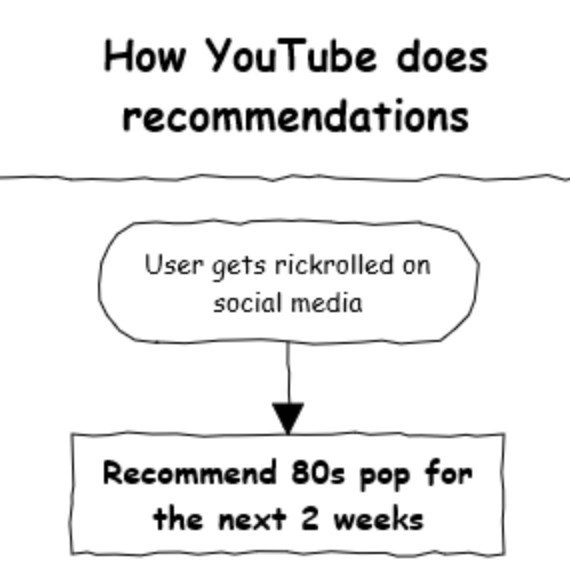
Let’s break down the joke for those newer to recommender systems and machine learning. The meme shows a simple flowchart titled “How YouTube does recommendations.” It starts with “User gets rickrolled on social media” and leads to “Recommend 80s pop for the next 2 weeks.” If you’re new to these terms:

  • “Rickrolled” means someone tricked the user into clicking a link that unexpectedly led to the music video for Rick Astley’s classic 1980s pop song “Never Gonna Give You Up.” It’s an old internet prank – you expect something else, but you get Rick Astley singing in his cheesy 80s glory. So, the user in this scenario didn’t intentionally seek out 80s music; they stumbled into it because of a joke.

  • YouTube’s recommendation algorithm is the system that decides which videos to suggest to you when you’re on YouTube (like the videos on your homepage or the “Up next” sidebar). It works by looking at what you’ve watched or liked in the past to predict what you might want to watch next. It’s a big part of AI in social media and content platforms.

Now, the joke is saying that if you watch just one 80s pop video (even by accident), YouTube might overreact and fill your recommendations with 1980s music for days on end (specifically, “the next 2 weeks”). This is referencing a concept in machine learning called overfitting. In simple terms, overfitting is when a model or algorithm learns from a very specific incident too much and assumes that incident tells the whole story about what you like. Here, the algorithm sees one video – a Rick Astley 80s hit – and seems to assume “aha, this user loves 80s pop!” without considering that it might have been just a one-time thing.

Why would YouTube do that? Well, these recommendation systems often use methods like collaborative filtering and content analysis. Collaborative filtering means the system looks at patterns across many users: for example, “people who watch Rick Astley also often watch other 80s pop songs or music from that era.” So if you suddenly watch Rick Astley, the algorithm might think you fit the pattern of an 80s music fan and start showing you what that group typically watches (maybe Michael Jackson, A-ha, or other hits from the 1980s). Another approach is content-based: “this video is an 80s pop song, so let’s recommend more videos from the 80s pop genre.” In either case, it’s taking one data point (your single viewing) and generalizing it into a recommendation spree. This is essentially single_data_point_bias – the system putting too much emphasis on one piece of data.

If you’re a new developer working with data, you might have encountered something similar. Imagine you write a program to recommend movies based on what someone watched recently. If that program isn’t careful, one day your friend watches a random documentary, and suddenly your program thinks “Okay, they only want documentaries now!” and shows nothing but documentaries until more data comes in. You’d have effectively overfitted to that one watch. The better approach would be to use more history or wait for a pattern (say, the user watches several 80s songs or regularly listens to that genre) before making a big change in recommendations.

The “next 2 weeks” part in the meme hints at how these algorithms use time and persistence. Many recommendation engines give a lot of weight to your recent behavior, assuming your interests can change. So right after that Rick Astley video, the algorithm might heavily tilt your recommendations toward similar content. Over time, if it notices you aren’t clicking those 80s songs and instead you go back to, say, watching tech tutorials or gaming videos, it will slowly realize “Hmm, maybe they’re not actually into 80s music” and the suggestions will shift again. That adjustment might take days or weeks (hence the joke of being stuck with 80s pop for two weeks). It’s poking fun at how slow or stubborn the algorithm can feel: for a while you’re bombarded with 80s hits, and you’re thinking “come on, I only clicked that once, I’m not that interested!”

In summary, this meme is a lighthearted way to explain overfitting in recommendation systems. It uses the rickroll – a famous prank – as the example of a quirky user behavior that confuses the algorithm. The humor comes from the exaggeration that such a complex system would behave in such a over-simplified way. As someone learning about DataScienceHumor and algorithms, it’s a reminder that even smart AI can make goofy mistakes if it doesn’t have enough data or context. The meme simplifies YouTube’s very advanced algorithm into a laughably basic flowchart, which is both funny and educational: it shows what can go wrong if an algorithm learns from too little data.

Level 3: Stuck in the 80s

To an experienced developer or data scientist, this meme lands as a tongue-in-cheek critique of recommendation engines like YouTube’s. The flowchart shows a comically simplistic logic: “User gets rickrolled on social media” → (therefore) “Recommend 80s pop for the next 2 weeks.” It’s funny because we know the real system involves billions of data points and sophisticated models, yet the outcome can feel absurdly one-dimensional just like this doodled flowchart. It captures that all-too-familiar scenario: you watch one off-genre video and your feed is suddenly flooded with related content. It’s as if the algorithm got overly excited about this one hint and is now stuck in the ’80s, blasting Rick Astley and A-ha at you non-stop.

This humor resonates with developers because it highlights a common industry problem: overfitting models to recent user behavior. It satirizes how a recommendation system can over-react to a single interaction. Many of us have experienced this: watch one nostalgic music video or click one random link, and the platform’s collaborative filtering engine suddenly pegs you as “the 80s music guy” (or “obsessed with whatever that one video was”). It’s a classic case of collaborative_filtering_gone_wrong. In collaborative filtering, the algorithm finds patterns like “users who enjoyed Rick Astley often also enjoyed other 80s pop songs.” So when you get rickrolled, the system essentially says: “Aha! You enjoyed that (it doesn’t know it was a prank), people similar to you then binge on 80s hits, so you probably want more 80s hits.” Engineers recognize this as a feedback loop issue: the system is feeding you what it thinks you liked, thereby potentially pushing you further into that theme – even if your initial watch was a fluke.

Why is the meme specifically about “two full weeks” of 80s pop recommendations? In practice, many recommendation algorithms give extra weight to your recent activity (often a sliding window or exponential decay on user behavior data). It’s likely exaggeration, but not by much – frequently the boost from a single video can last days or more if not counteracted by other watches. Two weeks is humorously specific, hinting that YouTube’s algorithm might persist with a new content trend for quite a while before it realizes you’re not interested. This aligns with user anecdotes: “I watched one cooking tutorial and for the next month my homepage was nothing but cooking!” The timeframe implies the algorithm’s decay rate for interests is slow, so it keeps recommending that genre in case you’re still into it. As a developer, you might chuckle and cringe because it means the system isn’t detecting the user’s disinterest quickly – there’s no strong negative feedback unless the user explicitly clicks “Not interested.” Until the algorithm collects enough evidence that you’re ignoring all those 80s suggestions (or you start watching something else to steer it), it’s essentially locked onto that target.

The mention of being rickrolled “on social media” is also key. Context matters: if a user came to that video via an external link (a prank on Twitter or Reddit), a smart recommendation system would perhaps treat it differently than if the user searched for “80s pop hits” on their own. But the joke implies YouTube’s system isn’t that nuanced — it sees a view as a view. From an engineering perspective, we know real-world systems do incorporate some context (like how you found the video, how much of it you watched, etc.), but errors happen when those signals are misinterpreted or weighed incorrectly. Maybe the user actually watched the whole Rick Astley video (let’s face it, some folks watch the rickroll all the way through because the song is ironically enjoyable). The algorithm likely measures watch time and completion rate; seeing a near-100% watch on a music video, it infers “this user loved it!” Boom – positive reinforcement. The humor (and pain) here is that the algorithm can’t tell a prank from genuine interest.

For seasoned engineers, this scenario also reflects internal KPIs and incentives that drive such outcomes. Platforms like YouTube optimize for engagement (watch time, click-through). So the recommendation engine is rewarded when it finds something that grabs you – even if it’s by accident. Once it finds that hook (you did watch that video after all), it will try to maximize engagement by giving you more of the same. It’s a greedy strategy: exploit any signal of interest to keep the user’s attention. The meme mocks this greedy approach by reducing it to a childishly simple strategy in the flowchart. It’s algorithm humor with an edge of truth — engineers recognize the tension between what an algorithm should do (act intelligently, understand the user’s broader tastes) and what it actually does under pressure to boost metrics (spam you with related content from one data point).

In summary, at the senior level we’re laughing (perhaps a bit darkly) because we’ve been there: building or debugging a system that made embarrassingly naive recommendations due to overfitting on a spike in data. The meme encapsulates that shared experience: all the fancy data science and AI in the world, yet sometimes it behaves like a dumb if-then rule. It’s a reminder that DataScienceHumor often springs from real limitations of our algorithms. And let’s be honest, we also find it funny because we can’t hear “Never Gonna Give You Up” without suspecting our YouTube feed is about to time-travel to 1987 for the next half-month.

Level 4: One-Hit Wonder Overfitting

From a deep machine learning standpoint, this meme highlights an overfitting issue in a recommender system. In ML terms, overfitting happens when a model learns patterns from one specific example (or a small set of data) so intensely that it starts treating noise or a one-time event as general truth. Here, the one-time event is the user getting rickrolled – clicking a disguised link on social media that led to Rick Astley’s 1987 hit “Never Gonna Give You Up.” In a perfect world, a robust YouTube recommendation algorithm would recognize this as a possibly anomalous event (especially since it came from social media, not the user’s usual viewing habits). But in practice, large-scale recommendation models can behave as if that one surprise viewing is a signal of a new passion, effectively reconfiguring the user’s profile toward 1980s pop music.

Modern recommendation engines (like those behind YouTube) often use high-dimensional embedding vectors to represent a user’s taste. Each video (and each user) is mapped into a multi-dimensional space. If a user suddenly watches an 80s pop video, the algorithm updates the user’s preference vector to move closer to the vector representing 80s pop lovers. Formally, you can imagine the user’s preference vector $\mathbf{u}$ being nudged in the direction of the Rick Astley video’s feature vector $\mathbf{v}_{Rick}$:

# Pseudocode: updating user profile based on a newly watched video
user_profile_vector = user_profile_vector + learning_rate * rick_astley_video_vector

In this simplified representation, rick_astley_video_vector has a strong component for 80s pop, so this update spikes the user's affinity for that genre. If the system’s learning rate or weighting for new interactions is high, a single “Never Gonna Give You Up” watch can tilt the user profile significantly. The result? The recommendation model now ranks 80s pop content much higher for this user. Technically, the algorithm has latched onto a single data point bias and amplified it. This is reminiscent of collaborative_filtering_gone_wrong, where one action has outsized influence: in collaborative filtering terms, it’s as if the system shouted “Oh, you’re in that cluster of users now!” based on one video.

Why would a sophisticated system do this? It comes down to the trade-off between reactivity and stability in personalized AI/ML systems. YouTube’s algorithm (a complex beast involving deep neural networks and gradient-boosted decision trees under the hood) is tuned to quickly adapt to changes in user behavior – if you suddenly start watching cooking videos, it wants to serve you more before you wander off. It’s performing a constant balancing act between exploration vs. exploitation: exploring new content vs. exploiting what it thinks you already like. A sudden Rick Astley view is interpreted as exploration success – the user found something new they enjoyed – so the system immediately pivots to exploitation mode, doubling down on that content. The downside is this short-term bias amplification: the algorithm overreacts to a transient signal, essentially overfitting the recommendation model to a single interaction.

This “one-click training for two weeks” behavior underscores a fundamental challenge in DataScience and recommender design: distinguishing a genuine shift in user interest from a blip. In academic terms, it’s about filtering out noise vs. signal. If the system doesn’t incorporate some form of dampening (like a time decay that quickly forgets one-off events or a rule that checks for more than one data point before committing to a trend), it ends up doing exactly what the meme jokes about. The humor here for AI/ML folks is that a massively complex recommendation pipeline can effectively boil down to a silly rule: user watched one 80s video ⇒ user is an 80s fan now. It’s an algorithm humor cautionary tale: even a state-of-the-art model can act like a naive classifier if it isn’t carefully regularized. In summary, the meme nails a truth in MachineLearning: without the right checks, a model will be "Never Gonna Give You Up" if you give it even a single reason not to. It’s both hilarious and a bit terrifying that our advanced algorithms can display such one-hit wonder overfitting behavior.

Description

A simple, hand-drawn flowchart meme that satirizes how YouTube's recommendation algorithm works. The title at the top reads 'How YouTube does recommendations'. The flowchart consists of two steps. The first step, enclosed in a rounded rectangle, says 'User gets rickrolled on social media'. An arrow points from this to the second step, in a sharp-cornered rectangle, which reads 'Recommend 80s pop for the next 2 weeks'. The humor is rooted in a widely shared user experience where a single, often unintentional, interaction with a piece of content - in this case, the classic 'rickroll' prank - causes an algorithm to incorrectly assume a deep interest. The system then over-saturates the user's feed with related but unwanted content. For developers, this is a pointed critique of naive recommendation engines that overfit on single data points, highlighting the challenge in building systems that can distinguish genuine user intent from anomalous or accidental views
Comments

10
Anonymous ★ Top Pick YouTube's recommendation algorithm is just a state machine with two states: 'guessing what you want' and 'aggressively reminding you of that one time you clicked on a sea shanty video by mistake.'
  1. Anonymous ★ Top Pick

    YouTube's recommendation algorithm is just a state machine with two states: 'guessing what you want' and 'aggressively reminding you of that one time you clicked on a sea shanty video by mistake.'

  2. Anonymous

    In our recsys post-mortem we discovered one accidental rickroll skewed the embeddings so hard that the principal component became “80s nostalgia” - turns out the only thing with higher cosine similarity than Rick Astley is our tech debt

  3. Anonymous

    After 15 years of building sophisticated deep learning models with billions of parameters, YouTube's recommendation system still hasn't figured out the difference between 'user clicked on a rickroll link as a joke' and 'user wants to relive their entire 1987 summer camp experience' - proving that even transformers can't transform correlation into causation

  4. Anonymous

    This perfectly captures the classic cold-start problem in reverse: YouTube's recommendation system demonstrates impressive recall but catastrophic precision when it decides that one rickroll means you're ready to pivot your entire music taste to the Reagan era. It's like a recommendation engine that learned from a single training example and decided to overfit so hard it turned your feed into a time machine - proof that even with petabytes of behavioral data, sometimes the algorithm just really wants you to never give up on 80s synth-pop

  5. Anonymous

    Apparently their bandit runs with epsilon=0 and watch-time as the only reward, so one rickroll overfits my feed for a fortnight

  6. Anonymous

    One rickroll from social and YouTube’s recsys pins your latent vector to 80s synthpop - then the bandit sets epsilon=0 and “Never Gonna Give You Up” becomes your entire personality for two weeks

  7. Anonymous

    Overfitting 101: one rickroll training sample, and your recsys deploys eternal 80s pop exploitation

  8. @AmindaEU 5y

    https://music.youtube.com/watch?v=-mLpe7KUg9U&feature=share

  9. @Kikadal 5y

    А я и не против

  10. @NiKryukov 5y

    I see this as absolute win

Use J and K for navigation