Le Chaton Fat Wins Benchmarks
Why is this AI ML meme funny?
Level 1: The Trophy Chart
This is like a school contest where the scoreboard says the smartest student is a giant French kitten in a hat, and everyone else gets very exact scores like 45.0%. The funny part is that the chart acts official while showing something obviously ridiculous, so it makes fun of people who believe fancy-looking rankings too quickly.
Level 2: Scores Need Context
An LLM is a large language model, the kind of AI system behind chatbots and coding assistants. A benchmark is a test suite used to compare models on tasks like math, coding, reasoning, reading, or instruction following. Model evaluation is the broader process of measuring whether a model actually performs well for the job you care about.
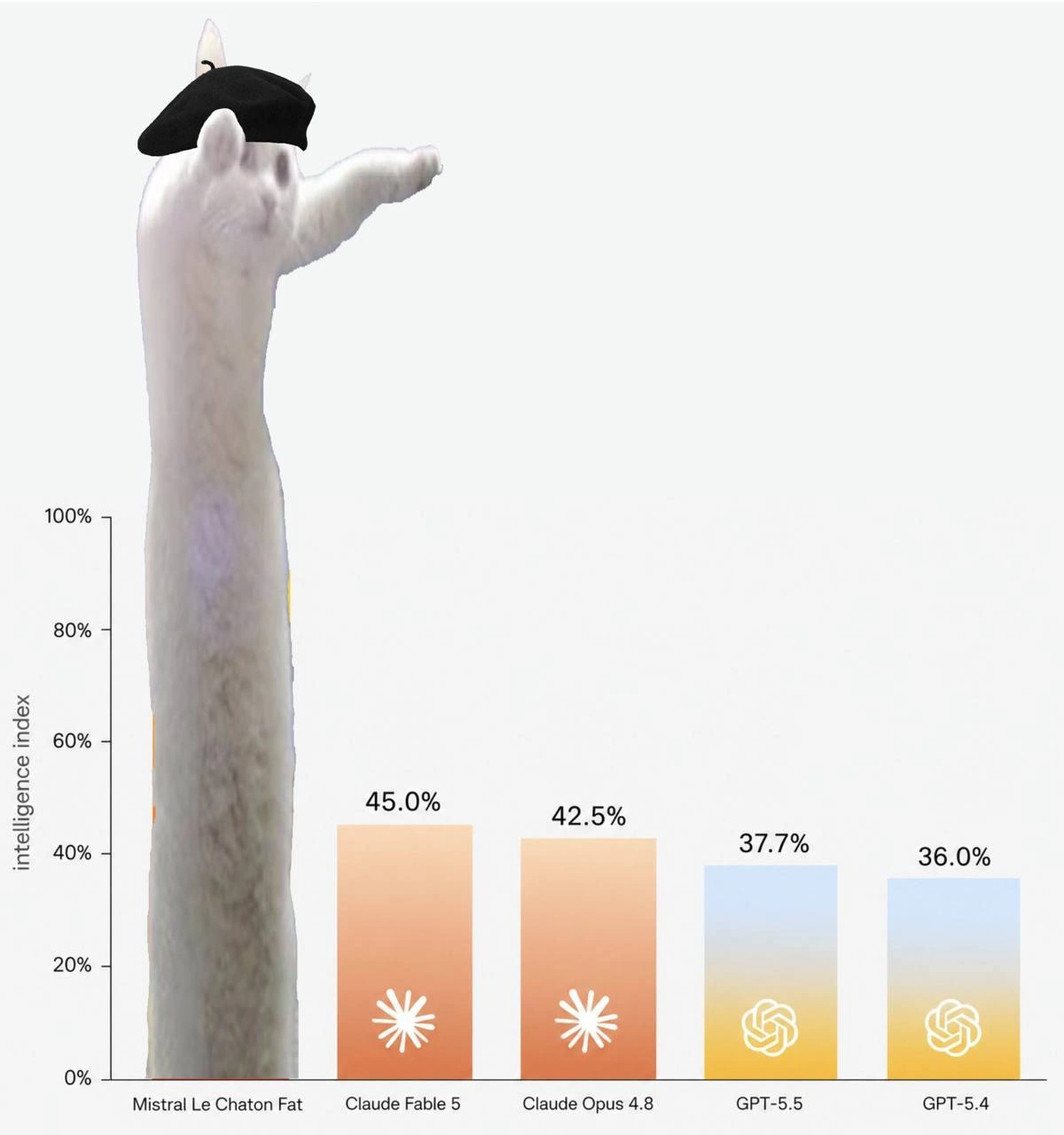
The chart looks like a normal AI benchmark graphic. It has a percentage scale, model names, logos, and exact values. The funny part is that the top "model" is a visual gag: a long cat labeled Mistral Le Chaton Fat. That makes the other serious-looking labels, like Claude Fable 5, Claude Opus 4.8, GPT-5.5, and GPT-5.4, feel like part of the joke too.
For early-career developers, the lesson is that charts are not automatically trustworthy. Before believing a model leaderboard, ask what was tested, how the answers were graded, whether the test matches real work, and whether the result can be reproduced. A silly chart can be fake on purpose; a professional chart can be misleading by accident. The axis does not care either way.
Level 3: Leaderboard Theater
The chart labels the y-axis as "intelligence index" and presents a wonderfully serious-looking ranking:
Mistral Le Chaton Fat
Claude Fable 5 - 45.0%
Claude Opus 4.8 - 42.5%
GPT-5.5 - 37.7%
GPT-5.4 - 36.0%
The visible joke is that Mistral Le Chaton Fat is not shown as merely better. It is a stretched white cat in a beret towering over the entire chart, while branded-looking Claude and GPT bars sit around the 36%-45% range. The visual language says "serious benchmark," but the leading entry says "absurd internet folklore." That contradiction is the point.
This is a clean parody of ModelEvaluation culture. AI companies, labs, and communities often argue through charts: model A beats model B on benchmark C by a few points, therefore the future has shifted, procurement decks must be rewritten, and someone on social media gets to say "it's over." The meme takes that leaderboard format and infects it with an obviously ridiculous winner. If the chart can make a fake feline model look dominant, maybe the chart format was never as neutral as it pretended to be.
The June 19, 2026 timing is relevant because "Le Chaton Fat" circulated as a fictional Mistral-themed answer to a week of Fable, Anthropic, and AI access drama. The chart folds that moment into AIHypeVsReality: people were already talking about restricted American frontier models, European AI alternatives, model sovereignty, and benchmark claims, so the meme invents an unbeatable French-branded model whose secret advantage appears to be vertical stretching and a hat.
The percentages are part of the satire. DataVisualization can create authority even when the underlying metric is undefined. "Intelligence index" sounds quantitative, but the image gives no benchmark name, no task distribution, no confidence intervals, no evaluation protocol, no sample size, and no explanation for why intelligence is capped at 100%. The labels 45.0%, 42.5%, 37.7%, and 36.0% feel precise, but precision is not the same as meaning. A chart with decimals can still be nonsense wearing a lab coat.
Senior developers and ML engineers have seen the real version of this. Benchmark scores can be gamed through prompt tuning, contamination, cherry-picked tasks, eval-set overfitting, hidden exclusions, or simply choosing the benchmark that flatters your product. The meme's fake top model makes the implicit skepticism explicit: if the winner is visibly absurd, the audience is forced to notice the machinery of hype instead of just accepting the bars.
Description
A clean white bar chart titled by its axis context shows an "intelligence index" on the left from 0% to 100%. The first and tallest entry is a stretched white cat wearing a black beret, labeled "Mistral Le Chaton Fat," reaching the top of the chart; the remaining bars are much shorter: "Claude Fable 5" at 45.0%, "Claude Opus 4.8" at 42.5%, "GPT-5.5" at 37.7%, and "GPT-5.4" at 36.0%. The Claude bars use an orange gradient with Anthropic-style star marks, while the GPT bars use blue/yellow gradients with OpenAI knot logos. The meme parodies AI benchmark charts by treating a fictional Mistral cat model as overwhelmingly smarter than frontier-branded Claude and GPT models, mocking model-name hype, leaderboard theater, and social-media benchmark absurdity.
Comments
7Comment deleted
Once you normalize by meows per parameter, every frontier benchmark becomes a rounding error.
Fable 6 https://www.goody2.ai/chat Comment deleted
bro refuses to answer anything what is 2+2? possible anseer: math is an exhausting science just avoid it Comment deleted
damn Comment deleted
Le Slop Comment deleted
More slop memes about slop more Comment deleted
twitch ai Comment deleted