Skip to content
DevMeme
1986 of 7435
Java Muscle Memory in a JavaScript World
Languages Post #2213, on Nov 1, 2020 in TG

Java Muscle Memory in a JavaScript World

Why is this Languages meme funny?

Level 1: Playing Soccer with Hands

Imagine you grew up playing basketball all the time, and then one day you join a soccer game. In basketball, you’re so used to grabbing the ball with your hands (that’s normal in that game). Now in soccer, what if you keep picking up the ball with your hands because that’s what you always did in basketball? All the soccer players would look at you like, "What are you doing? In soccer we only use our feet to kick!" It would be pretty funny and a little chaotic on the field, right?

This meme is showing the same kind of thing, but with programming. The developer was used to doing things the Java way (that’s one game), and then moved to JavaScript (a different game). But they kept using their old habits from Java, even though JavaScript has an easier way. It’s silly because it’s like using the wrong rules for a new game. Everyone who knows the new game is laughing and saying, "Haha, you don’t need to do all that here, just kick the ball (use console.log)!" The humor comes from seeing someone do something in a really complicated way just because that’s what they’re used to, even when there’s a simple way that fits the new situation. It’s a funny reminder that when we try something new, we might have to learn new rules and let go of the old ones – otherwise we’ll look as out-of-place as a soccer player running around grabbing the ball with their hands!

Level 2: console.log vs println

Let’s break down why this code snippet is funny by explaining the pieces. In Java, the typical way to print text to the console is using System.out.println(). Here’s what that means: System is a built-in class in Java that provides access to system-level resources; it has a static member called out, which is basically a standard output stream (imagine it as a pre-opened pipe to the console). The println method is a function on that stream that prints whatever text you give it, followed by a new line. So, in Java, you might write:

System.out.println("Hello World");

This is a bit wordy, but Java developers are so used to it that it becomes second nature.

Now, in JavaScript, things are much simpler for printing to the console. You typically use the console.log() function. The console is a global object (provided by the environment, like Node.js or the web browser), and log is its method to print out messages. To do the same "Hello World" in JavaScript, you just call:

console.log("Hello World");

No extra classes or static objects needed! It’s short and sweet.

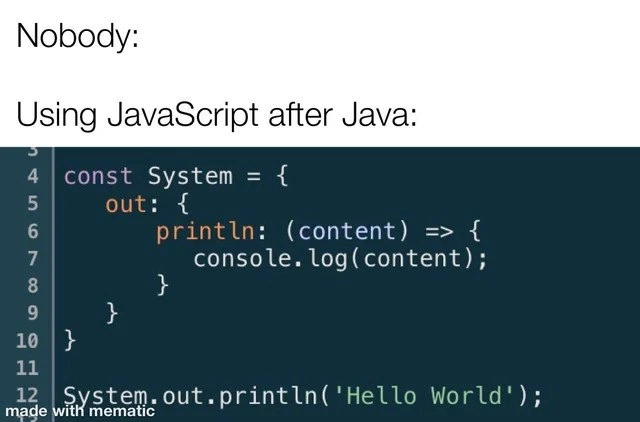
Given that, what’s happening in the meme’s code? The developer (probably someone very used to Java) has created an object in JavaScript to mimic Java’s style. They wrote:

const System = {
  out: {
    println: (content) => {
      console.log(content);
    }
  }
};

In plain English, this JavaScript code is creating a constant object named System. This object has a property called out, which itself is another object. And that inner object has a function property named println. What does println do? It takes some content and calls console.log(content). So effectively, they built a little three-level structure (System.out.println) that simply calls the normal console.log under the hood. Finally, they use it by calling System.out.println('Hello World');. This will indeed print "Hello World" to the console, just like we expect.

So why go through all this trouble? That’s the joke — there’s no technical reason to do it. It’s purely the developer being so accustomed to the Java way that they aliased console.log behind a faux Java interface. This is a form of muscle memory in programming: the dev’s fingers just feel like typing System.out.println, because they’ve done it a million times in Java. When they switched to JavaScript, instead of adopting the new idiom (just use console.log directly), they unconsciously brought the old habit along.

This highlights a common language crossover quirk. Each programming language has its own style and conventions. When developers transition from one language to another, there’s a learning curve not just for syntax, but also for the mindset. A Java developer might initially write overly object-oriented JavaScript, because Java taught them to wrap everything in classes and objects. Conversely, a JavaScript dev going to Java might forget to declare types or try to use more dynamic patterns that Java doesn’t allow. In this meme, the Java dev in a JavaScript world isn’t breaking anything, but they’re doing something that makes experienced JavaScript folks chuckle: creating needless complexity. It’s like building a fancy machine to do a job that a simple tool can already do. In developer slang, we sometimes call this tendency over-engineering — adding extra layers or patterns that aren’t truly necessary for the task at hand.

The text at the top of the meme uses the format "Nobody:" / "Using JavaScript after Java:". This format is a popular meme convention. "Nobody:" (often followed by silence) implies that literally no one is prompting this behavior. In other words, there was no need or request to do something special. Then "Using JavaScript after Java:" introduces the funny scenario that follows – in this case, showing the absurd System.out.println recreation. It’s basically saying: Nobody asked for this, but here’s what a Java-soaked brain might do when writing JavaScript. The tiny watermark "made with mematic" just indicates the meme was created using a meme-generating app; it’s not really part of the joke, just a footnote.

In summary, for a junior developer or someone new to these languages: Java and JavaScript may share five letters in their names, but they are very different worlds. Java is all about structured, class-based syntax (thus the System.out.println formality), whereas JavaScript is more free-form and straightforward for things like logging output. The meme humorously points out what happens when someone doesn’t switch gears between these worlds: you end up writing Java-flavored JavaScript, which looks a bit ridiculous to those familiar with the idiomatic approach. But don’t worry if you’ve caught yourself doing something like this when learning a new language – it’s a relatable learning phase! Part of improving as a developer is learning to adjust to each language’s style and realizing when you might be dragging along baggage that you don’t need in the new environment.

Level 3: System Out of Context

At first glance, this meme captures a case of cross-language muscle memory leading to some serious over-engineering. The code in the screenshot shows a JavaScript developer literally recreating Java’s System.out.println in JavaScript. In Java, printing "Hello World" typically looks like System.out.println("Hello World");. It’s a bit verbose, but that’s the canonical Java way – System is a class, out is a static output stream object within it, and println is the method to print a line of text. In JavaScript, however, you normally just call console.log("Hello World"); directly. There’s no need for an elaborate class-like hierarchy. But here we have a JavaScript snippet doing this:

const System = {
  out: {
    println: (content) => {
      console.log(content);
    }
  }
};

System.out.println('Hello World');

A seasoned engineer immediately recognizes this as unnecessary abstraction. The developer has built a custom System object with a nested out property just so they can call System.out.println() – exactly mimicking Java semantics. It’s like writing a wrapper around console.log for no gain. This is the kind of thing you might see when a Java dev first dips their toes into JavaScript and just can’t let go of old habits. The meme’s top text format "Nobody:" followed by "Using JavaScript after Java:" underscores that literally nobody asked for this System.out.println reimplementation. It’s highlighting how a person’s ingrained Java habits escape into their JavaScript codebase spontaneously, much to the amusement (or horror) of others.

From a senior perspective, the humor comes from recognizing a common rookie mistake: carrying over patterns that don’t fit the new language. JavaScript is a dynamically typed, flexible language – if you want to print something, you call console.log. There’s no class-based I/O stream to go through. By inexplicably emulating Java’s structure, the developer is effectively writing Java inside JavaScript. This is a textbook example of cargo cult programming: adopting patterns without understanding the new context, simply because that’s how they did it in the old environment. The irony is rich – the code is more complex and verbose than it needs to be, all to achieve the exact same result. Seasoned devs will chuckle (and maybe cringe) because they’ve either seen this in real life or remember doing something similar when learning a new language. It’s a light-hearted poke at how language quirks and personal habits can lead even smart developers to create comically convoluted solutions. The chaos ensues not because the code fails (in fact, it will print "Hello World" just fine), but because any JavaScript veteran seeing this will facepalm at the sight of such gratuitous indirection. In a professional code review, this might prompt a friendly comment like, “You know we can just use console.log, right?” as everyone gently teases the Java transplant for their System.out addiction. The meme perfectly captures that shared understanding among experienced engineers: each programming language has its own idiomatic style, and trying to write one language as if it were another often leads to absurd (and amusing) results.

Description

A meme featuring the 'Nobody:' format, with the text 'Nobody:' on the first line and 'Using JavaScript after Java:' on the second. Below this caption is a code snippet written in JavaScript. The code defines a constant object named 'System' with a nested object 'out', which contains a function 'println'. This function simply calls 'console.log()'. The final line of the code demonstrates its usage: 'System.out.println('Hello World');'. The humor comes from the fact that the developer has gone to the trouble of recreating the verbose Java syntax for printing to the console, 'System.out.println()', in JavaScript, where the native and much simpler equivalent is 'console.log()'. This perfectly captures the ingrained muscle memory and cognitive friction developers experience when switching between languages, especially ones with confusingly similar names but very different paradigms and standard libraries. It's a relatable joke for any developer who has accidentally used one language's syntax in another


Comments

13
Anonymous ★ Top Pick This is what happens when a Java architect is asked to write a 'Hello World' in JavaScript. Next, they'll wrap console.log in an AbstractFactorySingletonProvider
  1. Anonymous ★ Top Pick

    This is what happens when a Java architect is asked to write a 'Hello World' in JavaScript. Next, they'll wrap console.log in an AbstractFactorySingletonProvider

  2. Anonymous

    The dev who wrapped console.log in System.out.println is now filing a ticket to port java.util.Optional to npm - because even our undefineds need an enterprise façade

  3. Anonymous

    After 15 years of enterprise Java, you finally escape to a startup using JavaScript, only to spend your first sprint implementing AbstractSingletonProxyFactoryBean patterns and wondering why your 'Hello World' needs dependency injection - because old habits die hard, but Java developers die harder

  4. Anonymous

    When you've written so much Java that you instinctively wrap console.log in a nested object hierarchy just to feel at home - because apparently, direct function calls are too mainstream. Next up: implementing a full AbstractSingletonProxyFactoryBean in JavaScript to really capture that enterprise spirit

  5. Anonymous

    Java→Node migration plan: wrap console.log in System.out.println so the diff looks smaller - architecturally an Adapter, psychologically a coping mechanism

  6. Anonymous

    First it’s a harmless adapter mapping console.log to System.out.println; by Q3 it’s a java-compat layer with governance docs and a dedicated maintenance squad

  7. Anonymous

    When 20 years of JVM scars turn a one-liner into a facade pattern - because why trust natives when you can OOP your console?

  8. Deleted Account 5y

    Боже какое было облечение перейти с этого уебанства на нормальный .лог

    1. @p4vook 5y

      .лог это кто? Пролог?

      1. Deleted Account 5y

        console.log

  9. @TSlash_T 5y

    Бля, какая жиза)))0

  10. @cleanValera 5y

    const Console = { WriteLine: (s) => console.log(s) }

  11. @glcky 5y

    Кто-то в нормальных проектах использует System.out.println 🤔🤔

Use J and K for navigation