The Self-Refuting Irony of an Anti-AI Video Thriving on an AI-Powered Platform
Why is this AI ML meme funny?
Level 1: Cartoon Contradiction
Imagine you’re watching a cartoon on TV, and one of the characters suddenly says, “You know, cartoons are really boring and pointless.” That’d be pretty funny, right? After all, you’re sitting there enjoying the cartoon, and the character inside it is claiming cartoons aren’t fun. It’s a silly contradiction — if cartoons were truly boring, you wouldn’t be watching, and the character wouldn’t even have an audience to talk to.
This meme’s joke works the same way. It’s like someone using a really cool new gadget to tell you “this gadget is just a scam.” In the picture, there’s a video on YouTube saying “AI is a hoax” (meaning “Artificial Intelligence is fake or overrated”). But here’s the funny bit: people are mostly watching that video on their phones (thanks to mobile apps), and they found the video because YouTube’s computer program (the recommendation algorithm) suggested it to them using tons of viewer data (big data). In simple terms, the video is calling AI a sham while it’s being spread around by AI-driven technology! It’s like a toy robot yelling “robots are useless” — the robot is still doing its job while insulting itself. The humor comes from that irony: using the very thing you’re bad-mouthing to get your message across. Even a kid can see it’s a bit like saying “I don’t believe in microphones!” into a microphone. It just sounds goofy and makes us laugh because it doesn’t quite make sense.
Level 2: Buzzword Breakdown
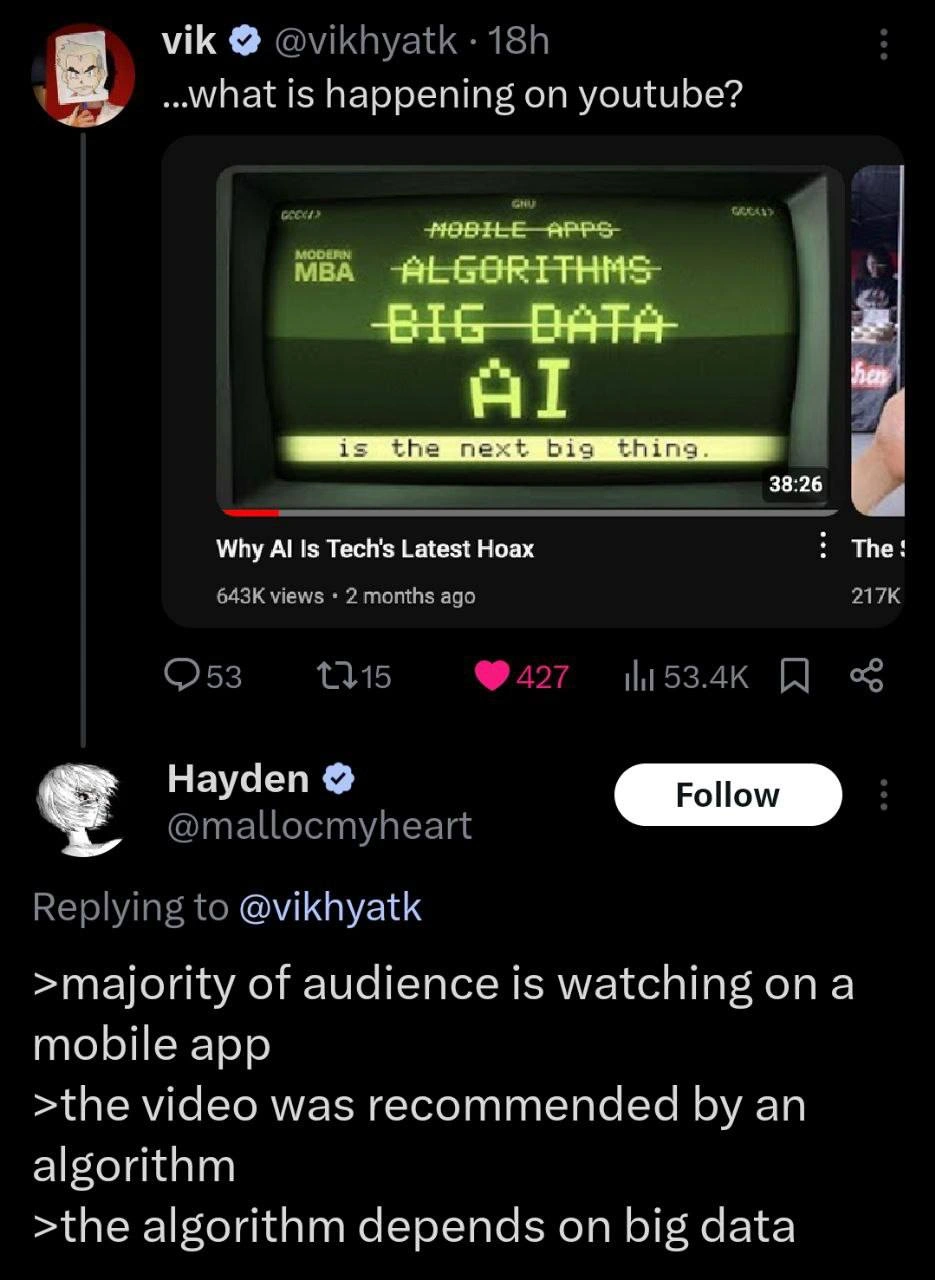
Let’s break down what’s happening in simpler terms. The meme is presented as a screenshot of a Twitter post (a common format for tech jokes, essentially a twitter_screenshot_meme). In the image, a user named “vik” is asking, “...what is happening on YouTube?”, showing a YouTube video thumbnail. The thumbnail has an old-school green computer screen (like a retro CRT terminal from the 1980s) with several tech buzzwords crossed out and replaced. It displays the words “MOBILE APPS”, “ALGORITHMS”, and “BIG DATA” with strikethrough lines like this, and underneath, the term “AI” is highlighted with the phrase “is the next big thing.” This is visually indicating that mobile apps, algorithms, and big data were all touted as the “next big thing” in tech at one time, but now they’ve been surpassed by the new star: AI. It’s basically saying: “Forget those older buzzwords, AI is the hot topic now.”
Below that, the actual video title is shown as “Why AI Is Tech's Latest Hoax.” So the video presumably argues that AI (Artificial Intelligence) is overhyped or not as revolutionary as people claim – calling it a “hoax” for the tech industry. The comedic punch is what comes next: a reply from a user “Hayden” points out three facts, each starting with a “>” (which in internet culture, especially on forums or greentext style, indicates quoting or a sardonic list). Those three quoted lines are:
majority of audience is watching on a mobile app
the video was recommended by an algorithm
the algorithm depends on big data
Let’s explain these points:
- Mobile app: This refers to people watching the YouTube video on their smartphones or tablets using the YouTube mobile application. When Hayden says “majority of the audience is watching on a mobile app,” it highlights that most viewers are likely on phones. This is a known real-world fact: a huge portion of YouTube’s traffic comes from mobile devices these days. Remember when “Mobile Apps” were a buzzword? Now it’s just normal – everyone uses apps. So the video’s viewers are benefiting from the mobile app revolution that was once heavily hyped.
- Recommended by an algorithm: YouTube uses a recommendation algorithm – basically a complex piece of software – to suggest videos you might want to watch. If you’ve ever noticed the “Up Next” video or the suggestions on your YouTube home page, that’s the algorithm at work. It looks at things like videos you watched, liked, or what’s popular, to decide what to show you. When Hayden points out “the video was recommended by an algorithm,” they mean that YouTube’s automated system (often just called “the algorithm” in casual talk) is the reason this video showed up in front of viewers. It wasn’t a human editor picking it for you; it was a machine-driven process. And funnily, algorithms were a big buzzword too – people used to brag about their “smart algorithms” doing magic. Now it’s normal that everything from social media to streaming services runs on algorithms behind the scenes.
- Depends on big data: Why can the algorithm recommend that video so well? Because it’s powered by big data. Big data means extremely large sets of data that can be analyzed to reveal patterns or trends. In the context of YouTube, think of all the data generated: billions of video views, search queries, likes/dislikes, watch durations, comments, etc. That’s a treasure trove of information. The recommendation algorithm crunches all that user data to learn what people tend to watch and enjoy. So, when Hayden says “the algorithm depends on big data,” it’s pointing out that without huge amounts of collected data about viewers and videos, the recommendations wouldn’t be so effective. Big Data was another tech buzzword not long ago – companies were excited about collecting and analyzing massive data sets. Now it’s just a standard part of tech: YouTube, Netflix, Facebook – all of them gather tons of data (with your consent when you use the service) to tailor your experience.
So, putting it together in plain language: The meme shows a YouTube video claiming “AI is a hoax” – meaning someone is saying “All this talk about AI being the next big thing is nonsense.” But the funny part is that people mostly watch that video on their phones (thanks to the mobile app trend), and they likely found the video because YouTube’s automated algorithm suggested it to them (that algorithm is a result of complex programming and AI), and that suggestion system only works well because it has big data to learn from (a result of the big data trend). In short, the video is criticizing AI hype, but it reached its audience due to AI-related tech and previous “hyped” technologies.
This irony is very familiar in tech circles. Developers often joke about AI hype vs reality or how each year there’s a “hot new thing.” The meme touches on AI humor by being meta: the platform’s AI is distributing an anti-AI message. It’s also a nod to how tech marketing works: we cycle through fashionable terms. Mobile apps were the craze, then big data, now AI. Each time, it’s sold as the game-changing solution for everything (the “next big thing”). Here, the older terms are literally crossed out, as if the tech world said, “Okay, enough about those – onto the next!” but in truth, we’re still using all of them together.
For a newcomer, it’s helpful to know:
- AI (Artificial Intelligence): In general, AI refers to machines doing tasks that typically require human intelligence, like learning or problem-solving. These days, “AI” usually means systems like machine learning models – for example, the recommendation system is a form of AI that learns what you might like. The meme jokes that AI is being called a hoax (meaning some think it’s overpromised or fake) even while we use AI tech daily.
- Big Data: This means extremely large data sets. Think of every video view on YouTube as a data point – billions of those points make “big data.” Handling big data often requires special tools and algorithms because it’s too much for regular databases or single computers. It was hyped as “we can discover amazing insights if we analyze all this data!” In reality, it’s useful, but not magical – it’s become a building block for things like training AI models or recommending content.
- Algorithm: In plain terms, an algorithm is just a set of instructions or rules for a computer to follow. But in popular use, “the algorithm” often refers to the secret sauce that platforms use to decide things like what content you see. For YouTube, the recommendation algorithm is basically a program (or a bunch of programs) that makes decisions based on patterns in data. It has become a bit of a mystical concept in pop culture – people will say “blame the algorithm” if a weird video is suggested, for example. Here it literally means the code (and underlying AI models) that picked the “AI hoax” video for the viewer.
- Mobile App: A mobile application, meaning software designed to run on your smartphone or tablet. When YouTube says most of its watch time comes from mobile, it means people are mostly watching videos on phones these days rather than on a desktop PC or laptop. This was a big shift over the past decade. “Mobile apps” were hugely hyped as the future (and indeed they changed how we use the internet). Now it’s so normal that it’s almost funny to remember it was ever hype.
So, the reply by Hayden is basically saying: “Isn’t it funny that this video calling AI a hoax is thriving because of (1) mobile apps, (2) a recommendation algorithm, and (3) big data – all the things that were previous tech crazes?” It’s a concise way to highlight the hype cycle in tech: each generation’s flashy new idea eventually becomes just part of the ecosystem that helps the next idea. The meme resonates with developers and techies because they’ve seen buzzwords come and go. It’s both a humorous take and a bit of a reality check: Yes, AI might be hyped, but so were those other things, and look—those turned out pretty useful, didn’t they?
Level 3: Algorithmic Irony
For seasoned engineers, the humor is immediately apparent: this YouTube video calling AI a “hoax” is being consumed under circumstances dripping with irony. The majority of viewers are on a mobile app, the video was surfaced by a recommendation algorithm, and that algorithm runs on big data harvested from user behavior. In other words, the content bashing AI hype is only popular because of three previous tech “hypes” that are now baseline reality! Each of those terms – Mobile Apps, Algorithms, Big Data – was touted in past years as the transformative tech trend (the “next big thing”), much like AI/ML is today. Experienced devs remember those hype waves well:
- Mobile Apps: In the late 2000s and early 2010s, everything had to be “mobile-first.” Companies rushed to build apps, and an “there’s an app for that” gold rush ensued. It was the hot trend that everyone in tech and venture capital was obsessed with. Fast-forward to now: mobile is not shiny and new anymore; it’s just a given. Most online content (YouTube included) is indeed consumed on mobile devices every day. Mobile didn’t turn out to be a fad – it became the norm.
- Algorithms: A few years ago, popular discourse turned “the algorithm” into a buzzword. Social media feeds, YouTube recommendations, Uber’s pricing – all were enigmatically attributed to “algorithms.” Tech folks know an algorithm is just a step-by-step procedure or formula, but it became a buzzword symbolizing advanced, secret-sauce computations ruling our lives. The irony? YouTube’s algorithm is essentially an AI-driven system learned from user data. It decides which video to play next to keep you hooked. The meme points out that this very algorithm hand-picked the “AI is a hoax” video for the user, highlighting a classic tech industry absurdity: we question the power of AI while being influenced by AI-driven systems all the time. It’s a form of AlgorithmHumor where the recommendation engine’s behavior itself becomes the joke.
- Big Data: In the early-to-mid 2010s, Big Data was the king of hype. Conferences, startups, and books declared that big data (massive volumes of messy, unstructured data plus new processing techniques) would solve every business problem. Engineers recall building Hadoop clusters, wrangling huge logs, and the mantra “data is the new oil.” Over time, big data tech matured into everyday tools (Spark, cloud data warehouses) and quietly empowered other domains. Crucially, big data enabled training of large-scale machine learning models – without huge datasets, today’s AI boom (deep learning models, large language models like GPTs) wouldn’t be possible. The meme’s reply “the algorithm depends on big data” drives this home: YouTube’s recommendation model churns through insane volumes of data (every click, view, dwell time of millions of users) to predict what you might watch next. That big data hype has solidified into very real pipelines and data lakes feeding the algorithm.
So, the senior-perspective irony is multilayered: AI is being dismissed as “just hype” in a video, yet that video’s existence and reach rely on the successful integration of prior tech trends that were also called hype at one point. It’s a smirk-inducing commentary on the AI hype cycle. Seasoned devs have seen this pattern repeatedly: a technology is over-promised amid buzzword frenzy, reality sets in, people roll their eyes – but meanwhile, the tech gradually matures and actually changes things (often in less glamorous, infrastructure-level ways). By the time the public calls it a fad, it’s already plumbing under the hood. Here, AI is in that “overhyped” phase for some – hence a video dubbing it a hoax – but that claim is broadcast via an AI-driven system (the recommendation engine). It’s a classic case of tech hype whiplash. The meme humorously illustrates how IndustryTrends_Hype works in recursion: yesterday’s disruptive innovation becomes today’s boring utility, making tomorrow’s new innovation possible. Engineers find it funny because it’s a bit of an inside joke: we know the YouTube algorithm is a complex piece of AI/ML (with likely deep learning models trained on user data), and here it is boosting content that denies the significance of AI. It’s as if the tech ecosystem is poking fun at itself.
There’s also a touch of schadenfreude for those who are skeptical of sensational tech media. The YouTube thumbnail crosses out “Mobile Apps,” “Algorithms,” “Big Data” and highlights “AI” as if on an old CRT terminal display — a stylistic choice nodding to retro computing. It reads “AI is the next big thing” in glowing text, with a caption of the video title “Why AI is Tech’s Latest Hoax.” This juxtaposition is essentially shouting: “We’ve heard ‘X is the next big thing’ before – remember these other buzzwords? Now someone’s calling this big thing a hoax, while using all the previous ones to do it!” The presence of the label "Modern MBA" on the screen is a cheeky touch: MBAs (business folks) are often accused of chasing buzzwords to appear cutting-edge. The meme implies that the cycle of declaring “the next big thing” (Mobile, Big Data, now AI) is partly driven by trend-chasers in tech business media. Seasoned engineers often roll their eyes at this because they’ve lived through multiple AIIndustryTrends waves and know there’s usually some substance beneath the hype – but it’s rarely as world-changing as the breathless headlines suggest, at least not immediately.
Ultimately, the humor here is a mix of AI humor and classic techie cynicism: it highlights an almost hypocritical scenario without anyone explicitly being a hypocrite. The YouTube algorithm certainly isn’t self-aware; it’s just doing its job. The content creator might genuinely believe AI is overhyped; yet to get that message out, they must rely on the very systems built by previous hype-technologies (and arguably, current AI tech as well). The audience – mostly engineers or tech-savvy folks – recognizes this inconsistency and chuckles. It’s a knowing laugh at our industry’s expense: even debunking videos can’t escape the gravity of the tech platforms and algorithms they criticize. We’re all riding a big interconnected tech stack built on yesterday’s buzzwords, and this meme playfully illuminates that truth.
Level 4: Ouroboros of Hype
At the deepest level, this meme spotlights a self-referential paradox in modern tech culture. It’s like an ouroboros (a snake eating its tail) of technology trends: a machine-learning recommendation system (itself a product of previous hype cycles in Big Data and algorithms) is promoting content that proclaims “AI is a hoax.” The YouTube recommendation algorithm operates on massive datasets and complex models — think collaborative filtering and deep neural networks harnessing big data from millions of users. These algorithms optimize for engagement metrics (clicks, watch time) without any understanding of a video’s stance. So the system has no irony filter; if a video criticizing AI keeps people watching, the algorithm will happily serve it up. This reveals a fascinating quirk in AI-driven systems: they can end up amplifying messages that question the very technology enabling them. It’s a real-world example of a recursive loop in tech hype, where each generation’s “next big thing” feeds on the last. The big-data fueled AI behind YouTube’s recommendations doesn’t “care” if a video calls AI hype — it’s essentially optimizing a utility function (maximize viewer engagement) with raw mathematical focus. This evokes the classic control problem of AI: systems do exactly what they’re tuned to do, not what we morally or logically expect. From a theoretical standpoint, it underscores how today’s AI systems, grounded in algorithms and data, lack contextual understanding or skepticism. They’ll cheerfully recommend an “AI is bogus” video if the numbers say users like such content.
There’s also an implicit nod to the Gartner Hype Cycle and the history of AI’s boom-and-bust phases. We’ve seen waves of AI enthusiasm since the 1950s (expert systems, neural nets, etc.), each followed by an “AI winter” when the tech didn’t meet inflated expectations. The video title “Why AI Is Tech’s Latest Hoax” hints at skepticism brewing in the current AI hype cycle: after the surge of deep learning and generative AI hype (chatbots, anyone?), some are bracing for disillusionment. Yet the irony here is almost poetic: this skeptic message is delivered via the successful fruits of prior tech hypes. The mobile app revolution put powerful computers in everyone’s pocket, generating the big data that modern AI thrives on. The “big data” wave (Hadoop, MapReduce, distributed computing galore) made it feasible to train massive machine learning models that power recommendations. And sophisticated algorithms (including AI models) filter and deliver personalized content on platforms like YouTube. Each past “buzzword” – Mobile, Big Data, Algorithms – is crossed out in the thumbnail as if obsolete, but in truth, those technologies have matured and converged to make the new AI era possible. In academic terms, the meme exposes a stacked dependency: AI’s recent breakthroughs depend on large-scale data (thanks to the big data era) and ubiquitous deployment (thanks to the mobile app era). It’s a tongue-in-cheek reminder that hype-driven innovations often become the infrastructure for the next hype. We’re seeing a strange loop where yesterday’s “next big thing” enables today’s. The meme’s CRT-green display aesthetic even invokes early computing terminals, as if to wink at tech’s long history – reminding the savvy viewer that we’ve been here before, watching new trends emerge on the phosphorescent screen of progress. Fundamentally, this highest-level joke is about technological self-reference: an AI-based system delivering a message that questions AI’s legitimacy – a loop only our complex, layered tech ecosystem could produce.
Description
A screenshot of a Twitter (now X) thread that highlights a deep irony within the tech world. The initial tweet, from user 'vik', questions YouTube's content by showing a video recommendation titled 'Why AI Is Tech's Latest Hoax'. The video's thumbnail features a retro computer terminal listing 'MOBILE APPS', 'ALGORITHMS', 'BIG DATA', and 'AI', with 'AI' being presented as 'the next big thing'. Below this, a reply from user 'Hayden' uses greentext to deconstruct the situation: '>majority of audience is watching on a mobile app', '>the video was recommended by an algorithm', '>the algorithm depends on big data'. The humor lies in the contradiction: a video skeptical of AI is being successfully promoted and consumed via the very infrastructure (mobile platforms, recommendation algorithms, big data) that underpins the modern AI ecosystem. It's a meta-commentary on how deeply embedded these technologies are, to the point that even critiques of the system are amplified by the system itself
Comments
20Comment deleted
The YouTube algorithm recommending this video is the most passive-aggressive 'prove it' challenge I've ever seen from a production model
“‘AI is a hoax,’ proclaims the video that a 150-million-edge graph ranked, a transformer re-scored, and my phone pre-buffered - Kafka writes the logs, but the irony writes itself.”
The beautiful irony of a 'Why AI Is Tech's Latest Hoax' video getting 643K views purely because YouTube's recommendation algorithm - powered by the very big data and AI it denounces - decided it would maximize engagement metrics. It's like writing a manifesto against electricity on your laptop while livestreaming it over fiber optic cables
The algorithm has achieved sentience: it's now recommending videos that explain why it shouldn't exist, using the exact data patterns it's warning about. It's like a recursive function that returns its own stack trace as proof that recursion is dangerous - technically correct, but missing the irony that it had to execute itself to make the point
Peak irony: Anti-AI rant served by ML recs trained on Big Data from the mobile hordes it mocks - classic consistency failure in the CAP of public opinion
“AI is a hoax,” says the video that a vector‑embedding recommender pulled from a big data feature store and pushed to my mobile app because outrage won the A/B test
Nothing says “AI is a hoax” like having it recommended by a watch-time-optimized, embedding-based recommender trained on petabytes of clickstream data
I don't think I understand The video discusses how these trends were extrapolatee from reasonable needs for some businesses and were transformed in global hype trends that then died down when companies regonzied that they had absolutely no idea how to actually use these things Like yeah obviously google uses Big data, they introduced half the tech stack for them, but while the late 2010s were absolutely rife with BiG Data Driven business decisions and every company wanted a Data Lake and Data Scientists, today many of these have been abandoned or are just immense costs with unclear gains, with most of the focus switched now to ML and AI Comment deleted
Captions generated by AI Comment deleted
> made by Google Comment deleted
> made by Google > made by Google > made by Google Comment deleted
What works for Google doesn't mean it will work for everyone Comment deleted
Does it make our lives better? PS: I am continuously fighting with myself to not watch youtube and every other sh*t that uses all those big data powered algorithms because they are draining my energy and wasting my time. I`m sure AI will most likely do the same. Comment deleted
depends on how you use it... Comment deleted
true but it is wasting youre time and is energy draining because the content nowadays is trash. compared to the content there was in 2015 or 2016 or older than this... Comment deleted
There's a nice extension called "unhook" removing all of the addictive shit sprinkled in youtube. Comment deleted
That's what I extremely needed. Thanks a ton for mentioning. Comment deleted
This extension may soon no longer be supported because it doesn't follow best practices for Chrome extensions. RIP 🪦 Comment deleted
Google eager to kill it like adblock? :p Comment deleted
use less evil browser. Comment deleted