Skip to content
DevMeme
5630 of 7435
An Assembly-Level Pun for Datacenter Technicians
LowLevelProgramming Post #6177, on Aug 22, 2024 in TG

An Assembly-Level Pun for Datacenter Technicians

Why is this LowLevelProgramming meme funny?

Level 1: Silly Sound-Alike

Imagine you have a big shelf for computers, and you need to lift a heavy computer and put it on a different shelf. That’s a tough, physical job – kind of like moving a bunch of books to a new bookshelf, but the “books” are computers called servers. Now, also imagine inside a computer’s brain (the CPU), there’s a tiny little box named RAX. To make the computer do something, a programmer might write a command that basically says “move a number into the RAX box.” They write it in a super short way: mov rax, 5 (which you can read as “move into RAX, the number 5”).

Now here’s the fun part: saying “mov RAX” out loud sounds almost the same as saying “move racks”! The first one is a nerdy computer instruction, and the second one is plain English for shifting those heavy shelves of computers. They’re completely different things, but our ears might think they’re the same phrase. The meme is a joke that plays with this coincidence. It’s as if someone noticed, “Hey, when I say this computer code phrase, it sounds like I’m talking about that big task of hauling equipment!”

Why is that funny? It’s kind of like a pun or a riddle. It makes you stop and realize two unrelated worlds – the tiny world inside a computer chip and the big world of real-life machines – share a similar-sounding phrase. It’s the contrast that’s amusing: moving a little piece of data versus moving a big piece of hardware. Imagine if you found out the word for a small action, like clicking a button in a video game, was the same as the word for a huge action, like demolishing a building. Saying “I’m demolishing” when you just mean clicking a game button would be silly, right? That’s what’s happening here, but with tech terms.

In simple terms, this meme is making a sound-alike joke. It’s like noticing that “bare claws” and “Bear Claus” sound the same and creating a funny sentence that makes you think of both a wild animal and Santa’s sibling at once. Here, the funny sentence makes you think of both a computer doing something small (“mov RAX”) and a person doing something big (“move racks of servers”). It’s amusing to tech-savvy folks because they spend time in both those worlds and love when those worlds collide in a playful way. Even if you don’t know much about computers, you can chuckle at the idea that a super technical phrase coincidentally sounds like a totally non-technical task. It’s a little nerdy “gotcha!” that can make you smile once you hear the explanation. In the end, it’s just a pun – a geeky one – that shows how language can connect very different things and make us laugh.

Level 2: Move RAX vs Move Rack

Let’s break down the joke in simple terms. It’s playing with two meanings that sound almost the same: one from computer programming and one from real-life server handling.

  • “mov rax, ...” – This is a bit of code in the x86 assembly language, which is a low-level programming language for computers using Intel/AMD processors. In this context, mov is an instruction that stands for “move.” It tells the computer to transfer data from one place to another. RAX is the name of a register in the CPU. A register is like a tiny mailbox or container inside the processor where it can hold a number or data that it’s working on. So, for example, mov rax, 1 would mean “move the value 1 into the RAX register.” If we had mov rax, rbx, it means “copy whatever is in register RBX into register RAX.” Think of it as a very basic command the computer’s brain understands, telling it where to put a piece of information. In assembly code, you’ll see a lot of these mov instructions because moving data around is one of the core things programs do. It’s written in a terse way – just three letters mov and then the names of locations or registers – but it represents a fundamental action in the machine.

  • “Moving servers (racking servers)” – Now to the hardware side: Servers are powerful computers, and a bunch of servers live together in a data center. In these data centers, servers aren’t just strewn about on tables; they are mounted in tall metal frames called racks. Each rack is like a big shelf that can hold many servers stacked on top of each other, each in its own slot. Racking a server means installing a server into one of those rack slots (or moving it to a different slot or a different rack altogether). It’s a physical job: you might have to unscrew the server from its current spot, support its weight, slide it out, carry it over to the new rack, and secure it there. “Physical relocation of servers” is a fancy way to say “moving servers around” – for instance, taking them from Rack A to Rack B. People who work in data centers do this when they reorganize hardware, replace faulty equipment, or set up new machines. It’s a common task in the world of IT infrastructure.

Now, here’s why the meme is funny: it asks if doing the real-world task (moving servers in a rack) means you are doing the programming command mov rax. The humor is a pun based on the sound of the words. “mov rax” in spoken English is usually pronounced like “move racks” (the word “rax” sounds just like “racks”). So if you say mov rax out loud, it’s basically identical to saying “move racks.” The meme is making a playful connection between the two: one is a tiny operation inside a computer’s CPU, and the other is a big task in a data center, but because the phrasing overlaps, it treats them as if they were the same thing.

To someone not familiar with these terms, the sentence might be confusing. But once you know that mov rax is just tech-speak, it becomes a classic bit of wordplay: two unrelated activities described by nearly the same phrase. It’s like a homophone (words that sound the same but have different meanings) that only tech folks would notice. The question “Does that mean you mov rax?” is tongue-in-cheek. The person asking it knows full well that moving physical servers isn’t literally the same as a CPU instruction — they’re jokingly using a programming phrase to label a manual task.

Consider why they specifically said an Intel datacenter. Intel is famous for its CPUs, and the assembly language syntax mov rax, ... is part of the x86-64 instruction set (used by Intel and AMD processors). If this were a different kind of data center (say, one using ARM processors or something else), the registers wouldn’t be called RAX, and the pun wouldn’t work. So saying “Intel datacenter” sets the stage: we’re talking about machines that indeed use the mov rax kind of instructions internally. It’s a cute detail that makes the joke technically accurate.

In summary, the meme is comparing:

  • Code world: mov rax – a very small, quick computer operation (moving a number into a CPU slot named RAX).
  • Real world: moving racks – a very physical, slow operation (moving actual server equipment around).

They sound the same, and that’s funny to the kind of people who deal with either or both of these worlds. It’s a bit like an inside joke. If you’ve ever written a line of assembly or ever mounted a server in a rack (or even just seen it done), you’ll appreciate how incongruous it is to equate these two actions. This is a prime example of developer humor: mixing tech jargon with everyday tasks to get a laugh. Here the mix is especially cool because it combines low-level programming (assembly code) with high-level hardware handling (datacenter work). The result is a one-liner that’s equal parts geeky and goofy. Once you decode the terms, the joke is basically saying, “Haha, I’m literally ‘moving racks’ – get it? That’s like a mov rax in real life!”

Level 3: Some Assembly Required

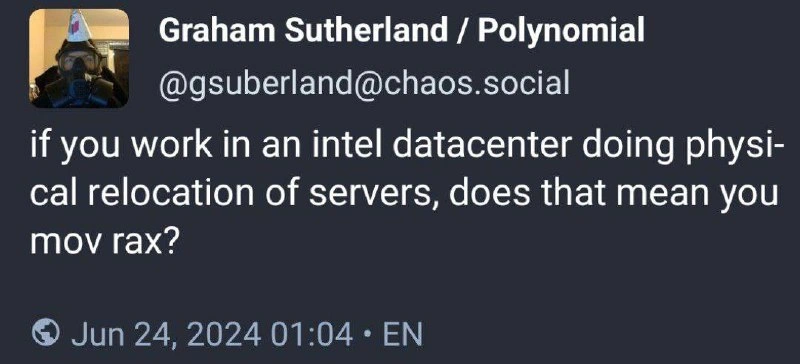
For experienced developers and IT pros, this joke hits a special kind of sweet spot. It’s one of those nerdy quips where you need a dash of assembly knowledge and a dash of data center experience to get the laugh — in other words, some assembly is required to appreciate it. The setup is a deadpan question: “If you work in an Intel datacenter doing physical relocation of servers, does that mean you mov rax?” At first glance, it sounds like gibberish unless you recognize the tech lingo. But for those in the know, a light bulb goes on: "mov rax... hey, that sounds like 'move racks'!" Cue the groans and grins.

What makes this funny to a seasoned techie is the wordplay and the collision of two worlds. On one side, we have an assembly language pun. Many of us who have been around low-level code immediately recognize mov rax as assembly syntax. It takes us back to banging out instructions in a debugger or maybe writing a bit of inline assembly for performance-critical code. Seeing RAX (in all caps) outside of a code editor is a glaring hint: “Psst, this is about the CPU register named RAX.” That alone signals LowLevelProgramming humor. Not everyone writes assembly these days, so it’s kind of an insider reference.

On the other side, the scenario described is totally hardware-centric: physically shifting servers in a data center. Anyone who’s managed on-premises servers or worked with colocation hardware knows the drill. Perhaps as a junior you helped your senior colleague rack some new machines, or as an ops engineer you’ve spent long nights re-stacking equipment to balance cooling and power. DataCenter life means dealing with heavy racks, noisy cooling fans, and labelled cables. So when this meme ties that very tangible experience to an assembly instruction, it’s hilarious in its absurdity. It’s HardwareHumor meeting programmer humor.

The experienced folks chuckle because we appreciate how disproportionate the two things are. A mov rax in code is so trivial you might write it as part of a Hello World exercise. Moving actual server racks, however, is a full-body workout that might leave you sore. The joke exaggerates by implying that the guy lugging servers around is casually “executing” a computer instruction. It’s like saying an Olympic weightlifter performing a clean-and-jerk is just running a small script — technically saying the action, but massively understating the effort. We find that contrast comical.

There’s also that satisfying “I understood that reference!” factor. This meme won’t land for people who’ve never dipped into assembly or seen the inside of a server closet. But for veteran devs, sysadmins, or engineers, it’s a chance to flex a bit of niche knowledge. It’s the kind of joke you might drop in a Slack channel with your team and get back a mix of 😂 and 🙄 reactions. One person might reply with a facepalm emoji or, as someone did here, a sarcastic “Bruh” — acknowledging the pun with a half-groan, half-laugh. (Let’s face it, developer humor thrives on these groan-worthy puns.)

To put it in a real-life context, imagine two colleagues in a server room:

Tech A: “We need to move three servers from Rack 7 to Rack 3.”
Tech B: “Ah, a classic mov rax operation, huh?” 😉

Tech A might roll their eyes while grinning, and Tech B knows they’ve scored a nerdy point. That’s exactly the vibe of this meme. It’s a camaraderie-building joke — small, clever, and just obscure enough to make those who get it feel a tiny bit proud. It also underscores how our work spans from the abstract (code) to the concrete (hardware). In a single sentence, it connects the assembly-language world of registers and opcodes with the gritty world of server maintenance. How often do you get to joke that lifting equipment is equivalent to writing assembly? Not often, which is why this little pun is a gem for those of us who appreciate both worlds.

Ultimately, experienced devs laugh because the meme is so literal and yet so ridiculous. “Mov rax” is something we usually see in code listings or processor manuals, yet here it’s cheekily reframed as a manual labor task. It’s that contrast and clever wording that earns an appreciative chuckle (and maybe an exasperated “Really? Did you just say that?”). Some jokes require high-level context; this one requires low-level context. In both senses of the phrase, some assembly required!

Level 4: Byte Lifting vs Weight Lifting

This meme brilliantly bridges the world of x86-64 assembly with the concrete reality of data centers. In low-level code, the instruction mov rax, ... is as fundamental as it gets: it moves (actually copies) data into the CPU’s RAX register. Meanwhile, in a server room, “racking a server” means physically moving a server into a rack slot. Pronounced aloud, mov rax sounds just like “move racks,” a delightful homophone that forms the crux of this joke. The tweet specifically mentions an Intel datacenter, hinting that these servers are powered by Intel x86 processors – the very habitat of the mov rax instruction.

On the assembly side, RAX is the name of a 64-bit CPU register in the x86-64 architecture (used by Intel and AMD processors). It’s the extended version of the old 32-bit EAX register (which in turn extended the 16-bit AX register from the original 8086). RAX is the accumulator register, often used for arithmetic operations and function return values in system ABIs. The mnemonic mov (short for “move”) is one of the most common instructions in assembly language, used to transfer data between two places. For example, mov rax, rbx copies whatever value is in register RBX into register RAX. In Intel syntax, the first operand is the destination and the second is the source. So a snippet like:

mov rax, rbx    ; Copy the content of RBX register into RAX register
mov rax, [0x100]; Load the value at memory address 0x100 into RAX

will result in the CPU’s RAX register holding new data. Under the hood, executing a mov is a quick, microscopic operation – the processor’s circuits transfer a pattern of bits from one place to another. In fact, on modern superscalar CPUs, a simple register-to-register mov can be optimised away via register renaming (the CPU might avoid doing any actual bit shuffling and just update its internal bookkeeping to make RAX mirror RBX). It’s all electric signals and nanosecond timing in the realm of LowLevelProgramming.

Now compare that to the physical side: moving a server rack or relocating servers is a massively macro-scale task. We’re talking about a human engineer unplugging machines, unscrewing them from their mounts, lifting 20-kg servers (maybe with a buddy or a lifting trolley), carrying them across a room (careful with static and cables!), and sliding them into a new cabinet. This is an entirely different kind of “move” – one that involves gravity, muscle power, and possibly a sore back afterward. The meme’s punchline asks if someone whose job is to perform this physical server relocation is effectively executing a mov rax. It’s absurd and clever at the same time: a tiny CPU instruction and a huge real-world chore, equated by a quirk of language.

There’s rich irony here. In assembly, the mov instruction doesn’t actually remove anything from the source; it leaves the original data intact and just copies it. After a mov rax, rbx, both RAX and RBX hold the same content. But in a data center, when you move a piece of hardware from one rack to another, you are taking it out of the first spot (the original rack is now empty). The computer’s notion of “move” is more like “clone,” whereas the human notion of move is a true relocation. The humor amplifies when you consider how effortlessly a CPU shuffles bits versus how laborious it is to shuffle servers. The processor never worries about weight or alignment (beyond maybe byte alignment!), but a technician certainly has to worry about weight distribution in a rack and tightening all those screws. In a sense, the meme juxtaposes bit-level moves with literal heavy lifting.

For seasoned systems engineers and assembly enthusiasts, this pun is a treat because it operates on multiple layers. It’s not just mixing jargon with real life — it’s highlighting the vast difference in scale. A mov rax is one of the simplest operations a computer can do, often taking a single CPU cycle. Moving servers across racks could take all afternoon and requires planning (and probably an extra cup of coffee). By phrasing the latter in terms of the former, the meme playfully calls a huge task “just a single instruction.” It tickles the brain precisely because of that contrast and the wordplay involved.

And let’s not forget the meta-humor: assembly language jokes are a niche within developer humor, a sort of geeky delicacy. The mov RAX pun here is so specific that only those who know about registers and server racks will fully appreciate it. There’s even a famous esoteric project called the Movfuscator that proves you can construct any program using nothing but mov instructions – a testament to how iconic mov is in low-level programming. People who know this kind of arcane trivia are exactly the ones likely to chuckle at this meme. In a way, the joke is a little nod, saying “we see the connection between our code and our hardware.” It’s a celebration of the fact that, whether you’re moving bytes in a CPU or boxes in a data center, you’re part of the grand dance that makes computing possible.

Description

A screenshot of a social media post from user Graham Sutherland / Polynomial (@[email protected]). The post, against a dark background, presents a clever pun targeted at a highly technical audience. The text reads: 'if you work in an intel datacenter doing physical relocation of servers, does that mean you mov rax?'. The humor is a play on words combining physical datacenter work with low-level programming. 'Moving racks' of servers sounds identical to 'mov rax', which is a fundamental instruction in x86-64 assembly language used to move a value into the 'rax' general-purpose register. This niche joke would be particularly amusing to systems programmers, reverse engineers, or anyone familiar with the specifics of computer architecture and assembly code, as it bridges the gap between the physical hardware and the most basic software commands that control it


Comments

11
Anonymous ★ Top Pick I asked my manager for a raise, but all I got was a 'push rax'. I guess my value is now on the stack
  1. Anonymous ★ Top Pick

    I asked my manager for a raise, but all I got was a 'push rax'. I guess my value is now on the stack

  2. Anonymous

    Our DC relocations feel like hand-coded assembly: “mov rax, Row42; add heat, +7°C; jmp if PDU_overloaded -> total panic()”

  3. Anonymous

    The only datacenter job where 'segmentation fault' means you dropped a blade server on your foot, and 'stack overflow' is what happens when you pile too many decommissioned 1U servers in the hallway

  4. Anonymous

    The beauty of this joke is that it works on multiple levels: MOV RAX is one of the most fundamental x86-64 instructions, moving data into the 64-bit accumulator register - but when you're physically relocating server racks in an Intel datacenter, you're literally 'moving racks.' It's the kind of pun that makes you simultaneously groan and appreciate the elegance of assembly mnemonics. Bonus points for the fact that in modern datacenters, you're probably moving servers with Intel CPUs that are executing billions of MOV RAX instructions per second while you're physically moving their racks - a delightful recursion of the joke itself

  5. Anonymous

    DC ops calls it rack‑and‑stack; the ISA calls it mov rax - either way it’s O(n) back pain with awful cache locality and zero atomic rollback

  6. Anonymous

    RAX: Register Accumulator eXtended, or Relocate And eXert? Datacenter ops finally get their mnemonic

  7. Anonymous

    Re‑racking at Intel is basically mov rax; just add an mfence or the forklift’s out‑of‑order execution will speculatively land it in the hot aisle and turn cooling into a Sev‑1

  8. @disembowlement 1y

    How many people can understend assembler memes?

    1. @endisn16h 1y

      rax one is like most basicest of bitches meme-wise

      1. @disembowlement 1y

        IF you know assembler commands

  9. @mihanizzm 1y

    Ahahahahhaahaha

Use J and K for navigation