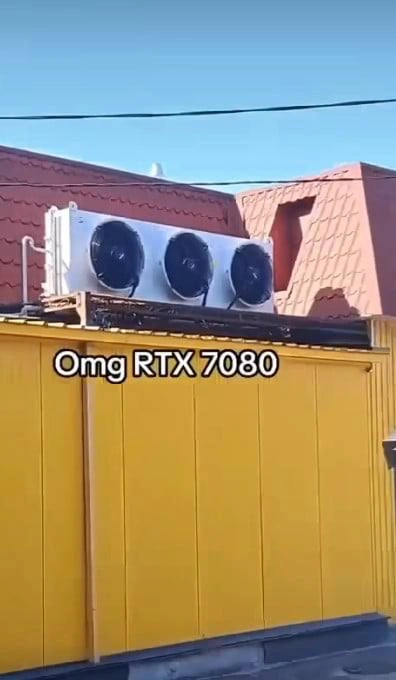
Leaked Photo of the Upcoming NVIDIA RTX 7080 Graphics Card Cooler
Why is this Hardware meme funny?
Level 1: Hot Computer, Huge Fan
Imagine you have a super powerful video game machine that gets really hot, like almost as hot as an oven when it’s running a game. Normally, you’d use a small fan to cool it, right? Now, this joke says: What if your machine got so hot that a little fan isn’t enough, and you needed a gigantic fan like the kind used to cool an entire house? In the picture, there’s a big box on a roof with three huge fans (that’s an actual air conditioner for a building). Someone pretended that big box is the next new computer gadget. Calling it “RTX 7080” is like giving it a fancy video card name. It’s funny because it’s over-the-top – it’s like saying your next PlayStation or Xbox will need a fridge or a house AC unit strapped to it to keep from melting! The humor comes from picturing something ordinary (a room AC) being used as if it were a part of a computer. It’s a silly way to say “Wow, these new gaming computers are getting ridiculously powerful (and hot)!” So, basically, it’s joking that future computers might be so extreme that cooling them becomes as big a job as cooling an entire house. A huge problem met with a huge fan – that’s the simple funny idea here.
Level 2: Bigger Fans, Bigger GPUs
For newer techies, let’s break down the joke: it’s comparing a graphics card to a giant AC unit. A GPU (Graphics Processing Unit) is the part of a computer responsible for handling graphics and heavy parallel computations – basically, it’s what renders your video game graphics or helps with video editing and AI calculations. Modern GPUs, especially the gaming and high-performance ones like NVIDIA’s RTX series, produce a lot of heat when they’re working hard. To keep them from overheating (which can cause crashes or damage), they use metal heatsinks and fans – often multiple fans – to cool down. You might have seen a gaming graphics card with two or three fans on it; those are there to blow air over the heatsink fins, carrying away the heat so the chip stays at a safe temperature.
Now, as GPUs have gotten more powerful over the years, they’ve also gotten hotter and bigger. Ten or fifteen years ago, a graphics card might have one small fan. These days, high-end cards like the RTX 4080 or RTX 4090 commonly come with a triple-fan cooler and take up a ton of space inside a PC. They also consume a lot of electricity (hundreds of watts), which means they generate a lot of heat (since nearly all that electrical power turns into heat during processing). This measure of how much heat a chip produces under max load is its Thermal Design Power (TDP). A higher TDP means you need a more robust cooling solution. Think of it like car horsepower: more power can mean more heat from the engine, so you need a bigger radiator. Here, the GPU is the engine, and the fans plus heatsink are the radiator.
In the image, we see a yellow building and on its roof is a big industrial air conditioning unit with three large fans on top. It looks a bit like a supersized version of a GPU cooler – same general shape (boxy metal unit) and the three fan layout that many graphics cards have. Someone found it funny that this roof AC resembles a giant triple-fan GPU, so they overlaid the text “Omg RTX 7080” on the picture. RTX 7080 is a made-up name riffing off Nvidia’s naming scheme (we have RTX 3080, 4080 in real life; the joke is jumping ahead to a fictional future model, the 7080, to exaggerate). By calling the AC unit “RTX 7080,” the meme is joking that a next-next-next-generation graphics card’s cooler might be as huge as an industrial AC. Basically, “OMG, look how huge this thing is – it could be the cooler for an RTX 7080!” It’s hardware humor through absurd comparison.
The irony here is tied to real industry trends. Every new GPU generation tends to promise big performance gains, and indeed they deliver, but often the cards also become larger, louder, and more power-hungry. The community often jokes about this escalation. This meme is one of those overengineering jokes: cooling a GPU shouldn’t require something you’d find on a building, but if current trends continue, who knows? It’s like saying, the next gaming graphics card will be so powerful you’ll need a house-grade cooling solution. There’s also a wink at the hype cycle: companies hype up new cards (bigger numbers like 5080, 6080, etc.), and some folks exaggerate that hype (“it’ll be a monster!”) – here that exaggeration is visualized literally as a monster-sized cooler.
To a junior developer or gamer, the key points are: GPUs produce heat, we manage that with fans and heatsinks, and as GPUs get more advanced, the cooling has to get more advanced too. The picture takes that to a silly extreme. It connects the world of computer graphics processing with something very non-computer like an AC unit to get a laugh. If you’ve ever felt how hot a laptop gets when gaming, you know high-performance chips run hot. Now imagine a card that’s many times more powerful – it might need an equally big jump in cooling. The meme just swaps the normal GPU cooler for an outrageously big one. It’s a bit of TechIndustryIrony and a bit of truth: technology keeps improving, but sometimes improvements bring literal heat. In summary, they’re saying “GPUs are evolving so much that one day, cooling them might look like this.” It’s an easy laugh for anyone who’s struggled with a noisy PC fan or seen the size of today’s top graphics cards.
Level 3: Industrial Strength GPUs
The meme is comically satirizing the trend in the graphics card industry where each new flagship GPU seems larger, hotter, and more power-hungry than the last. Seeing a three-fan rooftop HVAC unit labeled as “Omg RTX 7080” resonates with PC enthusiasts because it captures an absurd truth: high-end GPUs are becoming chonkier and more overbuilt with each generation, to the point where over-engineering is the norm.
Why is this funny to a seasoned gamer or hardware engineer? Because we’ve all watched the GPU cooler size creep in real time. A decade ago, a high-end GPU like the GeForce GTX 580 had a single blower fan and drew about 244W. Fast forward to today’s RTX 4090 with its triple-fan, triple-slot cooler consuming 450W – a card so physically large and power-thirsty that it can barely fit inside some PC cases and might trip your circuit breaker if you daisy-chain your coffee maker. Each launch event pitches the next-gen card as the biggest leap ever (cue the IndustryTrends_Hype), and indeed the specs leap – including the heat output. Enthusiasts half-jokingly refer to these GPUs as space heaters or hair dryers, since running a game on a 400W card will noticeably warm up your room. (On winter mornings, that’s not entirely unwelcome – talk about TechIndustryIrony where your gaming PC doubles as a heater!)
The image nails this running joke by pointing to a full-blown industrial air conditioner unit and saying, essentially, “here it is, the next NVIDIA RTX card!” It’s poking fun at how ridiculous cooler designs have become. The current high-end cards already sport multiple fans, massive aluminum fin-stacks, and heat pipes crisscrossing like the plumbing of a small refinery. We’ve seen GPU heatsinks grow so large they occupy four PCIe slots, and some models even come with built-in water-cooling loops or 360mm radiators. When a new RTX x080-series is rumored, seasoned builders half-jest “Will I need a bigger case… or a forklift?” This meme takes that quip to the extreme by picturing a GPU cooler so big it might as well be bolted to your roof, like an AC unit venting heat out of the house entirely.
This humor has a kernel of truth rooted in hardware evolution. Each generation, NVIDIA and AMD engage in a thermal arms race: if one pushes a bit more performance by upping TDP, the other often follows. It’s easier to boost frame rates by feeding a GPU more watts than by waiting for a miraculous efficiency gain. The result? We’ve gone from GPUs that sipped power to ones that chug electricity like a thirsty athlete chugging sports drinks. The community’s shared trauma here includes anecdotes like: rigs needing new power supplies and adapter cables melting (recall the 12-pin adapter issues on the RTX 4090 where high current caused connectors to overheat), GPU sag and support brackets because the cards weigh as much as a brick, and the sheer heat forcing gamers to re-think their PC cooling or even room ventilation. It’s “hot” hardware in both marketing and literally in temperature.
From an industry perspective, it’s a perfect storm of overengineering meets marketing hype. No one sets out to design a GPU cooler that looks like a mini-HVAC system for laughs – it’s driven by necessity (keep that 4K ray-tracing monster chip below throttling temperature) and by bragging rights (performance sells, even if it needs a power plant). There’s an ironic gap between ideal engineering (where efficiency and elegance reign) and real-world product strategy. Ideally, we’d make GPUs faster without a proportional jump in heat, but in reality, companies often take the path of pushing silicon to its limits and then slapping on a bigger cooler. As one engineer might put it, “we solved the problem by throwing hardware at it (literally).” The meme wryly hints that by the time we reach an RTX 7080, the logical conclusion of this trend is a GPU that’s practically an appliance – you might as well connect your PC to the house’s HVAC.
We laugh because it’s a shared inside joke about tech overkill. Remember when PC builders joked about needing a nuclear reactor or an industrial generator to run next-gen graphics cards? This is the visual punchline: a GPU cooler indistinguishable from a commercial AC. It highlights the “bigger is better” mantra taken to comic heights. For veterans, there’s also a bittersweet twinge: we’ve seen elegant, efficient designs give way to brute-force solutions. (Older GPUs from 15 years ago rarely exceeded 150W and often had quaint single-fan coolers; by contrast, today’s flagship cards resemble miniature jet engines with their multi-fan, high-RPM designs.) So the meme isn’t just random absurdity – it’s reflecting a real hardware humor trend. We chuckle, then glance nervously at our own rigs and hope we won’t literally need to mount a condenser on the roof for cooling in a few years. It’s funny because it’s almost plausible if things keep going this way, and that mix of truth and exaggeration hits home for anyone tracking GPU releases. The next-gen hype always promises more performance – this meme reminds us the unsaid addendum is “...and even more cooling!”
Level 4: HPC meets HVAC
At the most granular level, this meme pokes at the underlying physics and design limits of modern GPUs. It humorously visualizes a future where high-performance computing (HPC) literally converges with heating, ventilation, and air conditioning (HVAC) technology. Why might we end up strapping something the size of an industrial AC unit to a graphics card? It comes down to fundamental constraints in chip design and thermodynamics.
Today’s top GPUs already chew through hundreds of watts of power. All that electrical energy turns into heat – 1 watt in equals 1 watt of heat out – a hard truth from the first law of thermodynamics. As GPUs pack in more transistors and run at higher clocks, their Thermal Design Power (TDP) skyrockets. Dennard scaling (which once let transistors shrink without increasing power density) has effectively hit a wall, meaning we can’t just double performance on the same power budget anymore. Instead, to get more throughput, vendors often push higher voltages and frequencies or throw in extra cores – all of which superlinearly boosts heat. In CMOS circuits, dynamic power scales roughly with the square of voltage and linearly with frequency:
P ∝ C * V^2 * f
This formula means even tiny boosts in clock speed or voltage can make power (P) explode. For instance, going for that last 10% performance might demand 50% more power – an inefficient trade-off but one often taken to claim the performance crown. The NVIDIA RTX 4090 already has a ~450W TDP; if a hypothetical RTX 7080 pushed towards 600W (not unthinkable if current trends continue), we’re talking about dissipating heat comparable to a small room heater. Traditional GPU air-coolers start to look insufficient at that point. There’s a theoretical limit to how much heat you can dump into PC case air without resorting to exotic solutions. Enter the AC unit imagery: industrial HVAC systems use refrigerant cycles (obeying Carnot’s theorem) to pump heat outside – something a souped-up future GPU might jokingly “need” if it keeps doubling as a space heater.
In essence, the meme exaggerates a thermodynamic reality: as computing power increases, so does waste heat, and cooling apparatus must grow with it. It’s a tongue-in-cheek reference to the way hardware architecture is bounded by real-world physics. No matter how advanced our chip designs or materials get, we can’t escape the heat dissipation problem. If we don’t find more efficient architectures or materials, future GPUs might indeed blur the line between a gaming rig and an HVAC system – if not by literally mounting a condenser on your roof, then by requiring cooling solutions of industrial proportions. The humor is that the RTX 7080 is imagined less as a sleek card and more as a building installation, highlighting the absurdity of unchecked power and heat growth in graphics cards. It’s a nerdy nod to how Moore’s Law (more transistors) has run headlong into the reality of Newton’s Law of Cooling. The GPU cooling arms race could lead to scenarios so over-the-top that today’s parody might be tomorrow’s engineering whitepaper.
Description
The image shows a large, white, industrial-grade cooling unit with three prominent circular fans, mounted on the roof of a yellow-paneled building under a clear blue sky. A white text overlay with a black outline at the bottom of the frame reads, 'Omg RTX 7080'. The humor lies in the satirical exaggeration of a well-known trend in the PC hardware industry: high-performance graphics cards (like NVIDIA's RTX series) are becoming progressively larger and require more elaborate cooling systems with each new generation. This meme likens a future, hypothetical 'RTX 7080' to an industrial air conditioner, humorously suggesting that its power consumption and heat output will be so massive that it will require a cooling solution of this scale. The joke resonates with PC enthusiasts, gamers, and IT professionals who are familiar with the thermal challenges of managing increasingly powerful components

Comments
7Comment deleted
The RTX 7080's quick start guide will just be a single page with a structural engineer's phone number and a link to the local power grid's API documentation
RTX 7080 recommended specs: PCIe Gen5, a 400 A breaker, and a Kubernetes DaemonSet so the rooftop chiller stays in the same availability zone
At this rate, the RTX 8090 will require its own nuclear reactor and a dedicated substation, but at least we'll finally be able to run Crysis at 8K with path tracing while simultaneously heating our entire neighborhood
When your ML training cluster's cooling requirements finally match the TDP specs in the leaked roadmap. At this point, we're not sure if we need a data center or an HVAC certification to run next-gen GPUs - though given current power consumption trends, this might actually be the reference cooler design for the RTX 7080 Ti
Scaling AI training: add more GPUs, add more AC units. Repeat until bankruptcy
At this stage of the AI arms race, the only thing scaling faster than parameters is TDP - this 'RTX 7080' benchmarks in BTU/s and requires three-phase power
Finally got the RTX 7080 - roof‑mounted triple‑fan edition; computes zero FLOPS but handles our TDP and drops PUE harder than any real GPU