Rejecting Mainstream Media for Algorithmic Curation
Why is this AI ML meme funny?
Level 1: The Invisible Guide 🎮
Imagine you have a friend who proudly says, “Nobody can tell me what to do! I don’t listen to my parents or teachers about what to read or watch.” But then, every day, you see this friend go on their tablet and click on the first video or story that pops up, then the next, and the next, for hours. They think they’re choosing freely. But who picked those videos to show up for them? An invisible helper (let’s call it a computer friend) did!
This meme is joking about that situation. It’s like someone saying, “I won’t let the big TV channels decide what I think about,” while he’s blindly following what an app suggests instead. It’s as if he said he wouldn’t eat the meal the school cafeteria serves, but then he only eats snacks from a vending machine that lights up certain choices just for him. In both cases, he isn’t really deciding on his own – the vending machine (or the app’s algorithm) is guiding him to certain picks.
The funny part is the hypocrisy (a big word for saying one thing and doing another). He claims to be independent, but he’s actually being led by the nose, just by a different leader. It’s a bit like a puppet who thinks he’s cut his strings from the old puppeteer, but doesn’t notice new strings attached from a different puppeteer hiding above. We find it amusing because from the outside it’s so clear: he didn’t escape being influenced at all! He just swapped TV for YouTube, and now the YouTube computer program is his guiding force.
In simple terms: He’s bragging that he’s not a follower, but he ends up following something hidden. The meme points at him and says, “Buddy, you say you think for yourself, but look, this YouTube thingy is basically telling you what to watch and even what to get interested in!” It’s funny and a little teasing, because we all know someone like this – or maybe we’ve been that someone – who thinks we’re being totally original, while we’re actually just doing exactly what an algorithm figured we would do.
Level 2: Algorithmic Influence for Newbies 🤖
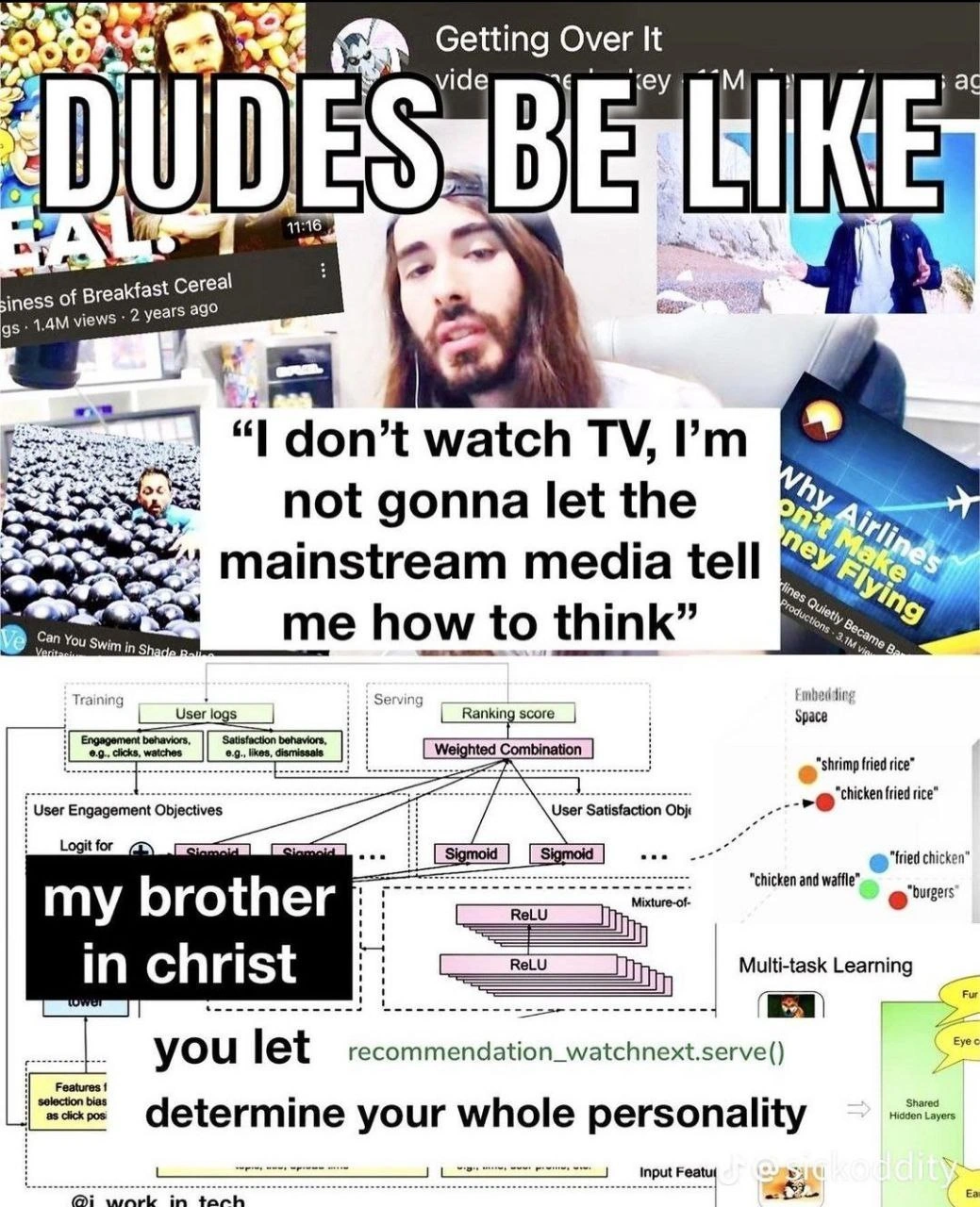
So what’s going on here, in simpler terms? This meme is calling out a guy (or many guys – hence “Dudes be like”) who says: “I don’t watch TV. I won’t let mainstream media tell me how to think.” That stance sounds independent, right? He doesn’t trust big TV networks or newspapers because he thinks they’re biased or controlling. But, here’s the kicker: he spends hours on YouTube instead, and he watches whatever YouTube’s algorithm puts in front of him. The meme is basically saying: “My friend, you’ve just swapped one kind of influence for another – and you might not even realize it.”
Let’s break down the components:
- YouTube’s Recommender System: Whenever you use YouTube and see “Up next” suggestions or a homepage full of videos “recommended for you,” that’s the work of a recommender system. It’s a piece of AI that decides which videos you are most likely to click or enjoy. It’s fueled by tons of data. Every time you click a video, watch it fully or drop out early, hit like or dislike, that information (your user logs) gets recorded.
- Training vs Serving: The meme diagram shows boxes like Training and Serving. In machine learning:
- Training is the learning phase. Imagine feeding a program all those YouTube user logs (billions of watch events) so it can detect patterns – like “people who watched video X often also liked video Y.” During training, the system adjusts its internal settings (weights in a neural network) to predict user behavior correctly. For example, it learns to predict “How likely are you to click this thumbnail?” by looking at what thousands of similar users did.
- Serving is the action phase. That’s when the trained model is actually used live. When you’re on YouTube and you finish a video, the serving system is what calls the model to say “Hey, give me the top 10 video suggestions for this user right now.” In the meme,
recommendation_watchnext.serve()is written like a function – think of it as the code that executes the trained model to get recommendations for “what to watch next.”
- Ranking score & Weighted Combination: The model doesn’t just pick videos at random. It gives each possible video a ranking score – basically a number representing how good a match that video is for you at that moment. How does it compute that number? It looks at multiple factors (objectives). For instance, one part of the model might estimate how likely you are to click on a video if it’s shown (that’s a measure of immediate interest or engagement). Another part might estimate how much you’d like it or how long you’d watch it (a measure of satisfaction or quality). The system then combines these – but not all factors are equal. It uses a weighted combination of them. Think of it like this: maybe clicks are important, but watch time is very important, so the model might do
Score = 0.3*(predicted_click_probability) + 0.7*(predicted_watch_time_metric)(just as an example). The weights (0.3 and 0.7 here) determine the balance. These weights might be decided by engineers or even learned automatically. The end result is one score that blends those factors. The video with the highest score is deemed the “best” recommendation, the next highest is second, and so on. - Sigmoid and ReLU: These are names of activation functions used inside neural networks. If you’re a junior dev not deep into machine learning yet, here’s the quick rundown:
- Sigmoid: This function takes any input (which could be any positive or negative number) and squashes it into a range between 0 and 1, in an S-shaped curve. When a model needs to output a probability or a score that makes sense as “likelihood,” a Sigmoid is handy because it naturally fits in that 0-1 range. In the diagram, Sigmoids are shown near something called “Logit” and in combining objectives. Likely the model produces a raw score (called a logit) for something like “user will click this” and then applies a Sigmoid to convert that into a probability (say 0.87 or 87% chance). So, Sigmoid = “give me a nicely bounded output, easy to interpret as probability”.
- ReLU (Rectified Linear Unit): This one is simpler – it’s like an on/off switch in math form.
ReLU(x) = x if x > 0, otherwise ReLU(x) = 0.So it chops off negative values to zero and lets positive values pass through unchanged. It’s used in hidden layers of neural networks (the internal layers that do feature processing) because it helps models learn patterns without some of the old problems (like gradients vanishing). You can think of ReLU as allowing the model to say “only if I get a strong positive signal, I’ll activate; if the signal is negative or not there, I stay silent (zero).” In the meme’s context, multiple ReLU layers means the model can combine inputs (like your viewing history, video attributes, etc.) in complex ways. Each layer gradually builds up more abstract features (maybe one layer detects “user likes educational content”, the next builds on that with “user likes quirky trivia specifically”).
- Embedding Space with dots: This part of the image with colored dots and labels might look confusing at first. An embedding is basically a way to represent something (like a video, or a word, or a user) with numbers so that a computer can work with it easily. More importantly, embeddings are designed so that similar things have similar embeddings. If you map these numbers in a coordinate system (like an X, Y plane or more dimensions), similar items will cluster together. The meme shows an example: terms like “shrimp fried rice” and “chicken fried rice” are very close – unsurprising because they’re almost the same phrase and likely the videos or context are quite similar (fried rice recipes, perhaps). “fried chicken” and “chicken and waffle” and “burgers” are somewhat near each other, likely because those might all be comfort food or fast-food-related topics. They’re a bit further from the fried rice cluster, but not too far (they all involve tasty food, just different kinds). This embedding space could be for video content or even for user interests. It’s a way the algorithm understands relationships: if you watched a video called “How to cook shrimp fried rice,” the system might recommend “How to cook chicken fried rice” next, because in embedding space those two are neighbors. The embedding is learned during training from patterns of co-occurrence (people who watch A often watch B, etc.). In plain terms, an embedding is a fancy data-scientist way of saying “we turned videos into points in a graph such that related videos are near each other.”
- Multi-task Learning: The diagram mentions this, and it’s a term in machine learning meaning the model is handling several tasks at the same time. In YouTube’s case, a single model might be trying to predict multiple things: clicks, watch time, likes, long-term satisfaction, etc. Instead of having separate models for each, they share some layers (the ReLU stacks, embeddings, etc.) and then diverge into separate outputs for each task. Why do that? Because some tasks can help each other. For example, knowing what makes you click might also help predict what makes you watch longer – they’re related signals of interest. By learning them together, the model might learn a more general understanding of what you find appealing. It’s like multitasking in learning – sometimes learning things together improves overall knowledge (like learning drums and piano at once might improve general rhythm understanding).
- Filter Bubble / Algorithmic Filter Bubble: This is an important concept in the meme’s message. A “filter bubble” is what happens when you only see content that matches your existing preferences or views, and you stop seeing anything that challenges or diverges from that. Algorithms tend to create this because if you show interest in something, they keep giving you more of it (the algorithm’s goal is to give you what you want, or at least what it thinks you want based on past behavior). Over time, that can isolate you in a bubble. For example, if you start watching a lot of one kind of political commentary, YouTube might mostly show you that perspective and never show you the opposite side – so you end up thinking that’s the whole world. In a less serious way, if you watch only coding interview videos, you might get a feed full of tech and never see, say, world news or other topics. The person in the meme shuns mainstream media presumably to avoid “their narrative,” but by doing so and relying on personalized feeds, he may end up in a bubble of his own making (or rather, the algorithm’s making).
- “Outsourcing free will”: The meme title says it humorously – it’s like he gave someone else the job of making decisions for him (that’s what outsourcing means: handing off a job to someone else). Here, free will (the ability to choose what to watch or what to think about) is being outsourced to the YouTube recommender stack (the whole algorithm and infrastructure behind recommendations). It implies he’s not actively choosing content; he’s letting the automatic suggestions choose for him. This is obviously an exaggeration – he does choose to click, but the idea is he’s heavily influenced by what’s teed up by the system.
- Bro, you don’t even watch TV: The top text “DUDES BE LIKE” and the quote “I don’t watch TV, I’m not gonna let mainstream media tell me how to think” highlights the persona being mocked. Many tech folks, maybe even you as a newcomer, might relate: a lot of us don’t watch traditional TV anymore. We get info from YouTube, Twitter, blogs, etc. There’s a sense of pride in that sometimes – like we’re being independent or consuming more authentic content. The meme cheekily reminds us that even that content is being filtered and arranged for us by algorithms created by large tech companies. It’s not exactly random or purely user-driven. YouTube’s algorithm in particular has become so influential that it’s almost like the new “network exec” deciding what millions of people will see (except it decides individually, based on each person’s data).
For a junior developer or someone new to this field, what’s noteworthy is how technical components translate into real-world influence. All those buzzwords – Sigmoid, ReLU, embeddings, training pipelines – might seem abstract when you learn about them in isolation. But here we see their concrete power: together, they form the engine that can subtly shape what content a person consumes daily. It’s basically Data Science meets daily life. The meme is humorously educating us that behind the YouTube homepage or the autoplay chain is a highly engineered system.
It might remind you of simpler projects you’ve done or read about, like a basic movie recommender (users who liked X also liked Y) or a news feed sort by “most relevant.” This is that concept on steroids. It’s not a static algorithm; it’s constantly learning from billions of interactions (that’s why AI/ML and Big Data are tagged – this is a prime example of those in action).
Also, let’s talk about the comedic angle in simpler terms: It’s funny because the dude in the meme is basically proclaiming to be a free thinker, yet unknowingly he’s being spoon-fed by the Algorithm™. If you’ve ever had a friend who boasts about not falling for advertisements or media bias but then you notice all their opinions or interests seem to come straight from whatever YouTube channel or subreddit they frequent, you’ll chuckle at this. It’s that vibe of: “Sure, you unplugged the TV, but you plugged in YouTube, and it’s doing the job just fine.” As a tech newcomer, you might not have built something like recommendation_watchnext.serve(), but you can definitely imagine a function like that in the code. It’s basically pseudocode for “serve the next recommended video.” It’s as if the meme is giving away the magician’s trick: Look, it’s just a program making the decisions for you. That black-and-white overlay text could almost be a developer posting on their social feed saying, “Friend, the call is coming from inside the house – the algorithm is telling you what to watch.”
One more bit: The collage of video thumbnails shown (“The Business of Breakfast Cereal”, “Getting Over It”, “Why Airlines Don’t Make Money Flying”, “Can You Swim in Shade Balls?”) – these are the kind of random yet intriguing videos YouTube might suggest after you’ve watched a few things. They’re not mainstream TV content; they’re more like quirky YouTube genres. “Getting Over It” likely refers to a popular difficult video game (there are many rage-funny videos about it on YT). The others are educational or explainer type videos that went viral. You might have seen similar titles in your own suggested feed, especially if you watch any educational or “explained” content. The meme chooses these to show what the guy is filling his time with instead of TV – arguably more niche stuff, which makes him feel special. But ironically, everyone on YouTube got those recommendations at some point because they were trending or highly engaging according to the algorithm. So the joke is also: he thinks he’s unique by skipping mainstream topics, yet he’s just consuming the flavor-of-the-month in YouTube-land. Those video topics became mini cultural phenomena precisely because YouTube’s algorithm blasted them out to millions.
In a nutshell, at this level: the meme is a playful reminder that algorithms have a huge influence on what we do online. The “anti-mainstream” guy is an unwitting example. As a new developer, it’s a peek behind the curtain of something you use daily. All those technical terms in the image? They’re real parts of a recommendation engine. And the comedic twist is realizing those parts together can silently guide someone’s choices as effectively as any TV network exec, perhaps even more so because it feels personal and subtle.
Level 3: Weighted Worldview 🎯
The meme’s humor hits home for any tech-savvy person who’s watched the rise of algorithmic content feeds. It brilliantly juxtaposes the “I’m too cool for mainstream media” attitude with the reality that the person’s whole content diet is curated by an algorithm. In other words, the dude trades one kind of puppet-master for another, without realizing it. That big caption “DUDES BE LIKE” sets the tone: it’s a setup commonly used to call out a stereotypical behavior (often hypocritical). Here, the stereotype is the self-proclaimed independent thinker who brags, “I don’t watch TV, I’m not gonna let the mainstream media tell me how to think.” He likely prides himself on getting information from YouTube, Reddit, podcasts – anything but those old-fashioned news channels or cable TV that the masses consume. The punchline? The meme points out he’s essentially letting YouTube’s Next Up algorithm do the thinking instead.
The line overlaying the system diagram says: “my brother in christ you let recommendation_watchnext.serve() determine your whole personality.” This phrasing is golden. First, the colloquial “my brother in Christ” has become a meme-y way of addressing someone in a tone that’s half-exasperated, half-endearing (as if saying “dear friend, please realize this obvious truth!”). It’s often used to call out ironic contradictions exactly like this. And here the obvious truth is that recommendation_watchnext.serve(), which sounds like a snippet of backend code, is effectively deciding what this guy watches next and next and next, shaping his interests. The meme author chose that function-like text to dramatize the point to developer audiences: it’s as if the YouTube code itself were a function that serves up his next obsession on a platter. By saying it “determines your whole personality,” the meme exaggerates for comedic effect: of course an algorithm doesn’t literally determine every trait of your personality, but it sure can influence your opinions, your conversation topics, even your sense of humor (after bingeing a bunch of algorithmically suggested comedy videos, for instance). We all know a friend or relative who after a year of watching “recommended for you” content has basically become a walking encyclopedia of whatever the algorithm kept feeding them – be it niche trivia about breakfast cereal economics or some fringe theory about airline profits.
What makes tech folks smirk here is how the meme marries the technical with the cultural. We see actual ML terms like Sigmoid, ReLU, and embedding space plastered on a diagram – things we normally discuss in architecture design docs or whiteboard sessions – being used as comedic props. It’s highlighting the absurdity that something as mundane as a person’s video binge habits is mediated by all this complex machinery. Industry veterans recognize that recommender systems (whether YouTube’s, Netflix’s, or TikTok’s) are some of the most influential pieces of software in daily life today. They’re also a product of intense engineering optimization. Companies have poured R&D into making these recommendation engines maximally engaging. So when our anti-mainstream dude distances himself from editorial influence (like TV producers or news editors), he jumps straight into the arms of an even more finely-tuned influencer: the AI running YouTube’s feed.
The shared experience being satirized is twofold. First, many of us have experienced going down a YouTube rabbit hole of weird, wonderful content thanks to the “Up Next” or sidebar suggestions. One minute you’re watching a tutorial on fixing your sink, the next you’re deep into a 40-minute video essay on, say, “Why Airlines Don’t Make Money Flying” (which funnily enough is one of the thumbnails shown). You look at the clock and suddenly it’s 3 AM, and you’ve learned about shade balls (those black balls they put in reservoirs) or the history of breakfast cereal marketing. You didn’t plan it – the algorithm hand-held you through it. It’s a relatable tech-era situation: the “just one more video” spiral that we joke about but also slightly fear because it’s so effortless. Second, the specific attitude being mocked (shunning mainstream media for being manipulators, while implicitly trusting “the algorithm”) is something a lot of us have seen, especially in tech circles. There’s this archetype of a tech bro (or just an internet-savvy individual) who’s proud to “cut the cord” – no cable TV, no network news, only self-curated content. They might say they’re above Mainstream Media™ because they find it biased or too shallow, so instead they consume hours of YouTube or TikTok thinking it’s more authentic or varied. The humor here is pointing out that this sense of being a free agent is partly an illusion: the curation hasn’t disappeared, it’s just been outsourced to an algorithm. The filter is still there, it’s just personalized.
From an industry perspective, this meme also pokes at the hype around personalization tech. The IndustryTrends_Hype of the last decade is that AI-driven personalization is awesome – it gives users what they want, when they want it, supposedly making media consumption more democratic (no stodgy editor deciding, “coming up next, on Channel 5…”). But insiders know there’s a dark side: these algorithms can create echo chambers, or as one of the context tags says, an algorithmic filter bubble. That’s where you only see content that aligns with your existing tastes or beliefs, reinforcing them further. The meme’s example of the algorithm essentially forming someone’s personality is exaggeration with a kernel of truth: people really can get radicalized or extremely niche-focused because of endless algorithmic recommendations feeding them more and more of the same. (Think about conspiracy theory rabbit holes or even just someone becoming “the cereal facts guy” in his friend group after watching dozens of cereal business videos suggested by YouTube’s autoplay.)
Another aspect here is the quiet stealth of this influence. The meme contrasts “mainstream media telling me how to think” – which is a very overt form of influence (e.g., a TV pundit explicitly stating opinions) – with the covert influence of a recommender. YouTube’s recommendation_watchnext doesn’t come out and say “Think this way!” It simply, silently lines up the next piece of content tailored to push your curiosity buttons. It feels passive and user-driven: you feel like you chose to watch that next video (after all, you clicked it). But did you choose it, or did the algorithm’s ranking score choose it for you? That rhetorical question is the heart of the meme. A seasoned developer might chuckle because it reminds them of the saying: If you’re using a product that’s free, you are the product. In this case, the guy thinks he’s just freely browsing, but in reality, his attention is being carefully guided and monetized by a big data brainchild.
There’s also an implied jab at how ironically mainstream this anti-mainstream behavior actually is. Millions of people nowadays say “I don’t watch TV, I get my info from YouTube/online.” It’s become almost a cliché – essentially a new mainstream. The collage of YouTube thumbnails (cereal, shade balls, etc.) are all actual well-known YouTube video genres/topics that went viral or at least were heavily promoted by the algorithm. So our dude isn’t forging a unique path; he’s one of the herd, just a different herd. A senior dev who’s been around might laugh at that irony: the same way everyone used to gather around the 8pm news, now millions of “TV cord-cutters” all end up watching the same few trending YouTube videos that the algorithm decided were engaging. It’s like trading one central feed for another, except the new one is individualized enough that you maintain the illusion of choice.
Why is fixing this (i.e., being truly independent in media consumption) harder than it looks? Because, frankly, these algorithms are really good at what they do. They’re designed to capture your attention. Any experienced engineer in AI/ML will tell you that the recommender team’s goal at a company like YouTube is to maximize watch time and engagement. They A/B test endlessly to fine-tune that weighted combination so that the recommended content is almost irresistible. There’s whole datasets and research papers about how to increase that CTR (click-through rate) by even 0.1% – a huge win for ad revenue. In doing so, they invariably learned to play off human psychology: curiosity, confirmation bias, the tendency to prefer comfort content or outrage content depending on the person. So when our meme’s subject tries to assert intellectual independence, he’s up against an army of data scientists and machine learning models quietly working to keep him hooked. It’s not a conspiracy in the tinfoil-hat sense; it’s just the business model. But the end effect can indeed be a kind of personality grooming. The meme exaggeration “determine your whole personality” alludes to cases where, say, someone’s entire worldview (from politics to hobbies) tracks back to what the YouTube algorithm kept feeding them. Not so far-fetched – there have been numerous anecdotes and studies on e.g. YouTube’s role in radicalization or simply shaping trends (how do you think certain random hobbies suddenly spike in popularity? The algorithm might have had a hand).
For a senior developer or data scientist, there’s an extra layer of chuckling at the technical specificity. The mention of recommendation_watchnext.serve() is hilarious because it reads like a function call one might see in back-end code or logs – as if the meme is showing the actual interface where the codebase decides “what to serve next.” It’s a nod to how this is literally an implemented system. It’s not magic or fate causing the dude to obsess over shade-ball pool videos; it’s a product feature, likely written by engineers in C++ or Python, running on Google’s infrastructure, calling something akin to serveRecommendations(userId). We, as devs, recognize our own handiwork in orchestrating user behavior. The meme is basically an engineer saying, “Buddy, I know you think you’re off the grid, but I’ve seen the kind of code that’s picking your next video – trust me, you’re on someone’s grid.” There’s a tiny bit of self-own here too: we in tech have built these addictive systems, and now we witness people claiming independence while our software quietly tugs their strings. It’s a mix of pride (wow, our algorithms can do that) and alarm (uh oh, our algorithms do that).
In summary, on the senior level this meme hits so many relevant points:
- Algorithmic Influence vs Perceived Independence: Highlighting the cognitive dissonance of modern media consumption.
- The invisible hand of AI: All those fancy ML components (Sigmoid, ReLU, embeddings, etc.) are the new puppet masters, more abstract but arguably more effective than old-school media execs.
- Shared tech culture humor: The use of phrases like “my brother in Christ” combined with a code snippet style is exactly the kind of irreverent, smart humor tech folks adore. It’s mixing internet slang with technical jargon – a hallmark of good TechHumor these days.
- Industry reality check: It subtly reminds us that Big Tech (through AI/ML and big data) shapes societal trends more intimately now, which is both fascinating and a little frightening. It’s funny here because it’s true – we all know at least one person who is basically a product of what the YouTube/TikTok/Instagram algorithm thinks they want.
- Hypocrisy called out: And of course, it’s always funny to see the irony when someone claims to evade influence but is actually neck-deep in another kind of influence. The meme delivers that with the tone of a tired friend or a sarcastic coworker pointing at the obvious.
All these layers make the meme AIHumor gold. It’s the kind of image you’d share in a work chat or on Twitter among devs/data scientists and instantly get nods and “lol so true” reactions. It encapsulates an entire modern phenomenon (algorithmic personas) in one chaotic collage and a blunt caption. In the end, “When Anti-Mainstream Developers Outsource Free Will to YouTube’s Recommender Stack” is both a mouthful and the perfect description: the dude outsourced his free will to the very ML stack he might claim is just neutral or not influencing him. And we’re left cackling at the thought that, indeed, a bunch of weighted logits and a sigmoid now have more say in his nightly thinking than the 9 o’clock news ever did.
Level 4: Deep-Fried Embeddings 🍤
At the cutting-edge of YouTube’s recommendation algorithm, we find a sophisticated ML pipeline quietly choreographing your viewing habits. Under the hood, it’s a multi-task learning behemoth optimizing multiple objectives at once. The meme’s block diagram isn’t just for show – it mirrors real design elements from large-scale recommender systems. On the training side, user logs of engagement (clicks, watch duration, likes, etc.) are fed into a model. These logs are massive (BigData at its finest), allowing the system to learn intricate patterns about what keeps users hooked versus what truly satisfies them. One part of the model might predict engagement probability (e.g. “likelihood you’ll click or watch this video”), and another part predicts satisfaction (perhaps “likelihood you’ll like or not regret watching”). These are the User Engagement Objectives and User Satisfaction Objectives hinted at in the diagram.
To juggle both, the system uses a weighted combination of predictions. Picture a formula that blends these objectives: one term for short-term engagement and another for long-term satisfaction, each multiplied by a tuned weight. In pseudo-math, it’s something like:
$$\text{score}(video) = \sigma(w_1 \cdot \text{EngagePred} + w_2 \cdot \text{SatisfPred})$$
Here $\sigma$ is a sigmoid function squashing the score into a nice 0-1 range (useful as a ranking probability). In practice, the ranking score for each candidate video is computed by such a formula, where $w_1, w_2$ are carefully chosen constants (or learned parameters) balancing “keep them watching” vs “keep them happy.” The output $\sigma(\cdot)$ is our logistic Sigmoid activation – it ensures the final ranking score is normalized, kind of like a probability that “this is the one video you’ll click next.”
Underneath, a deep neural network crunches all this. Those stacks labeled ReLU in the graphic? They represent hidden layers packed with Rectified Linear Unit activations. Why ReLU? Because deep networks love them: unlike Sigmoids, ReLU doesn’t saturate for large values – it just linearly passes them if positive, or outputs 0 if negative (ReLU(x) = max(0, x)). This keeps gradients flowing robustly during training, allowing the model to learn subtle nonlinear relationships in the data. Early recommenders and neural nets often used Sigmoid or tanh in every layer, but as seasoned ML engineers know, that made deep models prone to getting “stuck” (vanishing gradients). The shift to ReLU (an IndustryTrend in deep learning) was a game-changer: it enabled really deep stacks of layers to train on these huge user-interaction datasets. In our meme’s context, multiple ReLU layers mean the model is teasing out complex factors: maybe one neuron starts to encode your love of quirky DIY science videos, another neuron fires for gaming rage-quit compilations, etc., all hidden in those layers.
The embedding space depicted with colorful dots (“shrimp fried rice”, “chicken fried rice”, “fried chicken”, “burgers”, etc.) illustrates how the recommender represents content in high-dimensional math space. Each video or topic is mapped to a vector, essentially a point in this multi-dimensional space. If two videos are similar in theme or attract the same audience, their points end up close together. For example, “shrimp fried rice” and “chicken fried rice” are nearly the same concept (just a different main ingredient), so any sensible embedding will put those two dots nearby. They might both cluster around a “fried rice” region of the space. Meanwhile, “fried chicken” might be near “burgers” because those are comfort food topics, and “chicken and waffle” edges in too (it’s fried, it’s chicken… it’s related!). This clustering effect comes from training the embedding to capture co-watch and search patterns: if many users who watch one video also watch another, the model nudges their embeddings closer. Over billions of views, you get a rich galaxy of content where distance corresponds to how likely a user might hop from one topic to a related one. The meme slyly shows these embedding clusters to hint: the system knows the nuances of your interests even at the level of fried foods 🥘.
Bridging embeddings to recommendations is where ranking happens. When you finish a video, recommendation_watchnext.serve() (a sly reference to the internal service call that fetches next-video suggestions) takes your user embedding (your inferred tastes) and finds nearby content embeddings (videos related to what you’ve watched or enjoyed). Those candidates are then scored through the neural net: each candidate video’s features (including that embedding vector, plus other signals like popularity or freshness) get fed into those ReLU-rich layers, producing intermediate logits (raw scores) for each objective (engagement, satisfaction). Each of those logits might pass through a Sigmoid to become a probability (e.g. probability of a click, probability of a like). Then comes the weighted combination of these probabilities (a little linear mix using those $w_1, w_2$ weights) to get one final rank score. The serving system then sorts videos by this final score and hands the top suggestions to your app’s “Up next” list. All of this happens in milliseconds, every time you watch or refresh.
It’s a marvel of engineering: massive distributed training on GPU clusters to update that model, then super-fast inference calls at scale to serve millions of users concurrently. The architecture balances exploitation vs exploration, relevance vs serendipity by adjusting those weights and maybe even adding a dash of randomness or novelty so you don’t get bored seeing the same stuff. Even the sigmoid vs ReLU choices are results of years of research and on-call war stories – for instance, a poorly calibrated Sigmoid output could either spam you with clickbait or ghost some genuinely good content. Tuning this system is as much an art as science.
So from a theoretical lens, this meme isn’t just poking fun – it’s revealing how complex algorithms model human behavior. The humor has a foundation: your so-called free will on YouTube is influenced by a dense web of linear algebra, nonlinear activations, and optimization. It’s essentially pointing out the cognitive dissonance: one thinks they have autonomous taste, but behind the scenes a hundred million weight parameters are nudging that taste, ever so subtly. The algorithmic filter bubble effect emerges right here mathematically: the longer you interact, the more the model reinforces vectors similar to what you already saw, tightening the bubble. Unless objective weights or design add countermeasures (like “diversity regularization” or explicit exploration of new topics), you end up in a self-reinforcing loop. In plain terms: the network finds what keeps you watching and feeds you more of exactly that, possibly until your whole personality vector in that embedding space drifts toward some extreme corner (whether it’s endless cereal business trivia or every shade-ball pool video ever made).
Overall, the Level-4 irony is deliciously meta: we have an extremely advanced AI/ML system (with all its sigmoids, ReLUs, and embeddings – the stuff of research papers and PhDs) effectively acting as a puppeteer for human preferences. The meme shines light on this high-tech puppetry with glee. For seasoned engineers or data scientists, it’s an AI humor gem: the terms in the diagram are familiar from their day jobs (maybe they’ve tweaked a learning rate or fought a NaN output in a similar network at 2 AM). They’re laughing because the guy in the meme has unknowingly surrendered his decisions to this labyrinth of math. It’s like an inside joke: “my brother in Christ, the reason you can’t stop clicking those bizarre video essays is because a neural network with calibrated logits and a ton of click data basically predicts and dictates your cravings.” The complexity hidden in those few overlay words and diagrams encapsulates a whole saga of modern AI influence. And the punchline lands because all that complexity leads to one simple outcome – recommendation_watchnext ultimately decides who you become a fan of, one autoplay at a time.
Description
A multi-panel, chaotic collage-style meme with the text 'DUDES BE LIKE' at the top. The first text block says, 'I don't watch TV, I'm not gonna let the mainstream media tell me how to think.' This is contrasted with the bottom text, overlaid on a complex system diagram, which reads, 'my brother in christ you let recommendation_watchnext.serve() determine your whole personality.' The background is a collage of YouTube video thumbnails, many featuring streamer Cr1TiKaL (penguinz0), alongside a detailed diagram of a machine learning recommendation engine. This diagram includes components like 'Training,' 'Serving,' 'User logs,' 'Ranking score,' 'Weighted Combination,' activation functions like 'Sigmoid' and 'ReLU,' and concepts like 'Embedding Space' and 'Multi-task Learning.' The technical joke highlights the irony of a person believing they are an independent thinker by avoiding traditional media, while unknowingly allowing their entire worldview and personality to be shaped by a sophisticated, opaque recommendation algorithm from a platform like YouTube. The function name 'recommendation_watchnext.serve()' is a painfully realistic representation of a production service call that machine learning and backend engineers would recognize. The detailed diagram, showing a real-world architecture for a two-tower recommendation model, is what makes the meme deeply resonant for senior engineers who build or interact with such large-scale AI systems
Comments
12Comment deleted
Some engineers spend years building two-tower neural networks with complex feature crosses and embeddings, just to definitively prove that a user who claims to hate mainstream media will, in fact, click on a 4-hour video essay about the history of breakfast cereal
You painstakingly diff every PR for a missing semicolon, yet some mystery ReLU stack running at 25 000 qps is root-shelling your world-view
The same engineers who mock TV watchers for being 'programmed' spend their evenings debugging why their recommendation system keeps suggesting videos about medieval blacksmithing after they watched one React tutorial - turns out the embedding space thinks useState hooks and forging horseshoes share semantic similarity
The beautiful irony: rejecting 'mainstream media manipulation' while letting a multi-task learning model with sigmoid activations and ReLU layers literally optimize your engagement behaviors through gradient descent. My brother in Christ, you didn't escape the algorithm - you just traded broadcast scheduling for a personalized neural network that's A/B testing your dopamine receptors in real-time. At least TV executives had the decency to manipulate everyone equally; now you get bespoke psychological profiling with sub-millisecond latency
Claiming independence from “mainstream media” while your worldview is literally argmax over wCTR, wRetention, and wSatisfaction - sigmoided and served by watchnext - is peak multi-armed bandit lifestyle
You canceled cable and hired gradient descent as your editor-in-chief - watchnext().serve() is A/B testing your worldview toward the highest watch-time local minimum
Don't let media tell you what to think - let gradient descent do it instead
"watch next" or something, I don't use Netflix Comment deleted
I should ask Primeagen what netflix uses Comment deleted
Dunkey🤘 Comment deleted
You guys know what's intresting ? The joke about ITs and programmers being furries is not a joke Comment deleted
This is exactly what I'm talking about Comment deleted