Senior Dev's Guide to Complex Tasks: From Sketch to Masterpiece
Why is this Learning meme funny?
Level 1: Just Draw the Horse
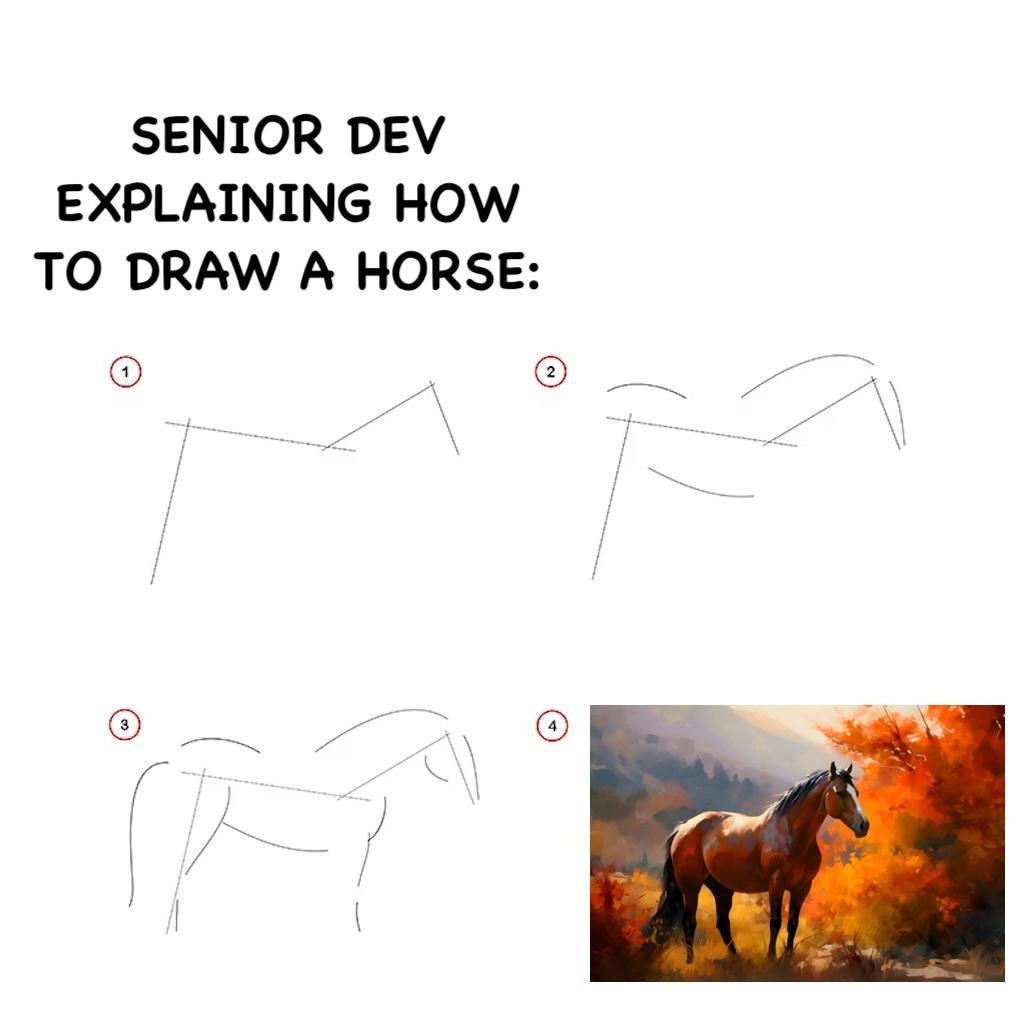
Imagine you ask someone how to draw a perfect horse, and they say: “Oh, it’s easy! First draw a couple of lines... then just finish the horse!” You look at your few simple pencil lines and then at their beautiful horse painting and think, "Wait, how do I get from this to that?!" It’s funny because that person acted like the hard part – all the details of the horse – didn’t need any explanation. It’s like if a friend gave you a recipe that said, “Mix some ingredients in a bowl, then poof! a gourmet cake comes out.” You’d laugh because they skipped all the real cooking steps. In the same way, this meme makes us laugh by showing how silly it is when someone skips all the important steps and pretends something really complicated is “super simple.”
Level 2: Mind the Gap
At a simpler level, this meme highlights how instructions can skip important steps, leaving newer developers confused. The four panels show a progression: Steps 1, 2, and 3 have only basic lines (like a rough outline of a horse), and then Step 4 suddenly shows a fully detailed horse painting. This is poking fun at how a senior developer might explain a complex task to a junior developer. They give a few high-level steps and assume the rest will just happen. In reality, the junior is left thinking, "Wait, how do I get from this rough sketch to that finished result?"
Let’s break down some terms and concepts here:
Microservice: This is a small, independent application or service that does one thing well, and is part of a bigger system. In the meme’s context, building a “full microservice” means creating a complete working program (with its own code, database, API, etc.) that can run on its own. That’s a lot of work! The title jokes that what was supposed to be an “easy four-step” guide by the senior dev suddenly turned into a whole microservice project. In other words, a tiny "just do this" task ballooned into a major undertaking.
Senior vs Junior Developers: A senior developer has a lot of experience and has done similar tasks many times before. They often think in broad strokes because they already know the details by heart. A junior developer is still learning and may need more guidance on each step. In the meme, the senior’s guide to “draw a horse” (or by analogy, build the software) goes from a couple of lines straight to a masterpiece, skipping how to actually draw the body, legs, shading, etc. This represents the knowledge_transfer_gap – the senior forgets that the junior doesn’t know all those in-between steps.
Documentation Gap & Oversimplification: Documentation is supposed to teach you how to use or build something. A documentation gap is when the docs jump over crucial details. For example, imagine a tutorial that says, "Install the tool, then deploy your app, and now you can serve millions of users." If you’re new, you’d be left asking, "Wait, deploy it how? Configure what?" That guide oversimplified (made it sound simpler than it is) by skipping the hardest parts. Oversimplification is exactly that: representing something complex as if it were easy. The meme clearly shows oversimplification – the senior dev’s “four easy steps” only covered the obvious starting bits, but not the real work needed to finish.
Hidden Complexity: This refers to all the complicated stuff that isn’t immediately obvious. In software, a task might look simple until you actually try to do it. For instance, adding a “login” feature sounds straightforward (“just add a login form, done!”), but under the hood there’s a lot of complexity – validating passwords, storing users securely, handling forgot-password flows, etc. In the meme, the beautiful horse painting at the end represents all that hidden complexity finally revealed. The first three sketchy panels didn’t show it, but doing the final painting required all those missing details.
Learning Curve & Mentorship: The learning curve is how much you have to learn to get good at something; if it’s steep, it means you have to learn a lot very quickly. When documentation or a mentor leaves out details, it makes the learning curve steeper for the junior dev – they have to scramble to figure out the missing pieces themselves. Good mentorship means the senior dev would guide the junior through all the important steps, not just give a rough outline. The meme is highlighting a case of not-so-great mentorship (or at least pretty incomplete instruction), in a humorous way.
Think of a real scenario: You ask your team lead how to implement a new feature. They say something like, "Oh, that’s easy – just create a new service, connect it to our user database, call the API, and you’re done." To them it sounds like a quick 1-2-3. But for you, each of those steps is huge:
- “Create a new service” means setting up a new code project, deciding on the right framework, and writing a bunch of new code from scratch.
- “Connect it to the database” means you need to figure out database connection strings, credentials, maybe an ORM (Object-Relational Mapper) or writing SQL queries, and ensure you don’t mess up any data.
- “Call the API” means learning how to make HTTP requests in your code, handling authentication, parsing the responses, and dealing with any errors.
- Finally, "you’re done" will only be true after you’ve possibly spent days or weeks debugging issues and covering all the things they never mentioned (logging, testing, error recovery, etc.).
Each bullet above was quietly hiding lots of sub-steps. You can see how the senior’s oversimplified explanation glossed over the actual work. For a junior developer, encountering this situation can be equal parts funny and frustrating:
- Funny, because the gap between the guide-lines and the final horse is so ridiculous that you have to laugh. It’s like being told "just build it, it’s simple" and then discovering a giant puzzle.
- Frustrating, because you might feel lost or think you’re missing something obvious, when in fact the “obvious” stuff was never provided. It’s not you — the instructions really did skip the hard parts.
This meme uses the four_step_horse_meme format to say: if you’ve ever read an “easy tutorial” that left you with more questions than answers, you’re not alone. It’s a lighthearted reminder for seniors to be more thorough, and for juniors to understand that a lot of complexity is often hiding behind “simple” instructions. The next time someone’s guide makes you feel like Step 3 to Step 4 might as well be magic, just remember the horse meme and know it’s a common experience in learning to code!
Level 3: Then a Miracle Occurs
This meme underscores a classic documentation gap that many developers have experienced. In the first three panels we get a skeletal outline of a horse – like a senior engineer rattling off four easy steps to build a new feature or a microservice. The final panel, however, is a stunningly detailed horse painting. The humor hits because between panel 3 and 4, there's an implied mountain of work that was never explained. It's as if the instructions jump straight from “set up a basic skeleton” to “now handle millions of users” in one breath. Every experienced dev recognizes this pattern from half-baked tutorials or overly-optimistic tech leads. There's an unspoken step 3.5 where “then a miracle occurs” – all the messy implementation details, edge cases, and integration work magically get done off-screen. 🪄
In real life, this kind of oversimplification happens all the time. A senior dev might say, “Oh, building a scalable microservice? Easy: just write the API code, hook it up to a database, containerize it, and deploy!” They compress what could be months of work and learning into a breezy one-liner. Why? Often because those steps have become second nature to them – they forget how complex each piece really is for someone who hasn't done it before. This meme nails the SeniorVsJuniorDevelopers dynamic: the senior genuinely believes they're giving a straightforward roadmap, but to a junior it's like being handed a rough sketch and expected to produce a masterpiece.
A big reason we find this funny (and painfully true) is the hidden complexity behind simple phrases. “Just hook it up to a database” sounds trivial, but it involves choosing between SQL vs NoSQL, writing migration scripts, handling ORM mappings or query builders, dealing with connection pooling and error handling – none of which was spelled out. Similarly, “just deploy” might conceal setting up CI/CD pipelines, writing Dockerfiles, configuring Kubernetes or cloud services, monitoring, scaling, and more. The final horse painting in the meme is all that invisible effort made visible: every muscle and shadow in that art is like a piece of code or config that had to be painstakingly filled in. The senior’s instructions skipped those, but the junior still has to do them.
This pattern is so familiar that it’s become an inside joke in developer communities. We see it in project README files that jump from “Installation” to “Usage at Scale,” skipping how to configure the app for real workloads. We see it in a boss’s email outlining “just refactor it into microservices” as if it's an afternoon task. There's even a well-known meme of “How to Draw an Owl” with two steps: Step 1, draw two circles. Step 2, draw the rest of the owl (a fully detailed owl). This horse-drawing meme is a direct nod to that, transposed into the software world. It exaggerates to make a point: mentorship and documentation often leave out 90% of the work. And guess who gets to figure out that missing 90%? The junior developer, of course.
From an engineering perspective, skipping details can be dangerous. It's how knowledge transfer gaps form in teams. The senior might assume something is obvious or already known, but the junior is left googling frantically or falling into “tutorial hell” trying to bridge that gap. It’s also how we get bugs and design flaws: crucial steps are glossed over, so a newbie might make wrong assumptions. For instance, if a senior says “just use a queue for that” without explanation, a junior might pick the first message queue they find and not realize the nuances of message ordering, retry logic, or distributed transactions. The result? The code might work on their machine, but blow up in production because the devil was in the details that were skipped.
Let’s not forget the human aspect: the junior developer likely feels lost and maybe a bit embarrassed to ask for clarification, because the steps were framed as “easy”. The senior didn't mean to put them in that spot, but their confidence (or curse of knowledge) made them outline a happy path that assumes everything goes perfectly. This is a wink and a nudge to seasoned devs: just because you can see the finished horse in your mind’s eye doesn’t mean you gave enough instructions to draw it. It also validates the less experienced folks: if those “four easy steps” felt more like four hundred, it’s not you – it’s that 90% of the drawing wasn’t actually in the steps! The title’s joke about a full microservice springing from “four easy steps” sums it up – in software, complex systems never come for free, no matter how simple someone makes it sound.
Description
This is a four-panel meme illustrating the 'How to Draw an Owl' format, adapted for a software development context. The title at the top reads, 'SENIOR DEV EXPLAINING HOW TO DRAW A HORSE:'. The first three panels, numbered 1, 2, and 3, show a progressive but extremely simplistic line-drawing tutorial. Step 1 starts with a few basic lines representing the horse's back and legs. Steps 2 and 3 add a few more rudimentary lines to vaguely outline the body shape. The final panel, number 4, abruptly transitions from the simple sketch to a fully detailed, photorealistic painting of a majestic horse in a vibrant, autumnal forest setting. The humor stems from the massive, unexplained leap in complexity and skill between step 3 and the final result. For experienced engineers, this is a highly relatable metaphor for the communication gap that often occurs when a senior developer explains a complex task to a more junior team member. The senior, operating at a high level of abstraction, provides the basic outline (the simple lines) but glosses over the vast, intricate details of the implementation (the finished painting), leaving the junior developer to bridge an enormous knowledge gap on their own. It perfectly captures the 'curse of knowledge' phenomenon in technical mentorship
Comments
12Comment deleted
This is how senior devs write documentation. Step 1: 'Clone the repo.' Step 2: 'Run `docker-compose up`.' Step 3: 'The application is now running.' They always forget step 2.5, which involves a three-day shamanic journey to debug undocumented environment variables and a cryptic C++ dependency from 2004
README.md: 1) git clone, 2) ./deploy.sh, 3) enterprise-grade horse appears - undocumented kube-YAML left as an exercise
The real step 4 is 'git blame' shows 47 different contributors over 8 years, 3 framework migrations, and a comment that just says '// TODO: explain this properly' from 2016
This is the architectural equivalent of a senior engineer's pull request comment: 'Just refactor the monolith into microservices' on line 47 of a 10,000-line legacy codebase. Sure, we all know the destination looks beautiful - that majestic horse in step 4 with its perfectly distributed services, elegant API gateway, and cloud-native observability. But somewhere between 'draw two circles' and 'ship to production,' there's about 6 months of Kubernetes YAML, service mesh debugging, and distributed tracing implementation that got conveniently abstracted away. The real art isn't knowing what the horse should look like; it's remembering that you once spent three weeks just figuring out how to draw the legs without them looking like table supports
Classic senior walkthrough: steps 1 - 3 are lines; step 4 is “just add a tiny CQRS/event‑sourcing layer with exactly‑once semantics” - boom, production-grade horse
Every senior-dev walkthrough: three lines on the whiteboard, then “just wire it up” - i.e., implement idempotent services, retries with exponential backoff, schema evolution, RBAC, observability, and the rollback you’ll discover at 2am
Senior dev fix: 'rm -rf /problem' becomes a 4-phase migration with Helm charts and SLOs
Senior dev explains: 1) Lorem ipsum dolor sit amet, consectetur adipiscing elit. Nulla a lorem tincidunt, sagittis erat quis, euismod eros. Quisque eu dolor vulputate felis feugiat congue. Sed placerat lacinia nulla, sed dictum odio tincidunt eget. Vestibulum nec felis convallis, gravida ipsum in, imperdiet lacus. Etiam congue neque eget ipsum aliquet, sed molestie mi posuere. Vestibulum scelerisque nisl ut neque semper, at rutrum sapien tincidunt 2) Cras volutpat risus a aliquet varius. Donec euismod bibendum tortor varius efficitur. Nam tincidunt mauris et condimentum feugiat. 3) Aenean pretium quam nibh, eget elementum ipsum aliquam nec. *TIRED EXPLAINING* 3.1) Uno 3.2) two 3.3) ughh 4) just add some colours idk In case of questions use google Comment deleted
what is this text that is used as placeholder? Comment deleted
Lorem ipsum generator, landing page will explain what is it. Comment deleted
This senior dev is an incompetent idiot, who failed at his most important task - helping his fellow junior engineers grow. Comment deleted
Sometimes I feel like there is no longer junior devs opening role in the market now. Comment deleted