
Skip to content
DevMeme
4066 of 7435
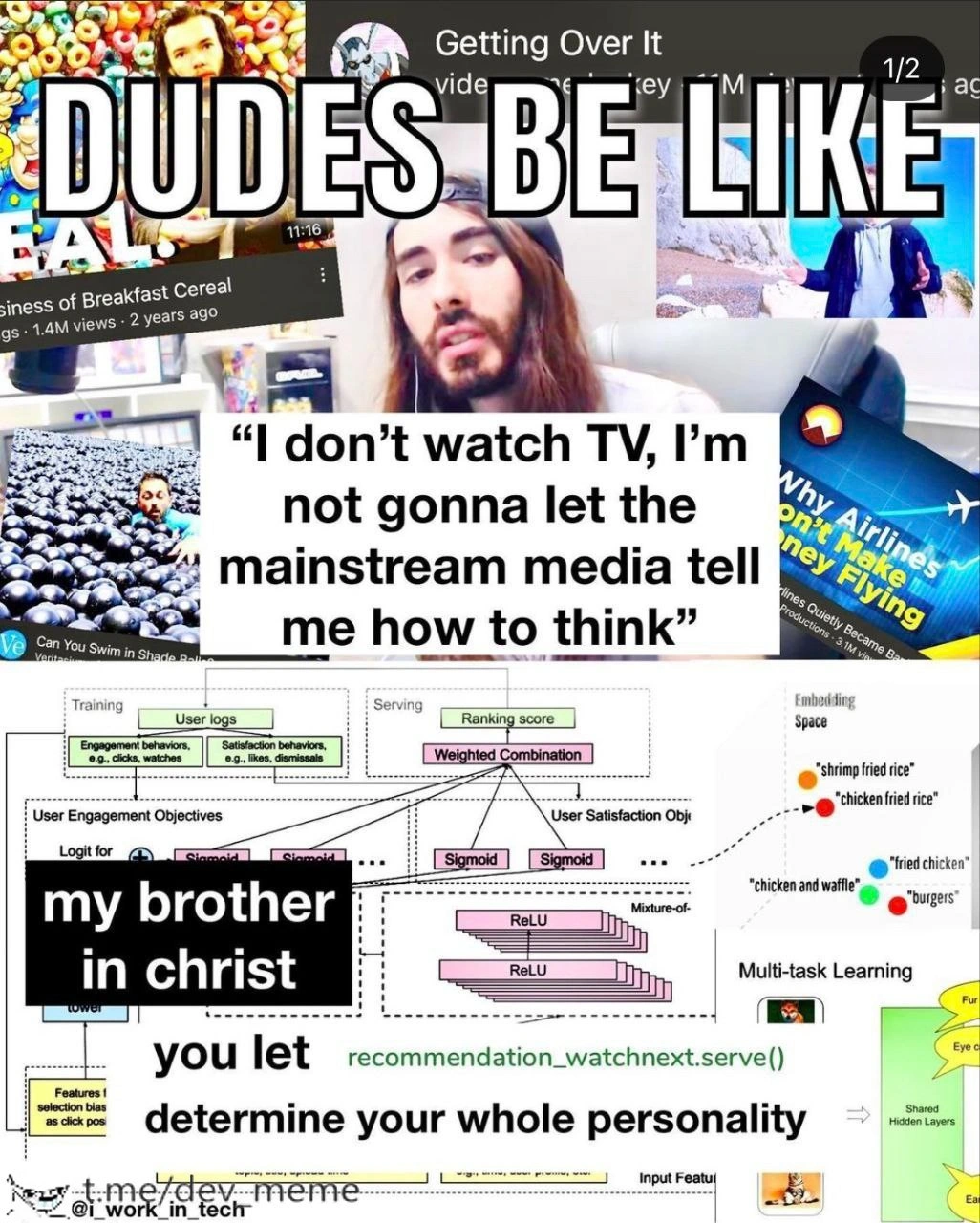
Avoiding TV yet blindly trusting YouTube’s recommendation_watchnext.serve to shape identity
AI ML Post #4434, on Jun 9, 2022 in TG

Avoiding TV yet blindly trusting YouTube’s recommendation_watchnext.serve to shape identity

Why is this AI ML meme funny?

Level 1: Who’s Really Choosing?

Imagine you say, “I won’t let my parents pick what I wear today, I’ll choose my own clothes!” You feel very independent and proud of that. But then, without noticing, you let a mysterious robot in your phone decide what you should wear by following all its suggestions. Kinda silly, right? That’s basically what’s happening in this joke. The guy refuses to let TV (which is like a big school teacher or a parent figure telling everyone the same thing) tell him what to think. He’s proud of not watching the news or TV shows that might influence him. But, at the same time, he’s watching YouTube and clicking on whatever video YouTube’s automated helper (the algorithm) puts in front of him next. It’s like he said “No, I won’t eat the meal that was cooked for everyone,” and then he proceeds to eat whatever a secret chef hides in his lunchbox every day. In both cases, he isn’t truly choosing for himself – someone or something else is choosing, and he’s just going along with it. The reason it’s funny is because he doesn’t realize the second situation is happening. We do (as the audience of the meme), and we’re playfully poking at that. It’s a bit like watching a friend avoid one trap only to fall into another. We laugh and think, “Oh man, you escaped the big obvious influence, but look, you’re letting the sneaky one guide you instead!”

Level 2: Curated by Code

Let’s break down what’s happening in simpler terms. This meme is highlighting a person who says, “I don’t watch TV because I don’t want big media telling me what to think.” That sounds like he wants to be independent and only think for himself. So far, so good. But, the funny (and a bit embarrassing) part is that the same person happily watches tons of YouTube videos that are recommended to him by a computer algorithm. In other words, he refuses to let a TV network boss or news channel decide what he sees, but he’s okay with letting a computer program decide what he sees. He probably hasn’t thought about it that way, which is why the meme comes off as a friendly reality check.

So, what is this mysterious computer program? It’s the YouTube recommendation algorithm – basically a smart system that figures out what videos you might want to watch next. Every time you finish a video (or even while you’re watching one), YouTube suggests a list of other videos in the sidebar or autoplay. Those suggestions aren’t random at all. They come from analyzing your behavior and thousands of other users’ behaviors. Here are the basics of how it works:

  1. It watches what you watch: The system keeps track of your viewing history – what videos you clicked, which ones you watched to the end, which ones you gave a thumbs-up, etc. These are all signals of what you enjoy.
  2. It looks for patterns: Using those signals, it tries to find other content that is similar to what you’ve enjoyed. If you’ve been on a kick watching, say, airplane economics videos (“Why Airlines Don’t Make Money Flying” as shown in the meme), the algorithm notes that interest. It represents this in data form, often as what's called an embedding vector (basically a list of numbers that capture the essence of that interest, like a fingerprint of your taste).
  3. It scores potential videos: The algorithm then scans a huge catalog of videos and gives each a ranking score based on how well it thinks you’ll like them. This scoring is where all those neural network things come in. For example, it might predict “User will click this” with some probability, and “User will enjoy or be satisfied with this” with another probability. It combines these predictions to decide what’s the best pick.
  4. It serves the recommendations: Finally, the videos with the highest scores show up as your recommendations – those tempting thumbnails that appear as “Up next” or on your homepage. And usually, because the algorithm knows your habits well, you end up clicking one of them. This in turn gives the system more feedback (it learns “oh, he clicked that, good, give more like that!”), and the cycle continues.

In the meme, the phrase recommendation_watchnext.serve() looks like a snippet of code (maybe Python-flavored pseudocode). You can think of that as the function or service in YouTube’s backend that actually does the job of picking and delivering the “watch next” suggestions. By writing it out like code, the meme is making the point: “Dude, you’re trusting this function – this line of code – to guide what you watch and essentially what ideas you consume.” It’s a stark contrast to him refusing to trust a TV channel. TV channels are run by people with schedules and editors. YouTube’s WatchNext is run by an algorithm with data and neural networks. But either way, something outside of you is curating your content.

Now, let’s demystify some of the jargon shown in that diagram (the one in the meme that looks super techy with boxes and arrows):

  • Training vs. Serving: Training is when the algorithm learns from data (like learning from all the watch history of millions of users). Serving is when it actually uses what it learned to give you recommendations in real-time. The meme’s diagram shows these as separate parts, which is exactly how many recommendation systems work. They train offline, then serve results live.
  • Embedding Space: This is mentioned with those colored dots labeled “shrimp fried rice”, “fried chicken”, etc. An embedding space is a fancy term in machine learning where items (like video topics or words) are represented as points in a geometric space. If two points are close together, it means they’re similar in context. So in that example, the algorithm has learned that “shrimp fried rice” and “fried chicken” have something in common (perhaps people who watch videos about one often watch videos about the other, since both might be comfort food related). The algorithm uses this to make educated guesses – if you liked one, you might like the other, because in this mathematical space they’re neighbors.
  • ReLU and Sigmoid: These are names of functions used inside neural networks. Think of a neural network like a giant math equation with many layers; ReLU (Rectified Linear Unit) and Sigmoid are just different types of operations in those layers that help the network learn patterns. ReLU is like “if input is positive, keep it, if it’s negative, zero it out” – this helps the network deal with complex relationships without getting bogged down. Sigmoid squashes a number into a 0 to 1 range, which is perfect when you want an output that represents a probability (like “what’s the probability user will click this?”). The meme shows multiple Sigmoid outputs which correspond to different objectives the algorithm might be trying to predict (like engagement vs satisfaction as mentioned).
  • Multi-Task Learning: This means the algorithm isn’t just learning one thing at a time; it’s learning several things together. In YouTube’s case, it could be trying to predict a bunch of outcomes: the chance you’ll click a video, the chance you’ll watch it for more than 5 minutes, the chance you’ll give it a Like, maybe even the chance you’ll leave a nice comment. Instead of having separate algorithms for each, they use one big model with some shared parts, so it learns a more holistic view of what you like. This is efficient and can actually improve accuracy, because some tasks reinforce others (for instance, if you watch a video fully, that usually correlates with liking it, so those predictions can share some insights). The meme labels this clearly with “Multi-task Learning” and shows a diagram of shared “Hidden Layers” feeding into multiple Sigmoid outputs – exactly how a multi-task neural net would be drawn on a whiteboard.

All these technical components basically serve one purpose: keep the user engaged. YouTube’s algorithm is famous (or infamous) for how well it can capture your attention. It learns what makes you tick. If you’re into AIHumor and machine learning memes, it’ll start serving you more of those. If you suddenly watch a few videos about shade-ball water reservoirs (one of the thumbnails in the collage references this niche topic), your homepage might start featuring “related” content because it thinks you found that interesting. At a high level for a junior dev or tech enthusiast: this meme is saying the algorithm is effectively acting like your personalized TV channel, except its selection of programs is driven by piles of data and neural network predictions rather than by a programming director.

It’s also subtly touching on the concept of algorithmic bias in a more general sense. Not bias as in prejudice, but bias as in skew. The content you see is skewed towards what the algorithm thinks you want. If you go along with that all the time, your view of the world can become skewed too. As a newcomer in tech or just a heavy internet user, it’s good to be aware: when you see that next recommended video and think “oh cool, that’s exactly what I was thinking about!”, that’s not magic – that’s years of engineering and data crunching working to pull you in. And that video will shape what you think about next.

The comedic punch of the meme is pretty clear now: the guy thinks he’s being a free thinker by avoiding TV, but he’s unknowingly surrendered to the will of a super-sophisticated YouTube suggestion engine. As someone learning about tech, you can appreciate both the power of these recommendation systems (they’re a huge success story in data science) and the irony that comes with them (they’re invisible influencers). The meme uses the technical diagram to exaggerate, in a fun way, just how complex and brainy that algorithm is compared to the straightforward “mainstream media” the dude is shunning.

Level 3: Mainstream vs Machine

The meme strikes a chord with anyone who’s watched the tech industry hype around AI/ML and seen how recommendation algorithms quietly worm their way into our lives. We have a guy proudly declaring, “I don’t watch TV, I’m not gonna let the mainstream media tell me how to think.” This is a common sentiment, especially in the age of cord-cutting and skepticism towards big news networks or cable TV. A lot of us in tech have heard friends or relatives boast about how they get information from YouTube or “do their own research” online instead of trusting CNN or Fox or whatever. It’s a bit of a badge of honor among certain crowds – rejecting the old-school centralized media.

But then the meme drops the hammer with the response: “my brother in Christ, you let recommendation_watchnext.serve() determine your whole personality.” 😂 That line, overlaying a complex YouTube recommender system diagram, is pure gold. It’s calling out the ironic hypocrisy: this dude has simply swapped one kind of media influence for another, arguably more insidious one. Instead of TV executives deciding the nightly news or the prime-time lineup, he’s got a neural network (built by a team of Google engineers he’ll never meet) quietly curating his reality. The phrase “my brother in Christ” here is internet-slang seasoning – it’s used to humorously address someone with mock solemnity right before you deliver a blunt truth. It sets up the punchline that follows in a sarcastically reverent tone, as if to say, “Buddy, please, have a seat. You need to hear this truth.” And the truth is: the almighty YouTube algorithm is effectively telling him what to think, one autoplay video at a time.

From a senior developer or data scientist perspective, this scenario is too real. We recognize the pattern: user swears off Mainstream Media for its supposed agenda, yet spends 4 hours down a YouTube rabbit hole about, say, flat-earth theories or the “business of breakfast cereal” – all because the Next Up sidebar kept serving enticing content. The meme’s collage of random YouTube thumbnails (cereal economics! swimming in a ball pit! airline profits! a guy raging at a video game!) captures how the algorithm can cobble together the quirkiest, most specific interests and keep you hooked. We laugh because we’ve experienced it: “I went on YouTube to watch one music video, and next thing I know I’m knee-deep in a 2 A.M. documentary about competitive marble racing.” How did we get there? The algorithm. It learns just enough about your quirks – maybe you clicked one video about an obscure topic, or watched until the end – and boom, it serves you another, and another, fine-tuning the suggestions each time.

The watchnext service mentioned (recommendation_watchnext.serve()) is a tongue-in-cheek reference to the internal microservice or function call that powers YouTube’s recommendations. In big tech companies, it’s common to name services in a self-descriptive way like that. So it’s totally believable that deep in YouTube’s backend there is a service whose job is to serve() the “Watch Next” suggestions. By naming it explicitly, the meme makes the influence feel concrete – it’s not just some abstract notion of “the internet”; it’s literally a piece of code deciding what content you see. That realization is both funny and a bit unsettling. As developers, we spend our days writing functions and tuning models exactly like this to increase user engagement. We know how effective they can be. We joke about “algorithmic dopamine traps” – e.g., NeuralNetworks that learn you love cute cat videos will happily inject endless cat content into your veins. It’s all fun and memes until you step back and realize your whole personality (the music you listen to, phrases you repeat, even political views) can be shaped by what the algorithm decides to show you next.

This meme also hints at the broader issue of algorithmic bias and echo chambers. In tech circles, we often talk about how recommendation systems can create filter bubbles. The more you watch a certain kind of content, the more the system feeds it to you, and the less you see outside that bubble. That “embedding space” in the diagram groups similar content and likely similar audiences together – it’s literally clustering worldviews. So if our friend here starts watching lots of videos debunking mainstream media, the algorithm might double-down and suggest more conspiracy-leaning or “alternative” commentary videos. Over time, he gets a skewed feed that reinforces his original stance, possibly pushing him to more extreme versions of it. We’ve seen this pattern play out in real life – YouTube’s algorithm was notorious a few years back for leading viewers from normal content to increasingly fringe content (the classic example: watch one video about a diet, and a few recommendations later you’re at a video about miracle supplements or some pseudoscience). Engineers at YouTube had to actively tweak the algorithm to dampen this effect and promote authoritative sources because it was influencing people’s beliefs too strongly. Yet, many users still believe they’re “independent thinkers” because they aren’t tuned into CNN or the BBC, oblivious that a personalized AI feed can be just as opinionated, if not more so. The humor here comes from that shared understanding among tech folks: we chuckle and shake our heads because we’ve all seen someone proudly proclaim they don’t trust the old algorithm (TV scheduling, news agendas) while implicitly trusting the new algorithm (YouTube/Netflix recommendations) that is just as curated, just in a different way.

The caption over the ML diagram saying “you let recommendation_watchnext.serve() determine your whole personality” nails another reality: People often start mirroring the content they consume most. An extreme but apt comparison is how “YouTube University” can essentially educate (or miseducate) someone these days. Think of the countless self-taught experts who got all their knowledge from recommended videos. As a senior dev, I’ve seen junior colleagues pick up frameworks or programming tactics because YouTube tutorials kept suggesting certain “hot” techniques. On the lighter side, we’ve also seen how our non-tech friends suddenly become die-hard aficionados of, say, DataScience or DIY woodworking after binge-watching a bunch of related videos. Their catchphrases, their examples in conversation, even their humor start aligning with whatever content rabbit hole they fell into. So when someone smugly says “I don’t let XYZ tell me who to be,” we in the industry know that something is always influencing you – and if it’s YouTube’s algorithm, it’s doing a darn thorough job of it! The meme resonates because it’s a bit of an inside joke: we architects of these algorithmic systems are pointing and saying, “Haha, you escaped the obvious influence, only to get owned by the subtle one we built.”

In summary, at the senior level this meme is a witty commentary on modern media consumption. It contrasts the old-school broadcast influence (the one our dude thinks he’s avoiding) with the new AI-driven influence (the one he’s soaking up without realizing). The mix of the phrase “DUDES BE LIKE” and that dense ML schematic is hilarious because it juxtaposes bro-science confidence with actual data-science complexity. We’re laughing, perhaps a bit cynically, at how effectively the AI hype has inserted itself into daily life: The guy won’t let NBC or BBC shape his thoughts, but he has zero clue how YouTube’s neural network is tailoring his reality. For those of us who build or understand these systems, it’s a poke-in-the-ribs reminder: the house doesn’t need to tell you how to think if it can show you exactly what it knows you’ll watch.

Level 4: Vectors of Influence

At the algorithmic core of YouTube’s recommendation engine lies a sophisticated deep learning pipeline that would make any mainstream TV executive’s head spin. Under the hood, an army of neural networks is continuously training on user logs – every video you watch, every like/dislike, every click – to build a mathematical representation of you and the content you consume. This is usually done in two phases: an offline Training phase where the model learns from historical data, and a real-time Serving phase where it deploys those learned patterns to decide, on the fly, what video to play next. The meme’s diagram (lovingly plastered with terms like ReLU, Sigmoid, and Multi-Task Learning) parodies this very architecture. It’s showing how complex and scientific the recommendation_watchnext.serve() system truly is.

In this system, both videos and users are mapped into an embedding space – a high-dimensional vector space where similar content ends up clustered together like constellations of related interests. For example, the diagram humorously labels embedding points as “shrimp fried rice”, “fried chicken”, “chicken and waffle”, etc., implying that the algorithm has learned to place all those tasty fried foods (or videos about them) near each other in the vector universe. If you show a keen interest in one, the model infers you might enjoy the others too, because in the embedding space they’re neighbors. This is how an algorithm “decides” that someone who watched a video on breakfast cereal economics might also click on a video about airline industry secrets – seemingly random topics can be connected through patterns in viewer behavior. The math makes bizarre connections look eerily logical.

The Multi-Task Learning aspect means the neural network isn’t just optimizing one simple goal; it’s simultaneously juggling multiple objectives. YouTube famously cares about User Engagement (e.g. will you click or watch for a long time?) and User Satisfaction (e.g. will you be happy with what you watched, perhaps measured by likes or not hitting “Not Interested”?). In the meme’s diagram, you see separate outputs with Sigmoid activations for engagement and satisfaction objectives. Those are basically probabilities between 0 and 1 – the network’s confidence that a given video will keep you hooked, or that you’ll respond positively. Each objective likely has its own sub-network (notice the multiple Sigmoid outputs and the mention of a Mixture-of-[experts] architecture hinting some parts of the model specialize in different tasks or content genres). These sub-networks share some hidden layers (the diagram’s pink stacks of ReLU layers) so that the model learns a common understanding of content, then diverges to fine-tune for each goal. ReLU (Rectified Linear Unit) is just the activation function of choice in those hidden layers – it lets the network handle non-linear patterns by zeroing out negative inputs and keeping positives, which helps stack layers without vanishing gradients. It’s standard deep learning plumbing, powering everything from image recognition to language models, and here it’s helping the recommender net learn complex user-content interactions.

All these pieces culminate in a ranking score. The meme explicitly shows a Weighted Combination going into a “Ranking score” box. In practice, the model might compute something like:

# Combining multiple objectives into one ranking score (conceptual)
ranking_score = w_engage * P_engagement + w_satisfy * P_satisfaction

Here P_engagement could be the predicted probability you’ll click/watch (from one Sigmoid output) and P_satisfaction could be the probability you’ll be satisfied (from another output). The system weights them (perhaps 0.7 engagement and 0.3 satisfaction, just as an example) to balance the goals. The result is a single score for each candidate video – basically a number representing “how good of a pick is this video for the user right now?” The videos with the highest scores get served to your Watch Next feed. This is all happening in milliseconds, every time you finish or pause a video. It’s an incredibly optimized assembly line of linear algebra and probability theory grinding away in the background.

What’s technically fascinating (and darkly funny) is how this complex machine learning system can literally shape a user’s identity over time. The meme calls out recommendation_watchnext.serve() as if it’s a deity or puppet master: a function controlling your worldview. And in a sense, it is! By mathematically estimating what you’re likely to engage with, the algorithm ends up reinforcing your interests, sometimes to an extreme. There’s a well-known feedback loop: the system gives you content similar to what you showed interest in before, and if you keep consuming that, it doubles down even more. Over time, the vector representing “you” in the embedding space moves deeper into certain clusters – be it tech videos, cooking videos, or conspiracy videos. This is algorithmic bias in action: not necessarily the classical bias like “the algorithm is racist” (though that’s another issue), but bias in the sense of a skewed perspective. The fundamental math and design – optimizing those weighted objectives – will naturally nudge the user toward content that maximizes the score, even if it means forming a more one-dimensional personality. There’s no evil mastermind manually pulling the strings here; it’s the emergent property of optimizing engagement metrics. The humor (and horror) is that this entire incredibly complex neural apparatus can gradually curate what someone thinks is their “independent” taste, all through pattern recognition and gradient descent. So the dude bragging “I don’t let mainstream media tell me how to think” is, unbeknownst to him, plugged into a matrix of embedding vectors and activation functions that’s arguably far more effective at influencing thought than any traditional TV broadcast ever was.

Description

The meme is a busy collage of assorted YouTube thumbnails - colour-saturated cereal, airline economics, ‘Getting Over It’ gameplay, shade-ball reservoirs - framed by the huge headline “DUDES BE LIKE”. Centered on a white block is the quote: “I don’t watch TV, I’m not gonna let the mainstream media tell me how to think”. Beneath that, a detailed schematic of a deep-learning recommender shows boxes for “Training”, “User logs”, “Ranking score”, ReLU layers, embedding dots labelled “shrimp fried rice”, “chicken and waffle”, and arrows into “Multi-task Learning”. Black caption tiles overlay the diagram saying “my brother in christ” and “you let recommendation_watchnext.serve() determine your whole personality”. The joke highlights how people reject broadcast media while unknowingly allowing complex AI/ML ranking pipelines and embedding spaces to curate their worldview and identity
Comments

18
Anonymous ★ Top Pick Cut the cable all you want - your “independent thought” is now a 128-dimensional embedding retrained nightly by watchnext.serve(), one gradient step from shrimp-fried-rice
  1. Anonymous ★ Top Pick

    Cut the cable all you want - your “independent thought” is now a 128-dimensional embedding retrained nightly by watchnext.serve(), one gradient step from shrimp-fried-rice

  2. Anonymous

    We spent 20 years building distributed systems to escape single points of failure, then willingly handed our entire worldview to a single ReLU layer trained on engagement metrics

  3. Anonymous

    The beautiful irony: engineers who claim immunity to mainstream media manipulation while their entire content diet is curated by a gradient-descent-optimized recommendation system that's literally trained to maximize their engagement through behavioral reinforcement. Your 'independent thinking' is just the local minimum your embedding vector converged to after 10,000 epochs of watch-time optimization. At least TV executives had the decency to admit they were programming you

  4. Anonymous

    I don’t watch TV - right, you just let recommendation_watchnext.serve() gradient-descent your identity in embedding space with a weighted sum of sigmoids on dwell time

  5. Anonymous

    Escaped MSM matrix, straight into our two-tower recsys farming their clicks for 'personality'

  6. Anonymous

    Rejecting TV while letting WatchNext's multi‑task MoE minimize cross‑entropy on your watch time - nothing says free thinker like being a dot product in someone else's embedding space

  7. @anatoli26 4y

    Ultimately each meme here needs an explanations team..

    1. @GaggiX 4y

      Websites like youtube use neural network to recommend you stuff

      1. @anatoli26 4y

        So? 🤔

        1. @GaggiX 4y

          So your personality is influenced by what output that function approximator gives to you

          1. @anatoli26 4y

            So a dude don’t want to be influenced by TV, so he searches the content he needs manually. Some website would try to suggest content in your current session, but you just close the browser and with the anon tools your session gets reset.. or.. 🤔

            1. @GaggiX 4y

              Is your text also generated by a neural network? Lmao

              1. @anatoli26 4y

                No, I just develop some of those systems..

            2. dev_meme 4y

              Simply speaking: Dude tries to avoud mainstream, but algos will suggest only what is mainstream in his specific group of interest => that guy already included to be a part of the mainstream

              1. @anatoli26 4y

                Mm 😑😆 too complex for a meme.. and not that certain either.. those who want to avoid msm will avoid it

  8. @GaggiX 4y

    And they are trained in keeping you on the platform as long as possible

  9. @SamsonovAnton 4y

    These guys just don't want to be "way too mainstream" in the most general sense, but are fine with being mainstream within their specific group of interest.

  10. @dontmindmehere 4y

    can someone please give me a link to the full-scale picture at the bottom of the meme? would be interesting to take a look

Use J and K for navigation
