Skip to content
DevMeme
4067 of 7435
Swaggering into QA to boldly declare the bug is actually a feature
Bugs Post #4435, on Jun 10, 2022 in TG

Swaggering into QA to boldly declare the bug is actually a feature

Why is this Bugs meme funny?

Level 1: Meant to Do That

Imagine you drew all over the living room wall with crayons, making a huge mess. Mom and Dad walk in and see scribbles everywhere. They get upset because the wall wasn’t supposed to look like that – it’s basically a big mistake. But you put on your brightest costume, smile proudly, and say, “I meant to do that! It’s a new wall design!” You’re just trying to avoid getting in trouble by pretending your accident was actually on purpose. Everyone can tell it’s a silly excuse, right?

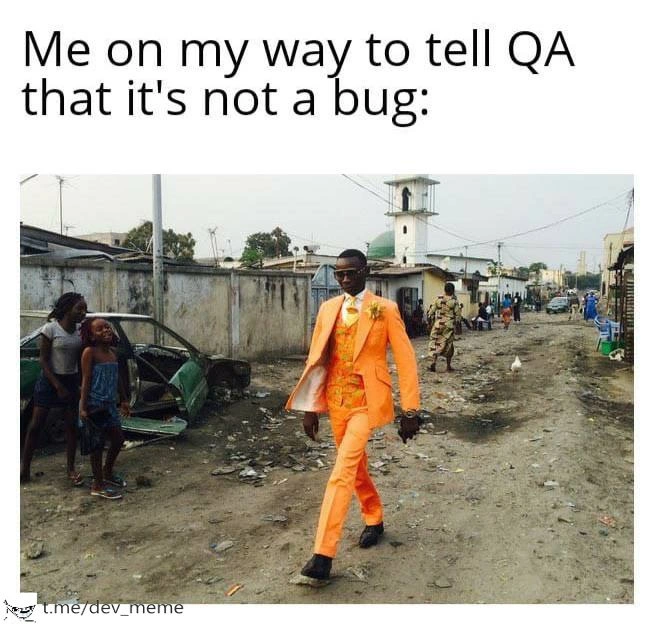
That’s exactly what’s happening in this meme. A programmer made a goofy mistake in a program (something that wasn’t supposed to happen). But instead of admitting it, he struts over to the tester with over-the-top confidence – like that man in the fancy orange suit – and says “No, no, that’s not a bug, it’s a feature!” In other words, “I did it on purpose!” It’s funny because everyone knows he didn’t really mean to do it. Just like your parents would know the crayon mess wasn’t really a “new art feature” for the house, the testers know the software’s quirk isn’t actually a planned feature. The joke is all about someone trying to cover up an obvious mistake with a ridiculous amount of swagger.

Level 2: Feature or Flaw?

In simpler terms, this meme is joking about a developer trying to convince a tester that a mistake in the software is actually on purpose. QA stands for Quality Assurance – that’s the team who tests the software to find problems (bugs) before the users do. A bug means something in the code is not working right or not doing what it’s supposed to do – maybe clicking a button does nothing or an app unexpectedly crashes. A feature, on the other hand, is a cool thing the software is meant to do – a planned functionality that developers intentionally added for users. So, when a developer tells QA “it’s not a bug, it’s a feature,” they’re basically saying: “This isn’t an error or accident at all, we meant for it to be like that!” It’s like claiming the weird behavior was part of the plan all along.

Why would a developer say that? Often it’s a tongue-in-cheek excuse. Developers take pride in their work, and sometimes when QA points out an issue, the dev might jokingly (or defensively) respond that “it’s a feature” to lighten the mood or dodge blame. For example, if a text on the screen is in an odd neon color that wasn’t in the design, the coder might quip, “Actually, that’s the new highlight feature!” instead of admitting it’s probably a mistake. It’s a way to say “we meant to do that” even when everyone knows they didn’t. This phrase has become common in DeveloperMemes and everyday coding humor because it happens so often.

Now let’s connect it to the picture: The man in the bright orange suit represents the developer. He’s walking super confidently down a dirty, wrecked street. That confidence is like the developer’s bold attitude in defending his code. The broken, messy street with the wrecked car is like the state of the software full of bugs (issues). Yet here he is, acting like everything is fine and as designed. The two bystanders staring at him are like the QA team (or coworkers) watching him march in and thinking, “Wow, he’s really going to claim everything’s okay?” The contrast is funny: the developer looks ready for a fancy party while the surroundings (the software) are literally falling apart.

In real development teams, this kind of developer-versus-QA moment is a mix of conflict and comedy. QA might say, “Hey, this part isn’t working correctly – it’s a bug,” and the developer might reply, “Actually, that’s how it’s supposed to work.” Sometimes the developer is right – maybe the tester misunderstood the feature or there was a miscommunication in the QA process. But a lot of times, the developer is just being cheeky or stubborn. New engineers quickly learn that simply calling a bug a feature doesn’t actually solve anything; it usually just gets a laugh (or an eyeroll) from the team. The meme is popular because so many people have experienced this tug-of-war. It emphasizes the importance of clear communication: if everyone isn’t on the same page about what the software should do, you get these funny situations where one person’s “bug” is another person’s “feature.”

Level 3: WONTFIX in Style

Ah, the classic developer–QA showdown. The meme’s caption “Me on my way to tell QA that it’s not a bug:” sets the stage for a scenario every seasoned dev recognizes. We see a man striding confidently through a muddy, dilapidated street in a blinding bright orange suit. He’s oozing swagger amid chaos – there’s a wrecked car on one side and trash all around. This visual perfectly symbolizes a codebase in disarray (bugs everywhere) while the developer remains flamboyantly unbothered. Those bystanders gaping in amused disbelief? They’re the QA engineers (and maybe fellow developers) watching this spectacle, thinking, “Is he seriously going to try to spin this?”

In the software world, Quality Assurance (QA) teams exist to catch bugs – those unintended flaws or errors in the product. When QA files a bug report, it means something isn’t working as expected. But here comes our developer, about to claim it’s working exactly as expected – just not the expectation QA had in mind. In dev-speak, he’s about to mark the report as WONTFIX“Working as Intended.” This is a known resolution in bug trackers (from JIRA to Bugzilla) where a dev basically says, “Not gonna change this, because we insist it’s supposed to be that way.” It’s the official way of declaring “not a bug, a feature.”

For experienced folks, this scenario is equal parts comedy and cringe. It highlights a common developer–QA dynamic issue: miscommunication or plain denial. Instead of acknowledging a defect, the developer is doubling down, armed with overconfidence. Why pull this stunt? Often it’s about saving face or avoiding a last-minute code scramble. Imagine it’s the night before release and a tester finds a glitch that would require refactoring half the module – suddenly someone suggests, “Maybe that’s not a bug… maybe it’s an undocumented feature.” Other times it’s pure ego: the developer wrote this code, so in their mind it must be correct. They’ll rationalize any odd behavior as a feature if it means not admitting they goofed. It’s practically an anti-pattern in the QA process — attempting to redefine a problem out of existence rather than fixing it.

Seasoned QA engineers have heard it all. “It’s not broken, it’s a feature,” “That’s by design,” “Works on my machine,” “User error, not a code issue” – these become running jokes after years of testing. In fact, the phrase “It’s not a bug, it’s a feature” is such a staple of developer humor (and testing humor alike) that it shows up on t-shirts and coffee mugs. We laugh because it flips the truth on its head. The meme exaggerates it perfectly with the developer’s confident_walk in that absurd suit: he’s metaphorically dressing up a mistake in flashy attire and calling it innovation. The gritty street around him (think of it as the messy legacy codebase) might be falling apart, but he sashays through it like it’s a red-carpet runway. He’s convinced he can charm his way through the BugVsFeature debate. It’s the ultimate CodingHumor scenario of brazenly turning a bug into a “feature” with nothing but swagger and a straight face.

Description

Meme with a white top caption that reads, "Me on my way to tell QA that it's not a bug:". Below the text, a sharply dressed man in an eye-searing bright orange three-piece suit strides confidently down a muddy, debris-strewn street in a run-down neighborhood; his face is blurred for privacy. On the left, two bystanders in casual clothes watch him in amused disbelief, while a wrecked green car and scattered trash underscore the contrast between his flashy attire and the dilapidated surroundings. The bottom-left corner contains the small watermark "t.me/dev_meme". Technically, the meme captures the classic developer - QA standoff where engineers, sometimes with misplaced swagger, insist that unexpected behavior is “as designed,” highlighting communication gaps and the perennial “bug vs. feature” debate in software delivery
Comments

8
Anonymous ★ Top Pick “Strolled into QA brandishing the Swagger YAML: ‘The 500 is an optional response showcasing non-deterministic resilience.’ They’re still debating which part is undefined - the behavior or my wardrobe.”
  1. Anonymous ★ Top Pick

    “Strolled into QA brandishing the Swagger YAML: ‘The 500 is an optional response showcasing non-deterministic resilience.’ They’re still debating which part is undefined - the behavior or my wardrobe.”

  2. Anonymous

    After 15 years in the industry, I've learned that the confidence required to mark a bug as 'Working as Designed' is inversely proportional to how well you actually understand what the original design was supposed to do

  3. Anonymous

    The classic developer defense mechanism: when your code exhibits unexpected behavior, the first instinct isn't to debug - it's to craft a compelling narrative about why this is actually the intended design. After 15+ years, you've perfected the art of walking into QA's office with the confidence of someone who just shipped production-ready code, when in reality you're about to argue that a null pointer exception is actually an 'aggressive memory optimization strategy.' The real skill isn't fixing the bug; it's maintaining that swagger while explaining why the application crashing on Tuesdays is actually a feature that encourages users to take mid-week breaks

  4. Anonymous

    Double negatives: dev's propositional logic hack to keep bugs in superposition until QA's gaze collapses the wavefunction

  5. Anonymous

    On my way to tell QA it’s not a bug - it’s an emergent feature of eventual consistency that marketing labeled “real-time” in the spec

  6. Anonymous

    Time to refactor a Sev‑1 into a “requirements update” using the WorksAsDesignedAdapter pattern

  7. @ZgGPuo8dZef58K6hxxGVj3Z2 4y

    Hahahahaha

  8. @ryzegorka 4y

    Try it soldier

Use J and K for navigation