Maximum CVE Density per Rack Unit
Why is this Security meme funny?
Level 1: The Guard with Many Keys
Imagine buying a giant lock for the front gate because it promises to protect the whole building. The salesperson proudly says the lock has room for lots and lots of ways to break it. That is funny because preventing break-ins is the one job the lock was bought to do. The real lesson is that even a security guard needs updates, strong keys, careful rules, and someone checking that an intruder did not already borrow the uniform.
Level 2: What a CVE Counts
A firewall controls which network traffic is allowed to pass between zones, such as the public internet and an internal company network. A VPN gateway lets approved users create an encrypted connection into that network. The many visible ports support different physical links, but the security behavior mostly comes from the software and configuration running inside the appliance.
A vulnerability is a weakness that can allow behavior the designer did not intend. The CVE program assigns standardized names such as CVE-2024-55591 so vendors, scanners, advisories, and customers can discuss the same flaw without relying on ambiguous nicknames. A CVE entry does not by itself say that every model is affected or that every exposed system can be hacked; administrators must read the vendor advisory for affected versions and conditions.
Related terms help prioritize the work:
- CVSS is a severity-scoring system, not a prediction that an attack will happen.
- A zero-day is exploited or known before a fix is available or before defenders have had a normal chance to respond.
- An N-day is already disclosed and usually has a known mitigation or patch, yet remains useful against systems that were not updated.
- Authentication bypass means an attacker can get past a login or trust check without valid authorization.
- Remote code execution means an attacker can cause chosen code to run on the target, subject to the flaw’s conditions and privileges.
Patch management is the process of discovering affected assets, testing a fixed version, deploying it safely, and confirming the update actually succeeded. For infrastructure at the network edge, that process should be paired with hardening: do not expose the administrative interface broadly, require MFA, limit trusted management sources, use unique credentials, collect logs somewhere the appliance cannot rewrite, and retire unsupported versions.
The meme exaggerates by imagining a box physically stuffed with vulnerability records. The real frustration is that every new advisory forces an enterprise team to answer the same urgent questions: Do we own it? Is it exposed? Is it exploited? Can we patch tonight? Did someone already get in? The salesman gets to leave after the purchase; the on-call engineer gets the CVE subscription.
Level 3: Perimeter Full of Holes
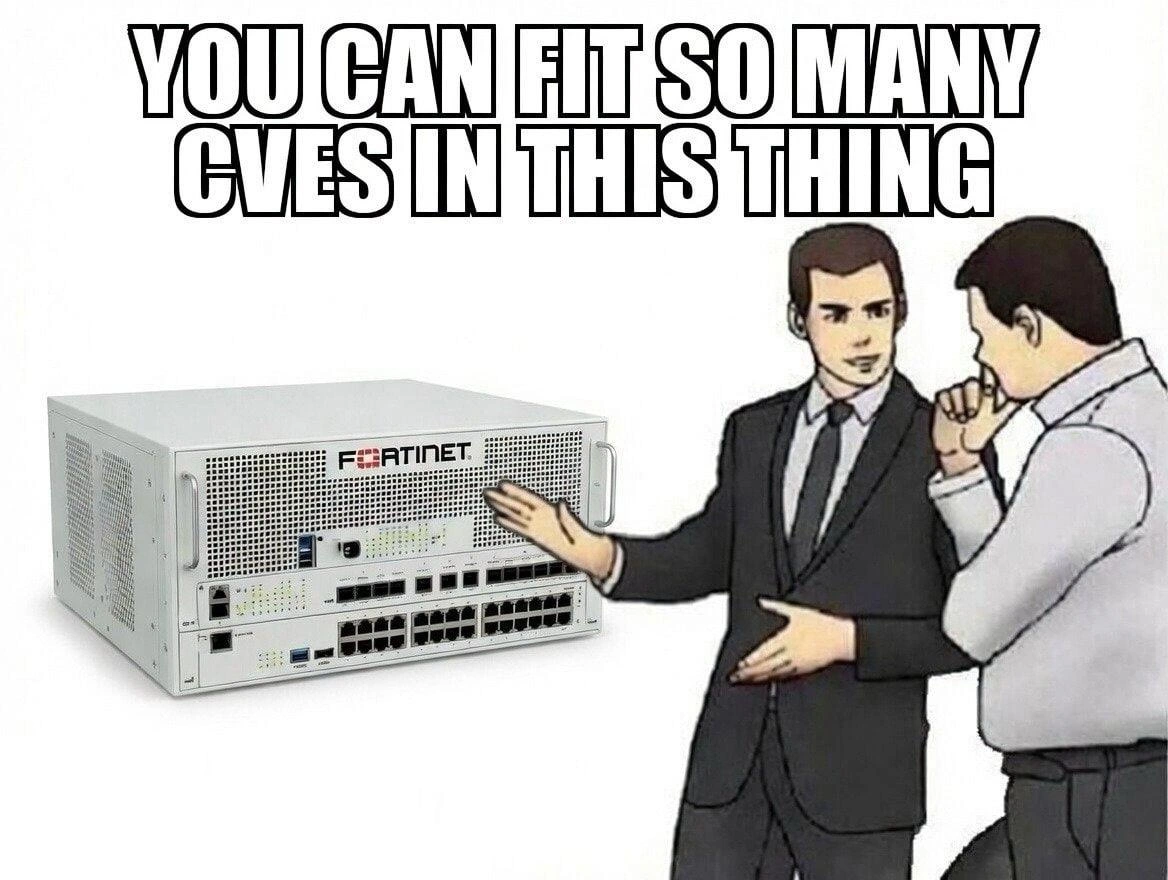
The salesman presents a large Fortinet-branded network appliance as if its best feature were storage capacity:
YOU CAN FIT SO MANY
CVES IN THIS THING
That wording adapts the familiar “this thing can fit so much” sales pitch, but replaces cargo with Common Vulnerabilities and Exposures. The rows of Ethernet and optical ports make the joke visually efficient: every interface that promises enterprise connectivity also appears to offer another entrance for the security team’s future incident report.
Technically, a CVE is an identifier for a publicly disclosed vulnerability record, not a physical flaw that occupies chassis space. The meme uses “CVEs” as shorthand for the weaknesses themselves. It also deliberately treats a firewall vendor’s worst possible output as a capacity metric. Customers buy a network-security appliance to reduce exposure; the salesman boasts that the protective boundary can accumulate exposures of its own. That inversion is the entire product demo, and procurement has apparently already scheduled the renewal meeting.
An edge appliance is an especially painful place for a vulnerability because it often combines several dangerous properties:
- It is reachable from untrusted networks by design.
- It terminates VPN sessions and may handle authentication.
- It has authority to route, filter, or inspect sensitive traffic.
- Its management plane can alter organization-wide security policy.
- It may store credentials, certificates, directory bindings, and network topology.
- Administrators expect it to be the guard, so its own telemetry may receive too much trust.
Modern firewalls are not simple packet filters. They can contain web administration, SSL VPN, single sign-on, intrusion prevention, application identification, TLS inspection, clustering, logging, update services, and parsers for a small museum of protocols. Each capability adds code, state, dependencies, and privilege boundaries. Complexity does not guarantee insecurity, but it increases the number of places where an authentication check, parser, authorization rule, or update path can fail.
The June 21, 2026 posting date gives the generic vendor jab a direct news backdrop. Days earlier, defenders were responding to the credential-harvesting campaign called “FortiBleed,” involving a leaked collection associated with more than 70,000 FortiGate devices. Fortinet’s June 19 analysis said this was not a newly disclosed Fortinet vulnerability; it attributed the activity to credential reuse from earlier incidents and brute-force attacks against devices with weak password hygiene and no multi-factor authentication. Government alerts nevertheless urged organizations to verify patching for older privilege-escalation and authentication-bypass CVEs as part of the response.
That distinction keeps the meme funny without turning it into bad incident intelligence. Three different failure classes can overlap:
- A product vulnerability lets an attacker bypass an intended control.
- A configuration exposure places a sensitive management or VPN interface where attackers can reach it.
- A credential compromise lets an attacker use the intended login path with an account they should not possess.
Patching addresses the first class. It does not automatically remove public management access, enable MFA, terminate stolen sessions, rotate passwords, or detect unauthorized configuration. Conversely, strong credentials do not make an unpatched authentication bypass safe. Security teams inherit all three layers because attackers are famously unwilling to choose only one.
Raw CVE count is also a poor vendor scorecard. One critical remotely exploitable authentication bypass on an internet-facing interface can matter more than dozens of low-impact local issues. Counts are influenced by product breadth, supported versions, researcher attention, disclosure practices, and how related flaws are assigned identifiers. Defenders care about affected assets, reachability, privileges required, exploitation evidence, business criticality, available fixes, and compensating controls. “So many CVEs” expresses accumulated operator frustration, not a statistically fair comparison.
The operational pain is what gives the joke staying power. Patching an edge firewall is not always equivalent to updating a desktop app. Teams may need to validate upgrade paths across several firmware versions, check configuration compatibility, test VPN clients and authentication, preserve high-availability failover, coordinate downtime, and retain a recovery image. The appliance protecting every service can become the appliance nobody wants to reboot. Attackers, regrettably, do not observe the change-freeze calendar.
A serious response to suspected compromise goes beyond installing current firmware. Administrators need an inventory of devices and versions, restricted management access, MFA for administrative and VPN accounts, terminated sessions, rotated credentials, reviews for unknown users and policy changes, comparison against a known-good configuration, and log analysis for unexpected administration or lateral movement. If persistence or unauthorized modification is found, recovery may require rebuilding or factory-resetting the device after preserving evidence and rotating connected directory credentials. “Patched” and “clean” are different states.
Visually, the skeptical buyer with a hand at his chin is the security engineer who understands the total cost. The suited presenter points toward the perforated chassis as though vulnerability density were another line-card specification. The blank white showroom removes every distraction except the logo and the accusation: the box sold to absorb network risk has become the box onto which years of risk discussions are projected.
Description
An adapted car-salesman meme places two illustrated businessmen beside a large white rackmount Fortinet network-security appliance with handles, status LEDs, and rows of Ethernet and optical ports. One suited salesman presents the chassis with his palm against its perforated front while the prospective buyer studies it. Huge outlined text reads, "YOU CAN FIT SO MANY CVES IN THIS THING," replacing the usual boast about product capacity with Common Vulnerabilities and Exposures. The image mocks Fortinet's reputation for recurring high-impact appliance flaws and was posted amid June 2026 reporting about widespread exposed FortiGate credentials and exploitation of known vulnerabilities.
Comments
1Comment deleted
Defense in depth is when every firmware layer gets its own CVE.