Elon Musk's Philosophical Hit on Internet Explorer
Why is this WebDev meme funny?
Level 1: Just Exploring
Imagine you have a very old toy that doesn’t work as smoothly as the new ones. Everyone complains that this toy is slow and clunky. Now picture a silly friend, looking very thoughtful (maybe after eating a ton of candy and getting sugar-high), who suddenly asks, “Wait... aren’t we all just like that old toy?” It’s a funny and ridiculous question. We laugh because usually we blame the toy for being the problem, not ourselves.
In this meme, the “old toy” is Internet Explorer, which is like an old web browser that people used to surf the internet. It had a reputation for being slow or not up-to-date. The joke is someone saying in a dreamy, deep voice: “Whoa, what if every one of us is actually an Internet Explorer on the inside?” Of course, that’s a very goofy idea — people aren’t actually web browsers! It’s just playing with words. We all do “exploring” on the internet, so in a simple literal way we are internet explorers. But calling us that makes it sound like we’re the same as the famously slow program, and that’s so out-of-left-field that it makes you giggle.
It’s like if you have a friend who’s always late, and you usually tease them by comparing them to a slow old car. This meme is as if that friend, in a puff of daydreamy thought, said, “Dude, maybe all of us are slow old cars on the inside.” It sounds deep for a second, but then you realize it’s just a silly thought that makes no real sense. The humor comes from pretending a simple pun is a mind-blowing revelation. In the end, it’s funny because it takes something annoying and turns it into a playful question. Even if you don’t know anything about web browsers, the idea of someone seriously asking if everyone is an Internet Explorer is so crazy and unexpected that you can’t help but laugh at how silly it is.
Level 2: We Are All Explorers
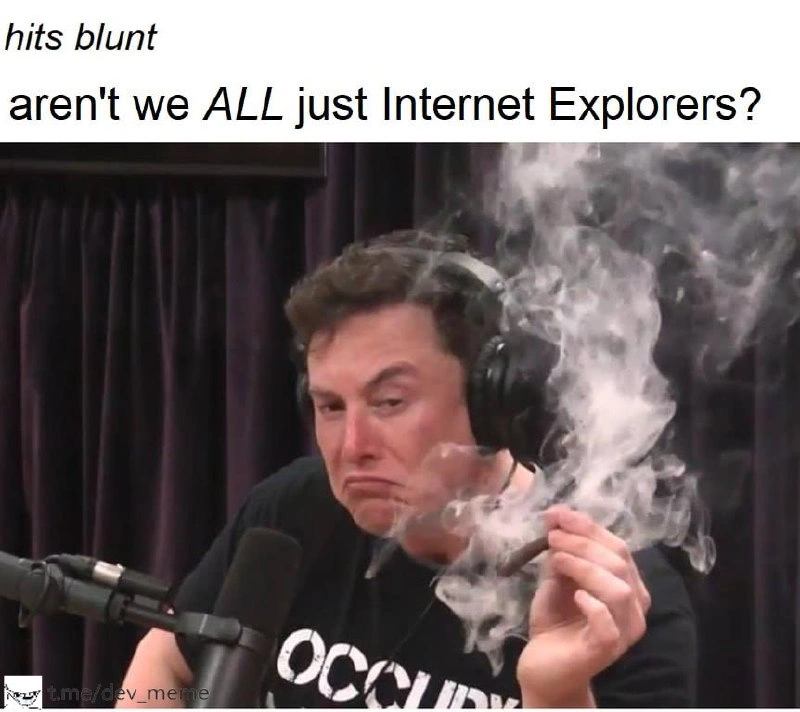
This meme jokes that since Internet Explorer is literally a program for exploring the internet, maybe every person who browses the web is an "internet explorer" in a sense. The text is presented in a "hits blunt" format – a popular meme style where someone says something that sounds profound or perplexing after supposedly taking a puff of a blunt (smoking marijuana). Here, the big question is, “aren't we ALL just Internet Explorers?” The humor relies on a play on words: Internet Explorer (IE) is the name of a famous web browser, but taken literally, an "internet explorer" could just mean anyone surfing the web. It’s as if a very relaxed, hazy-thinking person thought of a double meaning and found it mind-blowing. 😏
To understand why developers find this hilarious, you need to know a bit about IE’s reputation. Internet Explorer (especially older versions like IE6, IE7, IE8) has long been the bane of Web Developers and Front-End engineers. It’s what we call a legacy browser – an old piece of software that lingers around even after newer, better options are available. IE was notorious for not following modern web standards closely, which led to browser compatibility issues. That means a website might look or behave one way in Chrome/Firefox (modern browsers) and completely differently (or break entirely) in Internet Explorer. For example, early IE had its own idea of how to size elements in CSS, known as the “IE box model bug,” which could mess up page layouts. It also lacked support for many newer features that other browsers adopted, like certain HTML5 tags or CSS3 styles. Developers often had to write extra code or polyfills (shims) to make features work in IE, or they’d include special CSS hacks targeting IE alone. Maintaining InternetExplorerSupport was extra work — sometimes a lot of extra work — just to accommodate those users who still, for whatever reason (often corporate policy), used the old browser.
Now, calling someone or something "just like Internet Explorer" in developer circles is usually an insult (in a teasing way). It implies being slow, outdated, or incompatible with change – like how IE felt compared to other browsers. So when the meme asks "aren't we ALL just Internet Explorers?", it’s being comically self-effacing. It suggests that maybe everyone, including the developers who mock IE, has a bit of that slowness or outdatedness in them. It’s a playful jab at our own tendency to lag behind or struggle with new things. Developers chuckle because they remember how much grief IE gave them, and here someone jokingly suggests everyone is basically that. It’s absurd and funny.
Let’s also unpack the meme format itself. The phrase "hits blunt" in italics at the top is instructing the reader to imagine the scenario: someone takes a long hit from a blunt and then, in a hazy state, comes up with a seemingly deep question. The image beneath usually shows a person looking mind-blown or dazed (in this meme image, a man with headphones is exhaling smoke and making a serious-but-confused face). This format is used for jokes that sound philosophical or pseudo-intellectual when you’re high, but are kind of silly when you’re sober. So "aren't we ALL just Internet Explorers?" is phrased to sound life-changing, but it’s really just a pun. The person is equating human beings with a web browser in a humorous way.
In simpler terms, the meme is combining a tech humor reference with a classic meme style. The tech part comes from Internet Explorer’s cultural baggage: mention IE to any web developer and you’ll often get an eye-roll or a war story about something not working in IE. It’s practically the poster child of LegacySystems in web development. The humor is relatable because many developers have felt the pain of making a site work on IE — it’s almost a rite of passage in Frontend careers. The "therapy" aspect (as hinted by the tags like frontend_developer_therapy) is that by joking about it, devs collectively relieve some of the stress IE caused. It’s like laughing at the villain after it’s finally defeated (by 2020, IE was largely replaced by modern browsers, though some of us still had to deal with the last vestiges of it).
So, the meme basically says: “Dude, what if everyone using the internet is an Internet Explorer, you know?” This is funny in a dumb-clever way. Non-developers can get a chuckle because it’s a goofy stoner-style question about everyone being an explorer on the internet. But developers laugh extra hard (or maybe groan-smile) because they catch the deeper reference: Internet Explorer, that old browser we all struggled with, is being used as a metaphor for people. It’s a little bit of tech inside-joke and a little bit of general humor mixed together. And importantly, you don’t actually have to be high to find it amusing — though the image and format play up that feeling of “whoa, that’s deep... kinda”. The bottom line: it’s a jest that turns annoyance with a browser into a lighthearted philosophical musing, and that unexpected mashup is what makes it memorable.
Level 3: Quirks Mode Enlightenment
At first glance, this meme looks like a typical stoner philosophy gag, but for seasoned devs it's laced with insider humor about Internet Explorer (IE). The top caption "hits blunt" sets the stage: imagine a developer in a haze of smoke suddenly asking a grand, oddly profound question. And that question — "aren't we ALL just Internet Explorers?" — cleverly flips a source of Frontend frustration into a cosmic joke. It’s funny because it merges two very different contexts: a deep-sounding life question and the notorious reputation of IE in Web Development. The humor hits on multiple levels: a play on words (everyone who uses the internet is literally an "internet explorer"), and a wry nod to the idea that maybe every developer has a bit of Legacy Tech inside them.
For experienced web developers, Internet Explorer is more than just a browser; it's practically an era of pain and quirkiness. IE’s name suggests exploration, but to devs it evokes BrowserCompatibility nightmares and endless hacks for Browser Quirks. By asking if everyone might secretly be an IE, the meme satirically suggests that the very thing devs loved to complain about (IE’s outdated behavior) could be a trait we all share. It's a tongue-in-cheek way of saying, "Maybe the call is coming from inside the house." This combination of a philosophical tone with a RelatablePain from dev life is what makes the meme land so well among developers. We’ve all cursed a pixel misaligned in IE or a feature that worked everywhere except on that one manager’s ancient IE11 setup. Seeing that frustration turned into a pseudo-enlightened question is hilariously cathartic.
Why is this so relatable? Think of the unspoken trauma: countless hours spent making a website behave in IE the same way it does in Chrome or Firefox. Senior devs remember writing CSS hacks and JavaScript shims explicitly for IE, or maintaining two code paths because IE didn’t support something modern. The phrase "InternetExplorerSupport required" has haunted project requirements for years. This meme taps directly into that shared history. The "aren't we all IE?" line humorously suggests a form of empathy with the enemy: after all the years grumbling about that one archaic browser, now we wonder if we ourselves are running in quirks mode sometimes. It’s an absurd, ironic form of frontend developer therapy — laughing at the idea that deep down, we might be as slow to adapt and full of quirks as the browser we complained about.
From a senior perspective, there's also a grain of truth hidden in the smoke: in tech, if you don’t continuously update yourself, you become the legacy system. Internet Explorer started as the dominant, cutting-edge browser in the 90s, but over time it stagnated and fell behind modern standards. Similarly, a developer who stops learning new things can wake up years later feeling as out-of-date as IE6 on a modern website. This meme’s stoner-question format slyly alludes to that existential tech crisis – “dude, what if one day we become the thing we always complained about?” 😮 It’s funny and a bit sobering. The meme distills that fear into a joke: every dev might have an Internet Explorer hidden inside, representing our outdated knowledge or stubborn adherence to old ways. In a fast-moving industry, today’s hot framework is tomorrow’s legacy code. In other words, we all risk becoming “the IE” of our team if we’re not careful – a thought both amusing and motivating.
On a technical level, the mention of Internet Explorer brings a flood of specific memories for senior devs. IE had its own rendering engine (Trident), which often diverged from W3C web standards. It meant developers had to account for IE’s peculiarities on everything from CSS to JavaScript. Classic example: the CSS box model in IE6 was different, breaking layouts unless you used a doctype or special hacks. Many will recall writing conditional comments just for IE, like:
<!-- Only IE will read this comment -->
<!--[if IE]>
<link rel="stylesheet" href="ie-fixes.css" />
<![endif]-->
This allowed serving IE-specific fixes (like an ie-fixes.css file with all the quirky adjustments). Such workarounds were common. Another infamous quirk: older IE versions didn’t support modern JavaScript features or HTML5 tags, so devs used polyfills (additional code to mimic new features in old browsers) or libraries like jQuery to smooth over differences. The meme’s sly question invites those in the know to chuckle at all that history: “After everything, maybe we’re all running with a few polyfills and quirks of our own?” It’s a perfect senior-dev joke — simultaneously mocking and embracing the idea of being a LegacySystem. The use of a hits_blunt_format image (with a guy exhaling a huge cloud) exaggerates that this is a mind-blowing revelation, making it all the more comedic.
In essence, the meme resonates on multiple frequencies: it’s absurdly literal (yes, we all browse the web), it’s an industry in-joke about a notoriously problematic browser, and it’s a lighthearted philosophical ribbing of developers’ own fear of becoming obsolete. It turns years of frustration with InternetExplorerSupport into a moment of shared laughter. Seasoned devs see it and smirk: "Ha! After all those IE6 hacks and late nights, here we are pondering if we're any better." The humor comes from that reversal — transforming IE from the butt of the joke into the mirror. It’s a reminder that in the grand scheme (perhaps a very high grand scheme), we’re all just trying to explore this vast internet with our imperfect tools, and sometimes we’re as imperfect as the tools we gripe about.
Description
The image is a popular meme featuring Elon Musk smoking a blunt during an interview on the Joe Rogan Experience podcast. Musk, wearing headphones, is grimacing as he exhales a large cloud of smoke. The top of the image has text that reads, '*hits blunt* aren't we ALL just Internet Explorers?'. This meme combines the 'hits blunt' or 'stoner thoughts' format, used for pseudo-profound or silly realizations, with a tech industry pun. The humor lies in the double meaning of 'Internet Explorers' - referring both to people who explore the internet and to the notoriously slow, outdated, and now-deprecated Microsoft web browser. For developers, especially senior ones, Internet Explorer represents a long history of compatibility issues, bugs, and development headaches, making the comparison both a relatable joke and a form of shared trauma

Comments
7Comment deleted
Much like Internet Explorer, my brain on a Monday morning also has a quirky box model, renders reality incorrectly, and is definitely not standards-compliant
After 20 years of shipping, I’ve realized I’m basically IE11: slow to start, leaking memory, and yet still in production because some ancient SAP workflow can’t migrate off me
We're all just Internet Explorers: slow to load, incompatible with modern standards, and somehow still running critical enterprise systems that nobody wants to touch
This hits different when you realize that after decades of IE being the punchline, Microsoft finally gave up and rebuilt Edge on Chromium - essentially admitting 'you know what, maybe we ARE all just Chrome now.' The real existential crisis is that we fought the browser wars only to end up in a Chromium monoculture where even 'exploring the internet' means running Google's rendering engine with different skins. IE's legacy isn't its bugs or lack of standards compliance - it's teaching us that browser diversity matters, a lesson we apparently forgot as soon as we got rid of it
We're all internet explorers; just hope product never capitalizes it, or you'll be shipping X-UA-Compatible, conditional comments, and an IE mode runbook for that one ActiveX intranet
We’re all Internet Explorer eventually - deprecated, stuck in quirks mode, and kept alive by Group Policy because one exec’s ActiveX dashboard still ‘depends’ on us
Elon's right - we're all IE6: enterprise-mandated, unkillable, and rendering the business logic wrong since 2001