Skip to content
DevMeme
126 of 7435
When “hello world” is a one-way conversation with the universe
CS Fundamentals Post #159, on Feb 21, 2019 in TG

When “hello world” is a one-way conversation with the universe

Why is this CS Fundamentals meme funny?

Level 1: Shouting Into a Canyon

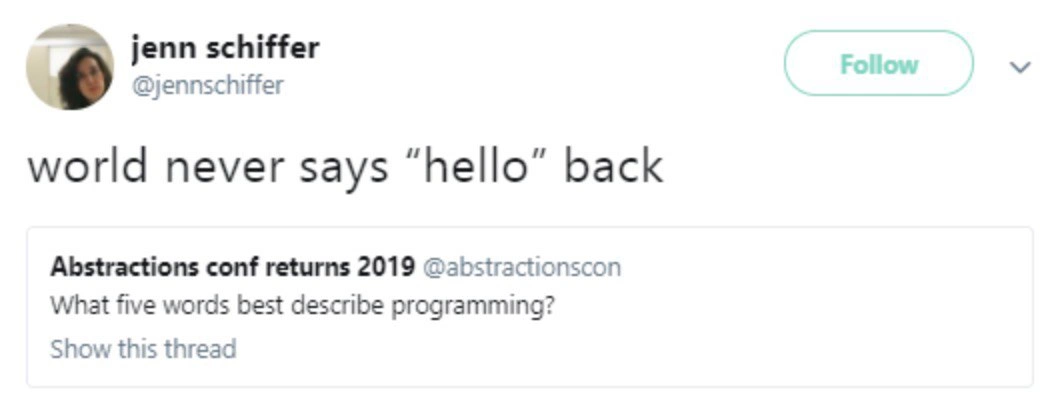
Imagine standing at the edge of a huge canyon every morning and yelling "HELLO!" as loud as you can — and in your whole life, not once does anything yell back. Not even an echo. Now imagine that's literally the first thing every programmer is taught to do, and they keep doing it for their entire career. That's the joke: programmers spend their lives greeting a world that never, ever answers — and when someone asked for five words to describe the job, this person summed up all that funny-sad loneliness perfectly: world never says "hello" back.

Level 2: Your First Program Was a Letter Nobody Answered

If you're early in your career, here's the context. "Hello, World!" is the traditional first program in any language — the smallest possible code that proves your toolchain works:

print("Hello, World!")

That's it. It exists purely as a sanity check: compiler installed, syntax understood, output visible. Virtually every tutorial, bootcamp, and textbook starts there, which is why the phrase is instantly recognizable to every programmer on earth.

The tweet's joke is the inversion: you've been saying hello to "the world" since day one, but the program only outputs — it never receives a reply. A few terms worth knowing that orbit this idea:

  • stdout (standard output): the one-way channel your program writes to. One-way is the key word.
  • ACK (acknowledgment): in networking, the packet that confirms "I heard you." Your print statement gets no ACK. Ever.
  • Quote tweet: the format here — schiffer's five words on top, the original @abstractionscon question framed in the box below — which lets the punchline land before you even see the setup.

You'll feel this for real the first time you ship something to production and the only "feedback" is a metrics dashboard staying flat. Welcome aboard.

Level 3: The Unacknowledged Handshake

The genius of jenn schiffer's reply — > world never says "hello" back — to @abstractionscon's prompt "What five words best describe programming?" is that it weaponizes the single most universal artifact in software education. Every developer, in every language, in every decade since Kernighan and Ritchie canonized it in 1978, has begun by transmitting a greeting into the void: printf("Hello, World!\n");. The tweet reframes fifty years of that ritual as a one-sided correspondence. We have collectively sent billions of hellos. The response rate is exactly zero.

What makes this land so hard with senior engineers is that it's structurally true, not just emotionally true. Programming is fundamentally fire-and-forget output to non-sentient systems. The compiler doesn't thank you. stdout is a write-only relationship. Even our protocols dramatize this: a TCP connection literally begins with a handshake — SYN, SYN-ACK, ACK — and an enormous amount of distributed-systems pain comes from the cases where the other side doesn't answer. Timeouts, retries, dead-letter queues, circuit breakers: half of backend engineering is machinery for coping with a world that never says hello back. The joke accidentally describes both the existential condition of the programmer and the failure mode every on-call engineer dreads.

There's also a sharper reading lurking in it, one the dev community (this was tweeted at a conference's crowd-sourcing prompt, the natural habitat of such distilled wisdom) recognized instantly: the loneliness is real. The craft selects for people who can tolerate long feedback loops, silent failures, and validation that arrives — if ever — as the absence of bug reports. Mental health in tech is increasingly discussed precisely because the work is an endless monologue. You pour intent into a machine; the best possible outcome is silence. The worst is a stack trace. Neither is a hello.

And the format matters: the conference asked for five words, and schiffer delivered exactly five, with the quoted tweet sitting in its bordered box below like a unit test passing. Constraint-satisfaction humor — meeting an arbitrary spec precisely while smuggling in devastating truth — is the most developer-shaped joke structure there is.

Description

Screenshot of a tweet from user “jenn schiffer (@jennschiffer)” with a teal “Follow” button on the right. The tweet text reads: “world never says “hello” back”. Below it, an embedded tweet card from “Abstractions conf returns 2019 (@abstractionscon)” says: “What five words best describe programming?” followed by the link text “Show this thread”. The humor subverts the classic beginner exercise “Hello, world” by lamenting that the “world” never responds, encapsulating the one-sided struggle developers feel when their code runs but offers no feedback. It nods to CS fundamentals, the learning curve of early tutorials, and the relatable silence developers encounter while debugging or waiting for output

Comments

7
Anonymous ★ Top Pick ‘Hello, World’ is the original distributed-systems tutorial: fire a message into the void, get zero ACKs, and realise logs, tracing, and retries were the actual syllabus
  1. Anonymous ★ Top Pick

    ‘Hello, World’ is the original distributed-systems tutorial: fire a message into the void, get zero ACKs, and realise logs, tracing, and retries were the actual syllabus

  2. Anonymous

    After 20 years of writing Hello World in every new framework, I've finally accepted that the world's response time is just undefined - which explains why it fits so perfectly with JavaScript's type system

  3. Anonymous

    Thirty years of 'Hello, World!' and the world hasn't even sent an ACK - that's the longest unhandled timeout in computing

  4. Anonymous

    After decades of writing 'Hello World' in dozens of languages, we've finally realized the uncomfortable truth: we've been shouting into the void this whole time. The world's response? A silent exit code 0 if we're lucky, segfault if we're not. At least our logs listen... until logrotate deletes them

  5. Anonymous

    World's the ultimate leaky abstraction: no hello response handler

  6. Anonymous

    Hello, World is a UDP broadcast to /dev/null - if you’re waiting for a reply, you forgot to provision the echo service, the queue, and the SLO

  7. Anonymous

    The world never says hello back - “Hello, World” is basically UDP for developers: fire-and-forget, no ACK, ship it

Use J and K for navigation