Using curl to keep your “internet pipes” warm during a polar vortex
Why is this Networking meme funny?
Level 1: Leave the Faucet Dripping
In very cold winters, plumbers give real advice: let your faucet drip overnight, because moving water doesn't freeze, and frozen pipes burst. This tweet takes that advice and applies it to the internet with a perfectly straight face: better keep some internet flowing through your computer cables, or the cold will freeze your internet-water and crack your internet-pipes! It even includes the exact magic words to type to start a slow, steady trickle of downloading. It's funny like telling someone to water their plastic plants so they don't get thirsty — the advice sounds responsible, the steps are real and doable, and the whole thing rests on one tiny problem: that's not even slightly how any of it works.
Level 2: Anatomy of the Magic Incantation
Breaking down the command, flag by flag:
curl --limit-rate 5K \
ipv4.download.thinkbroadband.com/1GB.zip \
-o internet-pipes-saver
curl— the ubiquitous command-line tool for transferring data over URLs; the Swiss Army knife of every developer's terminal.--limit-rate 5K— caps download speed at 5 kilobytes per second. Real uses: not saturating a shared connection, simulating slow networks for testing, being polite to servers.ipv4.download.thinkbroadband.com/1GB.zip— a public test file that ISPs and engineers use for speed tests; it's a gigabyte of throwaway data that exists purely to be downloaded.-o internet-pipes-saver— writes the result to a file with that name instead of dumping bytes to your screen.
The plumbing premise, for the record, is false in every direction: data over copper Ethernet is voltage changes, over fiber it's light, and neither "flows" like a fluid or freezes like one. Cold can hurt networks — outdoor cables turn brittle, connectors contract, hardware batteries sag — but no amount of downloading warms a cable measurably. What juniors should actually take from this: learn to read commands before running them. This one is harmless (besides a slow gigabyte of wasted bandwidth), but "paste this trusted-looking one-liner from the internet" is also how people end up running curl ... | sudo bash from less benevolent comedians.
Level 3: Laminar Flow for Your Last Mile
The genius of this tweet is its commitment. Plenty of jokes claim the internet is a series of tubes; Mr.PowerScripts files a weather advisory under that assumption and ships a working remediation script:
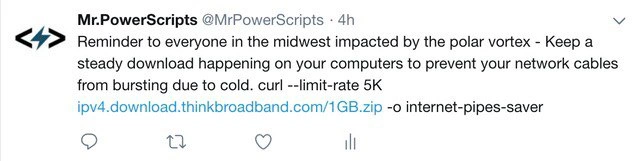
Reminder to everyone in the midwest impacted by the polar vortex - Keep a steady download happening on your computers to prevent your network cables from bursting due to cold.
curl --limit-rate 5K ipv4.download.thinkbroadband.com/1GB.zip -o internet-pipes-saver
This is satirical tech advice executed with the deadpan precision of real ops documentation, and every detail is load-bearing. The premise transplants genuine plumbing wisdom — during a hard freeze you leave faucets dripping, because moving water resists freezing and relieves pressure before pipes burst — onto Ethernet, where the "flow" is electrons and photons that are supremely indifferent to ambient temperature. The category error is the joke, but the form is flawless: a public-safety reminder, a root cause ("bursting due to cold"), and a copy-pasteable fix.
The command itself is where practitioners start grinning. --limit-rate 5K is the punchline within the punchline: a real curl flag, used here to keep a gentle, steady drip rather than blasting the line — exactly matching the dripping-faucet protocol, and conveniently downloading a 1GB file slowly enough to last through the entire cold snap (at 5KB/s, that file takes roughly two and a half days — coverage for the whole vortex). The source is ipv4.download.thinkbroadband.com/1GB.zip, a genuine bandwidth-test file that network engineers actually use, and the output lands in a file named internet-pipes-saver. It would run, today, on your machine. That executable plausibility is what separates engineer humor from civilian humor: the joke compiles.
There's a sharper sociological layer, too. The tweet parodies the chain-letter genre of well-meaning technical folklore — "unplug your router during storms," "drain your laptop battery fully," advice forwarded by relatives with total confidence and approximate physics. Posted during a brutal Midwest polar vortex, it weaponizes exactly the right register of helpful urgency. Somewhere, someone ran it just in case — and that person is why IT departments write acceptable-use policies.
Description
The image is a screenshot of a tweet in the classic white-background Twitter UI. It shows the user name “Mr.PowerScripts”, handle “@MrPowerScripts”, and a timestamp of “4h”, followed by the full tweet text: “Reminder to everyone in the midwest impacted by the polar vortex - Keep a steady download happening on your computers to prevent your network cables from bursting due to cold. curl --limit-rate 5K ipv4.download.thinkbroadband.com/1GB.zip -o internet-pipes-saver”. Beneath the text are the standard reply, retweet, like and analytics icons, all at zero. Visually there are no images, only text and UI chrome. Technically, the joke equates frozen water pipes with idle network cables, advising a throttled curl download to keep packets flowing; it references command-line tooling, bandwidth flags, and developer Twitter culture for comic effect

Comments
7Comment deleted
SRE Winterization 101: start a perpetual 1 GB curl at 5 KB/s - just enough packet friction to keep the fiber from freezing and to convince finance the 10 Gbps commit wasn’t a summertime impulse buy
Next time someone asks why our Kubernetes cluster needs constant health checks, I'll explain it's to keep the pods warm so they don't freeze and crack during winter deployments
Rate-limited to 5K, naturally - you want laminar flow in those pipes; full-bandwidth turbulence is how you get packet hammering
Ah yes, the classic Layer 0 problem: thermodynamic packet loss. Everyone knows TCP stands for 'Temperature Control Protocol' and that's why we need keep-alive packets - they're literally keeping the cables alive in sub-zero temperatures. This is why enterprise networks always spec heated cable trays; it's not for the equipment, it's to prevent catastrophic bit-freeze in the copper. Senior engineers remember the Great Freeze of '96 when entire data centers lost connectivity because someone forgot to run a continuous ping to keep the electrons moving. The 5K rate limit is crucial here - too fast and you risk thermal shock to the RJ45 connectors
DevOps winter tip: leave a curl --limit-rate 5K dripping. Won’t warm fiber, but it keeps Grafana green and Finance red
Because TCP congestion control is for theory; real ops heroes throttle curl to save cables from the pipe apocalypse
The sysadmin equivalent of leaving the faucet dripping: curl --limit-rate 5K to ‘warm the pipes’ - right up until FinOps opens a Sev-1 about surprise egress