Skip to content
DevMeme
127 of 7435
When your 8-hour workday overflows before the deadline drops
Deadlines Post #160, on Feb 22, 2019 in TG

When your 8-hour workday overflows before the deadline drops

Why is this Deadlines meme funny?

Level 1: The Overstuffed Lunchbox

Imagine packing a lunchbox perfectly — every sandwich and snack fits just right. Then someone keeps shoving in extra bricks, then a handful of live beetles, and the poor lunchbox bulges and cracks trying to hold it all. Finally, someone drops a giant rock on top of everything and says "lunch is at noon, no exceptions." That's what a programmer's workday feels like: the plan was fine, but everyone kept adding more, the box never got bigger, and the deadline squashed it all flat. It's funny because every worker has felt like that lunchbox.

Level 2: Why Your Sprint Never Survives Contact With Tuesday

Some vocabulary the panels are illustrating:

  • Capacity planning: estimating how much work fits in available time. Panel one is the plan: tasks fit the 8-hour box exactly. Real teams usually plan to ~100% capacity, which leaves zero room for anything else — and "anything else" always comes.
  • Meetings: standups, refinements, retros, "quick syncs." Each one fragments your day. A meeting at 11:00 and another at 14:00 can turn eight hours into three usable ones, because coding requires long uninterrupted stretches.
  • Bugs / unplanned work: defects discovered after planning. They jump the queue because users are affected now. In the comic they're literal insects — which is historically apt, since the term "bug" predates software.
  • Deadline: the fixed date everything must ship by. Notice it's the only object in the comic that's bigger than the container itself.

Your first few months on a real team will follow this exact sequence: a tidy sprint board Monday, calendar invites multiplying by Wednesday, a production bug Thursday, and Friday someone asking if "we're still on track." The comic is a flowchart of that week.

Level 3: Capacity Is a Lie We Tell Sprint Planning

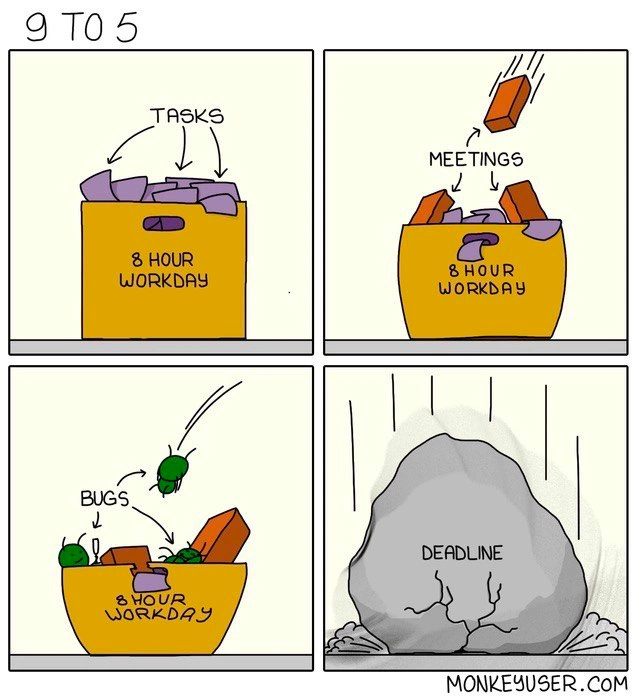
This MonkeyUser four-panel strip, titled "9 TO 5," is a physics lecture on why velocity estimates are fiction. Panel one shows the fantasy every project plan is built on: a rigid yellow container labeled 8 HOUR WORKDAY, neatly filled with purple TASKS. This is the sprint board on Monday morning — work sized to capacity, nothing more. It is also the last moment in the comic where the container retains its shape.

Then the orange MEETINGS bricks arrive, literally falling from the sky in panel two, smashing into the box and visibly deforming its walls. The detail that experienced engineers appreciate: the bricks don't replace tasks, they crush them. A meeting doesn't just consume its own thirty minutes — it shatters the focus blocks around it. Research on context switching has been saying this for decades: a deep-work task interrupted mid-flight costs far more than the interruption's duration, because rebuilding mental state isn't free. The comic encodes this as breakage, not displacement, which is exactly right.

Panel three escalates with green BUGS — drawn as actual beetles crawling into the now-bulging bowl, one rearing up with an exclamation mark. Bugs are the canonical unplanned work: nobody budgets for them, yet they always arrive, and they outrank planned work because production is on fire. Note the container's transformation across panels: it started as a box with straight walls and is now a sagging bowl. The org chart calls this "flexibility." The developers inside call it overtime.

Panel four is the punchline as geology: a massive cracked boulder labeled DEADLINE has flattened everything, dust clouds escaping from underneath. The deadline didn't move when the meetings and bugs arrived — deadlines never do. That's the systemic satire here: scope grows, interruptions accumulate, defects surface, and yet the delivery date stays fixed, so the only compressible variable left is the work (and the humans doing it). Every methodology from waterfall to Scrum has promised to fix this triangle, and every one has been defeated by the same management instinct: treat the 8-hour box as elastic, accept all incoming bricks, and act surprised when the boulder lands. The comic's quiet tragedy is that nothing in it is anyone's villainous decision — it's just what happens when capacity planning meets organizational reality without anyone empowered to say no.

Description

Four - panel comic titled “9 TO 5.” Panel 1 shows a yellow bucket labeled “8 HOUR WORKDAY” already packed to the brim with purple rectangular blocks; an arrow points to the blocks with the caption “TASKS.” Panel 2 adds orange bricks falling into the same bucket, annotated “MEETINGS,” forcing the contents higher. Panel 3 piles on two green cartoon insects labeled “BUGS,” clearly spilling over the rim. Panel 4 zooms out to reveal a massive gray boulder labeled “DEADLINE” plummeting toward everything below. The strip visually captures how everyday engineering tasks, meeting overload, and unexpected bugs saturate a standard workday long before the looming project deadline arrives, a scenario all too familiar in software development scheduling and capacity planning
Comments

7
Anonymous ★ Top Pick Management treats the 8-hour day like a fixed-size buffer - keep strcat’ing tasks, meetings, and surprise bugs until it stack-smashes, then act shocked when the deadline triggers the core dump
  1. Anonymous ★ Top Pick

    Management treats the 8-hour day like a fixed-size buffer - keep strcat’ing tasks, meetings, and surprise bugs until it stack-smashes, then act shocked when the deadline triggers the core dump

  2. Anonymous

    The 8-hour workday is just a container for holding the meetings about why nothing fits in the 8-hour workday

  3. Anonymous

    Velocity planning assumes the box is rigid; management assumes it's elastic. The deadline correctly models it as compressible

  4. Anonymous

    This perfectly captures the senior engineer's dilemma: you start the day with a carefully prioritized backlog, then Product schedules three 'quick syncs,' QA finds edge cases in production that somehow passed all your integration tests, and suddenly that sprint deadline becomes a geological event. The real kicker? Tomorrow's retrospective will ask why velocity is down, as if the boulder isn't still sitting on your desk

  5. Anonymous

    An 8-hour workday is just a single-threaded scheduler: meetings are synchronous blocking calls, bugs are high-priority interrupts, and the deadline is SIGKILL

  6. Anonymous

    An 8-hour workday buffer pool: enqueue tasks, watch meetings cause overflow, bugs leak memory, then deadline GC compacts it to weekends

  7. Anonymous

    Packing the eight-hour bucket to 100% with tasks, then paying a three-hour calendar tax while bugs push arrival rate past service rate, is how Little’s Law schedules the deadline boulder for standup

Use J and K for navigation