Skip to content
DevMeme
1209 of 7435
A Wild Pointer Tree in its Natural Habitat
CS Fundamentals Post #1350, on Apr 21, 2020 in TG

A Wild Pointer Tree in its Natural Habitat

Why is this CS Fundamentals meme funny?

Level 1: The Wrong Leaves on the Tree

Imagine you’re doing an arts-and-crafts project where you’re making a little paper castle scene. You have a tree in your scene, and you’re supposed to glue green paper leaves onto the branches. But someone mixed up your supplies, and instead of leaves, you end up with a pile of yellow arrow-shaped stickers (like the mouse cursor arrow) on your table. Not realizing the mix-up, you glue all these arrows onto the tree. Now step back and look at it: your tree has arrows all over it instead of leaves! It looks really silly and definitely not what anyone expected.

This is basically what happened in the meme. The game was supposed to put normal leaves on the tree, but because of a little mistake (kind of like grabbing the wrong bag of craft pieces), it put arrow cursors on the tree instead. The reason it’s funny is the same reason we’d laugh if we saw a real tree with, say, road signs or spoons or some totally wrong object hanging where the leaves should be – it’s a goofy mix-up. The people who made the game didn’t intend this at all; it was an accident. But it’s the kind of mistake that’s so bizarre and obvious that you can’t help but chuckle when you see it. In simple terms, the tree got the wrong leaves, and that surprise is both what makes it a mistake and what makes it amusing. Even if you don’t know anything about coding, you can appreciate that something went very wrong here – and it turned out hilariously.

Level 2: The Wild Pointer Tree

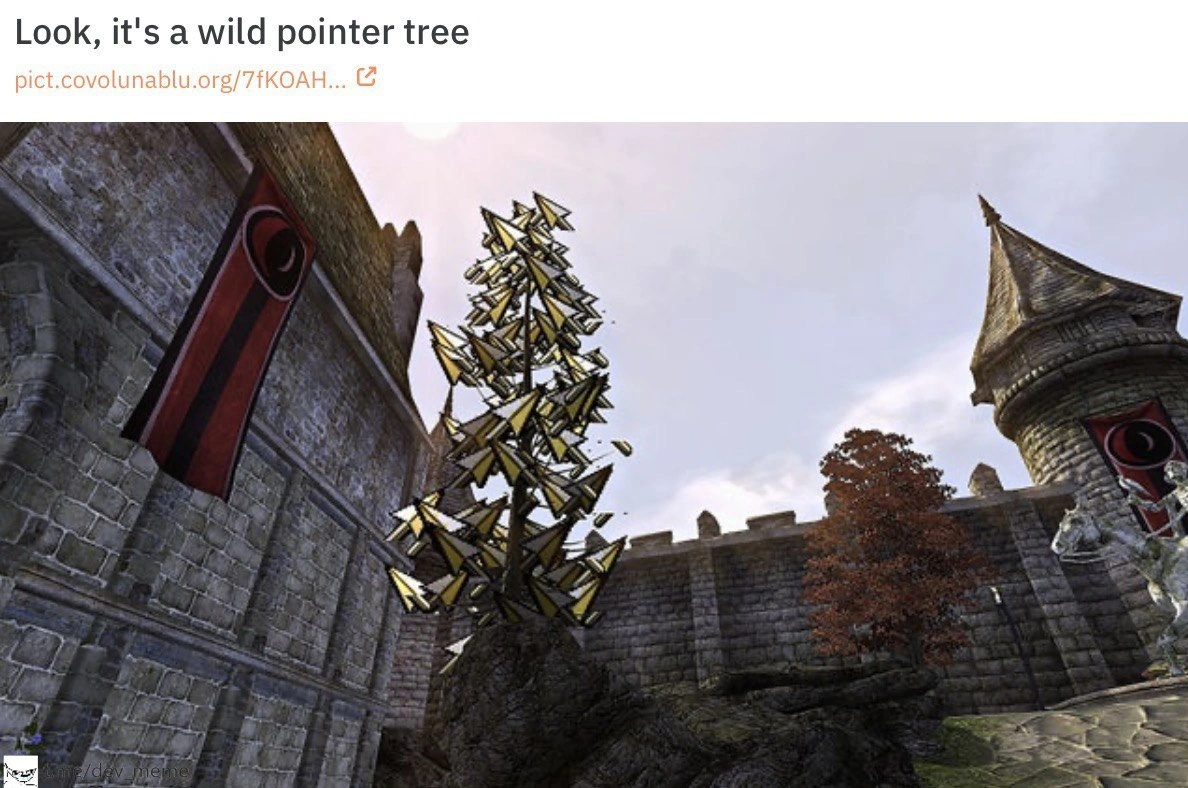
Let’s break down what’s happening here in simpler terms. The image shows a medieval game scene with castle walls and a big tree. But instead of normal leaves, the tree has dozens of yellow arrow cursors (you know, the mouse pointer icon) stuck all over it as its “foliage.” This obviously isn’t intentional – it’s a visual glitch caused by a coding error. The joke caption calls it a “wild pointer tree,” which hints at the technical cause. In programming, especially in languages like C or C++, a pointer is a special variable that holds a memory address (basically a location in the computer’s memory where some data is stored). If that pointer isn’t handled correctly – say it’s not initialized, or it gets changed to a wrong value – we call it a wild pointer because it’s “wildly” pointing somewhere it shouldn’t. Think of it like having a map with a wrong address: you’ll end up at the wrong place. Here, the game’s code had a pointer meant to reference the tree’s leaf model data, but due to a bug, it pointed to the cursor model data instead. So the game ended up drawing the wrong thing in the tree.

Now, games use a renderer (the part of the engine that draws 3D graphics) to display objects like trees, characters, etc. The renderer uses models (meshes made of triangles) and textures to draw each object. These models and textures are often stored in memory and referenced by pointers or ID numbers. For example, the tree object might have a pointer to a “leaf” mesh so it knows what shape to draw for the leaves. In this meme, something went wrong with memory management or asset referencing – basically, the game accidentally swapped the tree’s leaf mesh with the mouse cursor mesh. So, when the renderer went to draw the tree’s leaves, it fetched the cursor model by mistake. The engine doesn’t have a sanity check like “Hey, are you sure that’s a leaf?” – it just draws whatever model the pointer/address is pointing to. Hence, we get a tree covered in cursor arrows!

For a junior developer or someone new to GraphicsProgramming, it’s worth noting how such bugs can happen. One common issue is an array index out-of-bounds or an off-by-one error. Imagine you have a list (array) of game models: trees, rocks, cursors, etc., each with an ID. If the code asks for model number 7 but because of a bug it accidentally asks for model 17, that could return the wrong model. If model 17 was the cursor, suddenly your tree uses that. Another possibility is a pointer error: maybe the programmer forgot to set a pointer to nullptr after deleting an object, and later that pointer was reused incorrectly, still “holding onto” an old address. If at that old memory address there’s now a different object loaded (the cursor), the pointer will blindly give the renderer that object. This is what we call a pointer dereference bug – using a pointer that’s not pointed at what you think it is.

To put it simply, a glitch like this is the program’s equivalent of a mix-up. The game engine mixed up the assets because of a bug. It’s like having two boxes – one labeled “tree leaves” and one labeled “mouse cursors” – and due to a labeling mistake, the game pulled items from the wrong box to put on the tree. The phrase “majestic pointer tree” is just poking fun at how ridiculous the result looks. It’s majestic in a silly way, as if the game decided that mouse pointers do grow on trees. For a new developer, the takeaway is: bugs can get weird! Especially in languages like C++ where you manage memory manually, a small mistake can lead to very surreal outcomes in a game. On the bright side, these kinds of bugs are usually easy to spot (a tree covered in cursors is not subtle), but finding the root cause – the code responsible for the mix-up – can be a lot tougher. This is where tools like debuggers or memory error checkers (e.g., AddressSanitizer or Valgrind) come in handy, helping catch MemoryManagement snafus that lead to such glitches. In summary, this meme is showing a GameDevelopment blooper: the program grabbed the wrong asset due to a pointer mistake, and everyone gets a good laugh (after maybe a few hours of groaning) at the “pointer tree” that wasn’t supposed to be.

Level 3: When Pointers Branch Out

This meme strikes a chord with anyone who’s wrestled with C++ game engines and their occasional WTF moments. We have a medieval castle scene – sturdy stone walls, banners fluttering – and then smack in the courtyard is a tall tree whose foliage has turned into hundreds of yellow mouse cursors. The caption jokes, “Look, it’s a wild pointer tree,” playing on the double meaning of “wild pointer.” In programmer lingo, a wild pointer is a pointer that’s off in la-la land (uninitialized or pointing to garbage data). Here, that concept is literalized: the tree has literally grown wild pointers as leaves. It’s a spot-on piece of DeveloperHumor that combines a GameDev inside-joke with a visual pun. The humor comes from the absurd juxtaposition – a serious fantasy game environment invaded by UI cursor icons – and the knowing cringe that this kind of bug actually happens in development.

Why does this combination of elements make experienced devs smirk knowingly? Because we’ve all been there: a tiny memory management bug leads to a graphics freak-out that would be impossible to design intentionally. The scene is likely a result of an asset ID mismatch or a bad pointer causing the engine to pull the wrong model for the tree’s leaves. In a large GameEngine, assets (meshes, textures, etc.) are referenced either by pointers or by indices in an asset array. If there’s an off-by-one error or a stray overwrite in memory, the code that thinks it’s grabbing “leaf model #5” might instead fetch “cursor model #5” (or some other seemingly random asset) from the asset list. The renderer doesn’t know something’s wrong – a mesh is a mesh – so it dutifully spawns a tree of cursors. This is a prime example of an UnusualBug that’s funny in hindsight but was probably maddening to debug.

Game developers often swap war stories of bizarre bugs like this. Perhaps an engine intern messed up a pointer offset in the vertex buffer, or a physics calculation wrote beyond its array bounds into the rendering data. The result could corrupt the scene graph or material assignments. One minute, you’re coding a day/night cycle; the next, every NPC’s hair is the texture of a stone wall, or all the trees sprout Windows mouse pointers. It’s hilarious now, but imagine seeing that for the first time during a late-night debugging session – half of you is horrified, and the other half can’t stop laughing. There’s a shared understanding among experienced devs that BugsInSoftware can be absurd. We laugh because it’s better than crying: these kinds of glitches are notoriously hard to track down. The code that caused the pointer corruption could be in an entirely different system (AI, UI, networking – who knows?), scribbling over memory that the rendering system uses. Finding that culprit is like looking for a needle in a haystack, except the needle occasionally turns your trees into arrow cursors to taunt you.

Historically, such graphical hiccups have been around as long as games used dynamic memory. Old-school devs might recall missingno in Pokémon – a glitch Pokémon created by reading unintended memory – or the way early 3D games sometimes showed kaleidoscopic artifacts when the GPU got fed garbage data. The industry has learned better practices (like smart pointers, bounds checking, and memory debuggers), but the pressure of deadlines and the complexity of engines mean that pointer bugs still slip through. And when they do, they create memorable moments like this. The meme perfectly captures that “Ugh, classic graphics bug!” feeling. It’s a mix of frustration and fondness – frustration at how such a tiny mistake can cause a cascade of WTF, and fondness because, in a twisted way, these bugs are a rite of passage in graphics programming. After all, nothing says “welcome to game development” like chasing a wild pointer through a forest of bizarre on-screen anomalies.

// Pseudo-code illustrating how a leaf mesh might get wrong data
Mesh* leafMesh = loadMesh("tree_leaf");    // Load the tree's leaf model
Mesh* cursorMesh = loadMesh("mouse_cursor"); // Load the cursor model (for UI maybe)

// ... somewhere else, a memory bug or logic error ...
leafMesh = cursorMesh;  // Oops: leafMesh pointer now references the cursor model

renderer.drawMesh(tree.position, leafMesh); // Draws the cursor mesh where leaves should be
// Result: a tree with cursor icons instead of leaves!

In the code above, a simple mistake (the leaf mesh pointer getting overwritten with the cursor mesh pointer) would yield exactly what we see: a graphics programming nightmare (or comedy) where the game engine faithfully renders a cursed tree. This snippet is highly simplified, but it’s not far from what could happen in a real engine when there’s a pointer dereference fail or asset_id_mismatch. Seasoned developers look at that screenshot and can practically hear the collective groan and chuckle from the dev team: “Welp, we’ve got a wild pointer on the loose!” It’s a relatable reminder that even in a realm of complex shaders and high-end rendering, a single stray pointer can throw you back to the Stone Age of debugging memory errors.

Level 4: Dangling Leaves of Memory

In low-level graphics programming, memory mismanagement can manifest in spectacular ways. Here we see a classic case of a pointer going rogue inside a game engine’s renderer. At a hardware level, a pointer is essentially a numeric memory address – if that address gets corrupted or mis-assigned, the program might read the wrong data but still think it’s valid. This is undefined behavior in action: the engine expected to find vertex coordinates for tree leaves, but a misdirected pointer led it to a completely different memory region containing the mesh for the yellow cursor icon. Instead of a crash, the GPU was handed a plausible set of geometry data – just not the right one for leaves. The result? The renderer dutifully drew a tree full of arrow pointers. It’s a perfect storm of pointer arithmetic folly: an offset-by-one in an array index or a stray bit flip in an address can cause an object’s vertex buffer to point at a neighbor’s data. In C/C++ terms, a “wild pointer” (an uninitialized or dangling pointer) sprouted into a forest of undefined behavior on screen.

From a systems perspective, this glitch illustrates how heap memory reuse can produce bizarre but coherent visuals. If the tree’s leaf mesh pointer was freed or went out of scope prematurely, its memory slot might get reallocated for the cursor mesh. The stale pointer, now a dangling reference, still “points” to that address, which holds valid data – just for the wrong asset. Unlike a segfault (which occurs if a pointer references an invalid address outside the process’s memory), here the pointer landed in an address that remained within the game’s memory space, so the engine didn’t immediately detect the mistake. Instead, it happily uploaded those vertices to the GPU. The graphics pipeline doesn’t know these triangles were meant for a mouse cursor; it just renders whatever geometry it’s given. This is a textbook example of how memory corruption can lead to * emergent* and head-scratching outcomes rather than outright failure. Seasoned engine developers have seen similarly surreal bugs: textures mapping to the wrong models, skeletal rigs exploding into spiky blobs, or entire levels turning into nightmare fuel – all because some pointer dereferenced the wrong chunk of memory. The majestic pointer tree is a humorous embodiment of the underlying reality: in manual memory management, a single-bit error or mis-addressed pointer can literally reshape your world (or at least your world geometry) in unpredictable ways.

Description

A screenshot from what appears to be a fantasy video game, likely The Elder Scrolls series, showing a castle courtyard. The central and most prominent feature is a tree-like structure composed entirely of classic yellow-and-white mouse pointer cursors. The caption above the image reads, "Look, it's a wild pointer tree". The scene is set against a stone castle wall with red and black banners. This meme is a clever visual pun on a core computer science concept. In programming languages like C and C++, a 'pointer' is a variable that stores a memory address. A 'wild pointer' is a dangerous type of bug where a pointer has not been initialized or points to freed memory, leading to unpredictable and often catastrophic program crashes (segmentation faults). The image humorously literalizes this abstract threat, depicting a 'wild pointer' as a physical entity found in the 'wild' of a game world


Comments

7
Anonymous ★ Top Pick Someone forgot to free the memory, and now the whole forest is a memory leak. Good luck debugging that traversal
  1. Anonymous ★ Top Pick

    Someone forgot to free the memory, and now the whole forest is a memory leak. Good luck debugging that traversal

  2. Anonymous

    Who needs a SpeedTree license - one dangling pointer and the engine procedurally fills the map with mouse-cursor foliage; the frame rate becomes NaN, but hey, infinite trees ship free

  3. Anonymous

    Finally found the root cause of our segfaults - turns out someone's been watering the pointer tree with undefined behavior and now it's grown completely unbalanced with cyclic references

  4. Anonymous

    When your junior dev says they 'understand pointers' but their code creates a self-referential forest of dangling references that would make even Dijkstra weep. This is what happens when you malloc() without a plan and free() becomes more of a suggestion than a requirement - eventually you get a majestic monument to memory leaks that's simultaneously a tree, a graph, and a cry for help. At least it's not a circular reference... or is it?

  5. Anonymous

    Somewhere a dangling pointer read the asset registry as an int, so the foliage system instanced 20k cursor meshes - perfect in debug, an entire Heisen-orchard the moment you compile with -O3

  6. Anonymous

    The only tree structure that balances itself via unchecked pointer arithmetic - until it topples your entire heap

  7. Anonymous

    Nice pointer tree - every leaf is an extra indirection; traversal is an L3 cache benchmark, and the fruit are dangling references

Use J and K for navigation