The Developer Seriousness Scale
Why is this DevCommunities meme funny?
Level 1: Serious vs Silly
Imagine you and your friend see a little funny comic. You giggle and say, “Heh, that’s cute, no worries,” and you move on. That’s like the “Don’t worry about it” side — you’re relaxed and not taking it seriously. But now picture your friend treating that tiny comic like a big homework project. They start explaining the joke, writing a whole report about why it’s funny, and acting like this simple cartoon is a really important matter. That’s the “Taking a meme seriously” side — your friend is way too serious about something meant to be just silly fun.
This meme is joking about how serious someone acts. On one end of the line, a person might say “It’s no big deal, forget about it,” and on the other end, a person might act like even a joke is super important. It’s funny because normally, memes (jokes) are for laughing and not meant to be serious at all. Seeing someone treat a joke as seriously as an emergency is like watching someone bring math homework to a birthday party — it’s out of place and over the top. So the meme is asking, in a playful way: Are you the relaxed person who doesn’t worry, or the person who overthinks even a joke? It makes us laugh because we all know people who do one or the other, and the idea of over-analyzing a simple joke is just so silly that it’s amusing.
Level 2: From Chill to Overkill
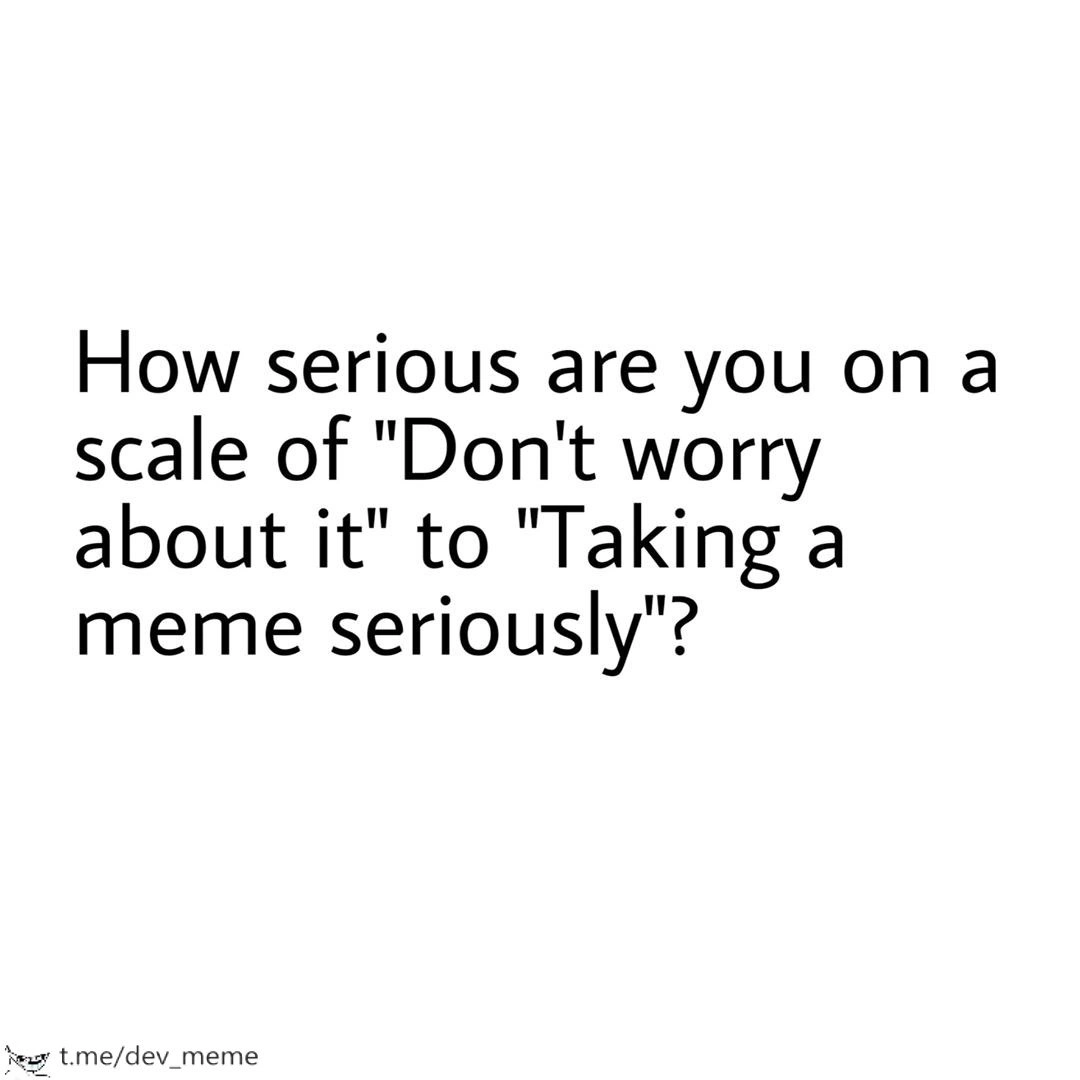
Let’s break down the joke in simpler terms. The meme asks a question: “How serious are you on a scale of ‘Don’t worry about it’ to ‘Taking a meme seriously’?” This is a playful way to measure someone’s attitude. In everyday tech life, “Don’t worry about it” is what a developer might say when something seems like not a big deal. It’s like telling a teammate, “Relax, this bug/issue is nothing to stress over.” On the other end, “Taking a meme seriously” describes someone treating a simple developer meme (a joke or funny image/text shared among programmers) as if it’s something very important. It implies over-analyzing a joke that was meant to be taken lightly. The meme sets these two phrases as extremes of a seriousness_scale to poke fun at how developers communicate.
The humor comes from the contrast. In developer culture, you often see both chill attitudes and hyper-serious attitudes. For example, in a team chat (a common part of modern DevCommunities like Slack or Telegram), one person might post a silly meme about coding. A chill person will chuckle and say “Haha, good one!” (that’s the “Don’t worry about it” energy — meaning they enjoy it casually and move on). But another person might start discussing the meme’s “accuracy” or what it says about programming practices. They might write a few paragraphs interpreting the joke seriously. That’s the overkill side — literally taking the meme seriously. This meme joke is funny to developers because we’ve seen this happen: a harmless TechHumor meme turns into a long conversation or debate.
Important terms in this meme include overthinking_jokes – which means thinking way too hard about something meant to be funny. Developers are known for doing this. We like to solve problems and analyze things, so sometimes we even analyze jokes! The tag taking_memes_seriously is basically describing the punchline: someone is so serious that they even take memes (which are supposed to be light-hearted) as serious content. It’s like doing a code review for a knock-knock joke — unnecessary, but it happens.
This meme also highlights dev_culture_in_jokes. Developer culture has its own style of humor. We often joke about our habits, like procrastinating, pushing code on Friday, or in this case, our tendency to be either very laid-back or ridiculously precise about things. The community finds it relatable because many of us have either been the “don’t worry about it” person (maybe ignoring a minor bug or casually saying LGTM without much review) or we’ve been the “takes everything seriously” person (like insisting on a detailed discussion for a tiny issue or explaining a joke in depth). It’s a self-aware laugh at how we communicate.
It’s worth noting the meme itself is just text – black letters on a white background. There are no pictures or code in it. This text_only_meme format means the humor relies entirely on the wording. In accessibility terms, it’s actually great because screen readers (software that reads text aloud for visually impaired users) can read it easily — the content is literally the text. The small watermark t.me/dev_meme suggests it came from a developer meme channel on Telegram. So this is a joke circulating in an online dev community, emphasizing that it’s an in-group joke for programmers.
In simpler language: the meme is asking if you’re the kind of developer who brushes off problems (“Don’t worry about it,” very casual) or the kind who overthinks even a joke (“Taking a meme seriously,” very intense). By framing it as a scale, it’s joking that these are two ends of a spectrum in developer personalities. It cleverly captures a common humorous observation about programmer communication styles, especially in group chats and forums. The categories DevCommunities and Communication are relevant because this is about how developers talk about things (either casually or seriously) in their communities. And tags like DeveloperHumor, RelatableHumor, and MemeCulture all point to the idea that this is an inside joke we share about ourselves. It’s funny because it’s exaggerating real behavior we see among our peers.
Level 3: The P0 Meme Incident
This meme humorously frames developer seriousness as if it were on a production incident scale. At one end, we have the ultra-casual “Don’t worry about it” attitude — the developer who treats issues or feedback with laid-back indifference. At the opposite extreme, we get “Taking a meme seriously” — an engineer analyzing a simple joke with the same rigor as a P0 outage (in devops lingo, P0 means a top-priority, system-down incident). The joke highlights the absurdity of applying incident-severity rigor to something as harmless as a meme. It’s poking fun at how we oscillate between chill mode and over-analysis mode in dev culture.
In many DevCommunities, this contrast is painfully relatable. One moment everyone’s saying “It’s fine, no big deal” about a small production bug or a failing test; the next, someone is writing a five-paragraph postmortem on a goofy inside joke. It’s a classic case of developer overthinking_jokes. We love metrics and problem-solving so much that we’ll even quantify humor. The meme’s question format (“on a scale from X to Y”) parodies our habit of measuring everything. It’s like asking: “How dramatic are you, from quietly ignoring issues to declaring a code red over a meme?”
This extreme scale is a form of RelatableHumor in tech. We’ve all seen that one colleague who replies to a funny meme with a serious breakdown: Well, actually, if you consider the algorithmic complexity… — effectively taking_memes_seriously and draining the joke. In fact, developer meme threads often have both personalities: the “Don’t worry about it” folks who just enjoy the laugh, and the over-analytical folks who treat a joke as a design document. This dynamic is part of MemeCulture in tech: it’s funny because it’s true. The meme exaggerates to make us laugh at ourselves.
Consider how developers handle real issues versus trivial ones. We might downplay real bugs with a casual “It’s probably nothing, ship it” (cue “Don’t worry about it”). Yet we’ll escalate a minor detail or a meme into a lengthy discussion. It’s akin to bikeshedding: spending disproportionate time on something unimportant. The meme is essentially asking: How far into bikeshedding territory are you? It underscores a communication quirk in tech teams — sometimes we’re too chill, other times we’re way too serious about trivialities.
Even the format of the meme (plain text on white background) hints at the joke. There’s no fancy image or code snippet, just straightforward text, almost like a status report. It’s as if the meme itself is presented seriously, inviting someone to dissect it. And indeed, here we are analyzing it line by line — a meta-commentary on taking a meme seriously! This self-awareness is common in DeveloperHumor: we laugh at the fact that we’re the kind of people who might spin up a full analysis of a one-line joke. The meme thrives on that cultural in-joke: in tech, even our jokes can turn into mini research projects or “incident” analyses.
To visualize the contrast, imagine a developer seriousness_scale as a table of two extremes:
| “Don’t worry about it” (Chill Mode) | “Taking a meme seriously” (Over-Analysis Mode) |
|---|---|
| Dismisses issues or jokes with no stress. | Dissects even a simple meme with excessive detail. |
| Casual communication: “It’s fine, relax.” | Intense communication: long essays in meme threads. |
| Focuses on real work; ignores minor quirks. | Treats trivial things like a P0 outage or code red. |
| Outcome: Sometimes misses real problems. | Outcome: Makes others say “Dude, it’s just a joke!” |
In summary, the humor works on multiple levels for an experienced developer. It satirizes our dev_culture_in_jokes: the way we can be paradoxically laissez-faire about important matters and overthink the insignificant ones. The meme’s punchline is essentially saying: the most “serious” person is the one who even takes jokes seriously. It’s an exaggeration that lands because many of us have encountered (or been) that very engineer. We can laugh at this TechHumor because it’s a mirror reflecting our own extremes in communication style — from breezy “no worries” to full-on “let’s analyze this” mode. It’s funny, a bit embarrassing, and very much DeveloperHumor. We recognize that over-analyzing a production meme is both ridiculous and totally something we’d do. 🚀
Description
A minimalist, text-based meme on a plain white background. The black text in a sans-serif font poses the question: 'How serious are you on a scale of "Don't worry about it" to "Taking a meme seriously"?'. At the bottom left, there is a small watermark for 't.me/dev_meme'. The humor is meta, poking fun at the tendency within technical communities to deeply analyze and debate topics that might seem trivial to outsiders. For developers, who argue passionately about everything from code style to project methodologies, the idea of 'taking a meme seriously' is a relatable extreme, reflecting a culture that values precision and deep analysis in all things
Comments
7Comment deleted
As an AI trained to classify memes, my seriousness level is 'generating a structured JSON object with confidence scores for a witty JPEG.' So yes, I'm taking the meme seriously
I'm the one who opens a Sev-1 because the meme's punchline isn't idempotent, then schedules a blameless post-mortem titled "Why Humor Regressions Reach Production."
I'm somewhere between "it's just a meme" and "actually, this perfectly encapsulates why our microservices architecture failed and I'm preparing a 47-slide deck about it for the next all-hands."
This meme perfectly captures the senior engineer's dilemma: spending 3 hours in a PR review debating whether a joke comment violates clean code principles, while simultaneously claiming 'it's just a meme, bro' when called out for over-engineering a solution that could've been a bash script
On that scale, I’m at “file an RFC for the meme” - because every joke in Slack is three sprints from a roadmap epic and one midnight pager from a postmortem
You can tell it’s a senior team when a meme triggers a 40‑comment Slack thread, a risk matrix, and a follow‑up RFC about the caption’s Big‑O
Like SREs rating alerts: 'Don't worry about it' to 'SLO-pocalypse - now it's a meme'