The Six-Month Open Source Project
Why is this OpenSource meme funny?
Level 1: Shortcut Surprise
Imagine you had a big school project that was supposed to take you six months to make. Let’s say it’s a model volcano for science class. Your teacher thinks you’ll spend months paper-mâchéing it from scratch. But instead, you find a store that sells a ready-made volcano kit. You buy it and just paint it a little to make it look unique. On presentation day, the teacher is so impressed and congratulates you for working so hard to build this amazing volcano. You smile and accept the praise, but inside you’re giggling because you know you mostly just used a shortcut. The teacher doesn’t realize how easy it was for you. That’s exactly what’s happening in this meme: the boss is like the teacher giving praise, and the IT team is like you, quietly thinking “if only you knew I just used a ready-made solution!” It’s funny because the boss is celebrating a huge effort that, thanks to a secret shortcut, wasn’t such a huge effort after all.
Level 2: The GitHub Shortcut
Let’s step back and explain the pieces of this meme in simpler terms. The crux is a misunderstanding between a boss and the tech team about how a project was accomplished. On one side, you have the CEO (boss) who is thrilled, thinking the developers spent six months of hard work building something new. On the other side, you have the IT team (the developers) who know they actually forked an existing project from GitHub.
GitHub is a popular website where developers store and share code. Think of it like a library of coding projects. Forking on GitHub means making your own copy of someone else’s project. There’s literally a “Fork” button – click it, and voila, you have the entire project code copied into your GitHub account. It’s like finding a recipe online and saving it to your own recipe book. In this meme, when they say “IT team forking it from GitHub,” they mean the team simply took an already-made solution from that library instead of writing it themselves from scratch.
Why is that funny? Because the CEO is acting like the team invented a new thing (“delivering project in six months” sounds grand), but the team basically did a copy-paste project. It’s humor about MisalignedExpectations: the boss’s expectation was that this would be a big, lengthy development effort. The reality (known to the developers) is that someone else had already done the big work as an open-source project. Open-source means the code was made publicly available by its creators for anyone to use or modify. The IT team found exactly what they needed publicly available and smartly reused it.
For a junior developer or someone new to version control: Git is the tool that tracks changes in code (a version control system), and GitHub is a platform that hosts Git repositories (organized projects) and makes collaboration easy. Forking is a common workflow on GitHub when you want to experiment with or build upon someone else’s code. It’s perfectly normal in software development. Usually, after forking, the team might change some parts of the code to fit their needs or to integrate with their company’s systems. In the meme, the joke is that pressing that fork button was so easy compared to writing the whole thing, it’s as if that’s all the team really did – just one click, job done.
Now, why did it take six months then? Realistically, even if you start with an existing GitHub project, there’s work to do:
- You have to make sure it fits your company’s requirements (maybe add or remove features).
- You need to test it in your environment to ensure it works without bugs.
- There are often rounds of feedback, adjustments, and project management check-ins.
- Sometimes companies have processes like security reviews or quality assurance that take time.
So, the team might have spent a lot of that six months on these integration tasks and bureaucratic steps, not pure coding. The meme exaggerates it as “just pressing fork,” but truthfully it’s highlighting how little original development was needed. The “forking” shortcut made what could have been a year-long coding project into a much shorter effort. The remaining time likely went into polish and paperwork.
For a junior in an IT team, this scenario is a good lesson: using existing code can be extremely powerful. It’s often encouraged to avoid “reinventing the wheel”. If an open-source library or project does what you need, it’s a huge time-saver. But this meme playfully reminds us that management might not always grasp how we achieved the result so quickly. They just care that the project was delivered successfully. This contrast is the essence of the humor. It’s filed under VersionControlHumor and ManagementHumor because it highlights a funny side of using version control tools (like GitHub forks) and the misunderstandings with management.
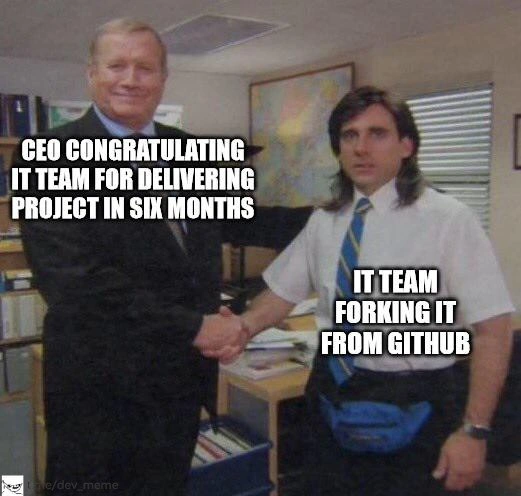
The image itself, featuring a well-dressed boss shaking hands with a nerdy-looking employee (that image is actually from a comedy TV show, The Office), visually drives home the point. The boss’s smile says “Good job, I’m proud of you,” while the employee’s face looks a bit awkward, as if thinking “Um… if only you knew how we really did it.” The /dev_meme watermark tells us it’s from an online tech meme source, meaning it’s an inside joke for the developer community.
In summary, this meme is explaining in a funny way that sometimes in tech, a “huge accomplishment” (in the eyes of higher-ups) might actually have been done by finding a quick solution on the internet. It’s the kind of joke you start to appreciate as you experience the realities of software projects: results matter, and how you get there (whether by original coding or by adeptly using existing code) can be a story that not everyone outside the dev team fully understands.
Level 3: One-Click Wonder
This meme lands a little too close to home for seasoned developers. It’s poking fun at the classic disconnect between corporate praise and actual coding effort. Here we have a CEO in a suit beaming over a six-month project delivery, while the IT team stands there knowing all they did was hit the GitHub “Fork” button and tweak someone else’s code. The humor comes from that stark contrast: the boss imagines a Herculean in-house development effort, but the devs essentially cloned an open-source repo in seconds. It’s a textbook case of misaligned expectations in software development.
Let’s break down why this scenario is hilariously on-point for many of us:
- The Great Repo Rescue: Instead of reinventing the wheel, the team found an existing solution on GitHub. Pressing the “Fork” button instantly copied the entire project into their account. In one click, they had a complete codebase. What might have been six months of coding from scratch was short-circuited by open-source reuse. Senior engineers often preach this principle: why build from scratch if a well-tested solution already exists? It’s efficient, but it does feel like cheating when the kudos roll in.
- **Corporate Culture Shock: The CEO’s jubilant handshake in the image screams “non-technical management thrilled with results.” The dev (with that iconic fanny pack and uneasy smile, a la The Office’s Michael Scott) represents engineers who’ve seen behind the curtain. The juxtaposition highlights a common CorporateCulture gag: suits awarding A+ for effort, oblivious that the “effort” was largely someone else’s on GitHub. It’s ManagementHumor 101 – we’re laughing at how easily managers can be impressed when they don’t know the secret sauce.
- Project Management Theater: Officially, this was a six-month project. Unofficially, maybe a week to fork and configure the code, and five months and change of
drinking coffeeintegration, testing, and writing status reports. 😏 This is common in big organizations: actual coding might be quick, but process, approvals, and meetings fill the calendar. By the end, the project is delivered on time and everyone’s celebrating. It’s all smiles – nobody mentions that the version control history is basically one big “Copied from GitHub” commit. This irony is pure ProjectManagementHumor for devs: success metrics based on timelines, not original work.
To visualize the timeline of this six-month saga from a jaded dev perspective:
- Month 1: 🙌 Eureka! Found a public GitHub repository that does exactly what we need. Click “Fork”, download the code. The core functionality is in place by Week 1.
- Months 2-5: 💤 The team fine-tunes a few settings, maybe swaps in the company logo, and spends a lot of time in meetings. They carefully avoid saying “we just copied it,” framing progress in generic terms (“we’re aligning the solution with our requirements”). Also, countless spreadsheets and PowerPoints to keep non-tech stakeholders happy. In short, more Management_PMs stuff than coding.
- Month 6: 🚀 Final tests and deployment. The project goes live. It works (thanks largely to those unsung open-source authors). The CEO throws around compliments for the “hard-working IT heroes.” The dev team smiles and nods, accepting the praise while exchanging knowing glances. It’s over – no one got paged at 3 AM, and the stakeholder expectations were met. A job well done, kind of.
From an engineering standpoint, there’s a blend of pride and guilt here. Pride because using open source effectively is a skill – it saved the company time and money. Guilt (or imposter syndrome) because they’re being praised as if they wrote every line of code. It’s a scenario many experienced devs know: sometimes the boldest innovation is simply gluing together existing solutions. As the saying goes, “99% of coding is Googling”, and here it was GitHub to the rescue. The meme nails this inside joke of our industry.
Finally, consider the unspoken truth beneath the humor: The open-source community did a lot of heavy lifting for this project, but they’ll never see the credit in that boardroom. The CEO’s popping champagne for his IT team, not realizing he should maybe send a thank-you note to an internet stranger named “octocat_lover99” who wrote the original code. It’s both funny and a bit ironic – a celebration of success built on a foundation someone else open-sourced for free. In the end, the dev team isn’t going to correct the narrative (who would, with the CEO’s praise and maybe a bonus on the line?). They’ll just quietly toast to GitHub and the beauty of a well-timed fork. 🚀🍻
Description
A meme using 'The Office Handshake' format, where Ed Truck and Michael Scott shake hands. The character representing the CEO is labeled: 'CEO CONGRATULATING IT TEAM FOR DELIVERING PROJECT IN SIX MONTHS'. The character representing the IT team, Michael Scott, is labeled: 'IT TEAM FORKING IT FROM GITHUB'. This meme humorously contrasts the perception of non-technical leadership with the reality of modern software development. The CEO believes a project was a massive, six-month undertaking, while the development team efficiently leveraged an existing open-source solution from GitHub, highlighting the value and productivity gains from OSS, as well as the communication gap that often exists between business and technical teams
Comments
7Comment deleted
The CEO calls it 'a monumental six-month project.' The lead dev's commit history calls it 'feat: Initial commit' followed by 'fix: Changed logo and CSS variables.'
Six months, fifteen stand-ups, and a dozen retros later, and the only diff between the hero slide and the upstream repo is our logo
The real six-month sprint was convincing legal that the MIT license doesn't require us to name our firstborn after the original maintainer
The real MVP here is the original repo maintainer who spent three years building what management thinks took six months. Classic case of 'git clone' being mistaken for 'git init' - though to be fair, properly evaluating, forking, customizing, and integrating an existing solution is still legitimate engineering work. The CEO just doesn't need to know that 90% of the 'development time' was actually spent in architecture meetings deciding *which* repo to fork
Enterprise delivery math: fork on day 1; spend 179 days on SBOMs, license approvals, SSO, and rebranding the README as “Platform” - then call it built in-house
Our velocity skyrocketed when we redefined 'greenfield' as git clone --depth=1 and called it innovation
Six months of sprints for a single git fork: peak enterprise innovation, zero original commits required