The Ultimate Job Security: Vague Client Requirements
Why is this Stakeholders Clients meme funny?
Level 1: Robots Can’t Read Minds
Imagine you have a robot that can build anything you want, but there’s a catch: you have to tell it exactly what to make, down to every little detail. Now, think about asking that robot to “make me something that I’ll love.” The robot is going to get stuck immediately – what does “something I’ll love” mean? Is it a toy, a cake, a song, a game? If you don’t give clear instructions, the poor robot has no idea what to do. But a human helper might respond by asking you questions: “Well, what do you enjoy? Do you want something to play with or something to eat?” The human can guess and clarify because people are good at dealing with unclear requests. The robot just waits there for proper instructions.
This meme is joking that programmers (the people who write code) won’t be replaced by robots any time soon, because the people who ask for software (clients) often talk like you did when you said “something I’ll love.” They aren’t specific. It’s funny because it’s true – often when someone wants an app or a website, they can’t describe exactly what they imagine, kind of like not knowing what you want for dinner but expecting the cook to somehow get it right. As long as people keep giving instructions that are incomplete or confusing, we’ll need real humans to figure out what they mean. In short, the joke is saying our jobs are safe because robots can’t read minds. A robot can follow a recipe, but if you don’t give it a recipe and just say “make it tasty,” only a human chef (asking questions or trying things) could hope to get it right. The humor makes us feel a bit relieved and amused – it’s a playful reminder that being able to understand each other (even when we’re not clear) is a very human skill, and one that keeps programmers around no matter how advanced robots get.
Level 2: Lost in Translation
For a junior developer or someone new to the field, let’s break down why this meme is funny and what it’s talking about. First, “programmers” are people who write code to create software. Clients (or stakeholders) are the people who want the software to be made – often non-technical folks, like a business owner or a manager, who have an idea or a need. Now, when the meme says “replace programmers with robots,” it’s referring to the idea of automation in coding – basically, a future where an AI or a machine could write code by itself, instead of needing human developers. This is something people worry about from time to time (that worry is jokingly called automation anxiety: the fear that a machine will take your job).
The twist in the joke is the condition given: “clients will have to accurately describe what they want.” If you’ve ever worked on a software project (even a school assignment or a small app for a friend), you might notice that people requesting the software often aren’t very clear about the details. This is called requirements ambiguity, where the requirements (the description of what the software should do) are ambiguous (not well-defined or open to interpretation). For example, a client might say, “I want an app that’s like Instagram but for pet photos,” and leave it at that. As a new developer, you’d probably have a ton of follow-up questions: Login system or not? Should users be able to comment? How should the feed be sorted? What does “like Instagram” really include? The meme is pointing out a real-life communication gap: clients, especially non-technical ones, often think they’ve explained what they want, but from a developer’s perspective, there are lots of missing pieces and unclear instructions.
So why does that make programmers “safe”? The joke implies that as long as people can’t explain exactly what they need in complete detail, a robot won’t be able to build it for them. Humans (programmers) are used to dealing with vague requirements. We ask questions, use our intuition, draw on past experience, and sometimes just make educated guesses to fill in the blanks when a client’s description is incomplete. A robot or an AI, on the other hand, isn’t inherently good at guessing what a person meant to say if it wasn’t said. Computers are very literal: they do exactly what you tell them, nothing more. So if the instruction is fuzzy (“make it user-friendly” or “it should look modern”), a computer would be stuck or do something odd, because those instructions aren’t exact. In contrast, a human developer knows how to navigate this fuzziness: they might ask the client follow-up questions (“Can you show me an example of a design you find modern?”) or they might implement something and then get feedback (“Is this what you had in mind?”).
The meme comes from Twitter (the image is a screenshot of a tweet). Tweets are those short messages people post on Twitter, and developer humor often circulates in this format. The text of the tweet is the joke itself. It’s basically laughing at the everyday challenge of requirements gathering – that phase where developers talk to clients to figure out what needs to be built. If you’re new to development, know that this phase can be surprisingly tricky! Clients might use everyday language or business jargon that doesn’t spell out the technical details. Part of a programmer’s job is to translate those client expectations into something concrete that a computer can actually do. There’s even a common saying: “The hardest part of programming isn’t coding; it’s getting the requirements right.” That’s exactly what this meme is poking fun at. Programmers have long joked that if requirements were always clear and complete, half our problems would vanish (and maybe a robot truly could do our job). But in reality, figuring out what a client really means is a big part of why programmers are needed.
In simpler terms: imagine a friend tells you, “Build me something that makes money and is popular. You’re the tech whiz, you’ll figure it out.” That’s not a lot to go on, right? You’d have to ask a bunch of questions (Build you what exactly? A website? An app? For what audience? Selling what?). This meme highlights that situation. We’re safe (our jobs are safe) because as long as people give instructions like that, they’ll need a human to interpret them and ask those questions. It’s humor that resonates in the tech community because every developer, junior or senior, has faced the dreaded unclear task or the project with constantly changing requirements. Now you know: behind the scenes of every software, there was probably a slightly confused programmer chasing down details from someone who couldn’t describe them clearly at first!
Level 3: Job Security Through Ambiguity
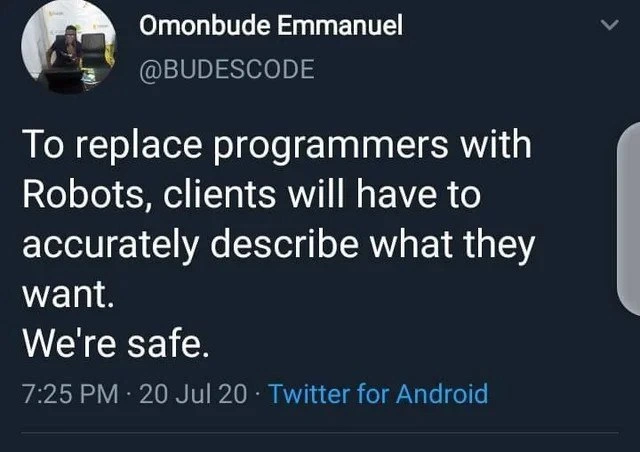
“To replace programmers with Robots, clients will have to accurately describe what they want. We’re safe.”
This witty tweet encapsulates a scenario every seasoned developer has experienced: the communication gap between what stakeholders say and what they actually want. The humor here plays on the daily absurdity of requirements ambiguity. Essentially, the author is joking that our job security as developers is guaranteed not by union contracts or anything, but by the sheer inability of many clients to accurately describe their desired software. It’s a darkly comic take on stakeholder expectations: clients often think they know what they want until you start asking for details. At that point, the picture becomes as clear as mud. Every senior engineer has had that meeting where a client provides a one-liner vision (“It should be like Uber, but for llamas, and also integrate with social media – you know what I mean, right?”) and expects a complete product out the other end. In practice, translating those vague requirements into a working system is basically 90% of the work of development. If a super-intelligent robot tried to do it without human guidance, it would be stumped the moment the spec said something like “make it look modern and user-friendly” – what does that even specifically mean? As the meme dryly notes, as long as clients continue giving imprecise, evolving, or self-contradictory instructions (which they will, because humans), developers aren’t losing our jobs to robots anytime soon. Our value isn’t just typing code; it’s figuring out what the heck needs to be coded in the first place. That involves conversations, clarifications, and often acting as a sort of technical detective or translator to pin down the true requirements. In other words, “ambiguity in requirements” is the developer’s best friend (and frequent bane) — it ensures there’s always a need for a human in the loop.
This joke touches on a well-known industry truth: requirements gathering is hard. In fact, many failed projects can trace their roots to requirements ambiguity or misunderstanding. There’s even an old cartoon meme showing how a client described a swing, how the project manager conveyed it, how the engineer built it, and how the user actually wanted it — each totally different. It’s funny because it’s true. Engineers have developed whole methodologies (Agile user stories, Scrum sprints, endless “let’s clarify this” meetings) to combat this eternal game of telephone. We know that the first thing a client says they want is rarely what they really need. The meme’s author quips that if clients were capable of giving a complete, consistent, detailed spec up front (something every dev has fantasized about but seldom seen), then maybe in theory a robot programmer could take over and just execute on it. But in reality, stakeholders change their minds, forget requirements, assume a lot of domain knowledge, or just can’t articulate their vision in a detailed way. This perpetual communication gap between stakeholders and engineers has become a running joke – and a form of job security – in the software world. We laugh about it to keep from crying, because every dev knows the stress of trying to read a client’s mind.
There’s also an undercurrent of automation anxiety here – the fear that one day software will write itself and make human coders obsolete. Every few years, we hear about the “next big thing” that will let managers replace programmers: maybe it was 4GLs (fourth-generation languages) in the 80s, or automatic code generation tools in the 90s, or drag-and-drop app builders, or more recently AI-powered code assistants. Each time, seasoned devs roll their eyes and ask, “But who’s going to tell the tool what the program should do?” This tweet is basically the veteran developer community saying, “We’re not scared of losing our jobs to a robot until clients learn to write crystal-clear specs… and we all know that’s not happening anytime soon.” It’s a comforting thought packaged as a joke. The stakeholder expectations vs. developer reality tension has fueled countless jokes, because it’s so relatable: clients might expect programmers to produce miracles from one-line requirements, and programmers expect clients to inevitably say “actually, what I really meant was…” halfway through the project. Here the programmer’s “safety” comes from that very predictability of misunderstanding.
The fact that this meme is presented as a tweet screenshot is also telling. Developer humor often spreads on Twitter and other social media as short quips. The tweet format — white text on a navy background, the @BUDESCODE handle, and the “Twitter for Android” timestamp — gives it authenticity. It feels like a real developer’s off-the-cuff insight during a Twitter discussion about AI replacing jobs. In July 2020 when this was posted, there was a lot of buzz about AI and automation (GPT-3 had just appeared on the scene, and people were speculating about AI coding). This tweet’s author wittily cut through the hype: even a cutting-edge AI can’t implement a feature based on a one-sentence, hand-wavy requirement. Only a flesh-and-blood programmer, through iterative dialogue and experience, can navigate those impossible client specs. In developer forums, jokes about robots vs. programmers or the myth of a push-button “make app” solution are common. There’s a shared understanding that building software is as much about human conversation and discovery as it is about typing out code. So the community finds solace (and a good laugh) in the idea that no automation can replace the human element of sitting down with a client and saying, “Let’s figure out what you really need.” In summary, the meme lands because it’s a clever one-liner that compresses years of collective software development pain into a punchy truth: we’re safe, not because robots aren’t smart, but because clients are human.
Level 4: The Halting Spec Problem
At the most theoretical level, this meme hints at a fundamental truth of computing and logic: you can’t build a program from an undefined specification. In formal terms, a program is a precise sequence of instructions, and to generate those instructions automatically, you’d need an equally precise specification of what the program should do. If clients can’t articulate requirements with mathematical precision, a “robot programmer” has basically no well-defined problem to solve – it’s an instance of an undecidable problem. It’s like trying to solve an equation with multiple unknowns and no additional constraints: infinite solutions fit, so the computer can’t magically pick the “right” one. This is analogous to the classic Halting Problem or other unsolvable scenarios: given incomplete input, determining the intended output can be computationally impossible. The humor hides a deep insight: a specification detailed enough to let an algorithm generate correct code is practically as complex as the code itself. In other words, writing a complete, unambiguous blueprint for a program can be as hard as programming – if not harder.
From a formal methods perspective, there’s a reason we still have human programmers and not just auto-coding machines. Decades of research into things like formal specification languages (think Z notation, TLA+, or even exhaustive UML models) show how demanding it is to capture every requirement, business rule, and edge case without ambiguity. A requirement that seems simple in English (“the user should be able to upload a file securely and easily”) explodes into dozens of detailed rules and conditions when stated rigorously. If you leave anything out, you get undefined behavior – the system might do something, but whether it’s what the client wanted is a roll of the dice. A robot or AI, lacking human intuition, does exactly what the input specifies. If the input (the spec) is vague, the output code could be anything. The tweet jokingly implies a paradox: to replace programmers with automation, clients would have to provide a perfect formal specification. But if a client could do that, they’ve essentially done the hardest part of programming already! It’s a catch-22 rooted in the very nature of programming: a computer will only do what it’s told, and telling a computer exactly what to do is literally what programming is.
Modern attempts at AI code generation (like machine learning models that generate code from natural language) grapple with this same issue. They work by statistically guessing what code might fulfill a loosely stated request, using patterns learned from tons of data. But they’re notoriously prone to errors when the prompt is ambiguous or underspecified. They might produce something syntactically correct that seems plausible, but whether it matches the user’s actual intent is hit-or-miss. Essentially, these AI tools shift the problem around: the human now must carefully phrase the request and then thoroughly validate the AI’s output, which is just another way of doing the work. There’s a tongue-in-cheek principle in information theory here: any ambiguity the client leaves in the request has to be resolved by someone, somewhere – if not by the client upfront, then by the developer or an AI interpreting it, or by a tester later on (often all of the above!). The information content of a vague request is too low; you can’t magically squeeze high-detail output from low-detail input without adding information. In short, until clients start writing specs as precise as code, fully automated programming remains a sci-fi fantasy. The meme delivers this with a punchline: since that level of perfect specificity isn’t how humans operate, programmers can breathe easy (for now).
Description
The image is a screenshot of a tweet from user Omonbude Emmanuel (@BUDESCODE), posted on July 20, 2020. The tweet, displayed in white text on a dark background, reads: 'To replace programmers with Robots, clients will have to accurately describe what they want. We're safe.' The humor stems from a universally painful experience for software developers: the difficulty of getting clear, precise, and stable requirements from clients or stakeholders. The tweet ironically posits that this human element of miscommunication and ambiguity is the ultimate defense against automation in the software industry. For senior engineers, this is not just a joke but a profound truth learned over countless projects. Their value often lies less in pure coding and more in their ability to translate vague business ideas, navigate scope creep, and fill in the logical gaps in a client's request - a task that is currently far beyond the capabilities of any AI
Comments
7Comment deleted
The first AI to replace a developer won't be a coding genius; it'll be the one that can translate a one-sentence email from a client into a 300-page functional specification document
I’ll start worrying about AI devs the day a stakeholder files a Jira ticket that distinguishes idempotency from eventual consistency - until then, Skynet’s stuck in triage with the rest of Product’s “quick wins.”
After 20 years in the industry, I've learned that the real P vs NP problem is 'Product requirements vs No way that's Possible.' The day clients can write unambiguous specs is the day we'll need to worry about AI - but by then, they'll have essentially become programmers themselves
The real Turing Test isn't whether AI can think like humans - it's whether AI can survive three consecutive client meetings where the requirements change each time, the stakeholder who 'just wants it simple' sends a 47-page specification document, and someone inevitably says 'make it pop' or 'can we just do what [competitor] does but different?' Until robots can decode 'I'll know it when I see it' and translate 'just like Amazon but for my niche industry' into actionable user stories, our jobs remain delightfully secure in the chaos of human ambiguity
AI excels at generating code from prompts, but clients' 'make it pop' specs remain the ultimate undecidable problem
LLMs can autocomplete code, but they still segfault on input 'make it pop' - the human requirements compiler remains the only parser resilient to stakeholder ambiguity
AI will replace devs the day a client ships a PRD with consistent, total ordering; until then, we're safe - requirements still achieve only eventual consistency across meetings