Skip to content
DevMeme
1619 of 7435
The True Cost of a Cloud Subscription
Cloud Post #1810, on Jul 29, 2020 in TG

The True Cost of a Cloud Subscription

Why is this Cloud meme funny?

Level 1: Candy Now, No Toy Later

Imagine you have a piggy bank with your allowance. Every day you stop by a store and buy a candy that costs a little bit of money. It doesn’t seem like much at the time – just a dollar here, a dollar there. But at the end of the month, you realize you spent all your money on candies! Now, you also wanted a new toy that costs about the same amount of money as all those candies added up. You complain, “Wow, that toy is too expensive, I can’t afford it.” But the funny part is: if you hadn’t bought a candy every single day, you would easily have enough to get the toy. This meme is making the same kind of joke, but with grown-ups and their coffee and computer stuff. The cup of coffee in the picture is like the daily candy, and the cloud software is like the toy you pay for each month. Grown-up developers buy a big fancy coffee drink often, without worrying about it. But then they see the bill for a computer service (the cloud software subscription) and they groan that it’s a lot of money. It’s silly because both cost around the same! The humor comes from that “Aha!” feeling – it’s pointing out something we all do. We spend a little here and there on fun treats (like yummy lattes or candies) and then act surprised when something else costs the same amount. In simple terms: it’s funny because it reminds us that small daily treats can add up to the same price as something important we need, and we’re being a bit goofy complaining about one while happily paying for the other.

Level 2: Bean Counting 101

Let’s break down the joke in simpler terms. Cloud computing means renting someone else’s computers over the internet – you pay for servers or services by the hour or month, instead of buying your own hardware. Many developer tools today are offered as SaaS (Software as a Service), which is just a fancy way to say “subscription-based apps you access online.” For example, instead of buying a database program outright, a company might pay $50 per month for a cloud database service. These are cloud computing services – convenient, but you get a bill regularly. CloudCostOptimization is the practice of trimming that bill down: developers will remove unused servers, downgrade pricey resources, or use cheaper plans, much like someone on a budget might cut coupons or skip a daily treat to save money. It’s a big topic in tech because cloud bills can surprise you if you’re not careful. In fact, entire teams (often called FinOps teams, short for Financial Operations) exist just to monitor and reduce cloud spending. Imagine finding out your small test app accidentally racked up a $500 bill overnight – that’s when cost optimization becomes your best friend.

Now, what about the coffee? Starbucks is famous for selling fancy coffee that costs a lot. A Starbucks latte might be $4 to $6 for one cup. If you buy one every workday, that’s easily over $100 a month on coffee alone. The meme’s text literally says: A cup of coffee. For only the price of a piece of cloud based software. It’s structured like an advertisement tagline. You’ve probably heard something like “For the price of a cup of coffee, you can buy XYZ!” – often to make a product sound affordable. Here they swapped it: they’re saying a single coffee costs as much as some cloud software. It’s a saas_pricing_metaphor using coffee as the unit of measure. The coffee_vs_cloud_pricing comparison highlights how we treat our money in two scenarios. On one side, developers (and people in general) don’t think twice about small daily purchases – like that frappuccino or espresso. On the other side, we have software subscriptions (say $5 or $10 a month for a useful app or service) that make us pause and complain, “Why is this so expensive?!” The meme is emphasizing that those little caffeine fixes and that “piece of cloud software” might hit your wallet the same way.

It’s also nodding to developer_lifestyle_spending habits. In tech culture, coffee is almost a symbol of the trade – coding late with a coffee is a cliché because it’s so common. Companies even offer free coffee as a perk, and devs line up at the café for their daily dose of bean juice. Meanwhile, the industry is buzzing about moving everything to the cloud (that’s the IndustryTrends_Hype part): hosting code, using online services, paying monthly fees for tools. So developers find themselves with two budgets: one for personal caffeine consumption and one for cloud software/services. A junior developer might not have experienced this fully yet, but they’ll notice it soon enough. The first time you deploy an app to the cloud and get a bill, you might be surprised: “That tiny app cost $20 this month?!” It’s a bit like realizing that buying a $4 coffee every day adds up to over $100 in a month. The meme is teaching this lesson with humor. It says: A cup of coffee and a cloud subscription fee can be equivalent – so think about what you’re spending on, and also, isn’t it kinda funny (and painful)?

Level 3: FinOps vs Frappuccinos

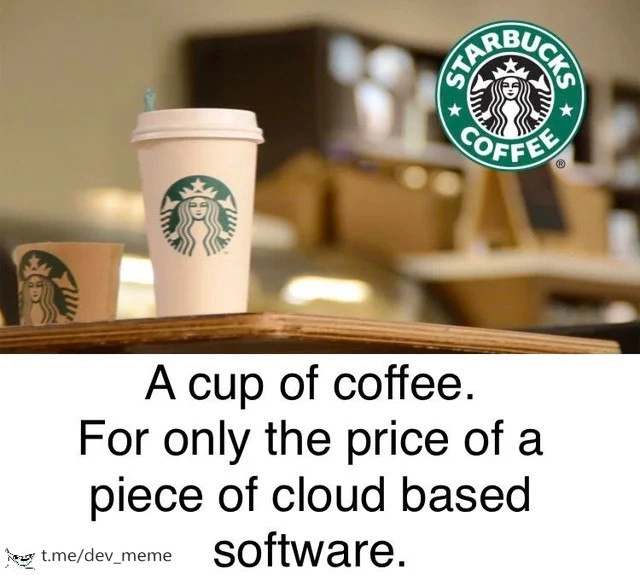
“A cup of coffee. For only the price of a piece of cloud based software.”

This meme hits senior developers right in the wallet with its cloud cost sarcasm. It’s doing a Starbucks cost comparison to lampoon our spending priorities. On one hand, we have the recurring fees of cloud computing services – those monthly SaaS bills for yet another “revolutionary” app or an AWS instance ticking away pennies per second. On the other hand, there’s the daily $5 caramel latte habit fueling our 3 AM deploys. The joke? We casually drop cash on coffee every day, but when the AWS bill or that SaaS subscription comes due, we suddenly turn into Scrooge. It’s classic CloudHumor mixed with real-life hypocrisy: coffee vs cloud pricing.

In the IndustryTrends_Hype era of “everything-as-a-service”, companies pitch software with the friendly payment model of a cloud-based subscription. They love to say, “For the price of a cup of coffee, you could get our premium plan!” This meme flips that SaaS pricing metaphor on its head. It basically says: “Hey developer, your fancy coffee costs as much as that cloud software you complained about.” We’re looking at two forms of developer fuel here – cloud computing resources that run our code, and caffeine that runs the coder. Both are metered, on-demand indulgences. The seasoned engineer chuckles (or maybe winces) because they’ve had to justify a $10/month productivity tool to finance, even while the team’s snack budget pours out $500/month on Starbucks. It’s an irony brewed strong: the DeveloperHumor of watching a cloud cost optimization meeting happen while everyone sips $6 lattes.

From a senior perspective, there’s also a whiff of historical irony. In the old days, you’d buy software once (like purchasing a coffee machine for a one-time fee). Now with SaaS and cloud, you rent everything monthly (like buying a gourmet coffee every morning). That shift from up-front investment to pay-as-you-go is great for flexibility – and sneaky on the budget. A savvy engineer knows those tiny expenses add up. One stray EC2 instance left running over the weekend, and the bill ”clouds” over – just like that daily espresso habit quietly becomes $100+ a month. This meme’s wry tone says: we’ve embraced subscriptions so much that even our coffee might as well come with release notes and a version number. It’s poking fun at our developer lifestyle spending: we chase the latest cloud service, we can’t code without premium coffee, and we groan about the price of both. The result is a punchline that’s painfully TechHumor and true: our code might scale in the cloud, but our budgets still have to handle very down-to-earth indulgences.

Description

The image is a two-part meme. The top portion is a photograph of a Starbucks coffee cup on a wooden tray, with the iconic green Starbucks Coffee logo visible on the cup and again in the blurred background of a cafe. The bottom portion has a clean white background with black text that reads, 'A cup of coffee. For only the price of a piece of cloud based software.'. A small watermark for 't.me/dev_meme' is visible in the bottom-left corner. The meme humorously juxtaposes the relatively high, everyday expense of a premium coffee with the often low monthly subscription cost of sophisticated cloud-based software (SaaS). This serves as a satirical commentary on value perception and the commoditization of software in the cloud era. For experienced developers, who have seen software pricing models evolve from exorbitant perpetual licenses to cheap monthly fees, the joke highlights the absurdity that a complex digital service can cost the same as a disposable beverage
Comments

7
Anonymous ★ Top Pick We spend more time debating a $10/month analytics tool than we do a $5,000/month database cluster that's running at 5% utilization
  1. Anonymous ★ Top Pick

    We spend more time debating a $10/month analytics tool than we do a $5,000/month database cluster that's running at 5% utilization

  2. Anonymous

    Starbucks: the ultimate serverless function - billed at $6 per invocation, complete with vendor lock-in and sudden spike costs, but at least this cold start comes with foam

  3. Anonymous

    The only subscription that auto-scales faster than your AWS bill is your team's coffee consumption during incident response

  4. Anonymous

    The real joke is that this comparison undersells it - a Starbucks venti costs about $6, while a modest production Kubernetes cluster with proper observability, multi-region redundancy, and compliance requirements will run you $6k/month minimum. At least with Starbucks, you know exactly what you're paying for upfront, and they won't surprise you with egress fees when you need to take your coffee to go

  5. Anonymous

    FinOps report: after we SaaS‑ified everything, the only serverless part is the money - our auth microservice drinks a venti per seat per month, plus egress

  6. Anonymous

    Cloud bills: the only thing scaling faster than your Kubernetes cluster - until you remember to prune those orphaned EBS volumes

  7. Anonymous

    Cloud pricing is Starbucks for software: the base instance is cheap, the add‑ons quietly turn it into an enterprise plan, and you only notice the egress fee when you take it to go

Use J and K for navigation