My Unit Test Preparing for Tomorrow's Big Release
Why is this Testing meme funny?
Level 1: Cooking with the Stove Off
Imagine you told everyone that you’re making a delicious breakfast and it will be ready tomorrow morning. But then you crack some eggs into a pan, place it on the stove, and... you never turn the stove on. The flame is on a different burner entirely, and your eggs just sit there raw and cold. Next day comes, and you cheerfully announce, “Breakfast is ready!” even though those eggs never actually cooked.
Sounds silly, right? That’s exactly the joke here. The boss is asking the programmer if the work is done and the programmer says “Yep, all set!” But in reality, the programmer hasn’t done a key part of the work (testing the code) – just like not cooking the eggs at all. We can all see the eggs are still raw in the pan, so we know breakfast isn’t really ready. It’s funny because the programmer is acting super confident, when clearly there’s a big problem left unattended. It’s like a kid saying “My homework is totally finished!” while the notebook is completely blank.
The meme makes us laugh because we recognize that overly optimistic feeling of “Everything’s fine!” when, actually, something important was forgotten. It’s a playful reminder: you can’t truly say you’re done until you’ve done the whole job – just like you can’t serve raw eggs for breakfast and call it a meal!
Level 2: Unheated Unit Tests
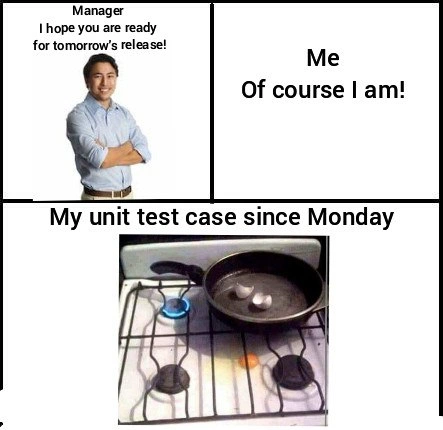
Let’s break down the meme in simpler terms. We have three panels:
- Top-left panel: A manager (business attire, arms crossed, looking expectant) says, “Manager – I hope you are ready for tomorrow’s release!” Managers usually are non-technical leaders concerned about timelines. “Tomorrow’s release” means that a new version of the software is scheduled to go live the next day. This sets a deadline – a fixed date by which the team must deliver. The manager is basically asking, “Are we on track? Is the product ready to ship?”
- Top-right panel: It simply has text, “Me – Of course I am!” This represents the developer (the person making the meme, i.e. “me”) replying confidently. No image here, just bold text. The developer is assuring their boss that everything is fine and ready. On the surface, it’s a positive, can-do response. But given what we suspect, there’s an air of comedy because that confidence might be misplaced.
- Bottom panel: This is where the punchline visual is. The caption says, “My unit test case since Monday”. The image shows a kitchen stove. On the stove, one of the back burners is turned on – we see a blue flame – but nothing is on that burner. Meanwhile, on a front burner (which is off – no flame), there’s a frying pan with two uncooked eggs just sitting there, still raw and transparent. Essentially, the pan with eggs is on the wrong burner; it’s not getting any heat at all.
Now, what does this mean in a software context? The “unit test case since Monday” implies that since the beginning of the week (Monday), the developer’s unit tests have been sitting idle or not executed. A unit test is a short program or script that checks a tiny piece of your code (a single “unit” like a function or module) to make sure it works correctly. Developers write many of these tests to automatically verify their code doesn’t have bugs. But writing tests is only half the story – you have to actually run them regularly (like turning on the stove under the pan) to get results. Here, the meme suggests the tests exist but have not been run (“cooked”) since Monday.
The stove image is a metaphor for this situation:
- The lit burner with no pan = effort or time being spent, but not on testing. Perhaps the developer was busy coding features, fixing other issues, or just procrastinating on running tests. There’s “heat” (energy) being used, but it’s not under the right pot.
- The pan with eggs on an unlit burner = the tests and what they’re supposed to validate, sitting there without any execution. The eggs (like the code’s correctness) are raw. They haven’t been exposed to heat (testing) which is needed to “cook” them (find bugs and make sure they’re done). Since Monday, those eggs haven’t changed state at all – they’re in the same uncooked condition because the burner under them is off. In software terms, since Monday, the tests haven’t been run, so the code hasn’t been verified.
When the developer says “Of course I’m ready [for release]!”, it’s funny because the bottom panel reveals the reality: they are not really ready, at least not by best practices. The phrase “ready for release” ideally means the code is feature-complete and well-tested (all the unit tests and other tests have passed). But here the developer has not run the tests in days. It’s like a student telling the teacher, “Yes, I finished my homework,” when the notebook hasn’t even been opened since Monday. The confident response is a bit of a fib or at least overly optimistic.
Let’s clarify some terms:
- Release: This is when the software is delivered or deployed to users/customers or to a production environment. Often teams will say “we have a release tomorrow” meaning that’s the deadline to get everything working and packaged. Releases can be stressful because you want the product to be as perfect as possible when it goes out.
- Unit Test: A piece of code written to automatically test a specific part of your program. For example, if you have a function
add(a, b)that should return the sum of two numbers, you’d write a unit test to calladd(2, 2)and check that it returns 4. If someone accidentally changesaddto do subtraction, the unit test would fail, alerting you to the bug. Unit tests are usually run frequently (like daily or on each code change) so that developers know quickly if something is broken. Here, the fact the unit test was sitting since Monday means this feedback loop has been broken for days. - Code Quality: This refers to how good and reliable the code is – things like being bug-free, well-tested, and maintainable. Running and writing tests is one way to ensure code quality. If tests aren’t run, code quality might suffer because you might miss a defect. In the meme, code quality is implicitly at risk: if those tests never got any “heat,” we don’t actually know if things are working.
- Deadline/Release Pressure: The tags like DeadlinePressure or just the context “tomorrow’s release” tell us there’s a time crunch. The developer has probably been rushing to finish features by the end of the week. When under pressure, sometimes teams make the mistake of skipping or delaying testing to save time. It’s a risky move, akin to saying “I’ll just hope nothing’s wrong.” This meme humorously portrays that pressure: the boss is checking in, and the dev, wanting to appear on top of things, says all good, even though an important task (running tests) was left incomplete.
For a junior developer or someone new to the field, this meme is a gentle warning wrapped in humor: don’t put testing on the back burner! It’s showing a common rookie mistake (and, to be fair, even seasoned devs fall into this under duress): you focus on writing code and think, “I’ll run the tests later, I’m sure it’s fine.” But if you wait too long or forget, you might discover at the last minute that things are not fine – just like eggs that have been sitting out uncooked when it’s time to serve breakfast.
The stove analogy is very relatable: imagine you’re cooking and you accidentally turn on the wrong burner. Your pot isn’t heating up at all, but you might not notice immediately. Time passes and your food is still raw. Similarly, the developer might have been so busy with other tasks (had their flame on something else) that they didn’t notice the tests never ran. So they made progress in some areas (time burned), but one crucial area (testing) stayed cold.
“Since Monday” also hints at procrastination or neglect. It implies, “I started cooking this at the beginning of the week and then completely left it there.” By Thursday or Friday, that’s pretty concerning. In many development teams, if you haven’t run your tests all week, you’re likely to run into unpleasant surprises when you finally do. It’s like leaving the most important part of the work – verifying it actually works – until the very end.
New developers often learn the hard way that continuous testing is vital. Modern workflows use Continuous Integration (CI) systems that run tests automatically whenever code is pushed, precisely to avoid the “forgot to run tests” scenario. If such a system were in place and the tests had issues since Monday, everyone would know quickly. The fact it’s gone unnoticed until the manager asks suggests maybe this process is manual or being skipped. That’s why this joke lands in the programmer community: we know that sometimes, under pressure, people cut corners and hope it doesn’t come back to bite them.
So, to sum up this panel: the developer is effectively misaligned in priorities. They assured the manager everything is ready for the release, but they haven’t actually confirmed that by running the unit tests in days. The stove with the wrong burner on is a visual cue that something fundamental is being done wrong. It’s a comical way to say, “I’ve been doing something, but not what I should be doing.” The impending release (tomorrow) makes this situation also a bit of a nail-biter – will those eggs ever get cooked in time? Will the tests be run at the last minute and reveal problems? The humor comes with a side of suspense that developers know all too well.
In everyday terms, this is like:
- Telling your teacher you finished the project, but you haven’t even checked if it runs without errors.
- Or saying you baked a cake for a party, but you haven’t tasted it or even fully baked it through.
- It’s that anxious bluff we sometimes do when we hope things will just work out, but we haven’t actually verified it.
The meme is categorized under Testing and CodeQuality for obvious reasons: it’s highlighting the importance of tests (and the folly of ignoring them). It’s also under Deadlines because that’s the pressure causing the situation. Tags like TestingHumor, ReleasePressure, DeveloperHumor all point to this being a joke about the developer lifestyle. If you’re new to coding, take it as a light lesson: always turn on the correct burner – in other words, don’t neglect your tests, especially not right before a big release!
Level 3: Quality on the Back Burner
At the highest level, this meme satirizes a clash between release deadlines and code quality. A manager excitedly asks, “I hope you are ready for tomorrow’s release!” and the developer chirps back, “Of course I am!” Meanwhile, the truth is hiding in that bottom panel: the unit tests have literally been left on the back burner all week. The caption “My unit test case since Monday” paired with a stove image of a lit burner empty, and a pan of raw eggs on an unlit burner, is a brilliant metaphor for neglected tests.
In software terms, the developer has code changes that haven’t been tested since Monday. The unit tests (small automated checks for each piece of code) exist, but they’re not being executed – just like the pan is present but not getting any heat. The blue flame burning on the empty burner represents the urgency and effort (time is literally burning), yet it’s misdirected. The developer is likely spending all energy coding or fixing bugs under intense ReleasePressure, but none of that heat is reaching the tests pan. It’s heat on the wrong burner – effort applied in all the wrong places. Every experienced engineer recognizes this as the “quality on the back burner” scenario, sometimes joked about but all too real under tight Deadlines.
Why is this funny? Because it’s painfully relatable. It’s an anti-pattern we’ve seen or done ourselves: under a looming deadline, the team skips running tests “just this once” and assures management everything is fine. The meme’s humor comes from exposing that lie with the obvious visual: raw eggs sitting on a cold stove are clearly not ready to serve, just as un-run tests mean the software is clearly not proven to work. It’s irony at its best – the developer’s “Of course I am ready!” is as credible as claiming breakfast is ready when the eggs are still raw. Seasoned developers chuckle (or cringe) because they know untested code has a way of exploding at the worst possible time (usually right after that confident release). It’s a shared trauma in DeveloperHumor: deploying in haste and debugging in dread later.
This scenario also highlights the systemic issue where DeadlinePressure trumps process. Management often values hitting the release date over thorough testing, whether explicitly or implicitly. Here the manager might not even ask about tests – they assume “ready” includes quality checks. But the dev, feeling the squeeze, quietly put testing aside, hoping to catch up later or praying everything just works. It’s a classic case of “What could possibly go wrong?” thinking (hint: everything). In real life, this is how you get the infamous “it works on my machine” situation or late-night hotfix parties. The code might appear okay in a quick run, but without running the test suite since Monday, there could be a dozen broken assumptions lurking. The CodeQuality has effectively been sacrificed to meet the deadline, which is why the whole situation is both comical and nerve-wracking to those in the know.
From an industry perspective, this is an example of accruing technical debt in testing. Instead of addressing test failures or maintaining test coverage daily, the work is postponed (put “on the back burner”). Everyone laughs because we know that debt will come due. Those raw eggs (untested features) might look harmless now, but bite into them later and you’re in for a nasty surprise (bugs in production). We’ve invented methodologies like CI/CD (Continuous Integration/Continuous Deployment) and UnitTesting best practices precisely to avoid this scenario – where tests run automatically and regularly so you can’t forget to run them since Monday. Yet, here we are, with a pan off the flame. Many a senior dev has stories of last-minute scrambles where test suites were run hours before release (or not at all), leading to release_tomorrow_panic and sometimes disastrous deploys. The humor is a coping mechanism: we laugh so we don’t cry about how common this is.
Another layer of wit is the literal “back burner” idiom. To put something on the back burner means to de-prioritize it. The meme artist has taken that phrase and made it literal: the tests are on the back burner of the stove, completely unheated. It’s a visual pun that senior folks appreciate because it perfectly captures the situation. Testing has been figuratively put on hold, exactly like that pan sitting forgotten while another burner wastes energy. We see the flame (the team might be busy alright, maybe doing last-minute fixes or PowerPoints for the go/no-go meeting), but not under the right task.
In practice, such misaligned priorities lead to what the cynical veterans predict: bugs. Skipping tests is flirting with disaster. You might ship on time, but a bug that those tests would have caught could blow up in production. Then you’re in full release_tomorrow_panic mode trying to patch things. It’s the software equivalent of serving undercooked eggs to your guests – expect some upset stomachs (angry users) and an embarrassing cleanup afterward. A seasoned developer might even quip, “Better keep the pager on tonight, those tests are still half-baked.” This dark humor underlines that feeling of impending doom that only experience teaches – if your CodeQuality checks aren’t done, you know you’re skating on thin ice.
The meme also implies a bit of deception or over-confidence. The developer saying “Of course I’m ready!” might genuinely believe they can get away with it or fix any issues last-minute (perhaps planning a late-night test marathon). Alternatively, they might be in denial. Either way, it’s a commentary on how communication in teams can gloss over reality. Senior engineers reading this can almost hear their own past managers: “Everything tested?” And the meek response: “Yep, sure!” while internally thinking, “Please let it just work...”. It’s funny because it’s true – we’ve been there, bluffing through a status update, knowing full well our UnitTesting regimen is on life support.
To illustrate how developers sometimes handle this, consider how easy it is to misalign or outright disable tests in the rush to release. You might find code like this in a project under crunch:
@Test
@Ignore("Will fix after release")
public void shouldCookEggsProperly() {
// This test is skipped for now, results not checked
assertEquals("cooked", eggs.getState());
}
In many testing frameworks (e.g., JUnit in Java), adding an @Ignore annotation means the test won’t run at all – effectively putting that test on an unlit burner. Here the developer has marked a critical test to be skipped with a note “Will fix after release,” which is eerily similar to leaving our egg pan off the heat with plans to cook it later. The code compiles, and the build might pass, but it’s giving a false sense of security. Senior devs recognize this pattern: failing test? just ignore it for now. It’s a quick hack to keep things moving, but it defeats the purpose of a test suite. We laugh (and wince) because that @Ignore is the software equivalent of sweeping dirt under the rug. Sure, the floor looks clean (the build is “green”), but the mess is still there waiting for you.
In summary, the top panel’s confident exchange combined with the bottom panel’s stove gag nails a core truth in development: readiness isn’t just delivering features; it’s making sure they actually work (CodeQuality via tests). The developer in the meme is essentially giving the manager good news while the bad news (untested code) sits simmering... or rather, not simmering at all. It’s a perfect blend of TestingHumor and cynicism. We find it funny because we’ve all seen this movie before – the big release that’s “all good” until you realize the tests were never run, akin to serving a client an omelet that was never cooked. DeveloperHumor often points out these absurd realities: everyone in the project acts like it’s fine, even as the risk of a raw deployment quietly grows. This meme gets a knowing laugh because it captures that crazy disconnect in one image. The code is on the stove, but nobody lit the fire – and tomorrow’s the dinner party. What could possibly go wrong? 🥚🔥
Description
A three-panel meme illustrating a developer's lack of readiness for a software release. The top-left panel shows a smiling stock photo manager with the text: 'Manager: I hope you are ready for tomorrow's release!'. The top-right panel simply states the developer's reply: 'Me: Of course I am!'. The bottom, larger panel is captioned, 'My unit test case since Monday', and displays a photograph of a gas stove. A single burner is lit with a blue flame, but a frying pan containing two raw garlic cloves sits on the grate next to the lit burner, not over the heat. The humor comes from the visual metaphor representing a completely useless and broken test. The system is 'running' (the lit burner), but the test itself (the pan) is fundamentally misconfigured, failing to interact with the code under test (the garlic), which remains completely unaffected. It’s a classic senior developer pain point: a test that is technically 'running' and perhaps even 'passing' in a CI/CD pipeline but provides zero actual validation, creating a false sense of security before a critical deadline
Comments
7Comment deleted
I've successfully mocked the heating element. The test now runs in 0.001 seconds and confirms the garlic remains at room temperature, so we're clear for deployment
Jenkins has been “green” all week - turns out the pipeline’s been torching the hello-world module while the real tests sit on @Ignore like that cold frying pan
The three eggs forming a frown perfectly capture that moment when you've been staring at the same failing assertion for so long that even your breakfast starts mocking your inability to figure out why a simple equality check is returning false - but hey, at least the eggs are properly isolated and reproducible, unlike that flaky test that only fails in CI
Ah yes, the classic 'Schrödinger's Test Suite' - simultaneously passing and failing until someone actually runs it before production. That unit test has been marinating in technical debt longer than most microservices stay in the architecture. At least when it finally runs, it'll have that nice crusty layer of flaky assertions and brittle mocks that really adds character to your CI/CD pipeline failures
We're 'ready' because CI is green: pytest collected 0 items while the pipeline autoscaled three unrelated services - the only thing not heated all week was the actual unit test runner
Release eve tradition: manager asks if I’m ready while my “unit test” has been slow‑cooking since Monday - CI lit the setup stage and left the assertions on a cold burner; pretty sure it’s an integration test now
Unit test since Monday: charred beyond recognition. Release tomorrow: served medium-rare with stakeholder tears