Skip to content
DevMeme
4753 of 7435
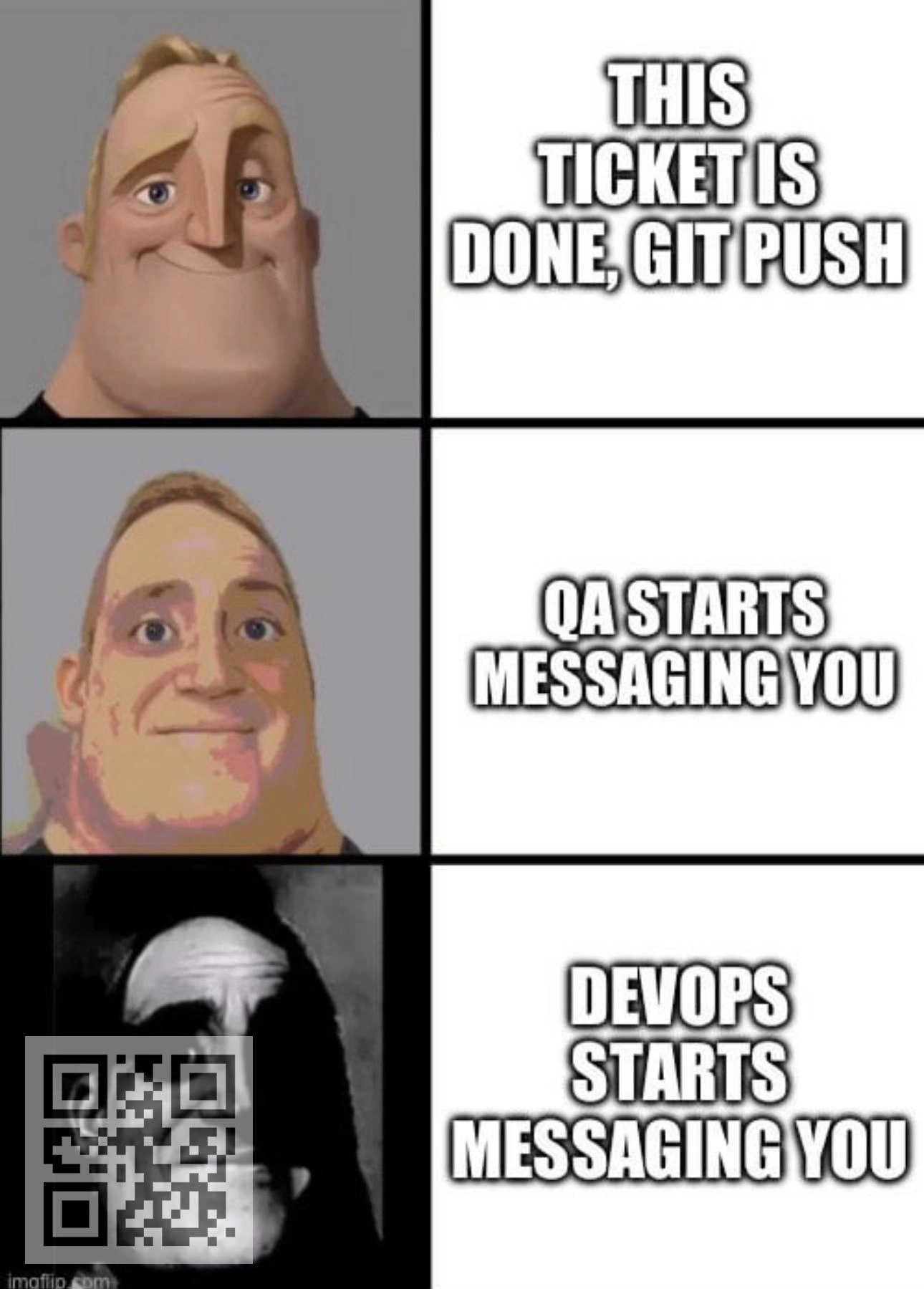
Confidence drops from git push to DevOps ping in Mr. Incredible meme
BuildSystems CICD Post #5208, on May 17, 2023 in TG

Confidence drops from git push to DevOps ping in Mr. Incredible meme

Why is this BuildSystems CICD meme funny?

Level 1: Not So Fast

Imagine you’ve just finished a big school project and you happily hand it in, thinking “I’m done, that was easy!” You feel like a hero for a moment. But then, your friend (like a junior teacher’s assistant) comes over and says, “Hey, I think you skipped a whole section in the instructions.” Uh-oh! Your confidence wobbles a bit because you realize you might have missed something important. Now you’re worried. And just when you start thinking about fixing it, the teacher (the person in charge, like the DevOps in our story) walks in with a serious look, calling your name. They found a big problem – maybe your project caused some issue or broke a rule you didn’t notice. In that instant, your proud smile turns into a terrified stare. You went from “Everything’s great!” to “Oh no, what did I do wrong?” very quickly.

This meme is joking about that exact feeling. First you’re sure you did a great job (like finishing the ticket and pushing code), then someone checking your work finds a mistake (that’s the QA noticing a bug), and finally the person who runs the whole show finds a big issue (that’s the DevOps discovering something crashed). It’s funny because everyone has felt this sudden drop in confidence – one moment you’re celebrating, the next moment you’re panicking. The pictures of Mr. Incredible’s face going from normal to spooky are just like your feelings going from confident to scared when surprises pop up after you thought you were all done. It’s a silly way to remember: don’t cheer too soon, because sometimes there’s more work hiding around the corner!

Level 2: Push Chain Reaction

Let’s break down what’s happening in this meme. It uses three images of Mr. Incredible (a popular cartoon superhero dad from The Incredibles) with increasingly freaked-out expressions. The text in the right column describes a sequence of events that many devs recognize:

  • “This ticket is done, git push” – In the top panel, we see a normal, happy Mr. Incredible face. The developer has finished a “ticket” (a task or bug fix tracked in a system like Jira) and runs the git push command to upload their code changes to the team’s central Git repository. In software teams, saying a ticket is “done” means you believe you’ve completed the work and met the requirements. That git push is an act of confidence: you’re effectively saying “I’m confident this code is ready to integrate.” Often, pushing code triggers a Continuous Integration build: automated compile and test runs on a server (for example, using Jenkins, Travis CI, or GitHub Actions). At this moment, everything seems fine – the code worked on your machine, and you feel accomplished. Mr. Incredible’s smile reflects the developer’s pride and relief.

  • “QA starts messaging you” – In the middle panel, Mr. Incredible’s face looks a bit distorted and concerned. QA (Quality Assurance) refers to testers or automated tests that verify the software’s quality. When QA “starts messaging you,” it means they found a problem with the code you just pushed. This could happen in a few ways. Perhaps the continuous integration system ran unit tests and some test cases failed, immediately alerting QA or posting a message in chat. Or maybe the code was deployed to a testing/staging environment, and a QA engineer manually testing the feature discovered a bug or something not working as expected. For a less experienced developer, the first time a QA teammate pings them on Slack or Teams with “Hey, I think there’s an issue with your latest build” is a heart-dropping moment. 😟 It means you might have missed something. Commonly, QA might say things like, “I tried scenario X, and the app is crashing,” or “This new feature isn’t quite following the specs.” Essentially, the code isn’t as “done” as you thought. The once-confident developer now starts doubting their work. That middle image captures the uh-oh feeling, when your face goes from 🙂 to 😬.

  • “DevOps starts messaging you” – The bottom panel shows Mr. Incredible in a creepy black-and-white, almost horror-movie face. This corresponds to the worst escalation: the DevOps or SRE (Site Reliability Engineering) team reaching out. DevOps engineers are responsible for the infrastructure, deployment pipeline, and keeping services running smoothly. If they’re messaging you, it usually means the issue has graduated from a contained bug to a system or deployment problem. For example, maybe your push caused the build pipeline to break entirely (the code didn’t compile on the server or a critical step failed, halting the deployment). Or if the code was deployed to a shared environment, perhaps it crashed a service or caused an outage. DevOps folks might send a message like, “The deployment of your change failed on stage/prod” or “We’re seeing errors after your update, can you check?” This is often accompanied by urgent phrases like “rollback” or “hotfix needed.” For a developer, that’s scary: it means your change has potentially impacted stability. The black-and-white terrifying Mr. Incredible face perfectly represents that “Oh no, what have I done?” panic. If you’re a junior developer, a DevOps engineer reaching out might also be intimidating because it feels like you’re in trouble (though in healthy teams it’s collaborative, not blamey).

All three stages together describe a chain reaction set off by the git push. First, you push code (triggering a build/deploy), then QA finds a bug, then DevOps notices a failure. The meme humorously exaggerates the drop in the developer’s confidence at each step. Initially confident (ticket done!), then concerned (QA found something), then downright horrified (something’s broken in the pipeline or production). It’s capturing post-commit anxiety – that nervous feeling after you release code and wait to see if anything goes wrong. Every developer learns that “done” isn’t truly done until it passes all tests and runs fine in production. So even if you finish coding a feature, the real validation comes from QA tests and deployment.

In practical terms, what would really happen in such a scenario? Imagine you push your code at 3 PM. By 3:05 PM, the automated CI tests run and one of the integration tests fails. The QA team, who keeps an eye on these, pings you: “Hey, some tests failed after your push. Could you take a look at test XYZ?” While you’re investigating that, by 3:10 PM the deployment to the staging environment also failed (maybe because that failing test prevented the package from being deployed). Now the DevOps engineer messages: “The build for release 2023.05 failed to deploy. Something in your commit might be causing a configuration error.” Now you have to scramble to fix it or revert the commit. This cascade is common in a continuous delivery setup, where code is automatically promoted through testing stages. It teaches new developers about the importance of CI pipelines and thorough testing.

The image of Mr. Incredible becoming uncanny is a popular meme format to illustrate escalating fear or dread. In the context of software:

  • The first image is the dev thinking everything is okay (just like a newbie might after passing local tests).
  • The second image reflects the first sign of trouble (maybe you recall the first time QA opened a bug against your “completed” task – it’s a bit embarrassing and stressful).
  • The final image is pure panic (like when your code breaks the production build or takes down a server – something any programmer dreads, especially early in their career).

Overall, this meme uses a simple scenario to highlight how interconnected modern development roles are. Version control humor is in that notion that git push (a simple version control command) can set off a much larger chain of events. Build pipeline humor comes from knowing these automated systems are great but merciless – they catch your mistakes quickly and everyone gets notified. And DevOps humor appears in that final twist: when Ops contacts you, you know it’s serious (developers jokingly say things like “If DevOps is messaging, start saying your prayers”).

For a junior developer, the lesson behind the laugh is: don’t celebrate too early. Any code change can have unintended side effects, and teamwork with QA and DevOps is critical. That slight anxiety you get after pushing code is normal – it’s why we have phrases like “🚀 push and pray,” meaning you deploy and then hope nothing explodes. This meme is basically a comically exaggerated tutorial in humility for anyone new to the software release process.

Level 3: Pipeline Purgatory

At the top of the meme, Mr. Incredible’s face is calm and confident beside the caption “THIS TICKET IS DONE, GIT PUSH.” These are the famous last words of a developer deploying code. Any senior engineer recognizes this post-commit confidence as a fragile illusion. The moment you run git push, your code enters the CI/CD pipeline – a gauntlet of automated builds, tests, and deployments. You feel victorious for a minute, but seasoned devs know to brace for impact. Why? Because that innocent push can awaken sleeping bugs and integration issues you never saw on your machine.

Sure enough, the meme’s middle panel text “QA STARTS MESSAGING YOU” appears, and Mr. Incredible’s face shifts to a more unnerved, uncanny look. This is the first crack in your confidence. It means the QA (Quality Assurance) team or automated tests found something off with your “done” ticket. Maybe a unit test failed in the build pipeline, or a QA engineer on the testing environment hit an edge-case that you missed. (Did you remember to test with zero items in that list? 😅) That Slack ping or email from QA is the developer’s equivalent of a check-engine light: not catastrophic yet, but definitely a sign that your “works on my machine” bravado was premature. In a well-oiled continuous integration setup, QA feedback comes fast. Perhaps your commit broke an assumption, or an integration test started flapping (passing sometimes, failing other times). At this point, an experienced dev feels a familiar knot in the stomach. Time to dig through logs, run the test suite again, and figure out if that small change you were so confident about has ripple effects.

Then comes the bottom panel – the coup de grâce – with a distorted, horrifying black-and-white Mr. Incredible and the caption “DEVOPS STARTS MESSAGING YOU.” This is when your heart truly sinks. A message from DevOps (the infrastructure/SRE team) usually means something really broke. Perhaps your code didn’t just have a minor bug; it took down a service or failed to deploy altogether. The CI/CD pipeline might have failed the deploy stage, or the new container refused to start in staging. In the worst case, if you practice continuous deployment, production might be on fire 🔥. Getting a DM from an on-call SRE saying, “Hey, the service crashed right after your deploy…” is every developer’s nightmare. It triggers flashbacks of late-night hotfixes and frantic rollback calls. DevOps/SRE messaging you is basically the final boss of post-push panic. It’s no longer about a failing test; it’s about system uptime, alarms, and real users potentially being impacted. The meme nails this progression: from “I’m done!” smugness to “uh oh…” anxiety to “oh no, oh no!” terror.

The humor here is equal parts catharsis and dark comedy. This DevOps humor lands because it’s a shared industry experience. We’ve all felt that whiplash: one moment you confidently close a JIRA ticket, announce the feature is complete, and push your code; the next moment, your Build System ping alerts start flashing red or a QA engineer finds a show-stopping bug. Then, if fate really laughs at you, the Ops team chimes in that your deployment caused a cascade of errors. It’s a rite of passage in software teams to accidentally break the build pipeline or bring down an environment. The meme’s use of Mr. Incredible becoming uncanny is spot-on – your optimistic smile fading into a haunted stare as the reality of software integration hits. Seasoned devs joke that CI/CD is just a more polite way of summoning demons: each stage (build, test, deploy) is an opportunity for something to go wrong. A veteran might even delay looking at messaging apps after a push, just to preserve those few minutes of blissful ignorance.

Why is this scenario so real? Modern development moves fast – committing code triggers automated processes that magnify mistakes quickly. In theory, all tests pass locally, and your change is minimal. In practice, that one-line config change you pushed might be missing in the production Kubernetes cluster, or that new library version conflicts on the server. QA and DevOps involvement means your code has exited your bubble. Version control isn’t the end of the story; it’s the beginning of integration into a complex system. The meme playfully dramatizes the confidence drop every dev experiences when confronting the gauntlet of QA testing and DevOps deployment. It’s essentially an anxiety graph for your code’s journey: each message from QA or SRE is a datapoint straight downward for confidence. Experienced developers have learned (often the hard way) to respect this process. They adopt practices like feature flags, extensive QA process checks, and canary releases precisely because they’ve lived the horror of “DevOps is messaging you” at 5 PM on a Friday. (Pro tip: never push big changes on a Friday, unless you enjoy spending your weekend with the on-call phone! 📞🤕)

In summary, the meme hits home with senior devs because it encapsulates a universal truth in software development: “Done” isn’t done until it’s tested and deployed everywhere. That innocent git push can send you on a wild ride through build failures, test failures, and deployment failures. The DevOps culture promotes “shifting left” (catch issues early), but no matter how good your process, there’s always that deployment that finds a new way to fail. The shared trauma of seeing a Slack message pop up from QA, then one from DevOps, is what makes this meme hilarious and horrifying at the same time. It’s basically a comic strip of a post-deployment anxiety attack, and every developer with a few scars finds themselves laughing and nodding knowingly (perhaps while double-checking their last pipeline run).

Description

The meme is a vertical three-row, two-column grid. Left column: progressively darker versions of the “Mr. Incredible becoming uncanny” face - from normal cartoon style at the top, to distorted and unsettling grayscale at the bottom - indicating rising dread. Right column, bold black text on a white background (one caption per row): top row reads “THIS TICKET IS DONE, GIT PUSH”, middle row reads “QA STARTS MESSAGING YOU”, bottom row reads “DEVOPS STARTS MESSAGING YOU”. The visual joke shows an engineer’s confidence after pushing code plummeting as first QA and then DevOps reach out, hinting at build failures or production issues triggered by that commit. It humorously touches on version control actions, CI/CD pipelines, QA hand-offs, and the anxiety of post-deployment alerts familiar to experienced developers
Comments

16
Anonymous ★ Top Pick Git push: dopamine spike. QA Slack DM: curiosity spike. DevOps ping: PagerDuty spike - proof that in our CI/CD pipeline, confidence is the only artifact that reliably fails fast
  1. Anonymous ★ Top Pick

    Git push: dopamine spike. QA Slack DM: curiosity spike. DevOps ping: PagerDuty spike - proof that in our CI/CD pipeline, confidence is the only artifact that reliably fails fast

  2. Anonymous

    The three stages of deployment grief: denial ('my code is perfect'), bargaining ('maybe QA won't notice'), and acceptance ('time to update my LinkedIn before DevOps finds out I pushed directly to main on a Friday')

  3. Anonymous

    The three stages of deployment grief: 'git push' euphoria, QA's gentle reminder that your code actually has to work, and that soul-crushing Slack notification from DevOps at 2 AM with a PagerDuty alert and a Grafana dashboard showing your service's memory consumption going parabolic. The QR code in the final panel? That's the postmortem document you'll be writing while explaining why you didn't load test that 'simple' database query that just brought down production for 47 minutes

  4. Anonymous

    After git push: QA ping - a test failed; DevOps ping - the test is the only thing still up

  5. Anonymous

    Git push: fleeting victory. QA: surgical strikes on edge cases. DevOps: full-system autopsy at 3AM

  6. Anonymous

    ‘Definition of Done’ isn’t git push; it’s when QA DMs stop, the Helm values are correct, migrations are behind flags, and the SRE error budget stops free‑falling - until then you just published to the incident pub/sub

  7. @Vanilla_Danette 3y

    What have you done!?

  8. @pixelsex 3y

    srsly wtf is this

  9. @callofvoid0 3y

    you pushed binaries for wrong os into prod?

    1. @RiedleroD 3y

      gitlab moment gitlab moment

  10. @RichStallman 3y

    Try git filter-branch --tree-filter 'find . -type f -exec sed -i "s/a/e/g" {} \;' -- --all

  11. @czarek 3y

    Unwatermarked it

  12. @endisn16h 3y

    based

  13. @grinya_a 3y

    HR starts messaging you

  14. @SamsonovAnton 3y

    CEO starts messaging you.

  15. @SamsonovAnton 3y

    District attorney starts messaging you Boy, that ticket escalated quickly!

Use J and K for navigation