Gentoo's WD-40: A Profile Feature to Strip Rust From Your System
Why is this OperatingSystems meme funny?
Level 1: Oil for the Squeaky Robot
There's a famous spray called WD-40 that grown-ups use to clean rust off old bikes and squeaky hinges. Some computer folks also use a tool named "Rust" — a perfectly nice tool, except it doesn't fit on very old computers, the way a giant modern engine won't fit in a tiny antique car. So the people who love keeping antique computers running made a cleaning feature that removes "Rust" from their machines — and named it WD-40, after the spray. It's funny because they fixed a computer problem with a hardware-store joke, and wrote it up in an encyclopedia with a completely straight face.
Level 2: Profiles, Masks, and Why Compiling Hurts
The moving parts, for those who've never run emerge:
- Gentoo is a Linux distribution where you compile nearly everything from source code on your own machine, customized by USE flags. Maximum control, maximum CPU time. Installing a browser can take a full day; Gentoo users consider this character-building.
- A profile is a preset bundle of defaults for a system type — one for desktops, one for servers, one for ancient i486 processors. The card shows certain retro profiles ship WD-40 by default, because those CPUs literally cannot have Rust.
- Masking a package tells Gentoo's package manager "never install this here." WD-40 is essentially an organized, profile-level mask for the Rust toolchain.
- Rust is a modern systems language prized for memory safety. Its compiler is built on LLVM, which supports many CPU architectures — but not all, and especially not museum pieces like the m68k.
- i486 is Intel's 1989 processor; m68k powered classic Macs and Amigas. Hobbyists genuinely still run modern Linux on these, which is either beautiful or a cry for help, depending on whom you ask.
The takeaway worth keeping: every dependency you add is a constraint you impose on every platform downstream. Someone, somewhere, is running your code on a CPU older than you.
Level 3: A Solvent for Load-Bearing Oxidation
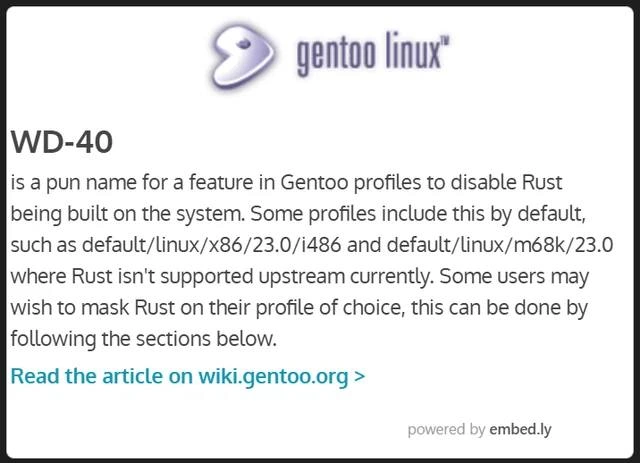
This is a real wiki card from wiki.gentoo.org, purple swirl logo and all, and the heading alone is a complete joke for anyone fluent in both hardware maintenance and systems programming:
WD-40 "is a pun name for a feature in Gentoo profiles to disable Rust being built on the system."
WD-40, the blue-and-yellow can in every garage, displaces water and loosens rusted bolts. Gentoo's WD-40 strips Rust — the programming language — out of your dependency tree. It is arguably the best-committed pun in distro history, because it isn't a forum joke; it's infrastructure, documented with the deadpan precision of someone listing default profiles like default/linux/x86/23.0/i486 and default/linux/m68k/23.0 where, as the card notes, "Rust isn't supported upstream currently."
The technical grievance underneath is genuine and increasingly loud. Rust has been steadily oxidizing its way into the foundational stack — librsvg, Python's cryptography package, parts of coreutils-alternatives, bits of the kernel — and Rust requires LLVM support for your target architecture. On an i486 or a Motorola 68k (the chip that powered the original Macintosh and the Amiga, and which Gentoo still earnestly supports), there is no Rust toolchain upstream. So when some innocuous SVG library declares a Rust dependency, a retro architecture doesn't get a slower build — it gets an impossible one. And on Gentoo specifically, the pain is squared: this is the compile-everything-from-source distro, where even on supported hardware, bootstrapping the Rust compiler is a multi-hour rite involving building a compiler to build the compiler. The meme "once Rust enters your dependency tree, it's load-bearing" is the exact corrosion WD-40 exists to treat — Gentoo's profile masking is one of the only places in modern Linux where a user can still say no and have the package manager respect it.
There's also a quietly political layer. The "Rust in everything" backlash isn't really about the language — it's about mandatory transitive dependencies imposed by upstreams onto platforms they've never heard of. Gentoo, the distro whose entire philosophy is USE flags and user choice, responding with a formally documented opt-out named after a rust remover is both a technical mechanism and a 30-year-old culture stating its values through naming conventions.
Description
A screenshot of an embed.ly card from wiki.gentoo.org featuring the purple Gentoo Linux 'g' swirl logo and the heading "WD-40". The text explains: "is a pun name for a feature in Gentoo profiles to disable Rust being built on the system. Some profiles include this by default, such as default/linux/x86/23.0/i486 and default/linux/m68k/23.0 where Rust isn't supported upstream currently. Some users may wish to mask Rust on their profile of choice, this can be done by following the sections below." A teal link reads "Read the article on wiki.gentoo.org >". The humor: WD-40 is the famous penetrating spray used to remove rust from metal, so Gentoo named its mechanism for excluding the Rust toolchain after it - peak distro wordplay, especially relevant on retro architectures (i486, m68k) where LLVM/Rust support doesn't exist and compiling Rust from source is agony
Comments
1Comment deleted
Only Gentoo would ship a degreaser for Rust - everywhere else, once Rust gets into your dependency tree, it's load-bearing