Tired of GitHub Actions, Time for GitHub Consequences
Why is this BuildSystems CICD meme funny?
Level 1: The Vending Machine
Imagine a vending machine at school that's supposed to give you a snack when you put in a coin. But this machine sometimes eats the coin, sometimes gives you the wrong snack, sometimes makes you wait twenty minutes, and sometimes just blinks an error code nobody understands — and you're not allowed to go home until it works. After months of this, you finally slap your hand on it and announce to the whole hallway: "I'm done being nice to this machine. Now the machine is going to hear from ME." That's the entire joke — the funny, dramatic moment when a patient person finally declares war on an object, and everyone watching nods because they've all wanted to do the same thing.
Level 2: What Actions Actually Are
For the unfamiliar, the load-bearing terms:
- GitHub Actions: GitHub's built-in CI/CD (Continuous Integration / Continuous Delivery) service. You write a workflow file in YAML (a configuration format where whitespace is meaningful) that says "when someone pushes code, run the tests, build the app, deploy it." GitHub runs those steps on cloud machines called runners.
- Workflow / job / step: The hierarchy of a pipeline. A workflow triggers on events (
on: push), contains jobs, and jobs contain steps — many of them reusable "actions" pulled from a marketplace, which is where the product name comes from. - Flaky CI: When the same code sometimes passes and sometimes fails for reasons unrelated to the code — network hiccups, race conditions in tests, runner differences. It erodes trust in the whole system.
- The pain loop: Unlike normal code, you mostly can't run workflows on your laptop. So fixing CI means push → wait minutes → read logs → guess → push again. It's the slowest feedback cycle in modern development, which is why it generates posts like this one at 11 PM.
Every junior dev meets this wall during their first week: the PR is done, but a red ❌ blocks the merge, and the failure log is 4,000 lines of someone else's shell script. Welcome aboard.
Level 3: The Pipeline Always Wins
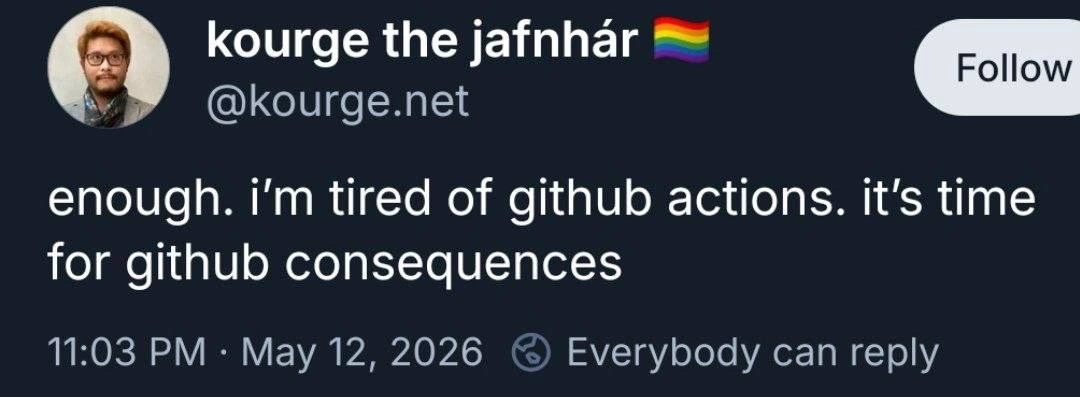
"enough. i'm tired of github actions. it's time for github consequences"
Eleven words, posted at 11:03 PM — and the timestamp is doing covert comedic work, because nobody is tweeting about CI/CD at eleven at night unless a pipeline has personally wronged them within the hour. The joke is a pivot on the idiom actions have consequences: GitHub Actions, the platform, has spent years dispensing actions without accountability, and the author is announcing the arrears have come due.
What makes this land so hard with practitioners is that GitHub Actions occupies a very specific niche of developer rage: it's the CI system you chose because it was the path of least resistance — bundled into the repo host, free tier, marketplace of prefab steps — and that convenience is precisely how it gets you. The failure modes are a bingo card of DX sins: YAML workflows where a two-space indentation error produces a parse failure (or worse, silently skips a job); the edit-push-wait-fail loop because there's no real local execution story, so debugging means committing fix ci seventeen times in a row; expression syntax (${{ }}) that's almost-but-not-quite a programming language; secrets that exist but somehow aren't visible to this trigger context; runners that queue forever or die mid-job; and the classic flaky CI experience where re-running the identical commit goes green, teaching everyone to treat red builds as weather rather than signal.
The deeper structural truth being vented: CI failures are uniquely infuriating because they sit between you and done. Your code works. Your tests pass locally. The feature is finished in every sense except the bureaucratic one, and a third-party YAML interpreter stands at the gate shrugging. It's the software equivalent of having your paperwork rejected for using the wrong shade of blue ink. And because the workflow file is versioned in the repo, every CI debugging session pollutes your git history with a confessional trail of despair commits — the consequences, ironically, land on you.
The format matters too: this is a Bluesky screenshot, the post-2023 home of a particular flavor of dev shitposting, where the single-sentence proclamation — lowercase, weary, legally threatening in tone but not content — has become its own art form.
Description
A screenshot of a Bluesky post on a dark background by user 'kourge the jafnhár' (@kourge.net), whose display name includes a rainbow pride flag emoji, with a profile photo of a bearded man in glasses and a 'Follow' button at top right. The post reads: 'enough. i'm tired of github actions. it's time for github consequences', timestamped 11:03 PM, May 12, 2026, with 'Everybody can reply' visibility. The humor wordplays GitHub Actions - the CI/CD platform notorious for flaky YAML workflows, cryptic failures, and surprise billing - against the phrase 'actions have consequences', threatening retribution against the tool itself
Comments
5Comment deleted
Unfortunately the consequences will also be retried three times, labeled flaky, and quietly ignored - same as the tests
gitlab? Comment deleted
Gonna push node_modules onto his repo? Comment deleted
Damn Comment deleted
github fafo 😁 Comment deleted